
Unlock Perfect Coffee: Your Moccamaster Water Ratio Guide
The Moccamaster coffee to water ratio is 55 grams of ground coffee per liter of water, which translates to their provided scoop measure of 2 level tablespoons per 6 fluid ounces. For a full 1.25-liter pot, that’s 69 grams of coffee, or 7 level scoops.
Most people trust the scoop that comes in the box. That’s the first mistake. The scoop works, but it hides the variable that ruins consistency: the density of your coffee grounds. A scoop of dark roast is lighter than a scoop of light roast. A scoop of pre-ground is denser than a scoop you just ground. You can follow the printed chart on the machine and still get a different strength pot every morning.
This guide breaks down the official Moccamaster ratio, why the scoop is both a blessing and a curse, and how to adjust for everything from high altitudes to a stubbornly weak brew. We’ll cover the exact gram weights for every scoop count, the one water type that can damage the boiler, and the simple trick baristas use to get even extraction without modifying the machine.
Key Takeaways
- Moccamaster’s official ratio is 55g coffee per liter of water, matching the Specialty Coffee Association (SCA) standard.
- One Moccamaster scoop holds roughly 9.9 grams of coffee, but weight varies with roast and grind. A scale guarantees consistency.
- Never brew less than 4 cups (16 oz) in an 8-10 cup Moccamaster. The water volume is too low to properly saturate the coffee bed.
- If your brew tastes too strong, add hot water to the cup. If it’s too weak, try a different coffee bean or roast profile before adding more grounds.
- Avoid distilled or reverse osmosis water. The lack of minerals lets the copper boiling element overheat and degrade over time.
The Official Moccamaster Coffee to Water Ratio
Moccamaster states their ratio clearly across all support documents: use 2 tablespoons of ground coffee for every 6 US fluid ounces of water. They call this the “industry standard for optimal flavor.” That standard is the Specialty Coffee Association’s Golden Ratio, which boils down to 55 grams of coffee per liter of water.
The Moccamaster coffee to water formula is 55 grams of ground coffee per liter of water, or 2 level tablespoons per 6 fluid ounces. This ratio is designated as the SCA-approved industry standard for balanced extraction and flavor in filter coffee brewing.
The provided plastic scoop is their tool for translating grams into volume. One level scoop is their equivalent of 2 tablespoons. The math is simple if you follow their volume markings.
| Brew Volume | Water (Liters) | Moccamaster Scoops | Coffee Weight (Grams) |
|---|---|---|---|
| 10 cups | 0.3 L | 2 level scoops | 17 g |
| 16 cups | 0.5 L | 3 level scoops | 28 g |
| 24 cups | 0.75 L | 4 level scoops | 41 g |
| 32 cups | 1.0 L | 6 level scoops | 55 g |
| 40 cups | 1.25 L | 7 level scoops | 69 g |
| 60 cups | 1.8 L | 10 level scoops | 99 g |
Those gram weights are precise. They come straight from Moccamaster’s support article, measured with their scoop. Notice the weight per scoop averages 9.9 grams. That’s your baseline.
TL;DR: The official ratio is 55g/L. Use the scoop count chart on your machine, but know each scoop should weigh about 9.9 grams.
Why a Scale Beats the Scoop (and When It Doesn’t)
The scoop is convenient. It’s also inconsistent. Coffee bean density changes with roast level. A dark roast bean is less dense than a light roast bean after moisture loss during roasting. Grind size also matters. Finer grounds pack more tightly into a scoop than coarse grounds.
I used the scoop for a month with a single-origin Ethiopian light roast. My first few pots were perfect. Then I switched to a dark roast Sumatra. Following the same scoop count gave me a weak, underwhelming brew. The dark roast beans were physically lighter, so I was using less coffee by weight. The scale doesn’t lie. 55 grams is 55 grams, whether it’s light, dark, or pre-ground.
Common mistake: Scooping dark roast coffee by volume, the beans are less dense, so you get fewer grams per scoop and a weaker brew that tastes flat and lacks body.
A $20 digital kitchen scale with 0.1-gram precision ends the guesswork. Weigh your whole beans before grinding, or weigh the grounds directly. It’s the single biggest upgrade you can make to your drip coffee routine that costs less than a bag of good beans.
That said, the scoop wins for speed and simplicity. If you always use the same bag of pre-ground coffee, the scoop is fine. The density is fixed. The problem starts when you change beans or roast levels. The scale is for people who chase consistency across different coffees.
How to Measure Water for Your Moccamaster
You have two options: use the markings on the tank or weigh the water. The tank markings are accurate enough for the scoop method. If you’re using a scale, remember that 1 milliliter of water weighs 1 gram. A liter is 1000 grams.
Moccamaster sets a hard floor: do not brew less than 4 cups (16 oz / 0.5L) in their 8-10 cup brewers. The shower head is designed to distribute water over a minimum coffee bed. Brewing a half-pot or less means the water stream hits a small area, leading to uneven extraction and channeling. The coffee tastes simultaneously bitter and sour.
For larger batches, just fill to the desired line. The 10-cup line on a 1.25L model is actually 1.25 liters, or about 40 fluid ounces. The math is already done for you.
What kind of water should you use?
Fresh tap or filtered water is ideal. Moccamaster explicitly warns against using distilled or reverse osmosis (RO) water. Here’s the why-layer: the copper boiling element relies on water minerals to conduct heat efficiently and prevent overheating. Pure, demineralized water causes the element to run hotter than designed, accelerating corrosion and potentially damaging the boiler over several months. If you only have RO water, remineralize it with a product like Third Wave Water or add a pinch of baking soda and Epsom salt.
Dialing in the Grind for the Perfect Ratio
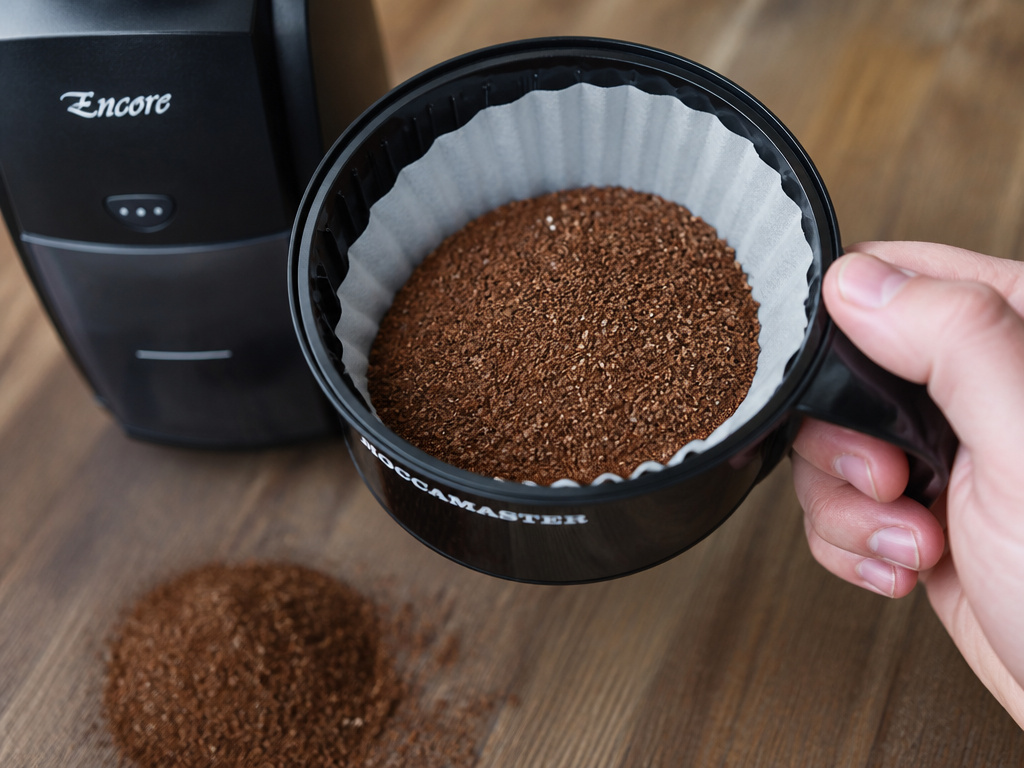
The ratio gives you strength. The grind size gives you extraction. Get one right and the other wrong, and the coffee still suffers. Moccamaster works best with a medium-coarse grind. Visualize grains of beach sand, not powder and not pebbles.
- Too fine (like table salt): Water struggles to drain, causing the filter basket to overfill. This leads to over-extraction, the water sits too long, pulling out bitter, astringent compounds. You’ll see the water pool dangerously high in the basket.
- Too coarse (like breadcrumbs): Water zips through too fast. This causes under-extraction, leaving you with a weak, sour, and grassy-tasting brew. The brew time will finish well under four minutes.
A good burr grinder like the Baratza Encore is essential. Blade grinders produce uneven particles, a mix of dust and boulders, that make consistent extraction impossible. The burr grinder gives you that uniform beach sand.
Aim for a total brew time between 4 and 7 minutes for a full liter. If your brew is too fast, grind finer. If it’s too slow and threatens to overflow, grind coarser. The flow control lever on the basket is your emergency brake. If you see it climbing, open the lever to increase drainage and save the brew.
Adjusting the Ratio for Taste and Altitude
You followed the 55g/L ratio and the brew tastes off. Now what? Moccamaster gives specific, counterintuitive advice.
If the coffee is too strong, do not use less coffee. That throws off the extraction balance. Instead, brew at the full ratio and add a splash of hot water to your cup after brewing. This is essentially making an Americano-style drink, and it preserves the intended extraction profile.
If the coffee is too weak, do not immediately add more coffee. First, check your grind size, it’s likely too coarse. If the grind is correct, the problem might be the beans themselves. Try a different coffee bean type or a darker roast profile. Some single-origin coffee beans, especially very light roasts, simply yield a lighter body. A coffee blend with some Robusta or a darker roast will naturally produce a stronger-tasting cup.
I won’t recommend changing the ratio to fix a weak brew from light roast beans. The ratio is sound. The bean’s density and solubility are the variables. Switching to a more developed roast fixed it for me every time.
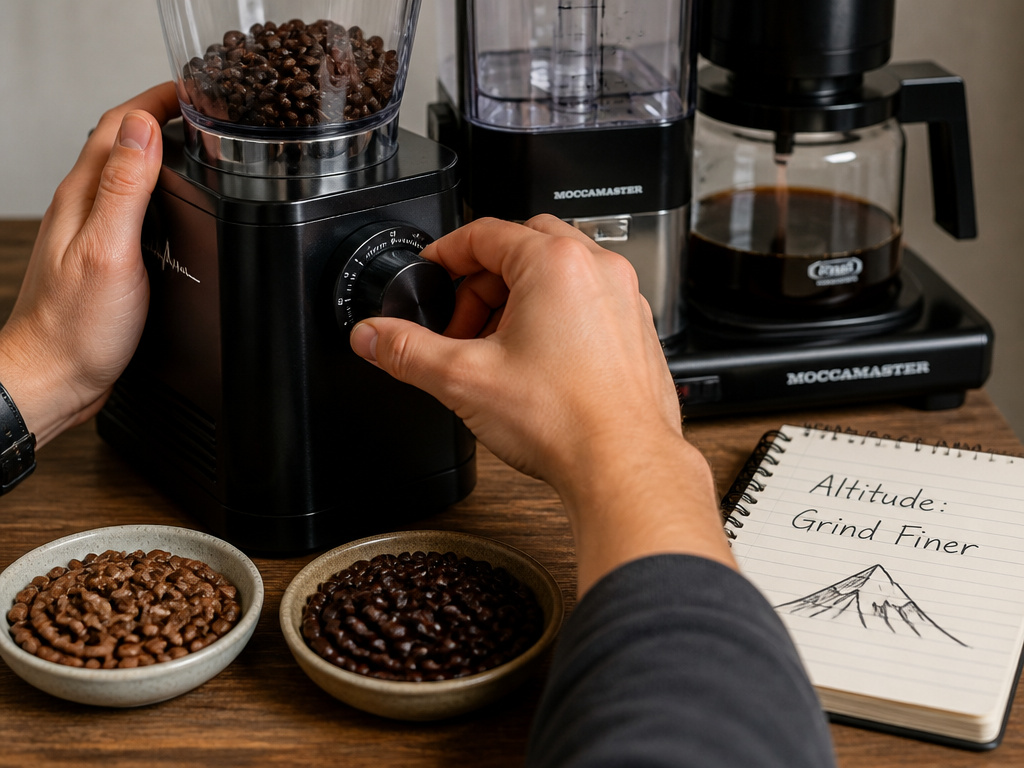
What about high altitudes?
Water boils at a lower temperature at high elevation, as low as 198°F (92°C) compared to 212°F (100°C) at sea level. Moccamaster acknowledges this but states the brewer still makes “great coffee.” The lower temperature will slightly reduce extraction, potentially making the coffee taste a bit brighter or more acidic. You can compensate by grinding a touch finer to increase surface area and contact time.
Essential Tools and Filters for Consistent Brews
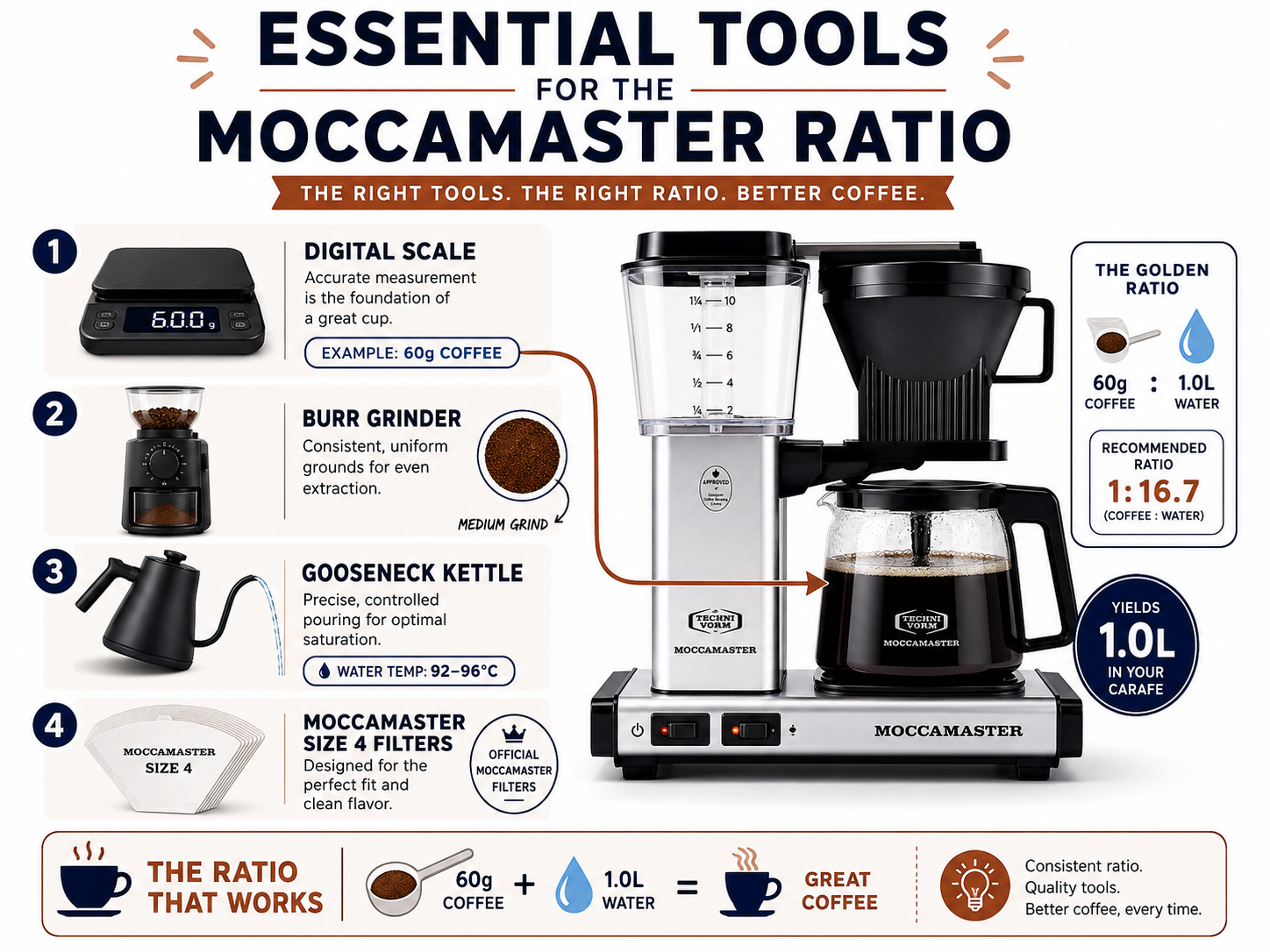
Your toolkit extends beyond the machine. Using the right supporting gear locks in the ratio.
- Digital Scale (0.1g precision): Non-negotiable for weight-based consistency. Measures both coffee and water.
- Burr Grinder: A Baratza Encore, Fellow Ode, or equivalent. Blade grinders cannot achieve the consistent particle size needed for even extraction.
- Gooseneck Kettle (optional): Useful for pre-wetting filters and heating components if you want to mimic a manual pour-over pre-infusion.
- Moccamaster Size 4 Paper Filters: Use the official ones. The company advises against gold-mesh or reusable filters, stating they cause inconsistent drawdown times and are hard to clean thoroughly.
The filter matters. Paper coffee filters remove oils and sediment, giving a cleaner cup. Unbleached filters can impart a slight papery taste, which is why the pre-rinse step is critical. If sustainability is a concern, biodegradable filters or high-quality cloth filters are alternatives, but expect a learning curve with drawdown times.
Frequently Asked Questions
What is the Moccamaster coffee to water ratio in tablespoons?
It’s 2 level tablespoons of ground coffee for every 6 US fluid ounces of water. Moccamaster’s provided plastic scoop is designed to hold exactly this 2-tablespoon volume when leveled off.
How many scoops of coffee for 8 cups on a Moccamaster?
“8 cups” on a Moccamaster is typically 1.0 liter (32 oz). For that, you need 6 level Moccamaster scoops, which equals 55 grams of coffee.
Why does my Moccamaster coffee taste bitter?
Bitterness usually means over-extraction. Your grind is likely too fine, slowing the water and over-extracting the grounds. Try a coarser grind setting. Also, ensure you’re not brewing less than the minimum 4 cups, which can cause channeling and uneven extraction.
Can I use pre-ground coffee in my Moccamaster?
Yes, but ensure it’s ground for drip/paper filter (a medium-coarse consistency). Pre-ground often leans finer, so watch for basket overflow. For the best flavor, grind whole beans fresh just before brewing.
How do I clean and descale my Moccamaster?
Rinse the brew basket and carafe after each use. To descale, run a solution of equal parts white vinegar and water through a brewing cycle, then run 2-3 cycles of fresh water to rinse. Do this every 100 brews or about every 3-4 months with hard water. Proper filter maintenance and descaling coffee makers prevents mineral buildup that affects taste and performance.
Before You Go
The Moccamaster ratio is a fixed point: 55 grams per liter. The scoop is a convenient shortcut, but a scale is your ticket to true consistency, especially when you switch between blonde roast beans and dark roasts. Remember the minimum brew volume, avoid distilled water, and let the grind size, not the coffee amount, be your primary tool for tuning extraction.
When a pot tastes weak, question the bean, not the ratio. A different geographic origin or roast can solve the problem without changing a single gram of your recipe. The machine’s job is to deliver hot water consistently. Your job is to give it the right amount of correctly ground coffee. Do that, and the perfect pot is a button press away.
{
“@context”: “https://schema.org”,
“@type”: “HowTo”,
“name”: “How to Use the Moccamaster Coffee to Water Ratio”,
“totalTime”: “PT8M”,
“tool”: [
{
“@type”: “HowToTool”,
“name”: “Moccamaster coffee brewer (e.g., KBG Select)”
},
{
“@type”: “HowToTool”,
“name”: “Digital kitchen scale (0.1g precision)”
},
{
“@type”: “HowToTool”,
“name”: “Moccamaster size 4 paper filters”
},
{
“@type”: “HowToTool”,
“name”: “Burr coffee grinder (e.g., Baratza Encore)”
}
],
“step”: [
{
“@type”: “HowToStep”,
“name”: “Measure water by weight or volume”,
“text”: “Fill the Moccamaster tank to your desired brew volume. For best accuracy, weigh the water: 1 liter weighs 1000 grams.”
},
{
“@type”: “HowToStep”,
“name”: “Weigh your coffee grounds”,
“text”: “Use the 55 grams per liter standard. For a full 1.25L pot, use 69 grams of coffee.”
},
{
“@type”: “HowToStep”,
“name”: “Grind to a medium-coarse consistency”,
“text”: “Set your burr grinder to a grind resembling beach sand. Too fine clogs the basket; too coarse makes weak coffee.”
},
{
“@type”: “HowToStep”,
“name”: “Rinse the paper filter”,
“text”: “Place a size 4 filter in the basket, run 250ml of hot water through it to pre-heat components and remove paper taste, then discard the rinse water.”
},
{
“@type”: “HowToStep”,
“name”: “Brew and adjust flow if needed”,
“text”: “Add grounds, start the brewer. If the basket nears overflow, open the flow control to half or fully open to increase drainage.”
}
]
}
{
“@context”: “https://schema.org”,
“@type”: “FAQPage”,
“mainEntity”: [
{
“@type”: “Question”,
“name”: “What is the Moccamaster coffee to water ratio in tablespoons?”,
“acceptedAnswer”: {
“@type”: “Answer”,
“text”: “It’s 2 level tablespoons of ground coffee for every 6 US fluid ounces of water. Moccamaster’s provided plastic scoop is designed to hold exactly this 2-tablespoon volume when leveled off.”
}
},
{
“@type”: “Question”,
“name”: “How many scoops of coffee for 8 cups on a Moccamaster?”,
“acceptedAnswer”: {
“@type”: “Answer”,
“text”: ““8 cups” on a Moccamaster is typically 1.0 liter (32 oz). For that, you need 6 level Moccamaster scoops, which equals 55 grams of coffee.”
}
},
{
“@type”: “Question”,
“name”: “Why does my Moccamaster coffee taste bitter?”,
“acceptedAnswer”: {
“@type”: “Answer”,
“text”: “Bitterness usually means over-extraction. Your grind is likely too fine, slowing the water and over-extracting the grounds. Try a coarser grind setting. Also, ensure you’re not brewing less than the minimum 4 cups, which can cause channeling and uneven extraction.”
}
},
{
“@type”: “Question”,
“name”: “Can I use pre-ground coffee in my Moccamaster?”,
“acceptedAnswer”: {
“@type”: “Answer”,
“text”: “Yes, but ensure it’s ground for drip/paper filter (a medium-coarse consistency). Pre-ground often leans finer, so watch for basket overflow. For the best flavor, grind whole beans fresh just before brewing.”
}
},
{
“@type”: “Question”,
“name”: “How do I clean and descale my Moccamaster?”,
“acceptedAnswer”: {
“@type”: “Answer”,
“text”: “Rinse the brew basket and carafe after each use. To descale, run a solution of equal parts white vinegar and water through a brewing cycle, then run 2-3 cycles of fresh water to rinse. Do this every 100 brews or about every 3-4 months with hard water. Proper filter maintenance and descaling coffee makers prevents mineral buildup that affects taste and performance.”
}
}
]
}
