
Is Light Roast Coffee Stronger? Unveiling the Flavor Truth
Light roast coffee is not inherently “stronger” in caffeine than dark roast when you measure by weight. The difference in caffeine per bean is negligible, often within single-digit percentages. The real driver of caffeine in your cup is the brew method: a long-extraction pour-over from light roast beans will deliver more caffeine than a short espresso shot from dark roast beans, regardless of the roast level.
Most people think dark roast equals more caffeine because it tastes stronger. The bitterness and smoky notes create a perception of intensity that feels like power. That perception is wrong.
This guide breaks down the science, the brewing variables, and the health edge you might get from a lighter roast.
Key Takeaways
- Caffeine content by bean weight is nearly identical across roast levels. A 2024 study in Scientific Reports confirmed the difference is minimal.
- Brew method is the dominant variable. A 10-minute filter brew from light roast can contain more caffeine than a 30-second espresso from dark roast.
- Chlorogenic acid, a compound linked to health benefits, drops by 83% in dark roast compared to green coffee. Light roast retains about half.
- The Specialty Coffee Association defines a “cupping level roast” as an Agtron Gourmet scale reading of 63. That’s a medium roast, not a light or dark one.
- Using volume to measure beans (like scoops) introduces massive error. Dark roast beans are larger and less dense, so a scoop holds fewer beans and less total caffeine.
The Roasting Process Explained
Roasting transforms green coffee beans through heat. The internal bean temperature determines the roast level. Light roast is typically pulled at 355-400°F (180-205°C). Medium roast runs between 202-209°C. Dark roast pushes to 212-217°C.
Caffeine has a melting point of 238°C. That’s higher than any typical roasting temperature. The compound itself is stable.
Common mistake: Assuming darker beans have more caffeine because they look bigger, they expand during roasting, but that expansion means less mass per bean. A scoop of dark roast holds fewer beans than a scoop of light roast, which is why volume measurements fail.
The beans lose mass as they roast. Water and other compounds evaporate. A dark roast bean weighs less than a light roast bean from the same green batch. If you measure by scoop, you’re comparing different numbers of beans.
TL;DR: Roast level changes bean size and weight, not caffeine concentration. Measure by weight, not volume.
Caffeine by Weight vs Volume
This is where the confusion starts. If you use a scoop, the dark roast beans are larger and less dense. Your scoop contains fewer beans. You get less total caffeine in your grinder.
Weigh your beans. A digital scale is the only tool that removes this variable.
| Measurement Method | Light Roast Result | Dark Roast Result | Why It Matters |
|---|---|---|---|
| By weight (e.g., 20g) | ~20 beans | ~20 beans | Caffeine content is directly comparable. |
| By volume (e.g., 1 scoop) | ~25 beans | ~18 beans | Dark roast appears weaker because you’re grinding fewer beans. |
The NCBI study on roast degree and caffeine found that at identical extraction yields, caffeine concentrations actually increased with darker roasts. But getting that identical yield is harder with dark beans, they are less dense and extract differently.
Light roast beans are denser, harder, and less permeable. They produce more fines when ground and give up their solubles less easily. This is why espresso with light roast is a challenge.
If you feel like you’ve been having a harder time with light roast coffees, you’re not crazy. The grind is different. The extraction is different. The result in the cup is different.
TL;DR: Always weigh your coffee beans. A scoop of dark roast contains fewer beans and less total caffeine than a scoop of light roast.
What Actually Changes During Roasting
Caffeine stays mostly constant. Other compounds do not.
Chlorogenic acid is one of the big losers. An HPLC analysis cited by Ember Coffee Co. tracked its decline: green coffee contained 543.23 mg/L. Light roast dropped to 270.93 mg/L, a 50% loss. Medium roast fell to 187.45 mg/L. Dark roast plummeted to 90.53 mg/L, an 83% loss from the original.
This acid is linked to improved glucose metabolism and may reduce sugar intake. The YouTube transcript from a health-focused channel states lightly roasted coffee contains more of this compound and may have a health edge. I agree.
The other major change is flavor profile. The longer, hotter roast breaks down sugars and creates bitter, smoky compounds. That’s the “strong” taste people associate with dark roast.
I prefer light roast for my morning pour-over. Not because it’s faster, but because the retained chlorogenic acid gives a cleaner finish and I notice less of a mid-afternoon crash. The flavor is brighter, and the caffeine feels more sustained.
The Brew Method Is Everything
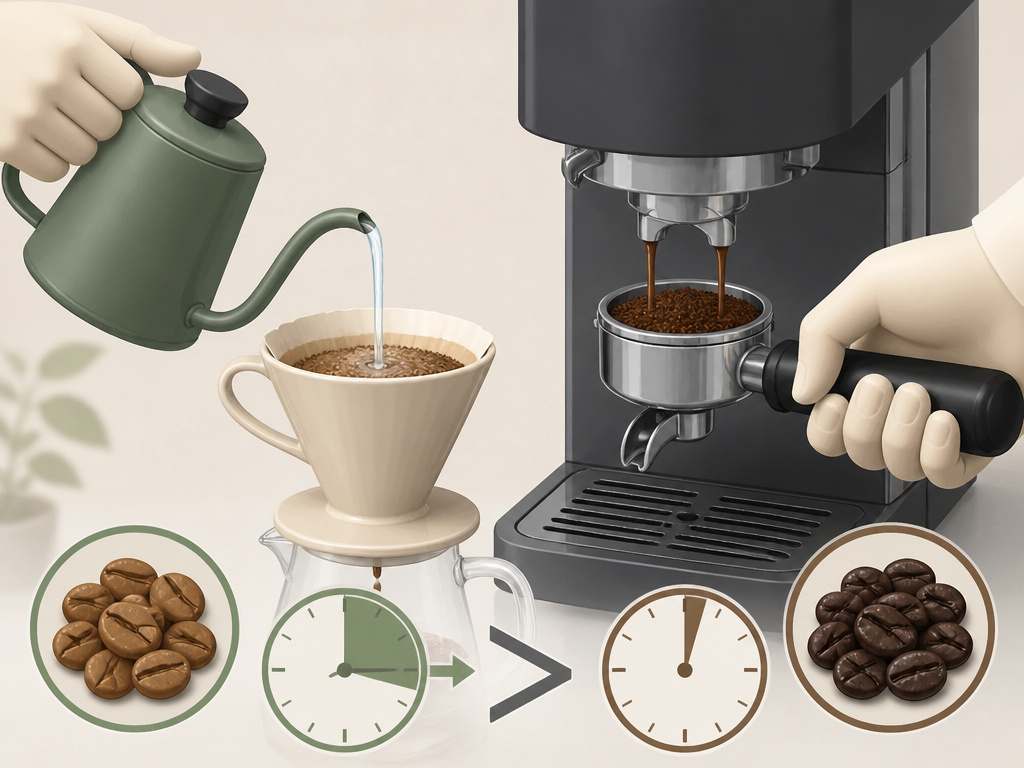
You might not believe it, but a light roast pour-over is often stronger than a dark roast espresso. Let me show you why.
Espresso uses a small dose, usually 18-20g of beans, extracted under high pressure for 25-30 seconds. A pour-over uses a larger dose (often 20-30g) extracted by gravity over 3-4 minutes. The longer extraction time and larger dose pull more caffeine into the cup, regardless of the roast level of the beans.
This is why comparing espresso vs coffee caffeine is more meaningful than comparing roast levels. The method dictates the outcome.
| Brew Method | Typical Dose | Extraction Time | Caffeine Result |
|---|---|---|---|
| Espresso | 18g | 25-30 seconds | ~60-80mg |
| Pour-over | 20g | 3-4 minutes | ~120-140mg |
| French Press | 30g | 4-5 minutes | ~180-200mg |
The brewed coffee vs Americano comparison follows the same logic. An Americano is espresso diluted with water; its caffeine content is fixed by the espresso shot. A brewed coffee’s caffeine is determined by dose and time.
If you want maximum caffeine, use a light roast bean in a long-extraction method like pour-over or French press. The density of the bean means it takes longer to fully extract, and that longer pull gets more of the caffeine out.
TL;DR: Brew method outweighs roast level. A light roast pour-over delivers more caffeine than a dark roast espresso.
How to Brew Light Roast for Strength
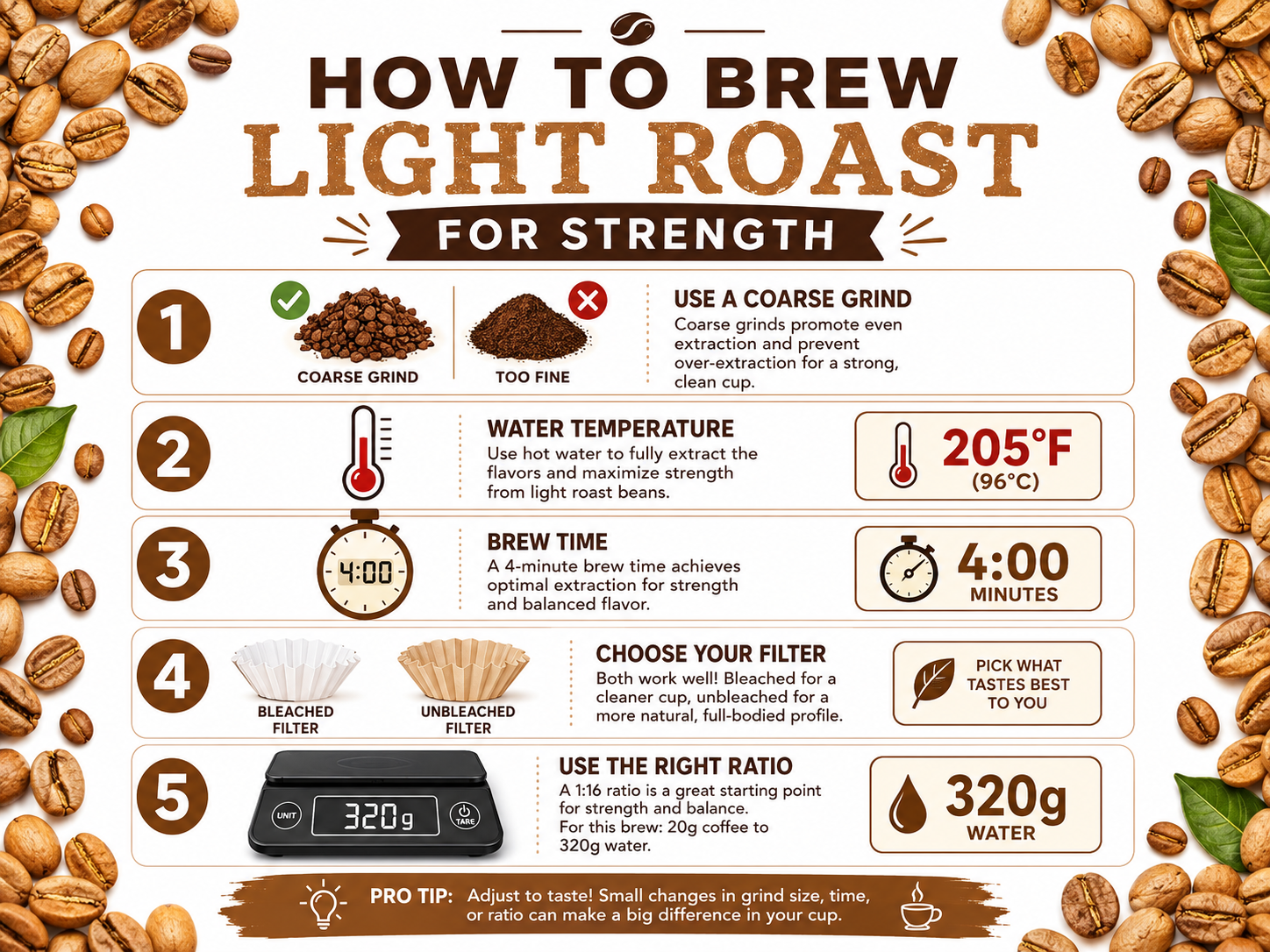
Light roast beans are denser. They resist extraction. You need to adjust your technique to get the most from them.
- Grind coarser than you would for dark roast. A finer grind on dense beans creates too many fines, which clog the filter and lead to uneven extraction. Use a burr vs blade grinder for consistency. The blade grinder produces uneven particles that exacerbate the problem.
- Use hotter water. Aim for 205°F (96°C). Dark roast extracts well at 200°F, but light roast needs that extra heat to open up.
- Extend the brew time. Give it 4 minutes instead of 3. The extra minute pulls more solubles, including caffeine.
- Consider your filter. Bleached vs unbleached filters can affect flow rate. Bleached paper filters are more consistent, which helps with the longer extraction.
- Weigh your output. If you’re using 20g of beans, you should target about 320g of brewed coffee. That’s a 1:16 ratio. Going weaker (1:18) dilutes the caffeine concentration.
Skipping the coarse grind step is the most common error. You’ll get a bitter, weak cup that channels and finishes fast. The caffeine extraction will be low, and you’ll blame the beans.
TL;DR: Grind coarse, use hot water, and extend the time. Light roast needs a push.
The Health Edge of Light Roast
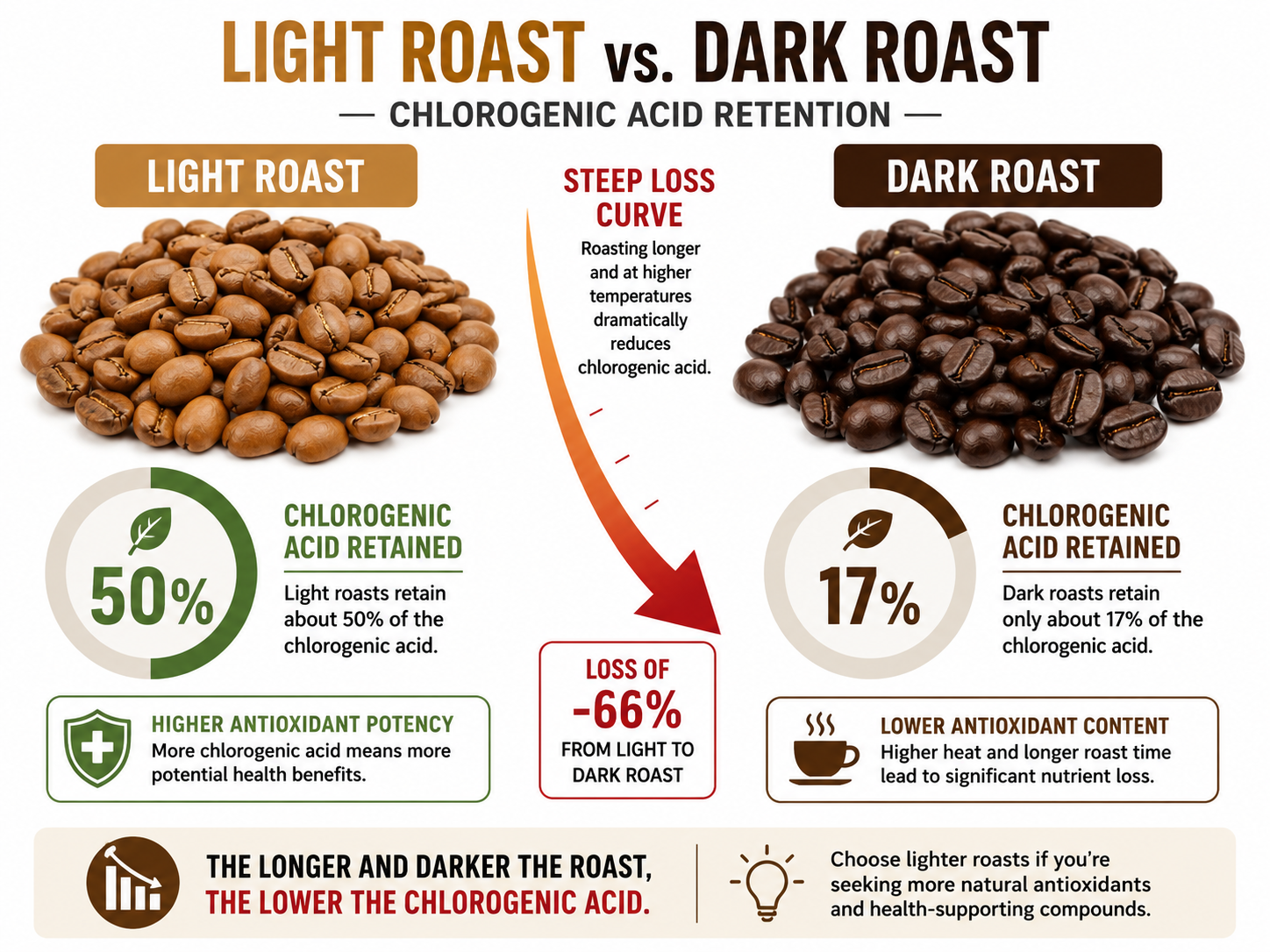
Above the light versus dark roast debate, having your coffee without added sugar and without artificial sweeteners is the most important thing to optimizing the net health benefits. But if you’re choosing based on compounds, light roast has a clear advantage.
The chlorogenic acid retention is significant. It’s not just about caffeine. This compound has studied effects on metabolism. The loss curve is steep: 50% gone at light roast, 83% gone at dark roast.
I won’t recommend light roast for espresso beginners. The puck prep is harder, and channeling is frequent. But for filter coffee, the health trade-off is worth the extra effort in grinding and water temperature.
The blonde roast coffee beans category sits at the extreme light end. Its characteristics are even more pronounced, higher acidity, more origin flavor, and the highest retention of chlorogenic acid.
Frequently Asked Questions
Does dark roast coffee have more caffeine?
No. When measured by weight, the caffeine content is nearly identical. Dark roast beans are larger and less dense, so a scoop contains fewer beans and less total caffeine. The perception of strength comes from bitterness, not caffeine concentration.
Why does dark roast taste stronger?
The longer roasting process breaks down sugars and creates bitter, smoky compounds like melanoidins. These compounds dominate the flavor profile, creating a sensation of intensity. Caffeine itself is not a major flavor contributor.
Is light roast coffee healthier?
Light roast retains significantly more chlorogenic acid, a compound linked to positive effects on glucose metabolism. From a compound perspective, light roast offers a health edge. The most impactful health choice, however, is avoiding added sugar and artificial sweeteners in your cup.
Can I use light roast for espresso?
Yes, but it’s harder. Light roast beans are denser and produce more fines, which can lead to channeling. You need excellent puck prep, precise grinding, careful distribution, and a consistent tamp. Many espresso traditionalists avoid it, but the bright, fruity notes are worth the effort for some.
What’s the best brew method for light roast?
Pour-over or French press. These methods allow for longer extraction times and hotter water, which are necessary to fully extract the dense beans. Espresso is possible but requires more skill and often yields a lower caffeine cup per volume.
The Bottom Line
Light roast coffee is not stronger in caffeine by weight. The difference is in single-digit percentages. The real strength of your coffee is determined by your brew method, dose, time, and temperature.
If you want the most caffeine, use a light roast bean in a long-extraction method like pour-over. If you want the perceived strength of a bold, smoky flavor, use a dark roast. And if you’re after the health benefits of chlorogenic acid, light roast is the clear choice.
Measure by weight, not volume. Grind coarse for light roast. And remember that the blend vs single-origin coffee decision will affect your flavor experience more than the roast level will affect your caffeine intake.
{
“@context”: “https://schema.org”,
“@type”: “HowTo”,
“name”: “How to Brew Light Roast Coffee for Maximum Caffeine”,
“totalTime”: “PT10M”,
“tool”: [
{
“@type”: “HowToTool”,
“name”: “Burr coffee grinder”
},
{
“@type”: “HowToTool”,
“name”: “Digital scale”
},
{
“@type”: “HowToTool”,
“name”: “Pour-over brewer (e.g., Hario V60)”
}
],
“step”: [
{
“@type”: “HowToStep”,
“name”: “Weigh Your Beans”,
“text”: “Measure 20 grams of light roast beans using a digital scale. Weight is the only reliable way to compare caffeine across roasts.”
},
{
“@type”: “HowToStep”,
“name”: “Grind Coarse”,
“text”: “Grind to a coarse, uniform consistency suitable for pour-over. A burr grinder prevents fines that cause uneven extraction.”
},
{
“@type”: “HowToStep”,
“name”: “Use Hot Water”,
“text”: “Heat water to 205°F (96°C). Light roasts require hotter water to extract solubles fully.”
},
{
“@type”: “HowToStep”,
“name”: “Brew for 3-4 Minutes”,
“text”: “Pour water evenly over the grounds and let the brew drip for 3-4 minutes. Longer extraction pulls more caffeine from the dense beans.”
}
]
}
{
“@context”: “https://schema.org”,
“@type”: “FAQPage”,
“mainEntity”: [
{
“@type”: “Question”,
“name”: “Does dark roast coffee have more caffeine?”,
“acceptedAnswer”: {
“@type”: “Answer”,
“text”: “No. When measured by weight, the caffeine content is nearly identical. Dark roast beans are larger and less dense, so a scoop contains fewer beans and less total caffeine. The perception of strength comes from bitterness, not caffeine concentration.”
}
},
{
“@type”: “Question”,
“name”: “Why does dark roast taste stronger?”,
“acceptedAnswer”: {
“@type”: “Answer”,
“text”: “The longer roasting process breaks down sugars and creates bitter, smoky compounds like melanoidins. These compounds dominate the flavor profile, creating a sensation of intensity. Caffeine itself is not a major flavor contributor.”
}
},
{
“@type”: “Question”,
“name”: “Is light roast coffee healthier?”,
“acceptedAnswer”: {
“@type”: “Answer”,
“text”: “Light roast retains significantly more chlorogenic acid, a compound linked to positive effects on glucose metabolism. From a compound perspective, light roast offers a health edge. The most impactful health choice, however, is avoiding added sugar and artificial sweeteners in your cup.”
}
},
{
“@type”: “Question”,
“name”: “Can I use light roast for espresso?”,
“acceptedAnswer”: {
“@type”: “Answer”,
“text”: “Yes, but it’s harder. Light roast beans are denser and produce more fines, which can lead to channeling. You need excellent puck prep, precise grinding, careful distribution, and a consistent tamp. Many espresso traditionalists avoid it, but the bright, fruity notes are worth the effort for some.”
}
},
{
“@type”: “Question”,
“name”: “What’s the best brew method for light roast?”,
“acceptedAnswer”: {
“@type”: “Answer”,
“text”: “Pour-over or French press. These methods allow for longer extraction times and hotter water, which are necessary to fully extract the dense beans. Espresso is possible but requires more skill and often yields a lower caffeine cup per volume.”
}
}
]
}
