
The Complete Guide on How to Make Coffee Without a Machine
To make coffee without a machine, you need three things: fresh coffee grounds, hot water just off the boil, and a simple filter or immersion device. The specific method, pour-over, French press, AeroPress, or cold brew, dictates the exact grind size, water temperature, and steeping time, but the core principle is manually controlling the contact between water and coffee.
Most people assume a missing machine means a bad cup. They grab pre-ground coffee, dump it into boiling water, and end up with a bitter, gritty mess. The frustration is real, but the assumption is wrong.
You can make exceptional coffee with tools already in your kitchen. This guide walks through the most reliable manual methods, the gear that actually matters, and how to adjust for altitude, water quality, and even a missing filter.
Key Takeaways
- Your coffee grind size is non-negotiable. A medium-coarse grind works for pour-over; a coarse, breadcrumb-like grind is essential for French press. The wrong grind guarantees over- or under-extraction.
- Water temperature is a silent variable. Aim for 200°F (93°C). Boiling water (212°F) scalds the grounds, pulling harsh, bitter compounds into your cup within the first 30 seconds of contact.
- The coffee-to-water ratio is your anchor. Use a 1:16 ratio (e.g., 25g coffee to 400g water) as a starting point. Eyeballing this is the single most common mistake behind weak or overpowering brews.
- Freshness beats gear every time. Stale, pre-ground coffee from a grocery store shelf will taste flat regardless of your method. Whole beans ground just before brewing make the biggest quality jump.
- Cold brew isn’t just iced coffee. It’s a 12–24 hour steep with cold water that extracts different flavor compounds, resulting in a naturally sweeter, less acidic concentrate that lasts up to two weeks in the fridge.
The Foundation: What You Actually Need
Forget specialty gadgets for a moment. You can start with items from a standard kitchen drawer. The goal is control, not complexity.
You need a way to heat water. A gooseneck kettle offers precision, but any saucepan works. You need a vessel to brew in. This could be a dedicated brewer like a Hario V60, a French press, or even a large measuring cup. You need a filter. This is where most improvisation happens, a clean paper towel inside a strainer, a fine-mesh sieve, or a cotton handkerchief can work in a pinch.
The ISO 6668:2008 standard for preparing coffee samples for sensory analysis specifies using water at 92–96°C (197–205°F) and a medium grind. This international benchmark validates the temperature and grind parameters used by professional tasters worldwide, proving the manual method’s legitimacy.
The two non-negotiable items are a burr grinder and a scale. A consistent grind is the single biggest factor you control without a machine. Blade grinders create a mix of dust and boulders, leading to uneven extraction. A scale ensures you hit the correct coffee-to-water ratio every time. A tablespoon of dark roast weighs differently than a light roast. Volume measures fail.
TL;DR: A burr grinder and a kitchen scale matter more than the brand of your brewer. They provide the consistency that turns a guessing game into a repeatable process.
Choosing Your Method: A Quick Comparison
Your choice depends on the flavor profile you want and the time you have. Each method manipulates water contact time and filtration differently.
| Method | Best For | Brew Time | Flavor Profile | Key Risk |
|---|---|---|---|---|
| Pour-Over | Clarity, bright notes | 3–4 minutes | Clean, nuanced, aromatic | Uneven pour causes channeling and weak spots |
| French Press | Body, rich mouthfeel | 4–5 minutes | Full-bodied, robust, oily | Fine sediment leads to gritty over-extraction |
| AeroPress | Versatility, strength control | 1–3 minutes | Smooth, concentrated, clean | High pressure can over-extract if plunged too fast |
| Cold Brew | Low acidity, convenience, shelf life | 12–24 hours | Sweet, mellow, less bitter | Weak concentrate if steep time is cut short |
Pour-over and French press are the two dominant manual categories. The first relies on filtration; the second on immersion. Your preference for a crisp or a heavy cup decides the winner.
Common mistake: Using the same grind for every method, a French press grind in a pour-over dripper will flow too fast, producing a sour, weak cup in under two minutes.
The Pour-Over Method (A 3-Step Process)
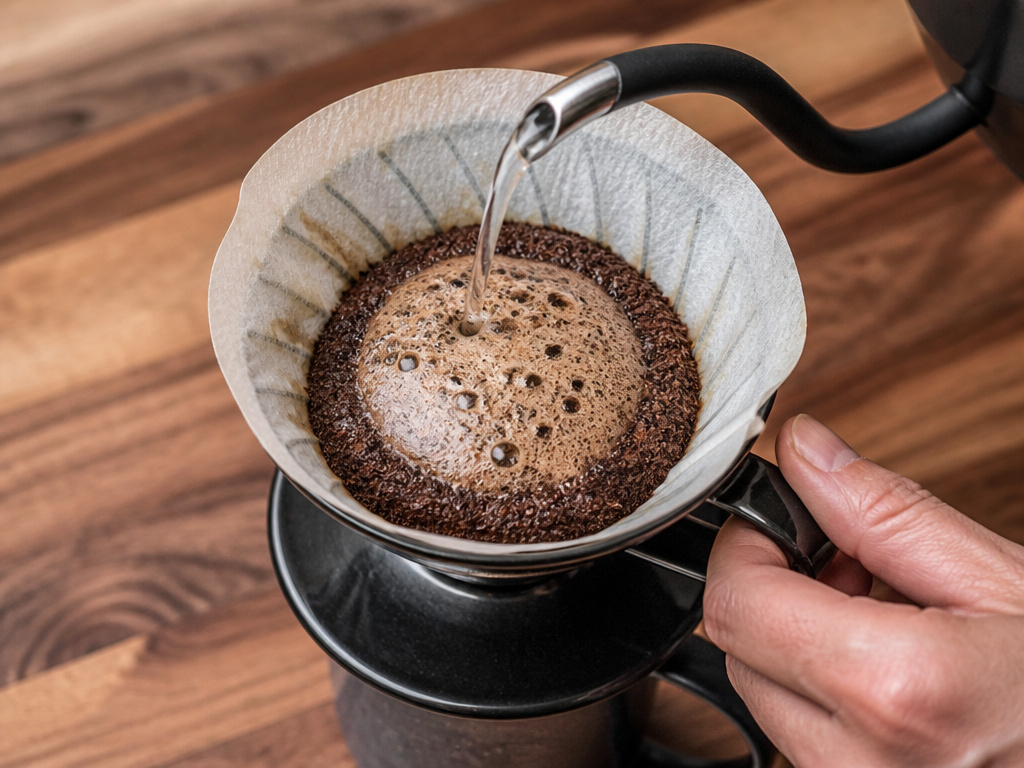
Pour-over coffee is a manual filtration method where you control the water flow directly over the grounds. It rewards patience with exceptional clarity.
First, place your paper coffee filter into the dripper (like a Hario V60 or Chemex) and rinse it with hot water. This eliminates any paper taste and preheats the brewer. Discard the rinse water. Add your medium-coarse ground coffee to the filter. Start with 25 grams of coffee for 400 grams of water.
Next, start your pour. Begin with a “bloom”: pour just enough hot water (200°F) to saturate all the grounds, about twice the weight of the coffee. Let it sit for 30 seconds. You’ll see the grounds bubble and rise as carbon dioxide escapes. This step is critical. Skipping it means those gases escape during the main brew, creating uneven extraction and a hollow taste.
I ignored the bloom phase for months, convinced it was coffee-snob theater. My cups were consistently thin and sour. Adding that 30-second pause was the difference between a drinkable cup and a great one.
Finally, pour the remaining water in slow, steady, concentric circles, starting from the center and moving outward. Avoid pouring directly onto the filter paper. The total brew time should land between 3 and 4 minutes. If it drips through faster, your grind is too coarse; slower, and it’s too fine.
TL;DR: Rinse the filter, bloom for 30 seconds, then pour slowly in circles. The entire process should take 3–4 minutes for a balanced, clean cup.
The Immersion Method: French Press & AeroPress
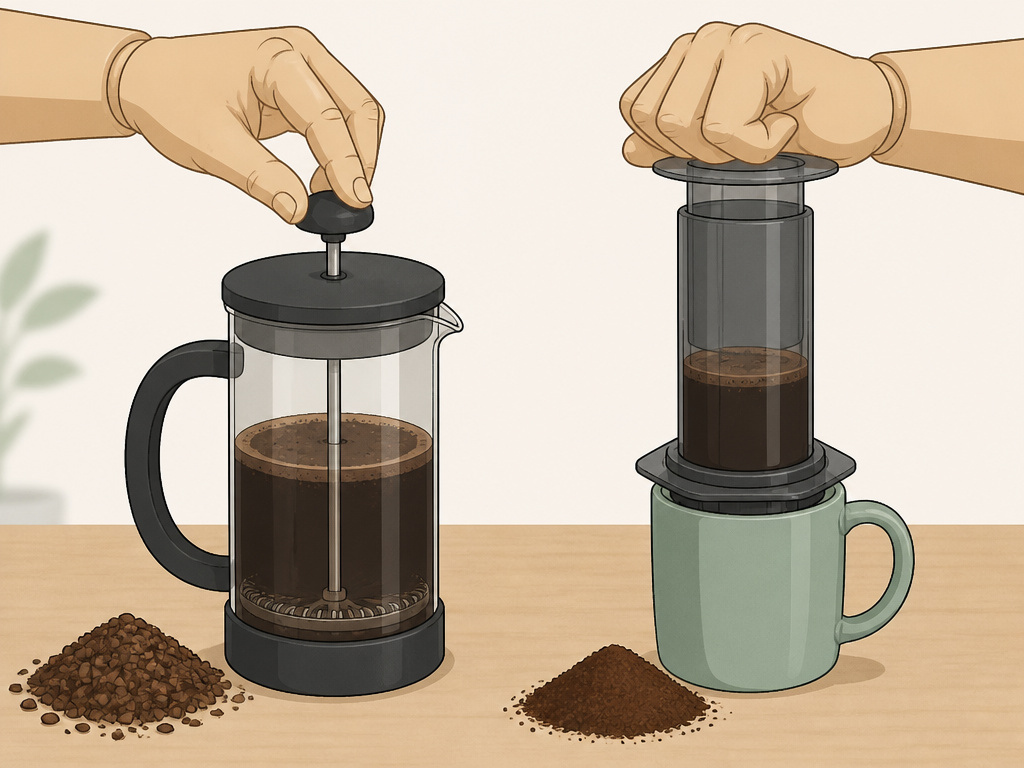
Immersion brewing saturates all the coffee grounds in water for a set period before separating them. It’s forgiving on pour technique but demanding on grind size and timing.
For a French press, use a coarse grind, think rough breadcrumbs. Finer particles will slip through the mesh filter and turn your last sips into sludge. Add the grounds to the clean carafe. Pour hot water (200°F) over them, ensuring all grounds are wet. Give it a gentle stir with a wooden or plastic spoon to break any dry clumps. Place the lid on top with the plunger pulled all the way up. Steep for 4 minutes.
After 4 minutes, press the plunger down slowly and steadily. If you meet strong resistance, your grind is too fine. Do not let the coffee continue to steep with the grounds trapped at the bottom. Pour it all into your mug immediately to stop the extraction.
The AeroPress is a hybrid. It uses immersion and then pressure. Use a fine-to-medium grind, similar to table salt. Place a filter in the cap, rinse it, and attach it to the chamber. Add your coffee, then pour hot water (175–185°F for a smoother cup, or 200°F for more intensity). Stir for 10 seconds. Insert the plunger and create a slight vacuum seal to prevent dripping. Steep for 1-2 minutes, then press down firmly for about 30 seconds. The result is a clean, concentrated coffee that can be drunk as is or diluted with hot water.
Both methods benefit from a consistent coarse grind. Using a blade grinder here is a guaranteed path to sediment. A burr grinder set to a French press setting creates uniform particles that the mesh screen can actually hold back.
The No-Filter, No-Device Workaround
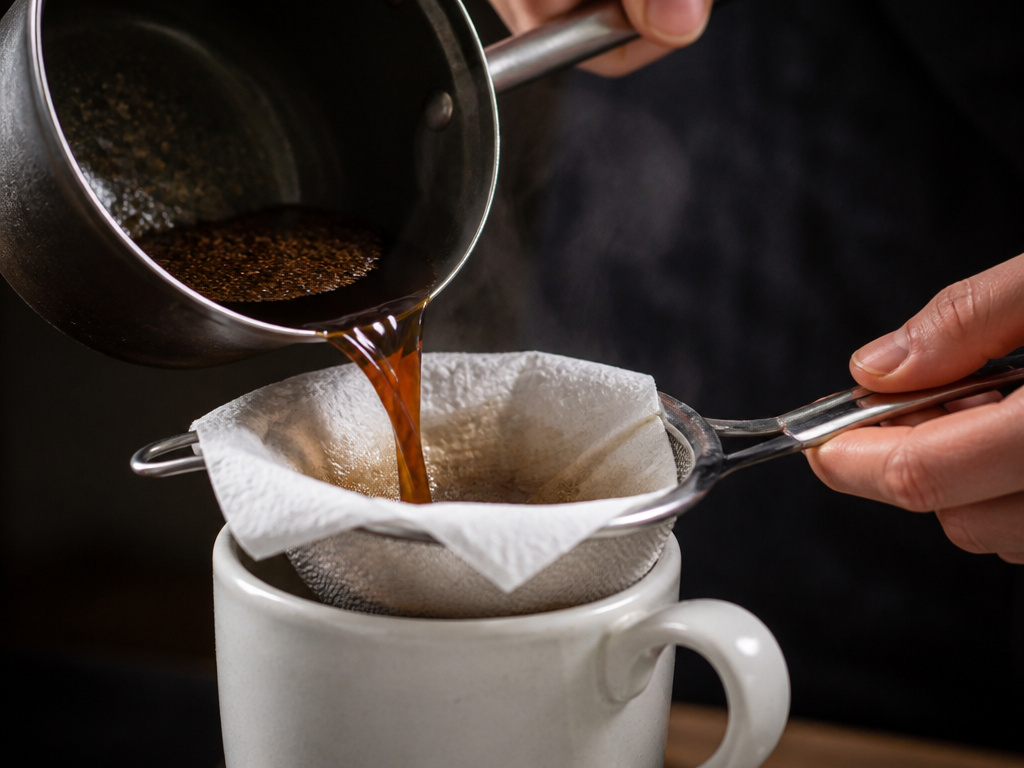
Your coffee maker broke, and you have no dripper, no French press. This happens. You can still make a decent cup with a saucepan, a mug, and a strainer.
This is the “cowboy coffee” or “Turkish-style” method. Use a slightly finer grind than for pour-over. Add the grounds directly to a pot of hot water (200°F) off the heat, roughly 2 tablespoons per 8 ounces of water. Stir gently and let it steep for 4 minutes. The grounds will sink, forming a bed at the bottom.
To separate, you have a few options. Carefully pour the coffee into your mug, leaving the sludge behind. For a cleaner result, pour the brew through a fine-mesh sieve lined with a thin paper towel or a permanent cloth coffee filter. Some traditions add a splash of cold water at the end to “settle” the grounds; it works, but fine silt remains.
Common mistake: Boiling the grounds directly on the stove, this cooks the coffee, extracting unbearable bitterness and tannins in under a minute. Always take the water off the boil before adding coffee.
The cup will have more body and potentially some sediment. It’s not as clean as a filtered pour-over, but it’s a robust, honest brew that gets the job done. It’s the original manual method.
The Cold Brew Alternative (And Why It’s Different)
Cold brew isn’t iced coffee. Iced coffee is hot-brewed coffee poured over ice. Cold brew is coffee steeped in cold water for 12 to 24 hours. The chemistry is distinct.
Cold water extracts flavor compounds slowly and selectively. It pulls out sugars and soluble oils but leaves behind many of the acidic compounds and bitter tannins that hot water grabs quickly. The result is a smooth, naturally sweet concentrate that is roughly twice as strong as regular drip coffee.
To make it, combine a coarse grind with cold, filtered water in a large jar or pitcher at a 1:8 ratio (e.g., 100g coffee to 800g water). Stir to ensure all grounds are wet. Cover and let it sit at room temperature or in the refrigerator for 12–24 hours. The longer it steeps, the stronger and more extracted it becomes, but going beyond 24 hours can introduce woody, harsh notes.
After steeping, strain the concentrate through a fine-mesh sieve lined with a paper coffee filter or a nut milk bag. This filtration is crucial, any fine sediment will continue to extract and bitter the concentrate in the fridge. The final product can be stored in the refrigerator for up to two weeks. Dilute with water, milk, or a dairy alternative like almond milk at a 1:1 ratio.
TL;DR: Combine coarse grounds and cold water (1:8 ratio), steep for 12–24 hours, then filter thoroughly. You get a low-acid, sweet concentrate that keeps for weeks.
Troubleshooting Your Manual Brew
Your coffee tastes off. Before you blame the beans, run through this diagnostic table. Manual brewing gives you the data; you just have to read it.
| Symptom | Likely Cause | The Fix |
|---|---|---|
| Sour, sharp, weak | Under-extraction | Use a finer grind or increase brew time |
| Bitter, harsh, dry | Over-extraction | Use a coarser grind or decrease brew time |
| Muddy, gritty sediment | Grind is too fine for method | Adjust grind consistency to a coarser setting |
| Flat, dull, lacking flavor | Stale beans or incorrect ratio | Use fresher beans and measure with a scale |
| Uneven taste (sour & bitter) | Channeling (pour-over) or uneven saturation | Master the bloom and pour technique |
If your coffee is consistently sour, your water is passing through too quickly without pulling enough sweetness. Go finer. If it’s bitter, the water is overstaying its welcome, pulling out undesirable compounds. Go coarser. This is the fundamental dial.
Water quality is an invisible variable. Hard water with high mineral content can inhibit extraction, leading to weak coffee. Very soft water can over-extract, making coffee taste sharp. If your tap water tastes bad or smells of chlorine, your coffee will too. Use filtered water whenever possible. It’s the cheapest upgrade you can make.
Frequently Asked Questions
Can I use instant coffee if I have no machine?
You can, but it’s a different product entirely. Instant coffee is brewed coffee that has been dehydrated. Follow the package instructions, typically a teaspoon or two stirred into hot water. It won’t taste like freshly brewed coffee from grounds, but it is the ultimate no-machine, no-filter option.
What’s the best grind size for making coffee without a machine?
There is no single “best” size; it depends entirely on your method. For pour-over (like a Hario V60), use a medium-coarse grind, similar to sea salt. For French press, use a coarse grind, like breadcrumbs. For an AeroPress, a medium-fine grind works best. Using pre-ground “drip” coffee in a French press will result in a very gritty cup.
How important is water temperature?
It’s critical. The ideal range is 195°F to 205°F (90°C to 96°C). Water that is boiling (212°F) will scald the coffee, extracting bitter flavors almost immediately. If you don’t have a thermometer, bring water to a boil and then let it sit off the heat for 30 seconds to a minute before pouring.
Can I make coffee without any filter at all?
Yes, using the immersion or “cowboy coffee” method. Steep coarsely ground coffee in hot water for 4 minutes, then let the grounds settle. Pour carefully to leave the sludge behind, or pour through a fine-mesh kitchen strainer. The cup will be stronger and have more body, with some sediment.
How long does manually brewed coffee stay fresh?
Drink it immediately for the best flavor. Brewed coffee begins to oxidize and degrade as soon as it’s done brewing. If you must keep it, store it in a sealed thermos, not on a hot plate. Avoid reheating it in a microwave, which breaks down the remaining aromatic compounds and emphasizes bitter notes.
Before You Go
Making coffee without a machine isn’t a compromise. It’s a return to the fundamentals of extraction. You control every variable: the grind, the water, the time, the pour. That control is what creates excellence.
Start with the method that matches your taste, clean and bright (pour-over) or rich and full (French press). Invest in a decent burr grinder before you buy a fancy kettle. Use a scale. And always, always use fresh, whole beans. The gear just facilitates the conversation between the water and the coffee; your job is to set the stage properly.
The best cup you make will come from paying attention to those details, not from owning the most expensive gadget. Now go heat some water.
{
“@context”: “https://schema.org”,
“@type”: “HowTo”,
“name”: “How to Make Coffee Without a Machine”,
“totalTime”: “PT10M”,
“tool”: [
{
“@type”: “HowToTool”,
“name”: “Burr coffee grinder”
},
{
“@type”: “HowToTool”,
“name”: “Gooseneck kettle or saucepan”
},
{
“@type”: “HowToTool”,
“name”: “Pour-over dripper or French press”
},
{
“@type”: “HowToTool”,
“name”: “Digital scale”
},
{
“@type”: “HowToTool”,
“name”: “Coffee mug”
}
],
“step”: [
{
“@type”: “HowToStep”,
“name”: “Grind your beans”,
“text”: “Use a burr grinder to achieve a medium-coarse grind for pour-over or a coarse grind for French press. Consistency is key for even extraction.”
},
{
“@type”: “HowToStep”,
“name”: “Heat your water”,
“text”: “Bring fresh water to 200°F (93°C), just below a rolling boil. Water that’s too hot will scorch the grounds.”
},
{
“@type”: “HowToStep”,
“name”: “Bloom the coffee”,
“text”: “Pour just enough hot water to saturate the grounds and let them bubble for 30 seconds. This releases gases for a smoother taste.”
},
{
“@type”: “HowToStep”,
“name”: “Pour and steep”,
“text”: “For pour-over, pour the remaining water in slow, concentric circles. For French press, add all water, stir, and steep for 4 minutes before pressing.”
},
{
“@type”: “HowToStep”,
“name”: “Serve immediately”,
“text”: “Decant the coffee into your mug to stop the extraction. Enjoy black or with your preferred additions.”
}
]
}
{
“@context”: “https://schema.org”,
“@type”: “FAQPage”,
“mainEntity”: [
{
“@type”: “Question”,
“name”: “Can I use instant coffee if I have no machine?”,
“acceptedAnswer”: {
“@type”: “Answer”,
“text”: “You can, but it’s a different product entirely. Instant coffee is brewed coffee that has been dehydrated. Follow the package instructions, typically a teaspoon or two stirred into hot water. It won’t taste like freshly brewed coffee from grounds, but it is the ultimate no-machine, no-filter option.”
}
},
{
“@type”: “Question”,
“name”: “What’s the best grind size for making coffee without a machine?”,
“acceptedAnswer”: {
“@type”: “Answer”,
“text”: “There is no single \”best\” size; it depends entirely on your method. For pour-over (like a Hario V60), use a medium-coarse grind, similar to sea salt. For French press, use a coarse grind, like breadcrumbs. For an AeroPress, a medium-fine grind works best. Using pre-ground \”drip\” coffee in a French press will result in a very gritty cup.”
}
},
{
“@type”: “Question”,
“name”: “How important is water temperature?”,
“acceptedAnswer”: {
“@type”: “Answer”,
“text”: “It’s critical. The ideal range is 195°F to 205°F (90°C to 96°C). Water that is boiling (212°F) will scald the coffee, extracting bitter flavors almost immediately. If you don’t have a thermometer, bring water to a boil and then let it sit off the heat for 30 seconds to a minute before pouring.”
}
},
{
“@type”: “Question”,
“name”: “Can I make coffee without any filter at all?”,
“acceptedAnswer”: {
“@type”: “Answer”,
“text”: “Yes, using the immersion or \”cowboy coffee\” method. Steep coarsely ground coffee in hot water for 4 minutes, then let the grounds settle. Pour carefully to leave the sludge behind, or pour through a fine-mesh kitchen strainer. The cup will be stronger and have more body, with some sediment.”
}
},
{
“@type”: “Question”,
“name”: “How long does manually brewed coffee stay fresh?”,
“acceptedAnswer”: {
“@type”: “Answer”,
“text”: “Drink it immediately for the best flavor. Brewed coffee begins to oxidize and degrade as soon as it’s done brewing. If you must keep it, store it in a sealed thermos, not on a hot plate. Avoid reheating it in a microwave, which breaks down the remaining aromatic compounds and emphasizes bitter notes.”
}
}
]
}
