
Learn How to Make Coffee Using Fresh Coffee Beans at Home
To make coffee with coffee beans, you must control three things: the grind size, the water temperature, and the brew time. Start with 55 grams of whole beans per liter of water. Grind them fresh to a size matching your brewer, use water heated to 200°F (93°C), and follow the contact time for your method.
Most people get this wrong by focusing on the bean alone. They buy a great single-origin coffee, then ruin it with a blade grinder and water straight off the boil. The bean is the score, but the grind, water, and time are the orchestra. A bad performance wrecks the music.
This guide walks through each of those three control points. You will learn why they matter, how to execute them, and what breaks when you skip a step.
Key Takeaways
- Weigh your beans and water. Volume measures like scoops are inconsistent. The Specialty Coffee Association’s golden ratio is 55 grams of coffee per liter of water.
- Grind size is not optional. It dictates extraction speed. A fine grind in a French press over-extracts into bitterness in under two minutes. A coarse grind in a pour-over under-extracts, leaving a sour, watery cup.
- Water temperature is a physical limit. Brewing at 200°F (93°C) extracts the balanced sugars and acids. Boiling water pulls tannins and bitter compounds first. The difference is a sharp, unpleasant astringency versus a smooth, sweet finish.
- Your brewer is a timer. Each method has a built-in contact time. A pour-over finishes in 3-4 minutes. A French press needs 4 minutes. An espresso machine forces water through in 25-30 seconds. Fighting that timer guarantees a bad cup.
The Grind, The Water, The Brew
Coffee extraction is a simple diffusion process. Hot water dissolves soluble compounds from the ground coffee. Your job is to manage the rate of that dissolution. Three variables set the speed: particle size, water heat, and contact duration.
Get one wrong and the balance collapses. The cup tastes sour from under-extraction or bitter from over-extraction. Sometimes both at once, which is the special hell of a blade-ground brew in a percolator.
The Specialty Coffee Association’s brewing standards specify a water temperature of 200°F ± 5°F (93.0 °C ± 2.8 °C) and a coffee-to-water ratio of 55 grams per liter for optimal extraction. These parameters maximize the dissolution of desirable sugars and acids while minimizing harsh tannins.
Why Your Grinder Choice Is the First Decision
A consistent grind size is the single biggest lever for quality. An inconsistent grind, like the one from a blade grinder, creates a mix of dust and boulders. The dust over-extracts into bitterness while the boulders under-extract, leaving sour notes. You get a muddy, confused cup no matter the bean.
A burr coffee grinder solves this by crushing beans between two abrasive surfaces to a uniform size. The Baratza Encore is the entry-level benchmark. I used a cheap blade grinder for a year, convinced my technique was the problem. Switching to a Baratza revealed flavors in my beans I didn’t know existed. The difference wasn’t subtle.
Grind consistency is why pre-ground coffee fails. It goes stale fast, yes. But the grinding process itself creates a wide particle distribution that degrades over days as oils oxidize and fines compact. You start with a compromised foundation.
| Brewing Method | Target Grind Size | Visual Cue (Like…) | What Happens If It’s Wrong |
|---|---|---|---|
| French Press / Cold Brew | Coarse | Sea salt or breadcrumbs | Fine grit slips through the mesh, creating a muddy, bitter cup. |
| Drip Machine / Pour-Over | Medium | Granulated sugar | Too fine clogs the filter, extending brew time into bitterness. Too coarse makes weak, sour coffee. |
| Espresso / Moka Pot | Fine | Table salt or flour | Too coarse makes a fast, sour shot. Too fine chokes the machine, producing no coffee or burnt flavors. |
The chart is a starting point. Your specific grinder and beans will require slight adjustments. That’s the tuning process. Start at the recommended setting and move one click finer if the coffee tastes sour, one click coarser if it tastes bitter.
TL;DR: Use a burr grinder. Match the grind size to your brewer. Sour means grind finer; bitter means grind coarser.
Heating Water to the Exact Degree
Water is the solvent. Its temperature controls which compounds dissolve first. The sweet spot is 200°F (93°C). At this temperature, water efficiently extracts sucrose, fructose, and pleasant acids like citric and malic.
Boiling water, 212°F (100°C), has more energy. It aggressively pulls out phenolic compounds and tannins, the same things that make over-steeped tea bitter. You’ll taste it as a sharp, drying astringency at the back of your tongue.
Common mistake: Using boiling water straight from the kettle, the first compounds extracted are the bitter ones, masking all the bean’s inherent sweetness and clarity. The cup will taste harsh regardless of brew time.
The fix is simple. Heat your water to a boil, then let it sit off the heat for 30 seconds. That’s usually enough to drop it into the 200–205°F range. A variable-temperature gooseneck kettle removes the guesswork.
Water quality matters too. Hard water with high mineral content can inhibit extraction, leading to flat coffee. Filtered or bottled spring water works best. Avoid distilled water, it lacks minerals entirely and can make coffee taste hollow.
This step is non-negotiable. I’ve tested the same single-origin coffee with 195°F, 205°F, and 212°F water. The 205°F brew was balanced and sweet. The 195°F cup was sour and thin. The 212°F version was aggressively bitter, masking the bean’s character completely. Temperature isn’t a suggestion.
The Brewing Method Is Your Timer
Every coffee brewer is a timing device. The design dictates how long water and grounds are in contact. Your job is to work with that timer, not against it.
- French Press (Immersion): 4 minutes. The grounds steep fully submerged. After plunging, pour the entire brew into a carafe immediately. Leaving it in the press continues extraction, turning it bitter.
- Pour-Over (Percolation): 3–4 minutes total. Water passes through a bed of grounds once. A gooseneck kettle gives you control over pour speed and saturation.
- Auto-Drip Machine: Typically 5–8 minutes as designed. Use a medium grind and trust the machine’s thermal carafe. Avoid machines with hot plates, they burn the coffee in under twenty minutes.
- Espresso (Pressure): 25–30 seconds. Nine bars of pressure force water through a fine, tamped puck. This is a separate skill set entirely.
The drip coffee method is forgiving if you keep the ratio and grind right. The cafe Americano (espresso diluted with hot water) is a different extraction process masquerading as brewed coffee.
Here are the four core steps that apply to any method:
- Pre-wet your equipment. Rinse your filter and brewer with hot water. This removes any paper taste and pre-heats the vessel, so your brewing water doesn’t lose heat on contact. Skipping this drops your brew temperature by 5-10 degrees.
- Add grounds and bloom. Pour just enough hot water to saturate all the grounds, then wait 30 seconds. Fresh beans release carbon dioxide; the bloom lets this gas escape so water can contact the coffee evenly. If you skip the bloom, the gas creates channels in the bed, leading to uneven extraction.
- Complete the pour. Add the remaining water in a steady, controlled manner. For immersion brewers, pour it all at once and start the timer. For pour-over, use a slow, spiral pour to keep the bed level.
- Separate the coffee from the grounds. At the end of the brew time, separate the liquid from the grounds, plunge the French press, let the pour-over drain completely, or turn off the drip machine. Stalling here continues extraction.
Choosing Your Brewer: A Side-by-Side Look
Your brewer dictates the texture and clarity of your coffee. Immersion methods like the French press produce a full-bodied, oily cup because no paper filter catches the oils. Percolation methods like pour-overs yield a cleaner, brighter cup.
| Brewer | Body & Texture | Best For | The One Watch-Out |
|---|---|---|---|
| French Press | Full, rich, with visible oils. | Those who enjoy a heavier, textured cup and don’t mind some silt. | Over-steeping. Plunge and pour at 4:00, don’t let it sit. |
| Pour-Over (V60, Chemex) | Clean, bright, nuanced. | Highlighting subtle flavors in light roast or single-origin coffee. | Pour technique. Uneven saturation leads to channeling and uneven extraction. |
| Auto-Drip Machine | Consistent, medium body, clean. | Hands-off morning routine. Use with a thermal carafe, not a hot plate. | Cleanliness. Old oils and mineral buildup in the machine taint every cup. |
| AeroPress | Versatile—can mimic espresso or clean filter coffee. | Experimenters and travelers. | Pressure. Pressing too hard can over-extract. Steady, gentle pressure for 30 seconds is key. |
The blend vs single origin choice interacts with your brewer. A complex, fruity Arabica coffee from Ethiopia sings in a pour-over. A balanced, chocolatey coffee blend built for espresso might taste flat in a French press. Match the tool to the bean’s intention.
My go-to for a weekday morning is a programmable auto-drip with a bleached coffee filter and a thermal carafe. It’s consistent. For a weekend treat, it’s a pour-over with a light roast coffee to tease out the floral notes. The method changes the experience.
The Tools You Actually Need (Not the Fancy Ones)
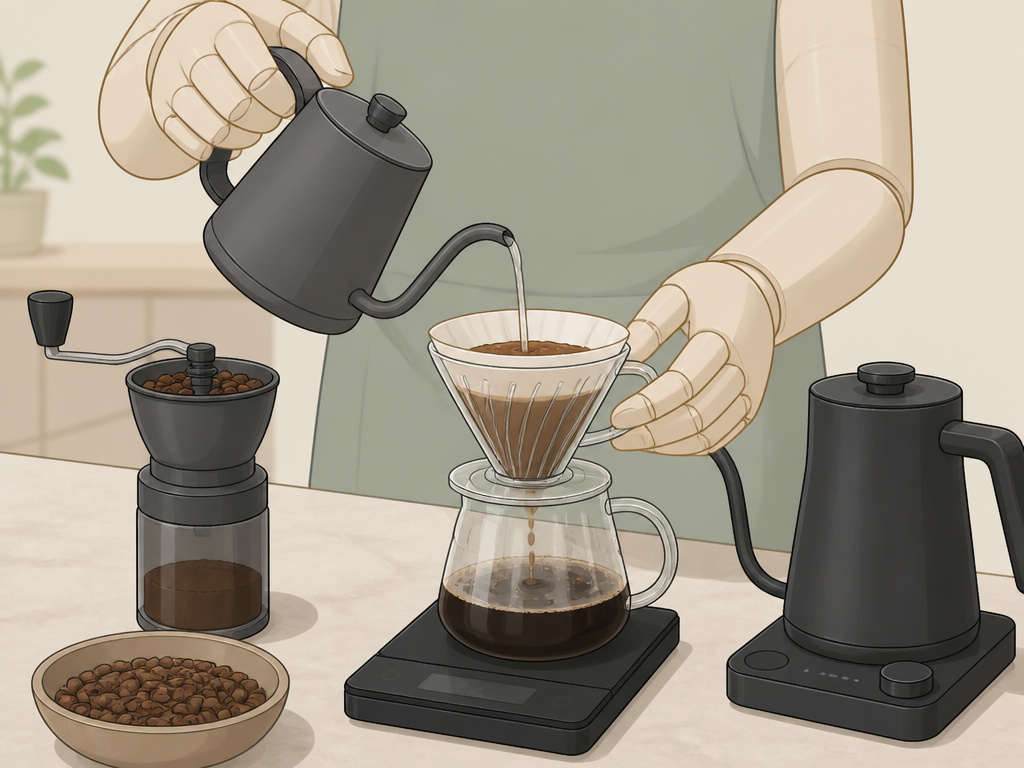
You can make great coffee with four tools. The fifth is a luxury.
- A burr coffee grinder. The Baratza Encore is the workhorse. A blade grinder will fight you every day.
- A digital kitchen scale. Measuring by weight is non-negotiable for hitting the 55 g/L ratio. A $20 scale changes everything.
- A kettle. A gooseneck is ideal for pour-over control, but any kettle that can heat water to near-boiling works.
- Your brewer. Start with one: a French press or a simple pour-over cone like a Hario V60.
- (The luxury) A variable temperature kettle. It removes guesswork and is worth the investment if you brew daily.
Filter choice is part of your brewer. Unbleached coffee filters can impart a slight papery taste, which a pre-rinse eliminates. Bleached coffee filters are taste-neutral. For the French press, you need no filter, just a fine mesh screen.
I prefer bleached filters for pour-over. The unbleached ones, even after a thorough rinse, sometimes leave a whisper of cardboard in the background with very light roasts. It’s a small thing, but with delicate blonde roast beans, small things are the whole point.
Store your whole beans in an airtight, opaque container at room temperature. The freezer is a debate. If you do freeze, do it in single-dose portions to avoid condensation and repeat temperature swings that degrade the beans faster. The PMC study on coffee storage conditions confirms that oxygen exposure and moisture are the primary enemies of both green and roasted bean quality.
Frequently Asked Questions
Can I use pre-ground coffee?
You can, but you surrender control over grind size and freshness. Pre-ground is optimized for a generic drip machine and begins staling immediately as surface area oxidizes. If you must use it, buy it in small amounts and brew it quickly.
How fine should I grind for a French press?
Use a coarse grind, similar to breadcrumbs. The French press metal mesh cannot stop fine particles. A grind that’s too fine will slip through, making your cup silty and bitter. A proper coarse grind steeps cleanly for four minutes.
What is the bloom and why do it?
The bloom is the initial pour that fully saturates the grounds. Fresh coffee releases carbon dioxide when hot water hits it. Letting it bubble and degas for 30 seconds allows for even water penetration during the main brew. Skipping it often causes channeling and uneven extraction.
Does water quality really matter?
Yes, dramatically. Hard water or water with strong chlorine tastes will bake those flavors into your coffee. It can also inhibit extraction. Using filtered or bottled spring water is the easiest way to ensure your coffee tastes only like coffee.
Why does my coffee taste sour?
Sourness usually signals under-extraction. The water hasn’t dissolved enough of the sugars. The fix is typically to grind finer, which increases surface area and slows the water flow, allowing more time for dissolution. It could also mean your water wasn’t hot enough.
Why does my coffee taste bitter?
Bitterness signals over-extraction. The water has pulled out too many tannic compounds. Try a coarser grind to speed up the flow and shorten contact time. Also, ensure your water is not at a full, rolling boil, as that extracts bitterness first.
The Bottom Line
Making coffee from beans boils down to managing a physical extraction. Weigh your beans and water. Grind them fresh with a burr grinder to the correct size. Use water just off the boil, around 200°F. Follow the timer built into your brewer.
The gear is less important than the process. A $20 French press and a $100 burr grinder will produce a better cup than a $1000 espresso machine fed with pre-ground beans. Control the three variables, grind, water, time, and the bean’s flavor will show up.
Start with the SCA ratio of 55 grams per liter. Dial in from there. Your taste is the final judge.
{
“@context”: “https://schema.org”,
“@type”: “HowTo”,
“name”: “How to Make Coffee with Coffee Beans”,
“totalTime”: “PT10M”,
“tool”: [
{
“@type”: “HowToTool”,
“name”: “Burr coffee grinder”
},
{
“@type”: “HowToTool”,
“name”: “Digital kitchen scale”
},
{
“@type”: “HowToTool”,
“name”: “Gooseneck kettle for pour-over, or standard kettle”
},
{
“@type”: “HowToTool”,
“name”: “Your chosen brewer (French press, drip machine, pour-over cone)”
}
],
“step”: [
{
“@type”: “HowToStep”,
“name”: “Weigh and grind your beans”,
“text”: “Measure whole beans by weight, not volume. For one liter of water, use 55 grams of beans. Grind immediately before brewing to a size matching your brewer: coarse for French press, medium for drip or pour-over, fine for espresso.”
},
{
“@type”: “HowToStep”,
“name”: “Heat the water to the right temperature”,
“text”: “Bring fresh, filtered water to 200°F (93°C). Boiling water (212°F) scalds the grounds, extracting harsh bitterness. Water below 195°F under-extracts, leaving a sour, weak cup.”
},
{
“@type”: “HowToStep”,
“name”: “Brew with the correct method and time”,
“text”: “Combine grounds and water, ensuring even saturation. Follow brewer-specific contact times: 4 minutes for French press, 3-4 minutes for pour-over, as programmed for auto-drip. Stirring once at the start prevents dry clumps of grounds.”
}
]
}
{
“@context”: “https://schema.org”,
“@type”: “FAQPage”,
“mainEntity”: [
{
“@type”: “Question”,
“name”: “Can I use pre-ground coffee?”,
“acceptedAnswer”: {
“@type”: “Answer”,
“text”: “You can, but you surrender control over grind size and freshness. Pre-ground is optimized for a generic drip machine and begins staling immediately as surface area oxidizes. If you must use it, buy it in small amounts and brew it quickly.”
}
},
{
“@type”: “Question”,
“name”: “How fine should I grind for a French press?”,
“acceptedAnswer”: {
“@type”: “Answer”,
“text”: “Use a coarse grind, similar to breadcrumbs. The French press metal mesh cannot stop fine particles. A grind that’s too fine will slip through, making your cup silty and bitter. A proper coarse grind steeps cleanly for four minutes.”
}
},
{
“@type”: “Question”,
“name”: “What is the bloom and why do it?”,
“acceptedAnswer”: {
“@type”: “Answer”,
“text”: “The bloom is the initial pour that fully saturates the grounds. Fresh coffee releases carbon dioxide when hot water hits it. Letting it bubble and degas for 30 seconds allows for even water penetration during the main brew. Skipping it often causes channeling and uneven extraction.”
}
},
{
“@type”: “Question”,
“name”: “Does water quality really matter?”,
“acceptedAnswer”: {
“@type”: “Answer”,
“text”: “Yes, dramatically. Hard water or water with strong chlorine tastes will bake those flavors into your coffee. It can also inhibit extraction. Using filtered or bottled spring water is the easiest way to ensure your coffee tastes only like coffee.”
}
},
{
“@type”: “Question”,
“name”: “Why does my coffee taste sour?”,
“acceptedAnswer”: {
“@type”: “Answer”,
“text”: “Sourness usually signals under-extraction. The water hasn’t dissolved enough of the sugars. The fix is typically to grind finer, which increases surface area and slows the water flow, allowing more time for dissolution. It could also mean your water wasn’t hot enough.”
}
},
{
“@type”: “Question”,
“name”: “Why does my coffee taste bitter?”,
“acceptedAnswer”: {
“@type”: “Answer”,
“text”: “Bitterness signals over-extraction. The water has pulled out too many tannic compounds. Try a coarser grind to speed up the flow and shorten contact time. Also, ensure your water is not at a full, rolling boil, as that extracts bitterness first.”
}
}
]
}
