
How to Make Black Coffee: Avoiding Common Wastage & Ratio Errors
To make black coffee, you need three things matched: a precise coffee-to-water ratio (1:16 by weight is the SCA standard), water heated to 200°F (93°C), and a brew time between 3 and 4 minutes. The grind size you choose, medium for drip, medium-coarse for French press, decides whether you hit that time or end up with a muddy or weak cup.
Most guides tell you to use a tablespoon of grounds per cup of water. That vague advice wastes coffee. A tablespoon of light roast can weigh 7 grams; a tablespoon of dark roast can weigh 5 grams. Your strength swings wildly from cup to cup, and you’ll burn through a bag twice as fast trying to correct it.
This guide walks through the measured parameters that actually define a good black coffee, from the Specialty Coffee Association’s brew control chart to the arguments over French press grind size. We’ll cover why your water matters as much as your beans, how to adjust for altitude, and when to break the standard rules for cold brew.
Key Takeaways
- Use a 1:16 coffee-to-water ratio by weight, not volume. For 300g of water, you need 18.75g of coffee. A tablespoon is unreliable.
- Water quality dictates flavor. The SCA recommends water with 17–85 mg/L total hardness and 40 mg/L alkalinity. Your tap water likely falls outside this range.
- Grind size controls extraction time. A medium grind for drip coffee should finish brewing in 3–4 minutes. If it drains in 90 seconds, your coffee will taste sour.
- Brew temperature is non-negotiable. 200°F (93°C) extracts the full range of flavors. At 185°F, you miss the sweetness; above 205°F, you pull out bitterness.
- Clean your equipment after every use. Oils left in a French press or drip basket turn rancid. Your next cup will taste like stale nuts.
The SCA’s Golden Ratio (and Why You’re Probably Missing It)
The Specialty Coffee Association’s Coffee Brewing Control Chart sets the professional standard. It specifies a brew ratio of 55 grams of coffee per liter of water, plus or minus 10%. That’s a 1:18.2 ratio at the center, but the acceptable range runs from 1:16.7 to 1:20. For a balanced, full-flavored black coffee, most professionals anchor at 1:16.
The SCA’s brew ratio is 55 g/L (±10%), which translates to a coffee-to-water ratio between 1:16.7 and 1:20. This weight-based standard eliminates the variability of volume measurements, ensuring consistent strength across different bean densities and roast levels.
You miss this ratio with a scoop. A “tablespoon” of a dense light roast can be 7 grams; a fluffy dark roast might be 5 grams. If your recipe calls for two tablespoons per 6 ounces of water, you could be dosing anywhere from 10g to 14g. That’s the difference between a weak, tea-like cup and an overpoweringly bitter one. The fix is a $20 digital kitchen scale.
TL;DR: Weigh your coffee and water. Start with 18g of coffee to 288g of water (a 1:16 ratio) and adjust from there based on taste.
Water Isn’t Just Water
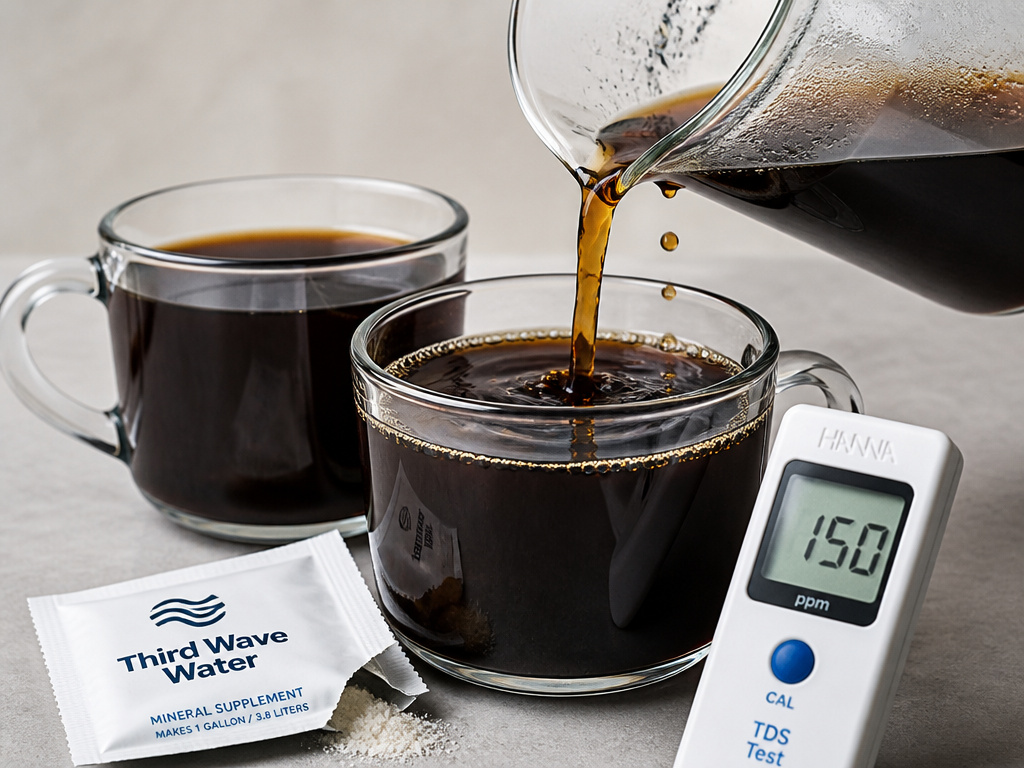
Your water is 98% of your cup. The SCA’s “Water Quality for Brewing Coffee” paper gives exact targets: total hardness between 17 and 85 mg/L (as CaCO3), alkalinity at 40 mg/L, and a pH of 6.5 to 7.5. Municipal water is often harder and more alkaline, which mutes acidity and highlights bitter, chalky notes.
If your black coffee consistently tastes flat or dull, your water is the first variable to check. A simple test: brew a cup with distilled water mixed with a third-wave mineral packet (like Third Wave Water) or even a bottled spring water known for low mineral content. The difference isn’t subtle, flavors you thought were inherent to the bean suddenly become clear.
| Water Problem | Taste Effect in Black Coffee | Fix |
|---|---|---|
| Too hard (>150 mg/L) | Muted acidity, heavy body, chalky aftertaste | Use a filter pitcher (Brita, ZeroWater) or diluted distilled water. |
| Too soft (<50 mg/L) | Sharp, sour, tea-like, lacking sweetness | Add a mineral supplement like Third Wave Water’s “Classic Profile”. |
| High chlorine/chloramine | Chemical, plastic-like off-flavors | Use a carbon filter or let water sit uncovered for 30 minutes before heating. |
Common mistake: Using straight distilled or reverse osmosis water, the complete lack of minerals makes extraction sluggish and the cup tastes hollow, like flavored hot water. Always remineralize.
The Grind Size That Actually Works
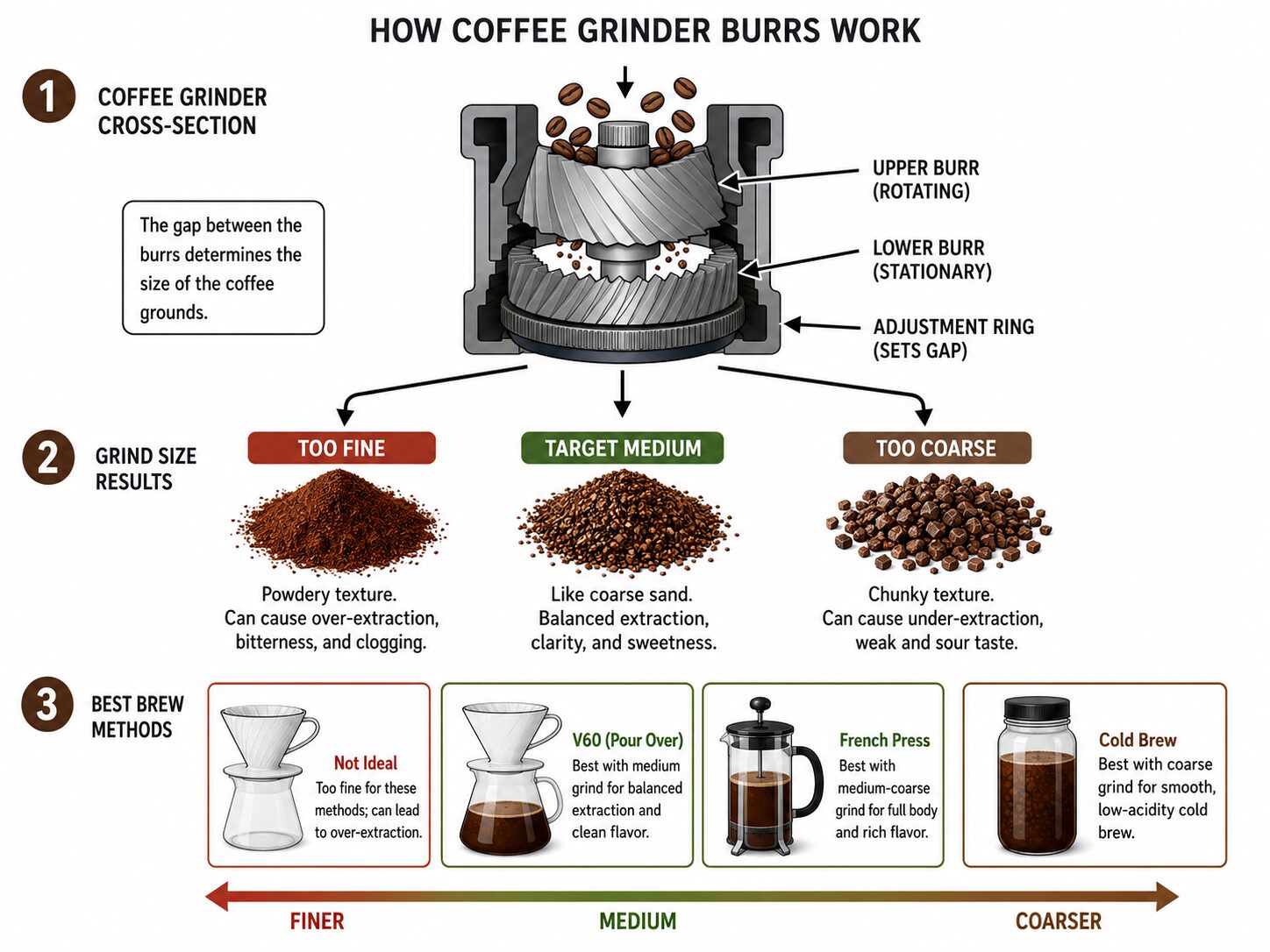
Grind size is your primary control for extraction time. Too fine, and water moves too slowly, over-extracting bitter compounds. Too coarse, and water rushes through, leaving sour, under-extracted coffee. For most drip coffee methods, a medium grind resembling coarse sand is the target. In a burr coffee grinder, this usually corresponds to a setting between 20 and 30 on a Baratza Encore, which produces a 3–4 minute brew time in a V60 or Chemex.
The French press is where manufacturer advice diverges from pro practice. Many press instructions say “coarse grind.” A truly coarse grind, however, often leads to a weak, under-extracted cup unless you steep for 6+ minutes, which then over-extracts the fines. The pro workaround is a medium-coarse grind and a shorter steep, 4 minutes, followed by a careful press and immediate decanting to stop extraction.
| Brew Method | Target Grind Size | Target Brew Time | What Happens If You’re Off |
|---|---|---|---|
| Drip / Auto-Drip | Medium | 5–6 min (total cycle) | Fine grind clogs the filter, over-extracts; coarse grind yields weak, sour coffee. |
| Pour-Over (V60, Kalita) | Medium | 3:00–3:30 | Fine grind stalls drawdown, tastes bitter; coarse grind finishes too fast, tastes sour. |
| French Press | Medium-Coarse | 4:00 (steep) + 0:30 (press) | Too coarse = weak, watery; too fine = silt in the cup, bitter finish. |
| Cold Brew | Coarse | 12–24 hours (steep) | Too fine = over-extracted, harsh concentrate; too coarse = weak, unbalanced flavor. |
The Pour-Over Puzzle
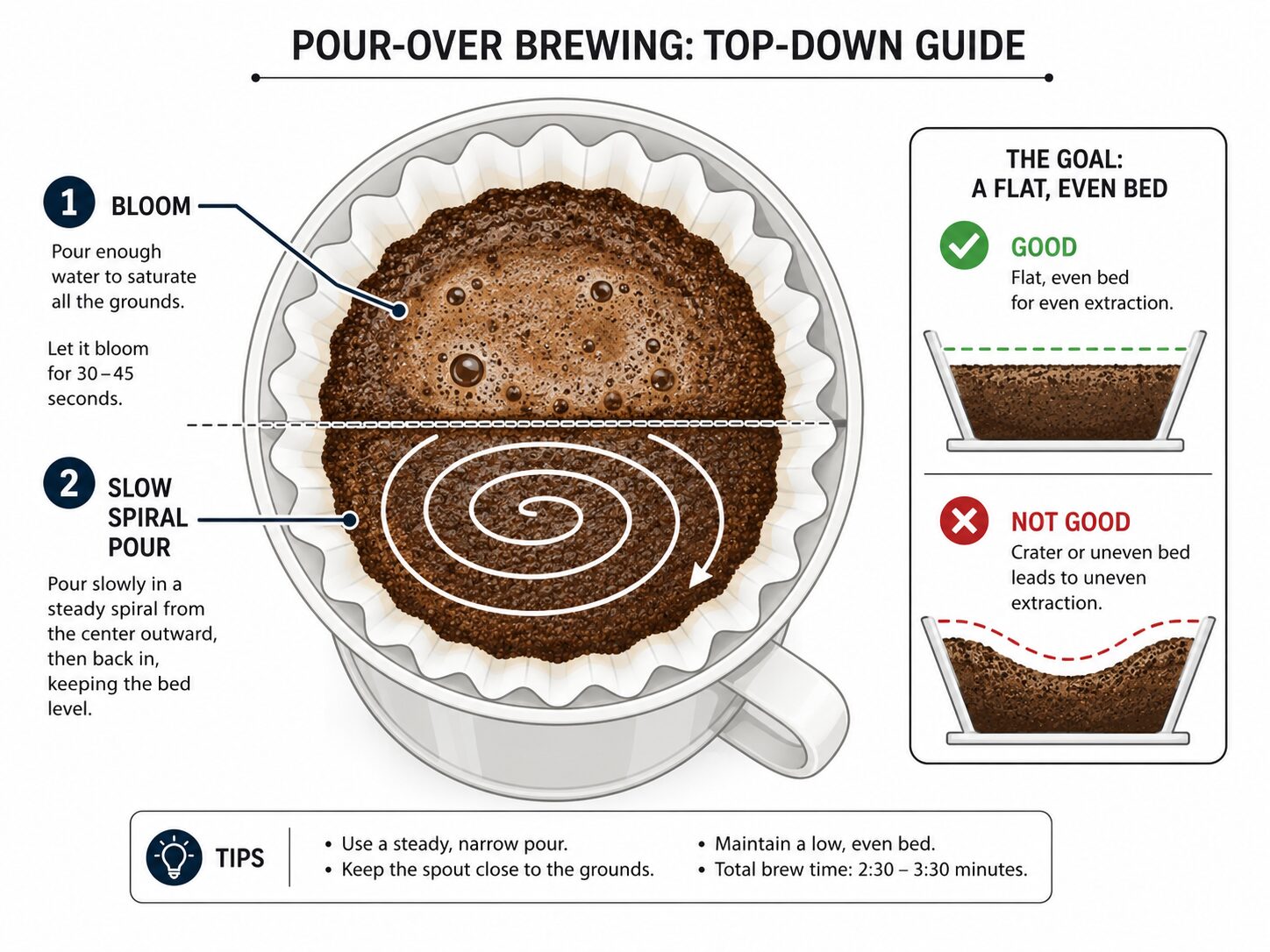
Pour-over methods like the Hario V60 or the Chemex Classic Series offer the most control but also the most variables. The key is even saturation. Start by wetting all the grounds evenly during a 30-second “bloom” with water just off the boil. This lets carbon dioxide escape, if you skip the bloom, the gas pushes water away from the grounds, creating dry pockets and uneven extraction.
James Hoffmann’s method for the Clever Dripper, a hybrid immersion-pour-over device, simplifies this. He adds all the water at once, stirs, waits three minutes, then places the dripper on the mug to drain. This method is forgiving because immersion ensures full saturation, while the filter provides a clean cup. It’s a fantastic entry point if you’re new to manual brewing.
TL;DR: Bloom your grounds for 30 seconds with twice their weight in water. Then pour in a slow, controlled spiral to keep the coffee bed level. Your goal is a flat bed of spent grounds, not a crater.
When the French Press Lie Costs You Flavor
The standard French press instructions, coarse grind, 4-minute steep, press, serve, produce a muddy cup. The problem is the silt. Even with a coarse grind, a significant amount of fine particles slip through the mesh filter and continue extracting in your cup, turning bitter within minutes.
I followed the coarse-grind advice for years. My afternoon cup from the same press always tasted like bitter ash. Switching to a medium-coarse grind and decanting the coffee into a separate carafe immediately after pressing gave me a clean, bright cup that held its flavor for an hour.
The fix is twofold. First, grind medium-coarse, not boulder-coarse. Second, press gently until you feel resistance, then stop. Do not force the sludge at the bottom through the filter. Pour the coffee into a separate mug or server right away. Leaving it in the press lets the settled fines over-extract, and your last sip will be punishment.
The Machine That Gets It Right (and Why)
Not everyone wants a manual ritual. For automatic drip coffee, the machine matters. An SCA-certified brewer like the Bonavita Connoisseur 8-Cup (BV1901TS) guarantees water heats to 200°–205°F and saturates the grounds evenly with a showerhead design. Most cheap drip machines barely hit 185°F, which underextracts acids and leaves sweetness behind.
If you use an auto-drip, always preheat the machine by running a cycle of plain water first. A cold brew basket steals heat from the initial pour, dropping the temperature below the extraction sweet spot. And never let coffee sit on the hot plate for more than 20 minutes. The continuous heat scorches the oils and produces that familiar burnt-diner flavor.
Common mistake: Using the machine’s “strong” or “bold” setting instead of adjusting the ratio yourself. These settings often just slow the drip rate, which can over-extract without improving strength. Increase your coffee dose by weight for more intensity.
Cold Brew as Black Coffee
Cold brew concentrate diluted with water is a legitimate, if unconventional, black coffee. The standard dilution is 1:2 or 1:3 (concentrate to water). Steep coarse-ground coffee in cold water for 12–24 hours, then filter. The result is smooth, low-acid, and intensely flavored.
For a true black coffee experience from cold brew, I prefer a 1:1 ratio with hot water. It preserves the body without watering it down to iced-tea levels. The key is using a good paper coffee filter for the final filtration, not just the metal mesh. Paper catches the ultra-fine silt that otherwise makes the concentrate taste gritty.
High-Altitude Adjustment (The Variable Nobody Mentions)
Water boils at a lower temperature as elevation increases, about 203°F at 5,000 feet. If you’re following a recipe that calls for 200°F water, you’re actually brewing at 203°F, which is close enough. But at 7,500 feet, water boils near 198°F, which is below the ideal extraction range.
The workaround is to grind finer. A finer grind increases surface area, compensating for the lower temperature by extracting more efficiently. If your high-altitude coffee tastes sour no matter what beans you use, try dropping your grind setting two clicks finer on your burr coffee grinder. It usually fixes the issue within one adjustment.
Frequently Asked Questions
What’s the best coffee-to-water ratio for black coffee?
Start with a 1:16 ratio by weight. That’s 18.75 grams of coffee for every 300 grams (about 10 ounces) of water. This is the center of the Specialty Coffee Association’s recommended range and works for most brewed coffee methods.
Can I make black coffee without a scale?
You can, but you’ll waste beans dialing it in. A tablespoon of coffee can vary from 5 to 7 grams depending on the roast. If you must use volume, start with 2 level tablespoons per 6 ounces of water and expect inconsistency.
Why does my black coffee taste bitter?
Bitterness comes from over-extraction. Your water is too hot, your grind is too fine, or your brew time is too long. Check your grinder setting first. If you’re using a blade grinder, upgrade to a burr grinder for consistent particle size.
Why does my black coffee taste sour?
Sourness is under-extraction. Your water isn’t hot enough, your grind is too coarse, or your brew time is too short. Make sure your water is at a full boil (212°F at sea level) when it hits the grounds, and tighten your grind size.
Is black coffee healthier than coffee with milk?
Black coffee has zero calories and contains antioxidants like chlorogenic acid. Adding milk or sugar introduces calories and can mask some of the subtle flavors, but the health difference is primarily about calorie intake, not the coffee itself.
How do I reduce bitterness without adding anything?
Two proven methods: use better water (softer, with lower alkalinity) or add a tiny pinch of salt to your grounds before brewing. The salt ions block some bitter receptors on your tongue. Start with a few grains, too much and you’ll taste salt.
Before You Go
Ignore the tablespoon. Buy a scale. Your coffee consumption will drop by half because you’ll stop wasting beans on weak cups you have to rebrew.
Water is not a neutral ingredient. Test yours. If it smells like chlorine or leaves scale in your kettle, it’s wrecking your coffee. A filter pitcher is the cheapest upgrade you can make.
The French press doesn’t have to be muddy. Grind medium-coarse, steep for four minutes, press gently, and decant immediately. The last sip will taste as good as the first.
Finally, write down what you do. Note the grams, the grind setting, the time, and the taste. One variable at a time. That notebook, more than any machine, is what turns a routine into a ritual.
{
“@context”: “https://schema.org”,
“@type”: “HowTo”,
“name”: “How to Make Black Coffee”,
“totalTime”: “PT8M”,
“tool”: [
{
“@type”: “HowToTool”,
“name”: “Burr coffee grinder”
},
{
“@type”: “HowToTool”,
“name”: “Digital kitchen scale”
},
{
“@type”: “HowToTool”,
“name”: “Gooseneck kettle (for pour-over)”
},
{
“@type”: “HowToTool”,
“name”: “SCA-certified brewer or pour-over device”
}
],
“supply”: [
{
“@type”: “HowToSupply”,
“name”: “Fresh, whole coffee beans”
},
{
“@type”: “HowToSupply”,
“name”: “Filtered water”
}
],
“step”: [
{
“@type”: “HowToStep”,
“name”: “Weigh your coffee and water”,
“text”: “Use a 1:16 coffee-to-water ratio by weight. For one cup, start with 18g of coffee to 288g (about 10 oz) of water.”
},
{
“@type”: “HowToStep”,
“name”: “Grind fresh beans”,
“text”: “Grind beans immediately before brewing. Use a medium grind for drip or pour-over, medium-coarse for French press.”
},
{
“@type”: “HowToStep”,
“name”: “Heat and pour water”,
“text”: “Heat filtered water to 200°F (93°C). Pour slowly in a spiral motion to saturate all grounds evenly, starting with a 30-second bloom.”
},
{
“@type”: “HowToStep”,
“name”: “Control brew time”,
“text”: “Aim for a total brew time of 3-4 minutes for pour-over, 4 minutes for French press. Adjust grind size to hit this target.”
},
{
“@type”: “HowToStep”,
“name”: “Serve immediately”,
“text”: “Decant coffee into a pre-warmed mug immediately after brewing to stop extraction and preserve flavor.”
}
]
}
{
“@context”: “https://schema.org”,
“@type”: “FAQPage”,
“mainEntity”: [
{
“@type”: “Question”,
“name”: “What’s the best coffee-to-water ratio for black coffee?”,
“acceptedAnswer”: {
“@type”: “Answer”,
“text”: “Start with a 1:16 ratio by weight. That’s 18.75 grams of coffee for every 300 grams (about 10 ounces) of water. This is the center of the Specialty Coffee Association’s recommended range and works for most brewed coffee methods.”
}
},
{
“@type”: “Question”,
“name”: “Can I make black coffee without a scale?”,
“acceptedAnswer”: {
“@type”: “Answer”,
“text”: “You can, but you’ll waste beans dialing it in. A tablespoon of coffee can vary from 5 to 7 grams depending on the roast. If you must use volume, start with 2 level tablespoons per 6 ounces of water and expect inconsistency.”
}
},
{
“@type”: “Question”,
“name”: “Why does my black coffee taste bitter?”,
“acceptedAnswer”: {
“@type”: “Answer”,
“text”: “Bitterness comes from over-extraction. Your water is too hot, your grind is too fine, or your brew time is too long. Check your grinder setting first. If you’re using a blade grinder, upgrade to a burr grinder for consistent particle size.”
}
},
{
“@type”: “Question”,
“name”: “Why does my black coffee taste sour?”,
“acceptedAnswer”: {
“@type”: “Answer”,
“text”: “Sourness is under-extraction. Your water isn’t hot enough, your grind is too coarse, or your brew time is too short. Make sure your water is at a full boil (212°F at sea level) when it hits the grounds, and tighten your grind size.”
}
},
{
“@type”: “Question”,
“name”: “Is black coffee healthier than coffee with milk?”,
“acceptedAnswer”: {
“@type”: “Answer”,
“text”: “Black coffee has zero calories and contains antioxidants like chlorogenic acid. Adding milk or sugar introduces calories and can mask some of the subtle flavors, but the health difference is primarily about calorie intake, not the coffee itself.”
}
},
{
“@type”: “Question”,
“name”: “How do I reduce bitterness without adding anything?”,
“acceptedAnswer”: {
“@type”: “Answer”,
“text”: “Two proven methods: use better water (softer, with lower alkalinity) or add a tiny pinch of salt to your grounds before brewing. The salt ions block some bitter receptors on your tongue. Start with a few grains, too much and you’ll taste salt.”
}
}
]
}
