
How to Keep Coffee Beans Fresh for Maximum Flavor & Aroma
To keep coffee beans fresh, get them into an airtight, opaque container stored in a cool, dark place immediately after opening. Whole beans stay good for six to eight weeks this way. Ground coffee lasts about two weeks. The one-way valve on a coffee bag only works until you break the seal; after that, it’s an oxygen highway into your beans.
Most people think that fancy bag with the little valve is doing the hard work. It’s not. That valve is a one-trick pony designed for the journey from roaster to your door. Once you open the bag, its job is over. From that moment, oxygen floods in and starts turning your bright, fruity notes into cardboard.
This guide walks through why that happens, which containers actually work, and the real timeline for flavor loss. We’ll cover the science of staling, bust the freezer myth, and explain why your burr grinder’s static is the silent killer of your last week’s worth of beans.
Key Takeaways
- The one-way valve on a coffee bag only vents CO2 out. It does nothing to stop oxygen from getting in after you open it.
- Whole bean coffee stays fresh for 6–8 weeks in a proper container. Pre-ground coffee lasts about 2 weeks before turning flat.
- Clear glass or ceramic canisters fail because light catalyzes oxidation, even in a dark cupboard when you open the door.
- Freezing whole beans works only if you portion and seal them in truly airtight bags before freezing, and never refreeze.
- Burr grinder static cling coats your grinder with yesterday’s coffee oils, which go rancid and taint tomorrow’s grind.
The Four Enemies of Fresh Coffee
Oxygen is the primary villain. The Specialty Coffee Association calls it the “primary enemy of coffee freshness.” Once oxygen meets the roasted bean’s porous surface, a chemical reaction called oxidation begins. This strips away volatile aromatic compounds, the very molecules that give coffee its distinct flavor notes of citrus, chocolate, or berry.
Heat speeds everything up. Storing beans near a stove or in a sunlit cabinet acts like a catalyst, accelerating oxidation and driving off those delicate aromatics faster. Light, particularly UV, provides the energy for photo-oxidation, a separate degradation path that dulls flavor.
Moisture is the stealth agent. It doesn’t just promote mold; it hydrates the bean structure, making it more susceptible to oxidation and staleness. Humidity above 60% RH in your kitchen can cut a bean’s shelf life in half.
Common mistake: Leaving beans in the original bag after opening, oxygen floods in through the broken seal, and the valve becomes irrelevant. You’ll lose the top-end fruity notes within 72 hours.
TL;DR: Oxygen, heat, light, and moisture work together to destroy flavor. Airtight, opaque, and cool storage fights all four.
Why Your Coffee Bag’s Valve is a One-Way Street
That little plastic patch with the tiny hole on your coffee bag is a one-way degassing valve. Its sole purpose is to let carbon dioxide (CO2) escape from freshly roasted beans during shipping and storage. If it didn’t, the bag would inflate and potentially burst.
It does not work in reverse. It cannot stop oxygen from entering once you’ve opened the bag. Every time you open that bag to scoop beans, you’re letting in a fresh wave of oxygen. Resealing it with a clip or rolling the top down does not recreate a factory seal. The valve remains a passive exit, not a barrier.
The valve is a shipping safety feature, not a long-term freshness solution. Once you break the factory seal, its utility ends.
This is the core reason the National Coffee Association USA and the Specialty Coffee Association both recommend moving beans to an airtight container immediately. The original bag, no matter how fancy, becomes the worst place for your beans after day one.
Choosing the Right Container (Not All Are Equal)
Your container needs to block light, seal airtight, and live in a cool place. The material and mechanism matter.
| Container Type | Best For | The Catch |
|---|---|---|
| Vacuum Canister | Maximum shelf life | Daily pumping is a chore; seals can fail over time. |
| Press-Seal Canister | Daily use convenience | Less perfect seal than vacuum; still far better than the original bag. |
| Glass / Ceramic Jar | Visibility, aesthetics | Light damage unless kept in total darkness; most lack a true airtight seal. |
| Original Coffee Bag | The first 24 hours | Useless for freshness after opening; the valve does not reseal. |
Vacuum canisters like the Fellow Atmos or similar pump-top models physically remove most of the air from the headspace. They are excellent but impractical if you open your coffee three times a day. Press-seal containers like the OXO POP or Airscape use a plunger lid to force air out and create a good seal. They strike the best balance for most home brewers.
Clear glass or ceramic jars are aesthetic traps. Even in a dark cupboard, the light exposure during your daily scooping adds up. A 2023 study in Scientific Reports detailed how light exposure directly degrades key quality parameters in stored coffee. An opaque container is non-negotiable.
TL;DR: Pick an opaque, airtight press-seal canister for daily use. Reserve a vacuum canister for beans you won’t touch for a month.
The Whole Bean vs. Ground Coffee Clock
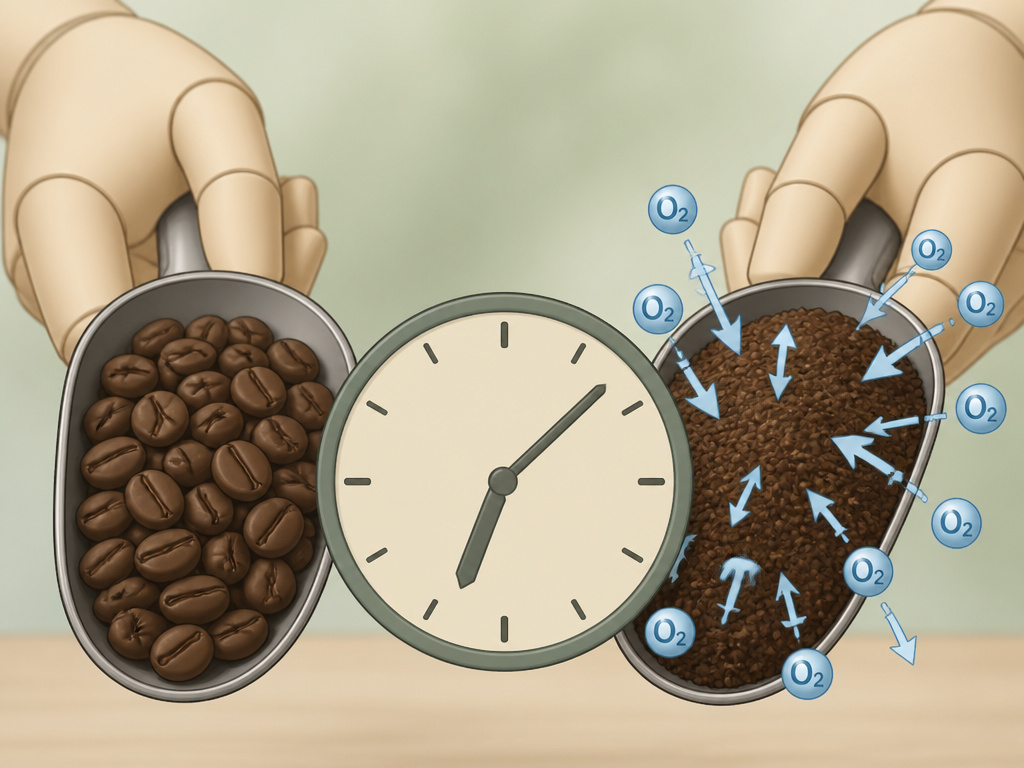
The surface area exposed to oxygen is the deciding factor. Whole beans have a relatively small exterior. The moment you grind coffee, you multiply its surface area by hundreds, exposing countless tiny cells to oxygen.
This is why timelines diverge so dramatically. The Specialty Coffee Association notes that while whole beans begin losing freshness immediately after roasting, the rate of degradation increases significantly once ground. Whole beans stored correctly can maintain good flavor for six to eight weeks. The same beans, once ground, have about two weeks before they taste flat and one-dimensional.
That two-week clock starts the second you grind, not when you open the bag. Grinding a week’s worth of coffee on Sunday to save time on weekday mornings is a trade. You are exchanging convenience for a noticeable drop in cup quality by Friday. The difference is most apparent in lighter roasts, where delicate acidity and floral notes fade first.
Grinding is the point of no return for freshness. Pre-ground coffee is a convenience product, not a quality one.
This is also why your choice of grinder matters immensely. A blade grinder pulverizes beans unevenly, creating a wide range of particle sizes. This inconsistent surface area means some particles stale faster than others, creating a muddled, off-flavor cup. A quality burr coffee grinder produces uniform particles that extract evenly and stale at a more predictable rate.
The Freezing Debate: When It Works and When It Ruins
The National Coffee Association states you may freeze coffee if you plan to keep it for more than two weeks, with the critical caveat: do not return it to the freezer after removal. This is the official, cautious green light.
Freezing whole beans can work for long-term storage, but only under strict conditions. You must portion the beans into amounts you will use all at once, like a single week’s supply, seal them in a truly airtight, moisture-proof bag (think heavy-duty freezer bags with all air pressed out), and freeze them immediately. When you remove a portion, thaw it sealed at room temperature, use it entirely, and never refreeze it.
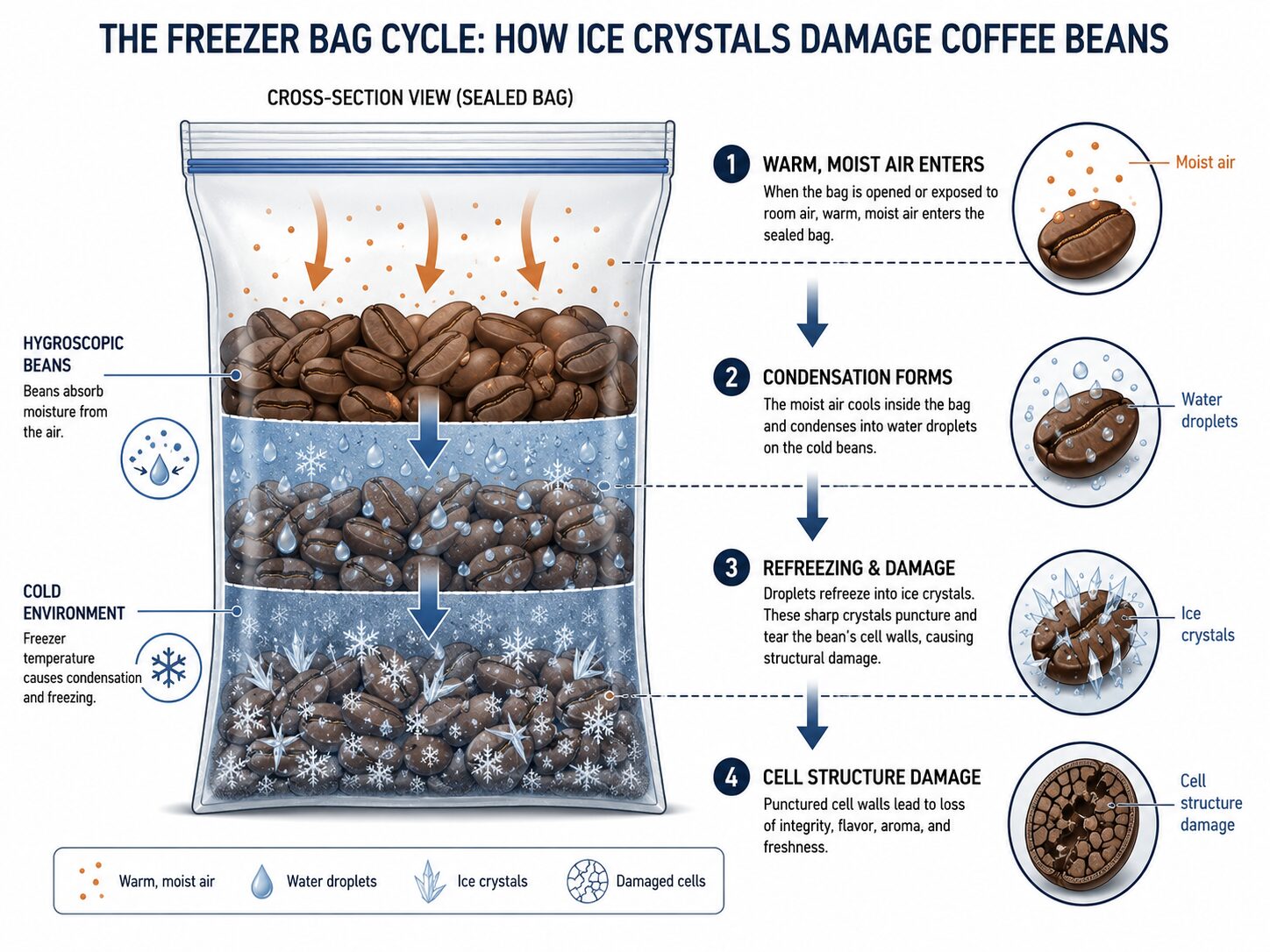
The failure mode is moisture. Beans are hygroscopic. If you freeze a whole bag, take it out to scoop some beans, and refreeze it, you introduce warm, moist air into the container. That moisture condenses on the cold beans inside the bag, then refreezes as ice crystals. Those crystals puncture the bean’s cellular structure, leading to a dull, papery flavor. This is also why you should never freeze ground coffee, the increased surface area accelerates moisture absorption.
Common mistake: Freezing the entire bag and taking it out daily, each temperature cycle pulls in humidity, and the refrozen condensation destroys cell structure. The bag will taste like wet cardboard after three cycles.
For most people drinking coffee within a month or two, freezing adds complexity without much reward. A proper airtight container in a cool pantry is simpler and fails less catastrophically.
The Static Problem Nobody Talks About
If you use a burr grinder, you’ve seen the static. Ground coffee clings to the grinder’s plastic catch cup, the chute, and the lid. That isn’t just messy, it’s a freshness time bomb.
Those clinging grounds are coated in coffee oils. They are exposed to air inside your grinder. By tomorrow, those oils have started to oxidize and turn rancid. When you grind your fresh beans the next morning, they mix with yesterday’s stale, oily residue. The result is a cup that always has a faint, bitter background note, no matter how fresh your beans are.
The fix is simple. After each grinding session, brush out the grinder’s catch cup and chute with a dedicated brush. Some people use a single drop of water on the beans before grinding, the “Ross Droplet Technique”, to neutralize static. It works, but it adds a variable. Brushing takes ten seconds and guarantees a clean slate.
This is a small, daily habit that has a bigger impact on your cup than any container if you neglect it. Your shiny burr coffee grinder can be its own worst enemy.
A Week-By-Week Storage Plan
Your approach should change based on how quickly you drink your coffee.
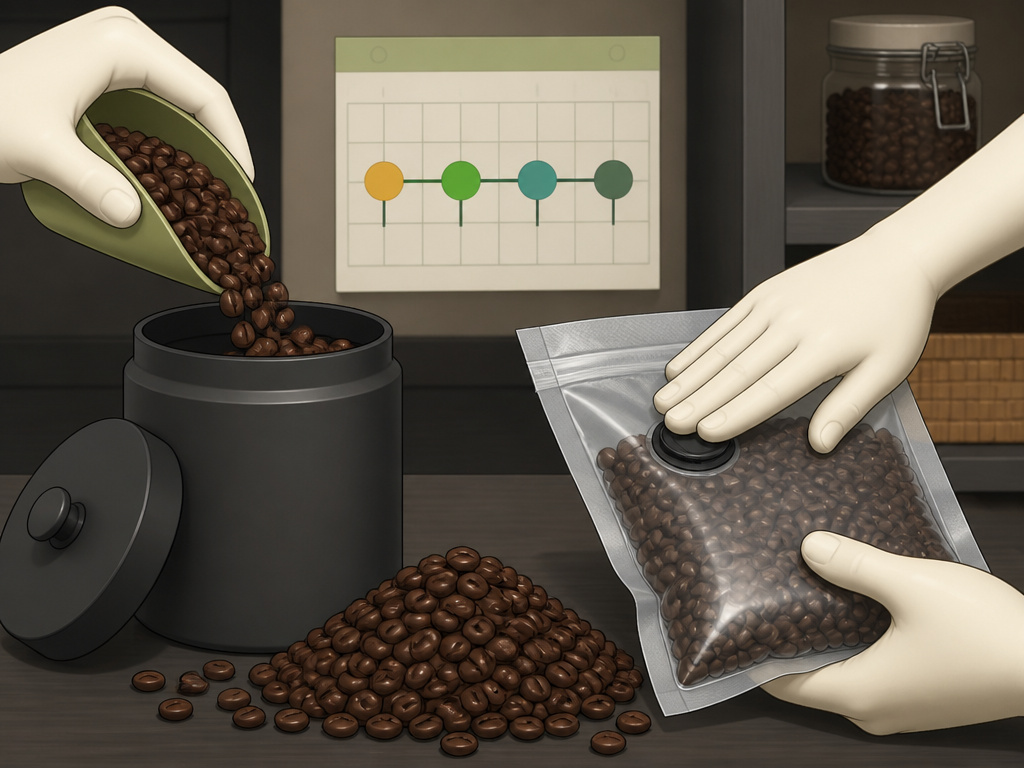
If you finish a bag in 1–2 weeks: Keep it simple. Transfer the whole beans to an opaque, airtight canister like an OXO POP. Store it in a cool, dark pantry. Grind only what you need for each brew. This method preserves about 95% of the roaster’s intended flavor.
If you take 3–6 weeks to finish a bag: Divide and conquer. When you open the bag, immediately split the beans into two containers. Fill your daily-use canister with a 1–2 week supply. Portion the remainder into a vacuum-sealed bag, press out all the air, and store it in the back of a dark pantry. Refill your daily canister from the sealed bag as needed. This limits the oxygen exposure for the majority of your stash.
If you buy in bulk or won’t use beans for over 2 months: Freezing is your only viable option. Portion the beans into weekly amounts in heavy-duty, airtight freezer bags. Squeeze out every bit of air, seal, label, and freeze. When you need a portion, move the unopened bag to the fridge for 24 hours to thaw slowly, then to the pantry for a few hours before opening. Use that entire portion within two weeks; do not refreeze any leftovers.
Frequently Asked Questions
Does the roast level affect how I should store beans?
Yes, but the storage rules are the same. Darker roasts have more surface oils and degrade slightly faster due to increased oxidation. Lighter roasts, like many single-origin coffee beans, have more delicate aromatic compounds that are the first to vanish when exposed to oxygen. The mechanism is identical, so the airtight, opaque, cool container is non-negotiable for both.
Can I use the refrigerator instead of the freezer?
Do not use the refrigerator. The temperature fluctuations every time you open the door introduce condensation and moisture. Coffee acts like a sponge for odors, so your beans will also pick up flavors from other foods. The back of a cool, dark pantry is always superior to the fridge for short-term storage.
How can I tell if my beans have gone stale?
The smell is the first clue. Fresh beans have a pronounced, pleasant aroma, nutty, chocolaty, fruity. Stale beans smell flat, dusty, or like cardboard. In the cup, stale coffee lacks brightness and complexity. Acidity disappears, bitterness dominates, and the finish is short. If your morning cup tastes monotonous and dull, your beans are likely past their prime.
Do those coffee canisters with the CO2 valve on top actually work?
They are a solution to a problem that doesn’t exist in home storage. Those valves are designed for commercial settings where large volumes of beans off-gas significant CO2. At home, the tiny amount of CO2 your beans release after the first few days is harmless and actually helps displace oxygen in a sealed container. A standard airtight seal is more effective and less prone to failure than a valve system.
Is it worth buying specialty storage containers for pre-ground coffee?
No. The damage is done the moment you grind. Putting pre-ground coffee in a perfect container might slow staling by a day or two, but you cannot regain the lost surface area. If you must use pre-ground, buy it in small quantities and plan to use it within two weeks of opening. A coffee machine filter change or a different paper coffee filter will have a bigger impact on your cup quality than any storage trick for ground coffee.
Before You Go
Fresh coffee is about controlling oxygen from the moment you break the seal. That fancy bag did its job getting the beans to you. Its work is done. Your job starts with an opaque, airtight container and a cool, dark shelf.
Grind only what you need for the next pot. Brush out your grinder after every use. And remember that the best storage container in the world cannot resurrect beans that were ground two weeks ago. The clock starts ticking the second those beans are roasted, and it speeds up dramatically the moment you open the bag or hit the grind button. Your daily ritual deserves the first week of a bag’s life, not the last.
{
“@context”: “https://schema.org”,
“@type”: “HowTo”,
“name”: “How to Keep Coffee Beans Fresh”,
“totalTime”: “PT5M”,
“tool”: [
{
“@type”: “HowToTool”,
“name”: “Airtight, opaque storage container”
},
{
“@type”: “HowToTool”,
“name”: “Coffee beans (whole, not ground)”
}
],
“step”: [
{
“@type”: “HowToStep”,
“name”: “Transfer beans immediately”,
“text”: “Move your whole coffee beans from their original bag into an airtight, opaque container as soon as you open them.”
},
{
“@type”: “HowToStep”,
“name”: “Choose a cool, dark spot”,
“text”: “Store the sealed container in a pantry or cupboard away from heat sources like stoves, ovens, or direct sunlight.”
},
{
“@type”: “HowToStep”,
“name”: “Grind only what you need”,
“text”: “Measure and grind only the amount of coffee you will brew immediately. Never store pre-ground coffee for later use.”
},
{
“@type”: “HowToStep”,
“name”: “Freeze for long-term storage only”,
“text”: “If storing beans longer than six weeks, portion them into truly airtight bags, remove all air, and freeze once. Do not refreeze after thawing.”
}
]
}
{
“@context”: “https://schema.org”,
“@type”: “FAQPage”,
“mainEntity”: [
{
“@type”: “Question”,
“name”: “Does the roast level affect how I should store beans?”,
“acceptedAnswer”: {
“@type”: “Answer”,
“text”: “Yes, but the storage rules are the same. Darker roasts have more surface oils and degrade slightly faster due to increased oxidation. Lighter roasts, like many single-origin coffee beans, have more delicate aromatic compounds that are the first to vanish when exposed to oxygen. The mechanism is identical, so the airtight, opaque, cool container is non-negotiable for both.”
}
},
{
“@type”: “Question”,
“name”: “Can I use the refrigerator instead of the freezer?”,
“acceptedAnswer”: {
“@type”: “Answer”,
“text”: “Do not use the refrigerator. The temperature fluctuations every time you open the door introduce condensation and moisture. Coffee acts like a sponge for odors, so your beans will also pick up flavors from other foods. The back of a cool, dark pantry is always superior to the fridge for short-term storage.”
}
},
{
“@type”: “Question”,
“name”: “How can I tell if my beans have gone stale?”,
“acceptedAnswer”: {
“@type”: “Answer”,
“text”: “The smell is the first clue. Fresh beans have a pronounced, pleasant aroma, nutty, chocolaty, fruity. Stale beans smell flat, dusty, or like cardboard. In the cup, stale coffee lacks brightness and complexity. Acidity disappears, bitterness dominates, and the finish is short. If your morning cup tastes monotonous and dull, your beans are likely past their prime.”
}
},
{
“@type”: “Question”,
“name”: “Do those coffee canisters with the CO2 valve on top actually work?”,
“acceptedAnswer”: {
“@type”: “Answer”,
“text”: “They are a solution to a problem that doesn’t exist in home storage. Those valves are designed for commercial settings where large volumes of beans off-gas significant CO2. At home, the tiny amount of CO2 your beans release after the first few days is harmless and actually helps displace oxygen in a sealed container. A standard airtight seal is more effective and less prone to failure than a valve system.”
}
},
{
“@type”: “Question”,
“name”: “Is it worth buying specialty storage containers for pre-ground coffee?”,
“acceptedAnswer”: {
“@type”: “Answer”,
“text”: “No. The damage is done the moment you grind. Putting pre-ground coffee in a perfect container might slow staling by a day or two, but you cannot regain the lost surface area. If you must use pre-ground, buy it in small quantities and plan to use it within two weeks of opening. A coffee machine filter change or a different paper coffee filter will have a bigger impact on your cup quality than any storage trick for ground coffee.”
}
}
]
}
