
How Long Should Coffee Steep in a French Press? Full Guide
Steep coffee in a French press for 8 minutes using a 1:15 coffee-to-water ratio, a coarse grind, and water at 200°F (93°C). Break the crust and stir at the 4-minute mark, then let the grounds settle before plunging at 8 minutes.
The universal advice is four minutes. That’s what the little booklet in the box says. It’s also what produces the thin, bitter cup that convinces people a French press is a dusty relic. The mistake is treating time as a constant when it’s the final variable in a chain. Get the first three things right, and the clock tells a different story.
This guide breaks down why the standard timer fails, walks through the method that fixed it for good, and shows you how to adjust when your beans, grind, or patience demand it.
Key Takeaways
- The 8-minute steep (4 minutes steep, stir, 4 minutes settle) produces a cleaner, fuller-bodied cup than the standard 4-minute plunge.
- Grind size dictates steep time. A true coarse grind needs the full time; a medium grind requires pulling back to 5-6 minutes total to avoid bitterness.
- Always use a 1:15 coffee-to-water ratio (e.g., 64g coffee to 1000g/1L water). Volume measurements like “scoops” introduce a 20% error.
- Water temperature should be 200°F (93°C), not boiling. Water at 212°F (100°C) scalds the grounds on contact, extracting harsh flavors early.
- Pour the coffee out of the press immediately after plunging. Leaving it in the slurry over-extracts and turns your second cup to mud.
Why Four Minutes Is Almost Always Wrong
Manufacturer instructions aim for simplicity. They assume a pre-ground, stale coffee of unknown coarseness and a user who wants coffee in five total minutes. That recipe guarantees a drinkable, if underwhelming, result. It does not guarantee good coffee.
Common mistake: Plunging at exactly four minutes with a fine or medium grind — the over-extracted bitterness masks all origin flavor, and the cup tastes generically harsh.
The four-minute rule ignores grind size. Pre-ground “French press” coffee from a supermarket is often closer to a medium grind. At that surface area, four minutes in near-boiling water is an over-extraction trap. You get every bitter compound the bean has to offer. A proper coarse grind, with particles the size of coarse sea salt, has less surface area. It needs more time for water to penetrate and pull out the sugars and oils. That’s where the extended steep comes in.
TL;DR: Four minutes is a safe default for unknown coffee. For good coffee, start with an 8-minute process that separates steeping from settling.
The 8-Minute French Press Method
This technique popularized by coffee expert James Hoffmann inverts the standard process. It uses time not just for extraction, but for clarification. The goal is a rich, clean cup without the silty sludge at the bottom.
You need a scale. You need a grinder. Eyeballing this fails.
- Weigh and grind. For a 1-liter press, use 64 grams of coffee beans. Grind to a coarse setting. On a Baratza Encore, that’s between 28 and 30. The grounds should look like coarse sea salt, not breadcrumbs. Skipping the scale and using scoops throws the ratio off by at least two grams per scoop — your coffee will be either weak or harsh.
- Heat the water. Heat 1000 grams (1 liter) of filtered water to 200°F (93°C). If you don’t have a temperature-controlled kettle, boil water and let it sit for 30 seconds. Pouring boiling water onto the grounds scorches them. You’ll smell a faint acrid note immediately.
- Add coffee and water. Place the grounds in the dry press. Pour all the water over them, ensuring all grounds are submerged. Start your timer.
- Steep for four minutes, then stir. Let it sit completely undisturbed. At the four-minute mark, take a spoon and break the crust of grounds and foam that has formed on top. Stir the entire slurry gently. This encourages the grounds to sink.
- Steep for another four minutes. Place the lid on the press but do not plunge. Let the coffee continue to steep while the grounds settle to the bottom. This settling phase is crucial. It lets the fine particles fall out of suspension, which they won’t do if you agitate them with the plunger.
- Press and pour. After the full eight minutes, slowly press the plunger all the way down. Pour all the coffee into your cup or a carafe immediately. Leaving it in the press with the grounds continues the extraction, turning the last half of the pot bitter.
I switched to this method after a month of gritty, bitter cups that made me consider retiring my Bodum Chambord. The first attempt with the extended steep was a revelation — the body was still thick and oily, but the flavor was clear and sweet, not murky. The grounds formed a tight, compact layer at the bottom. No silt in the cup.
TL;DR: Grind coarse, use 64g coffee to 1L water at 200°F, steep 4 minutes, stir, wait 4 more minutes for grounds to settle, then plunge and pour immediately.
Grind Size is Your Secret Timer
The steep time on your phone is a proxy. The real clock is the surface area of your coffee particles. Grind size controls extraction speed more than any other variable.
| Grind Size | Visual Reference | Recommended Steep Time | Risk If Too Fine |
|---|---|---|---|
| Coarse | Coarse sea salt | 7–9 minutes (full method) | Extreme bitterness in under 5 minutes; silt passes through the mesh. |
| Medium | Sand / table salt | 5–6 minutes total | Over-extraction and astringency; cup tastes dry and harsh. |
| Fine | Powdered sugar | 2–3 minutes (not recommended) | Clogs the filter; creates unbearable bitterness; impossible to press. |
A true coarse grind, like that from a quality burr coffee grinder, is non-negotiable for the 8-minute method. Blade grinders produce a mix of dust, chunks, and medium particles. The dust over-extracts in seconds, the chunks under-extract, and the medium bits get lost in the chaos. The result is a simultaneous bitter and sour cup. The best grind for French press is uniformly coarse.
If your grinder can’t achieve a consistent coarse grind, you must shorten the steep time. For a medium grind, aim for a total steep of 5-6 minutes. Skip the extended settling phase. Stir at 4 minutes and plunge at 5 or 6. The coffee will still be good, but you’re capping the bitterness before it dominates.
TL;DR: Your grind size sets the extraction speed. Coarse grind needs 8 minutes. Medium grind needs 5-6. Fine grind will ruin the press.
How Coffee Roast Changes the Equation
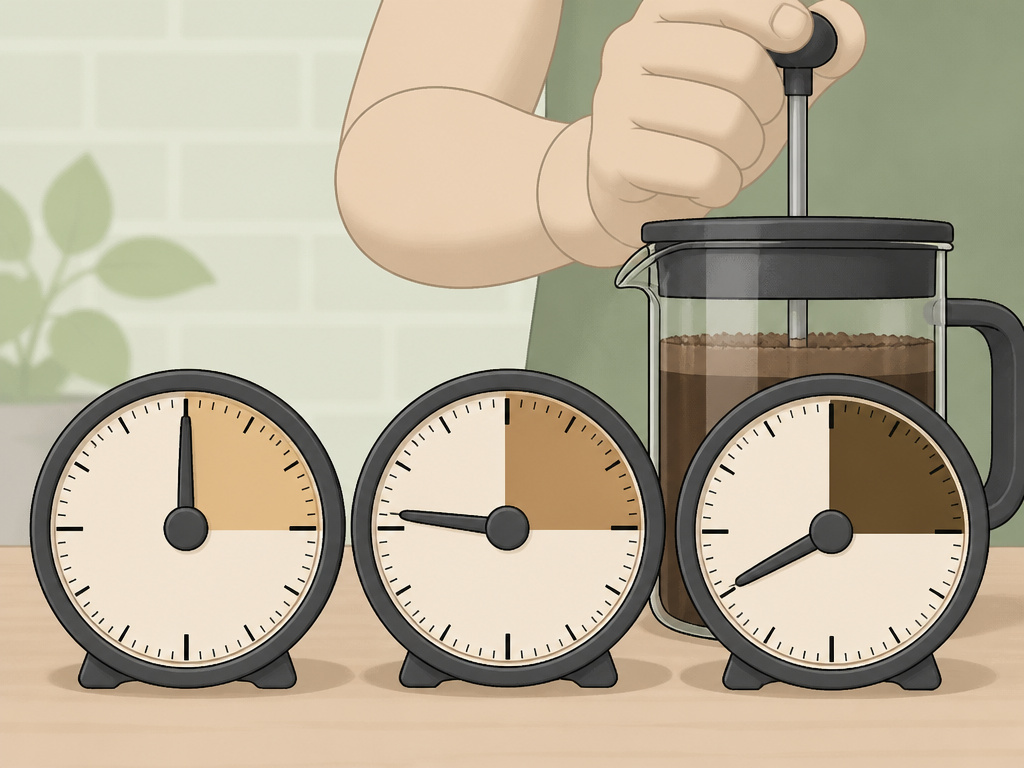
Bean density changes with roast level. A dark roast is more porous and brittle, extracting faster. A light roast is denser and harder, extracting slower. Your steep time needs a slight adjustment at the extremes.
- Light Roasts (e.g., blonde roast coffee): These dense beans benefit from the full 8-minute steep, even pushing to 9 minutes. The higher acidity and complex floral notes need time to fully develop. Use water at the higher end of the range, 205°F (96°C).
- Medium Roasts: This is the sweet spot. The 8-minute method works perfectly. Use 200°F (93°C) water.
- Dark Roasts: These beans release their oils and soluble solids quickly. Try shortening the total steep to 7 minutes. Consider using slightly cooler water, around 195°F (90°C), to avoid pulling out ashy, bitter notes.
This is also where single-origin coffees differ from blends. A single-origin Ethiopian might have brighter, tea-like notes that shine with a longer steep. A dark, smoky blend might taste better with a shorter contact time. Treat the 8 minutes as a baseline, not a prison.
The Cold Brew Exception

When you switch from hot to cold brew, you throw the standard steep time chart out the window. Cold water extracts compounds orders of magnitude slower than hot water.
For cold brew in a French press, use a coarse grind and a 1:8 coffee-to-water ratio (it’s stronger because you’ll dilute it). Steep for 12 to 24 hours in the refrigerator. The extended time is safe because heat isn’t accelerating extraction and oxidation. The result is smooth, low-acid coffee concentrate. Plunge and decant immediately after steeping.
Before you start: Never hot-steep coffee for more than 10 minutes. The combination of heat, water, and time begins extracting unpleasant, woody compounds that no amount of milk can hide. If you forget your press on the counter for an hour, dump it and start over.
Troubleshooting Your Steep Time
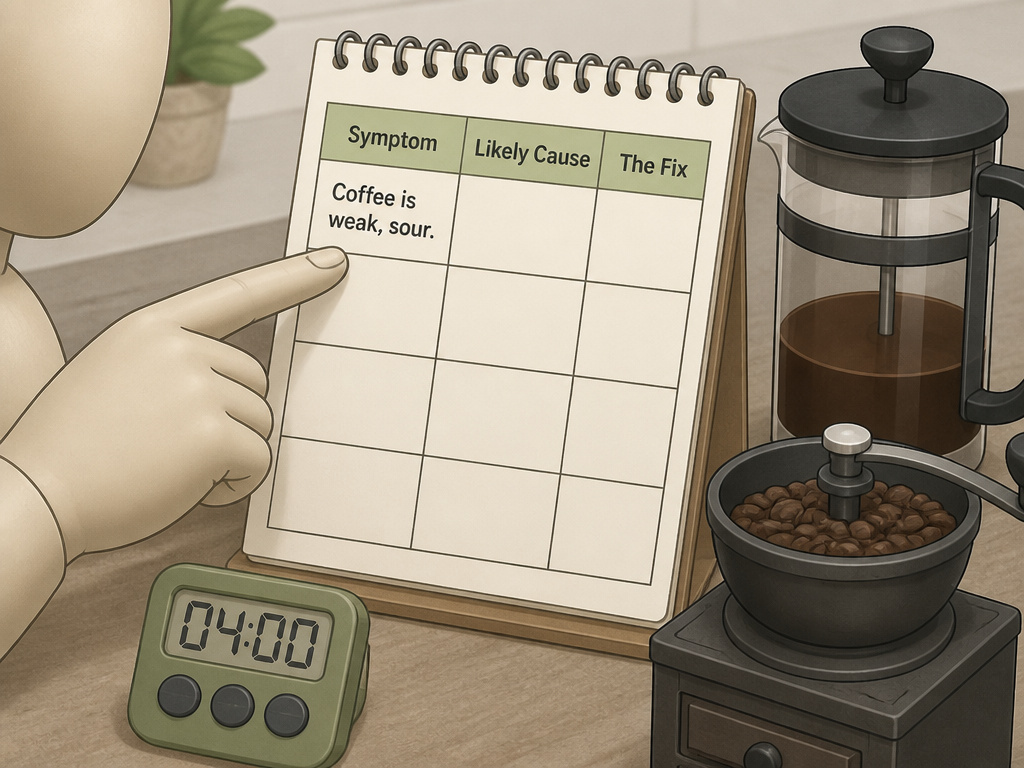
Your taste buds are the final judge. The timer is a guide. Use this chart to diagnose and fix common problems.
| Symptom | Likely Cause | The Fix |
|---|---|---|
| Coffee is weak, sour | Under-extraction; grind too coarse, time too short, water too cool. | Grind slightly finer, extend steep by 1 minute, ensure water is at 200°F+. |
| Coffee is bitter, harsh | Over-extraction; grind too fine, time too long, water too hot. | Grind coarser, shorten steep by 1-2 minutes, lower water temp to 195°F. |
| Excessive silt in cup | Grind is too fine or inconsistent; plunging too fast. | Use a better grinder, ensure full 4-minute settle period before plunging gently. |
| Flat, dull flavor | Stale coffee beans; water is too soft or filtered excessively. | Use beans roasted within the last 2 weeks; try mineral spring water. |
If you’ve dialed in the grind and time and still get bitterness, your water might be the culprit. Extremely soft or hard water can distort extraction. Try brewing with bottled spring water once as a test. The difference can be shocking.
Frequently Asked Questions
Can I reuse French press grounds for a second steep?
No. All the desirable soluble oils and sugars extract in the first steep. A second run with the same grounds produces a ghostly, bitter, and hollow cup that tastes like wet paper. It’s a waste of your time and water.
Why does my French press coffee taste bitter even after 4 minutes?
Your grind is almost certainly too fine. Pre-ground “French press” coffee is notoriously inconsistent. Invest in a burr grinder and set it to a true coarse setting. Also, check your water temperature — boiling water guarantees a bitter edge.
What’s the best coffee-to-water ratio for French press?
The industry standard ratio is 1:15. That means 1 gram of coffee for every 15 grams of water. For a standard 1-liter (34 oz) press, that’s about 67 grams of coffee. Most people use half that, which is why their coffee tastes weak. A digital scale is the only way to get this right consistently.
Does the French press brand affect steep time?
Not materially. The brewing mechanics are the same whether you use a Bodum, an IKEA, or a stainless-steel press. The quality of the filter mesh might affect silt, but it doesn’t change extraction time. Focus on your process, not the brand.
How does French press coffee compare to drip coffee in strength?
French press coffee has a heavier body and more oils because no paper coffee filters trap them. This makes it taste “stronger” or richer. In terms of caffeine levels, a typical 8-oz cup of French press has slightly more caffeine than drip, assuming the same coffee-to-water ratio, because the full immersion extracts slightly more efficiently.
Can I make French press coffee with a Ninja blender as a grinder?
You can, but you shouldn’t. A blender pulverizes beans into an inconsistent mix of dust and chunks. You will not achieve a uniform coarse grind. This forces you to shorten the steep time drastically to avoid bitterness from the fines, which then under-extracts the chunks. The result is a muddy, unbalanced cup. A dedicated grinder is the first upgrade you should make.
The Bottom Line
Stop watching the clock blindly. A perfect French press steep is a negotiation between grind size, water heat, and time. Commit to the full 8-minute method with a coarse grind just once. The clarity and sweetness it unlocks will retire the old 4-minute rule for good. When in doubt, let your taste guide you — sour means more time, bitter means less. And always, always pour it out after the plunge.
