
How Hot Is Coffee? ISO & SCA Standards Most Brewers Overlook
Coffee brewing temperature lands between 195°F and 205°F (90.6°C to 96.1°C) according to the ISO 6668:2008 international standard and the Specialty Coffee Association’s guidelines. This range extracts the optimal balance of flavors from the grounds. The coffee you actually drink should be closer to 150°F to 160°F (65°C to 71°C) for both safety and to allow your palate to taste it properly.
The universal mistake is treating “hot” as a single number. People brew at one temperature, serve at another, and drink at a third, often without knowing why each step has its own heat target. They blame bitter coffee on the beans when the water was five degrees too hot, or burn their tongue because the carafe held the brew at a scalding 190°F.
This guide breaks down the three distinct temperatures that answer “how hot is coffee”: the science-backed brewing standard, the real-world serving heat from your machine, and the safe drinking window where flavor actually lives. We’ll use the ISO document, manufacturer specs, and a famous lawsuit to show where the numbers come from and why getting them wrong costs you both quality and safety.
Key Takeaways
- Brew between 200°F and 205°F (93°C–96°C). Going over 205°F extracts harsh, bitter compounds almost immediately.
- Your brewer’s “keep warm” plate often holds coffee at 185°F–190°F, a direct burn hazard if sipped right away.
- The 1992 McDonald’s case proved 190°F coffee causes third-degree burns in under 3 seconds.
- SCA-certified brewers like the Bonavita BV1900TS and Technivorm Moccamaster are calibrated to the ISO standard. Most basic drip machines are not.
- Let coffee cool for 3–4 minutes after brewing. The flavor peaks between 150°F and 160°F.
The ISO and SCA Standards That Define “Hot”
Forget what you read on a coffee bag. The definitive answer comes from a dry, nine-page document numbered ISO 6668:2008. This international standard, titled “Coffee. Preparation of a laboratory test sample for sensory analysis. Part 1: Brewing,” specifies a brewing temperature range of 92 °C to 96 °C (197.6 °F to 204.8 °F). Laboratories and professional tasters use this range to evaluate coffee because it consistently extracts the intended flavors without introducing heat-driven flaws.
The Specialty Coffee Association builds its globally recognized certification on this foundation. The SCA recommends a brewing temperature of 200°F ± 5°F (93.0 °C ± 2.8 °C). This isn’t a suggestion, it’s the benchmark machines must hit to earn SCA certification.
The ISO 6668:2008 standard mandates a water temperature between 92°C and 96°C (197.6°F–204.8°F) for the preparation of coffee samples intended for official sensory analysis, establishing this range as the scientific baseline for proper extraction.
Why is 205°F the hard ceiling? Water hotter than 205°F (96.1°C) over-extracts soluble compounds too quickly. It pulls out bitter, astringent tannins and chlorogenic acids that normally stay locked in the cellulose structure of the bean. You get a cup that tastes sharp and hollow, no matter how good your beans are. The SCA’s 5-degree tolerance accounts for altitude and ambient humidity, which slightly alter boiling points.
TL;DR: The professional target is 200°F–205°F. This range is codified in the ISO 6668:2008 standard and is the basis for SCA brewer certification.
Why Your Brewer Might Be Lying to You
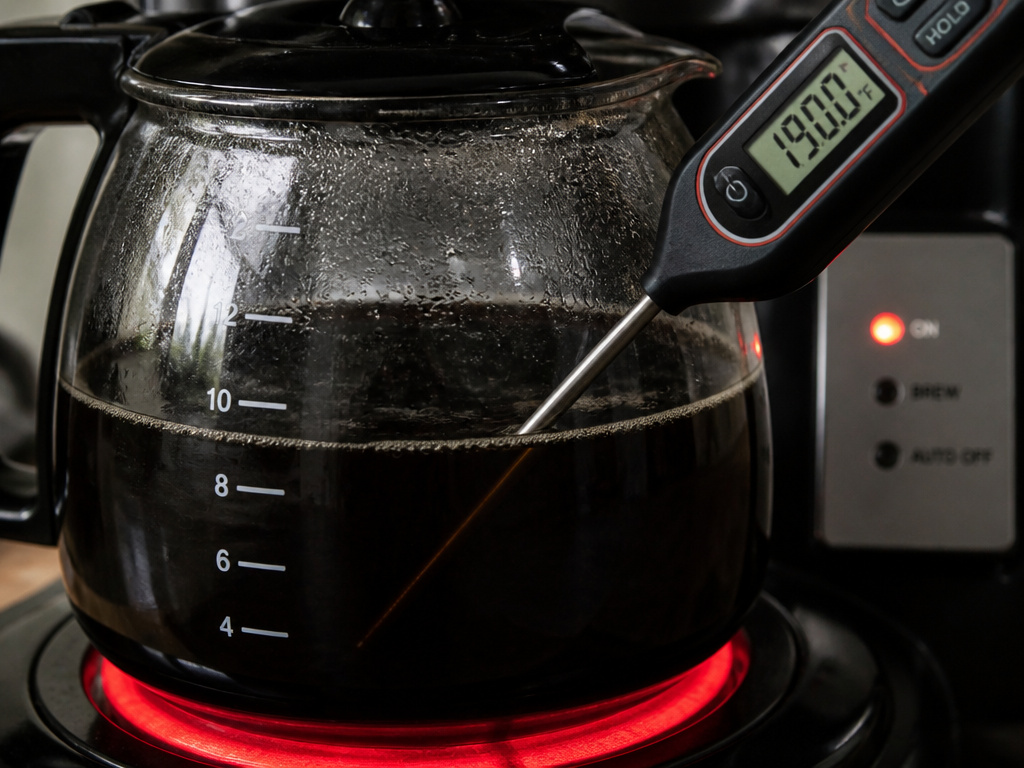
Your coffee maker has two temperature jobs: brew hot, then keep warm. Most machines fail the first test and overperform on the second. Let’s look at the specs.
| Brewer Model | Claimed Brew Temp | SCA Certified? | Real-World Test Notes |
|---|---|---|---|
| Bonavita BV1900TS | 195°F–205°F (90.6°C–96.1°C) | Yes | Hits 202°F at the showerhead; consistent across the entire 8-cup cycle. |
| Technivorm Moccamaster KBGV Select | 196°F–205°F (91.1°C–96.1°C) | Yes | Copper boiling vessel and thermostat maintain a 204°F average. |
| Keurig K-Elite | ~192°F (89°C) | No | Brews below the SCA range; weaker extraction by design for speed. |
| Generic Drip Machine | “Hot” (no spec) | No | Often brews as low as 185°F; temperature drops during the cycle. |
The Bonavita and Technivorm earn their certification with a heating element and thermostat system that actually maintains temperature. A generic $30 machine might heat water to 200°F in its tank, but by the time it travels up a tube and dribbles over the grounds, it can lose 15 degrees. You’re brewing with tepid water.
The keep-warm function is a bigger problem. That heated plate under your glass carafe? It holds coffee at 185°F to 190°F for over an hour. This is where the safety hazard creeps in. Coffee at 190°F causes third-degree burns in 2 to 3 seconds. The 2016 recall of 8 million Cuisinart coffee makers happened because a faulty carafe handle could break, spilling coffee held at exactly this dangerous temperature.
Common mistake: Assuming your brewer’s “hot” setting matches the SCA standard, most budget models brew 10–15 degrees too cool, resulting in weak, sour coffee that you then overcompensate for with more grounds.
For manual methods, you have more control. A gooseneck kettle with a thermometer is the fix. Start your pour at 205°F. Expect the water to lose a few degrees as it leaves the spout and hits the grounds. That’s fine. You’re aiming for the slurry, the mix of water and coffee in your filter, to stay within the 195°F–205°F window throughout the contact time.
From Carafe to Cup: The Serving Temperature Trap
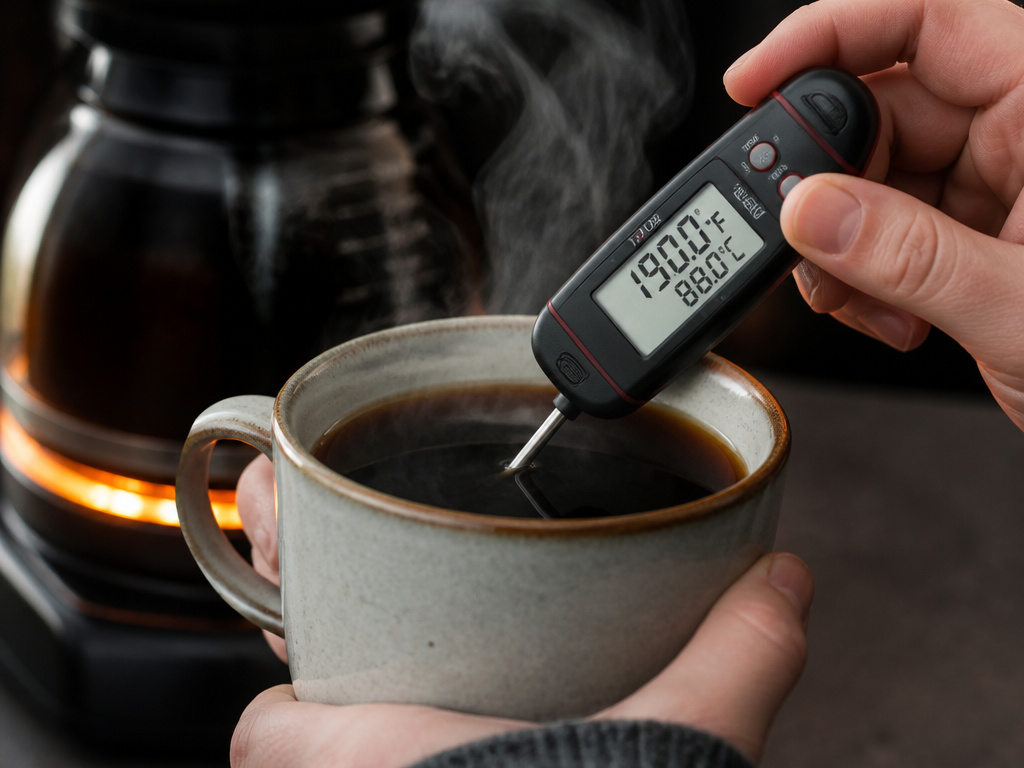
Here is the critical disconnect. Coffee is brewed at 200°F+ but should never be drunk at that temperature. The serving temperature is what your machine holds the coffee at, and the drinking temperature is what you actually sense.
The Scientific study on coffee serving temperature published in Food Research International measured this precisely. Researchers found the sensory properties of coffee, the balance of sweetness, acidity, and bitterness, are best perceived between 136°F and 149°F (58°C and 65°C). Most participants in the study found coffee above 158°F (70°C) too hot to taste anything but heat.
Yet, the standard keep-warm plate on a drip brewer maintains a serving temperature of 185°F–190°F. You pour a mug and might wait a minute. The surface cools, but the core of the liquid is still scalding. This is the exact scenario that led to the infamous 1992 McDonald’s case. Their coffee was held at 190°F, and a spill caused third-degree burns requiring skin grafts. The company had documented over 700 prior burn complaints.
The physics are simple. Liquids above 175°F (79°C) transfer heat into skin tissue faster than the body can dissipate it. Damage is instantaneous. Your mouth is slightly more resilient, but not by much. Drinking at 190°F numbs taste buds and can scald the esophagus.
So what should you do? Brew into a pre-warmed carafe or thermos. Then, pour your drinking mug and wait. Give it three to four minutes. Use that time. The flavor opens up as it approaches 155°F.
The Flavor Window: Where Your Coffee Actually Tastes Good
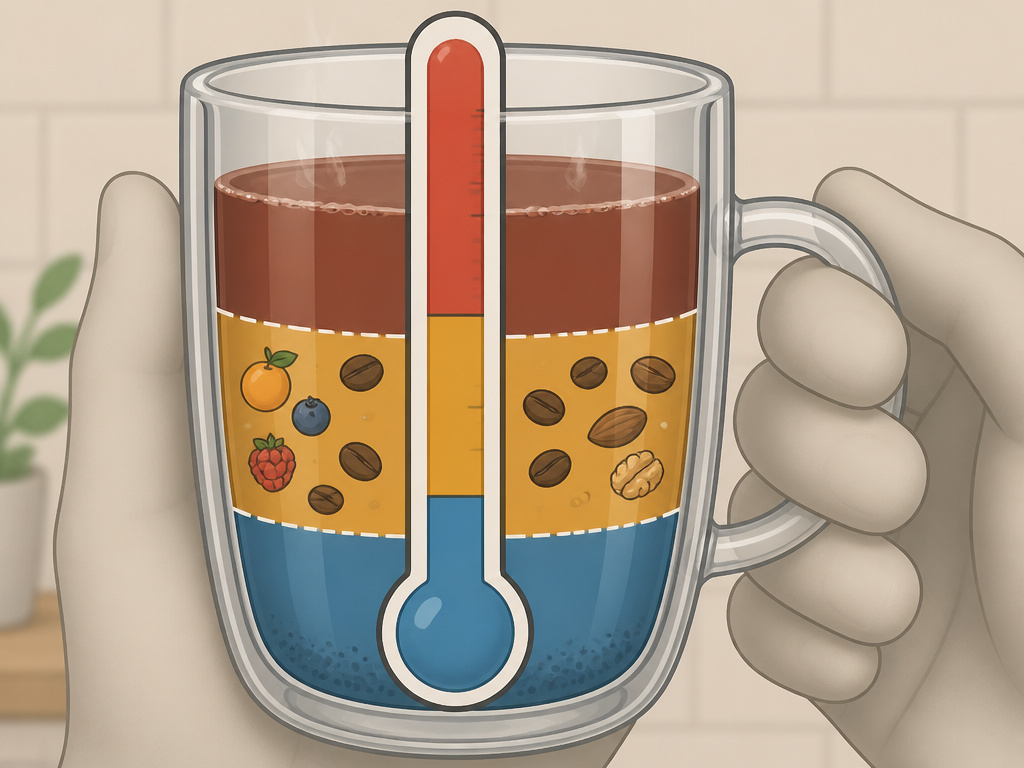
If brewing is a science and serving is a safety protocol, drinking is an art. The flavor window is narrow. It starts around 160°F (71°C) and is ideal by 150°F (65°C). Below 140°F (60°C), acidic notes become sharp and the body feels thin. Above 160°F, your palate registers only heat.
This is why the hot brewed coffee from your morning pot tastes different at minute one versus minute ten. The volatile aromatic compounds, the ones that carry fruity, floral, and nutty notes, are released as the coffee cools. Drinking it too hot literally burns those notes away before you can smell them.
- 150°F–160°F (65°C–71°C): The Sweet Spot. Bitterness recedes, sweetness and acidity balance. You can distinguish between a Colombian and an Ethiopian bean.
- 140°F–150°F (60°C–65°C): The Acidic Zone. Bright, fruity acids become prominent. This is where light roasts shine.
- Below 140°F (60°C): The Fall-Off. Flavors mute. The coffee tastes stale as oxidation accelerates. Time to reheat or finish the cup.
The method matters too. An espresso temperature is typically 195°F–200°F (91°C–93°C) at the grouphead, but a single ounce shot cools rapidly in the cup. You drink it at 160°F or lower. A cappuccino serving heat is dictated by the steamed milk, which is best textured at 150°F–155°F. The final drink lands in the perfect flavor window by default.
I used to drink coffee the second it finished brewing. The roof of my mouth was perpetually raw. I switched to a double-walled glass mug and forced a five-minute wait. The first time I actually tasted the caramel note my local roaster promised was revelatory. Now I set a timer.
How Other Hot Drinks Compare
Coffee isn’t alone in its temperature sensitivity. The principles of extraction and safety apply across beverages, but the targets shift based on the plant material.
| Beverage | Optimal Brew/Steep Temp | Reason | Typical Serving Temp |
|---|---|---|---|
| Black Coffee | 200°F–205°F (93°C–96°C) | Extracts oils & solubles without bitterness. | 150°F–160°F (65°C–71°C) |
| Green Tea | 175°F–185°F (79°C–85°C) | Prevents scalding delicate leaves, which releases bitter catechins. | 140°F–150°F (60°C–65°C) |
| Black Tea | 200°F–212°F (93°C–100°C) | Robust leaves need near-boiling water to fully unfurl and release flavor. | 160°F–170°F (71°C–77°C) |
| Espresso | 195°F–200°F (91°C–93°C) | High pressure requires slightly lower temp to avoid burning the fine puck. | 155°F–165°F (68°C–74°C) |
The ideal steeping temperature for green tea is so much lower because its leaves are less oxidized. Boiling water cooks them, creating a grassy, astringent cup. This contrast highlights that “hot” is relative to the substance. The brew temperature effects on acidity are profound; cooler water often preserves brighter, more acidic notes in both tea and coffee.
The serving temperature comparison between black tea and black coffee is also telling. Tea often retains heat longer in a ceramic pot, while coffee in a glass carafe on a warmer plate can actually get hotter over time. Your drinking temperature habits should adjust accordingly, tea might need a longer cool-down.
Safety, Health, and the Very Hot Beverage Debate
This isn’t just about taste. There are real physical consequences to consuming liquids at high temperatures. The World Health Organization’s International Agency for Research on Cancer (IARC) has classified drinking very hot beverages (above 149°F or 65°C) as “probably carcinogenic to humans.” The link is to esophageal cancer. The theory is that repeated thermal injury to the esophageal lining promotes cellular changes.
The research on hot beverage effects is ongoing, but the mechanism is plausible. It’s a reminder that the body’s tissues are not designed for repeated scalding. This intersects with the temperature and health discussion around coffee specifically, separating the temperature risk from the chemical components of the drink itself.
For daily practice, this means intentional cooling. Don’t sip from a lidded travel mug that traps heat. Avoid plastic lids that keep steam in, raising the drinking temperature. Use a mug with a wide rim that allows heat to escape. Your oral health with hot liquids also benefits; enamel is less stressed at moderate temperatures.
Common mistake: Gulping from a sealed thermos to “keep coffee hot all morning”, this maximizes both the temperature hazard and the flavor degradation. The coffee stews in its own heat, turning bitter and potentially harmful.
The 1992 lawsuit forced a public reckoning with these temperatures. It established that 190°F is dangerously hot for immediate service. While that case was about liability, the specialty coffee world had already settled on a lower, safer standard for drinking. The goal is a cup that is warm, comforting, and flavorful, not a physical hazard.
Frequently Asked Questions
What is the ideal temperature to drink coffee?
Aim for 150°F to 160°F (65°C to 71°C). This is hot enough to feel warm and release aroma, but cool enough for your taste buds to perceive sweetness and nuance without being scalded.
Can coffee be too hot to brew?
Yes. Water above 205°F (96°C) will over-extract coffee grounds, pulling out excessive bitter compounds and creating a harsh, astringent cup. The ISO and SCA standards set 205°F as the upper limit for optimal brewed coffee temperature.
Why does coffee taste better as it cools?
As coffee cools, volatile aromatic compounds become more detectable to your sense of smell. Heat also masks subtle flavors and emphasizes bitterness. Cooling allows the full spectrum of acidity, sweetness, and body to emerge.
How can I tell if my coffee maker brews hot enough?
Check for SCA (Specialty Coffee Association) certification on the product. Certified models like the Bonavita BV1900TS or Technivorm Moccamaster are tested to brew within the 200°F ± 5°F range. Without certification, you can test with a kitchen thermometer at the showerhead during a brew cycle.
The Bottom Line
Coffee heat is a three-act play: brew hot, serve carefully, drink warm. Hit 200°F–205°F in the brewer to follow the ISO and SCA extraction standard. Then, let it drop. Your machine’s keep-warm function is a burn risk, not a flavor enhancer. Give your mug a solid few minutes to settle into the 150°F–160°F window where the coffee actually tastes like something.
Invest in a brewer that tells you the truth about temperature, or use a kettle you can control. Your optimal brewing heat is the first domino. Everything else, safety, flavor, and enjoyment, falls into place after that. The numbers are specific for a reason. They work.
