
The Science Behind How French Press Coffee Actually Works
French press coffee works by fully immersing coarsely ground coffee in hot water, allowing flavors and oils to extract directly into the brew. After a steeping period, a metal mesh filter attached to a plunger is pressed down through the water, physically separating the spent grounds from the finished coffee. This immersion method, unlike paper-filter drip brewing, retains natural oils for a full-bodied cup with characteristic sediment.
Most people get this wrong by treating the plunge as a filter. It’s a separator. The brewing happens during the steep. Plunging too fast or with fine grounds agitates the bed, forcing bitter silt into your cup and making the last sip gritty.
This guide walks through the physics of immersion, the exact role of the mesh filter, and the steps that turn ground beans into that rich, textured brew. We’ll also cover why your press might break and how to adapt the method for cold brew or tea.
Key Takeaways
- The French press is an immersion brewer, not a percolator. All extraction occurs while the grounds and water sit together.
- A coarse grind is non-negotiable. Fine grounds clog the 150–200 micron mesh filter and create excessive, bitter sediment.
- The plunger’s primary job is separation, not extraction. A slow, steady press minimizes agitation of the fine particles at the bottom.
- Preheating the beaker matters. A cold glass carafe can drop your brew water temperature by 5–10°F, leading to under-extraction.
- The standard 4-minute steep is a starting point. Light roasts often need 5+ minutes, while dark roasts can extract fully in 3.5.
The Core Mechanism: Immersion and Filtration
Drip machines and pour-overs work by percolation. Water passes through a stationary bed of coffee, extracting as it goes. The French press uses full immersion. Every coffee particle is surrounded by water for the entire brew time. This allows for a different, and often more complete, extraction of oils and soluble solids.
Immersion brewing, as defined by the Specialty Coffee Association, involves steeping coffee grounds in water for a prescribed time before separating the liquid from the solids. This method typically yields a brew with higher total dissolved solids and more retained lipids compared to paper-filtered percolation.
The metal mesh filter is the other half of the equation. Paper filters trap oils and microscopic fines. A French press filter, with pores around 150–200 microns, only stops the bulk of the grounds. The oils and very fine particles pass through, creating the signature body and the silt at the bottom of your cup. This is a feature, not a bug.
TL;DR: Immersion extracts everything simultaneously; the mesh filter lets oils through for body but also allows fine sediment.
What’s Inside a Standard French Press?
The classic design is simple but specific. Understanding each part explains why the method works, and where it can fail.
The beaker is usually borosilicate glass, like in the Bodum Chambord. It’s heat-resistant but brittle. Sudden temperature changes or a tap against the sink can crack it. The plunger assembly has a metal plate attached to a rod. A fine mesh screen is sandwiched between a spiral spring and a perforated plate. This three-part stack is the filter.
| Component | Primary Material | Critical Function | Common Failure Point |
|---|---|---|---|
| Beaker/Carafe | Borosilicate glass | Holds water & grounds for steeping | Thermal shock cracking; impact breakage |
| Plunger Rod | Stainless steel or chrome-plated steel | Provides leverage to press filter down | Bent rod from forcing a jam |
| Filter Screen | Stainless steel mesh (~150–200 micron) | Separates grounds from brew liquid | Mesh fraying/holes after 1–2 years of use |
| Lid/Frame | Steel or plastic | Stabilizes plunger, retains heat | Plastic hinge breaking; lid not sealing |
Higher-end models like the Frieling Double-Wall use 18/10 stainless steel. They’re insulated and nearly indestructible, but you lose the visual cue of the brew color. The filter mechanism is also more robust, often with a two-stage design.
The filter’s micron rating is the most important spec nobody lists. Standard coffee grinders produce a range of particles. The coarse chunks extract evenly. The “fines” are inevitable. A 150-micron screen stops the coarse grounds but lets most fines swim through into your cup. A tighter mesh would clog. A looser one would let chunks through.
Step-by-Step Breakdown: More Than Pour and Plunge
The basic instructions leave out the nuances that define a great cup. Here’s what happens at each stage, and why the details change the outcome.
Heat and Grind: Setting the Stage
Water temperature dictates extraction speed. The National Coffee Association USA recommends 195–205°F (90–96°C) for optimal extraction. Boiling water (212°F) can scorch grounds, adding a harsh, bitter note. Preheating the empty press with hot water stabilizes the temperature. Skipping this can cool your brew water by 10 degrees, especially with a glass beaker.
Grind size is the biggest lever. You need a consistent coarse grind. Blade grinders create a mix of dust and boulders. The dust over-extracts instantly, turning bitter. The boulders under-extract, leaving sour notes. A burr grinder like the Baratza Encore is the tool for the job. Set it to a coarse setting, the particles should look like coarse sea salt or very fine gravel.
Common mistake: Using a fine or medium grind, the fines jam against the filter screen during the plunge, creating back pressure. This often cracks a glass beaker at the base when you force the plunger down.
The Bloom and Steep: Where Extraction Happens
Add the grounds to the dry beaker. Pour in just enough hot water to saturate them, roughly twice the weight of the coffee. This is the bloom. The grounds release carbon dioxide, bubbling up. Wait 30 seconds. This degassing prevents the gas from blocking water contact later.
Now stir. This is the step most manufacturer guides omit. A gentle stir ensures every ground is wet. Dry clumps are pockets of wasted coffee. After stirring, pour the rest of your water. Start your timer.
The steep time depends on your coffee. A light roast bean is denser and extracts slower. Give it 5 minutes. A dark roast is more porous and can be ready in 3.5 to 4 minutes. The standard 4 minutes is a safe middle ground. During this time, water-soluble compounds (acids, sugars, caffeine) and insoluble oils diffuse from the grounds into the water.
The Plunge and Pour: Separation, Not Extraction
Place the lid on top with the plunger all the way up. This keeps heat in. When the timer goes off, press down. Slow and even is the rule. You’re not filtering. You’re lowering a physical barrier to trap the spent grounds at the bottom.
A fast plunge churns the water, swirling the settled fines back into suspension. You’ll get a murky, gritty cup. The goal is a clean separation. Once the plunger is down, pour all the coffee out immediately. Leaving it in the beaker lets the trapped grounds continue steeping in the concentrated brew at the bottom, over-extracting and turning bitter.
TL;DR: Heat stabilizes, a coarse grind extracts evenly, the steep does the work, and a slow plunge keeps the silt down.
The Science of Sediment and Body
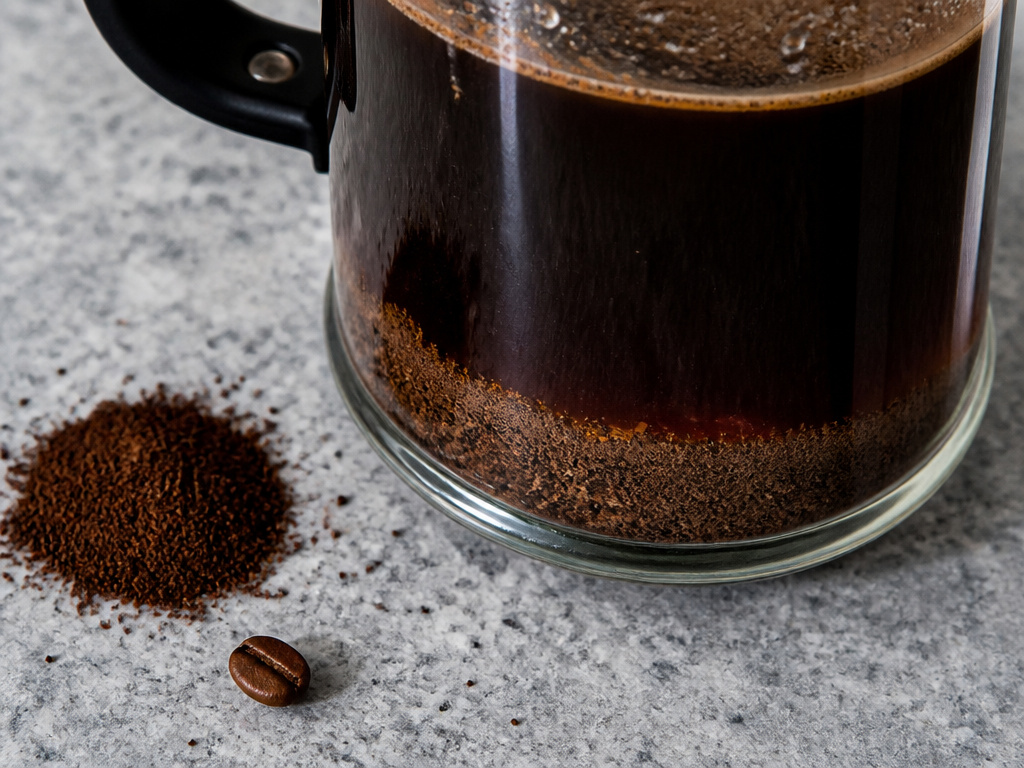 That layer of sludge at the bottom of your mug is the direct result of the mesh filter’s pore size. A 2023 study on extraction methods in the PMC journal noted that immersion brews like French press retain significantly higher levels of certain antioxidants and lipids compared to paper-filtered coffee. Those lipids are the oils that give the coffee its viscous, rounded mouthfeel, what we call “body.”
The sediment is mostly very fine coffee particles, smaller than the filter’s pores. They contribute to the overall taste and texture. Some people love it; some hate it. To minimize it, you need a very consistent coarse grind and the patience to let the fines settle completely before plunging. Some pro techniques, like the 8-minute method from the YouTube transcript, involve a long settling period after stirring, then pouring without plunging at all.
This trade-off between clarity and body is fundamental. A paper filter gives you a clean, bright cup. The French press gives you a rich, textured one. It’s not better or worse, it’s different.
When the Standard Process Breaks (Or You Break the Press)
 The French press is versatile, but the basic method has fixed boundaries. Step outside them, and you’re in edge-case territory.
Cold brew is the most common adaptation. You use cold water and steep for 12–24 hours in the refrigerator. The immersion principle is the same, but the cold temperature extracts different compounds, fewer acids, more sugars, resulting in a smooth, low-acid concentrate. The plunge still separates the grounds.
Using the press for loose leaf tea works perfectly. The mesh filter contains the leaves during steeping. Just remember tea often needs a lower temperature (170–200°F for green/white) and a shorter steep (1–5 minutes) than coffee.
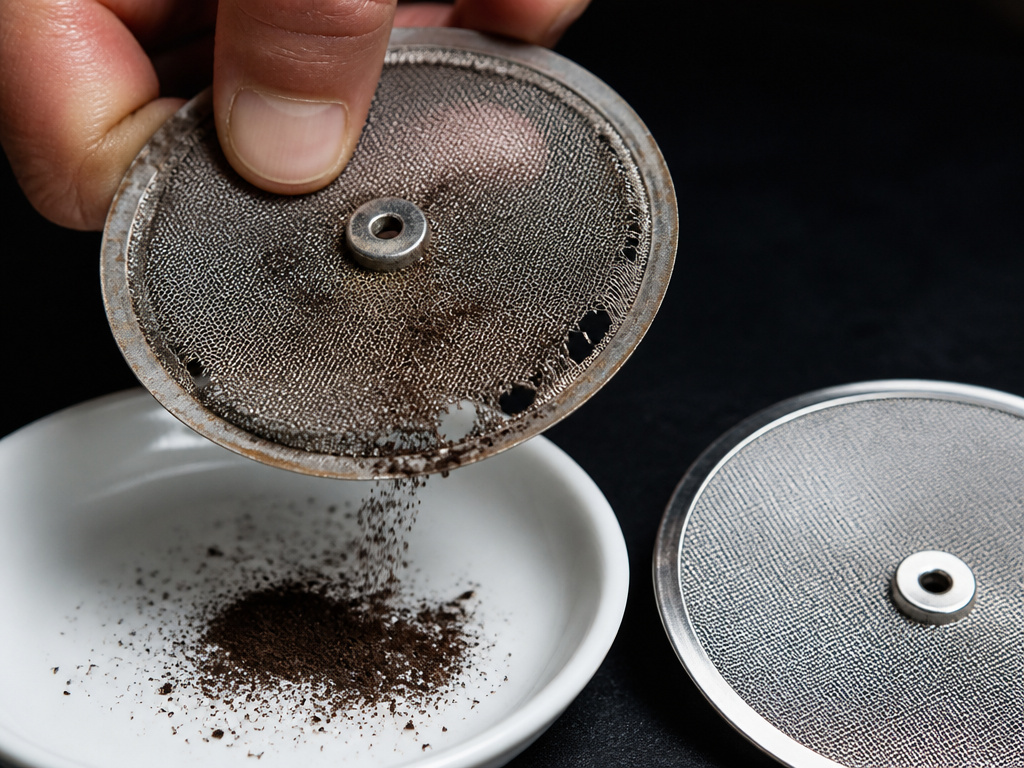
Then there’s wear and tear. The filter screen degrades. After a year or two of daily use and cleaning, the fine mesh can fray or develop tiny holes. You’ll notice more and more silt in your cup. Replacement screens are cheap and easy to install. The glass beaker is the other weak point. Pouring hot water into a cold glass, or placing a hot glass on a cold granite counter, can thermal-shock it into cracking. It happens fast.
French Press vs. Other Brew Methods
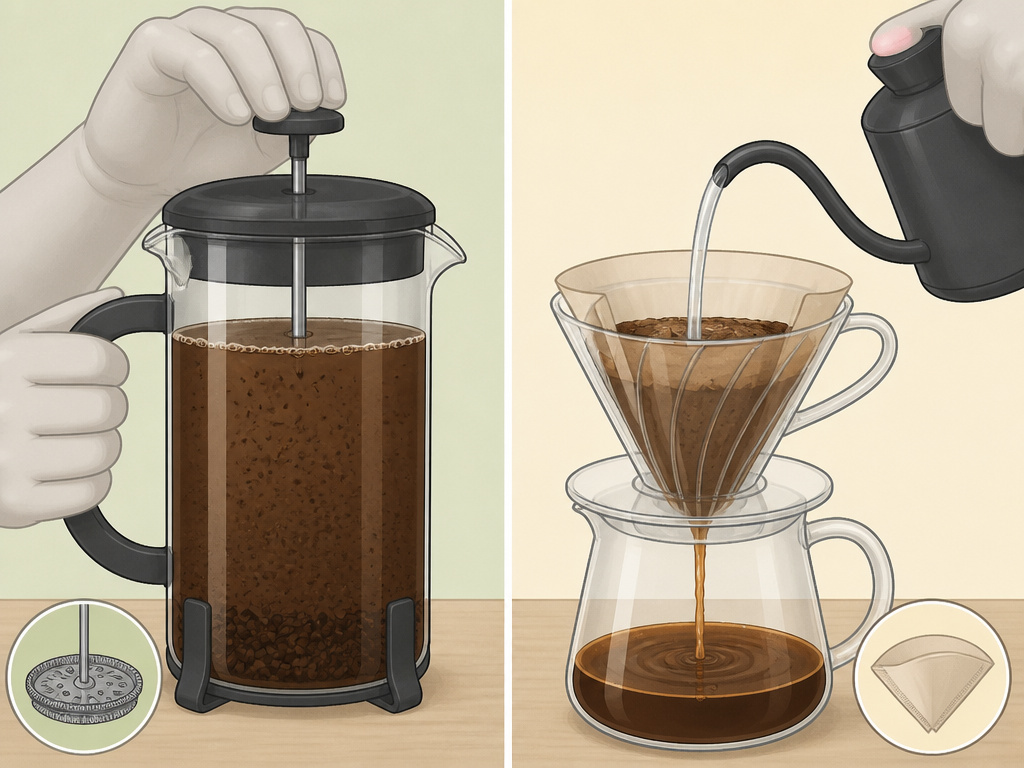 It’s useful to see where the French press sits in the brewing landscape. Its closest relative is the Clever Dripper, which is also full immersion but uses a paper filter for a cleaner finish.
| Brew Method | Mechanism | Filter Type | Resulting Body | Best For |
|---|---|---|---|---|
| French Press | Full Immersion | Metal Mesh (150–200µ) | Full, oily, textured | Rich, heavy-bodied coffee lovers |
| Pour-Over (V60) | Percolation | Paper | Light, clean, bright | Highlighting clarity & nuanced acidity |
| Aeropress | Immersion/Pressure | Paper or metal disc | Clean to medium, versatile | Experimentation & travel |
| Auto-Drip | Percolation | Paper | Light to medium, consistent | Hands-off convenience |
The French press wins when you want maximum body and a straightforward process. It loses if you prioritize crystal-clear coffee or dislike sediment. Compared to an espresso drink like an Americano, the French press delivers similar strength but without the concentration and crema. It’s a different brew method entirely.
For flavor, single-origin coffee with bright, fruity notes can sometimes get muddied by the French press’s heavy body. A coffee blend designed for balance often shines. A light roast needs that longer steep. A dark roast can over-extract if you’re not careful.
Frequently Asked Questions
Does a French press make stronger coffee?
It makes fuller-bodied coffee, not necessarily stronger in terms of caffeine concentration. Caffeine content is mostly a function of the coffee-to-water ratio and brew time. A French press and a drip machine using the same ratio will have similar caffeine levels. The French press just feels heavier and oilier on your tongue.
Why is my French press coffee bitter?
Two likely reasons. First, your grind is too fine. Fine particles over-extract quickly, releasing bitter compounds. Second, you steeped too long. For a dark roast, try reducing the time to 3.5 minutes. Bitterness can also come from water that’s too hot, use a thermometer and aim for 200°F.
Can you make tea in a French press?
Absolutely. It’s excellent for loose-leaf tea. Use the appropriate water temperature for your tea type (boiling for black, cooler for green), add leaves, steep, and plunge. Just clean it thoroughly afterward to prevent coffee oils from flavoring your tea.
How do I clean a French press properly?
Disassemble the plunger completely after each use. Rinse the mesh screen, the plates, and the spring. Coffee oils and fine grounds get trapped in the assembly and go rancid, giving your next brew an off flavor. A monthly deep soak in a cafiza or vinegar solution keeps it fresh.
Is French press coffee unhealthy because of the oils?
The oils contain diterpenes, which can raise LDL cholesterol in some people if consumed in very large, daily quantities. For most people drinking a few cups a day, the effect is negligible, and the antioxidant benefits likely outweigh the risks. If you’re concerned, alternate with a paper-filtered method.
What’s the best coffee for French press?
medium to dark roast is most forgiving. Look for a coffee bean type known for body, like a Sumatran or a Brazilian. Arabica beans are the standard for quality. You can use a blonde roast, but you’ll need to extend the steep time and grind slightly finer to compensate for its density.
The Bottom Line
The French press works because it’s simple physics: immersion followed by mechanical separation. The reward is a cup of coffee that’s unapologetically rich and textured. The trade-off is sediment and a need for careful grinding.
Mastery comes from controlling the variables the manual doesn’t mention. Grind coarse. Preheat the glass. Stir the bloom. Press slow. Pour it all out. Those steps bridge the gap between a muddy, bitter brew and the deep, satisfying cup the method promises. It’s a hands-on process that rewards attention. And when you get it right, no paper filter can replicate what’s in your mug.
