
Discover the World’s Most Commonly Cultivated Coffee Species
The world’s most commonly cultivated coffee species are Coffea arabica (Arabica) and Coffea canephora (Robusta). Together, they make up roughly 98% of global coffee production, with Arabica accounting for 60-70% of the market and Robusta for 30-40%. Arabica commands higher prices for its complex flavor profile but is more vulnerable to disease, while Robusta is hardier and contains about 50-60% more caffeine.
Most people think the difference is just taste. The real split is about survival. Arabica needs specific, cooler high-altitude conditions to develop its prized flavors, while Robusta grows aggressively at lower elevations where pests and heat would kill its delicate cousin. That agricultural reality, not just consumer preference, is why your supermarket shelf looks the way it does.
This guide breaks down the two giants, the wild species that could change the industry, and why the coffee in your cup is a product of centuries of botany, economics, and climate.
Key Takeaways
- Arabica dominates the specialty market but is genetically bottlenecked, with much of Latin America’s crop tracing back to just two historic varieties: Typica and Bourbon.
- Robusta’s higher caffeine acts as a natural pesticide, allowing it to thrive in warmer, lower regions where Arabica would fail.
- Global production in 2020 hit 105,262 thousand 60kg bags of Arabica, with Brazil alone producing over 60,292 thousand bags.
- Several wild Coffea species from Madagascar are naturally low in or completely lack caffeine, offering a genetic path to pest resistance without chemical sprays.
- Choosing a coffee variety is now a critical climate-change decision for farmers, balancing yield, survival, and market price.
What Are the Two Main Coffee Species?
Coffee comes from a genus (Coffea) with over 120 species. Only two have achieved global commercial dominance. You are drinking the result of a very specific agricultural filter.
Arabica and Robusta are distinguished by their chromosomes, growing conditions, and chemical makeup. Arabica is a self-fertile species with 44 chromosomes, thriving at 610–1830 meters altitude in 15–24°C temperatures. Robusta is an outcrossing species with 22 chromosomes, tolerant of lower elevations and 24–30°C heat, with caffeine levels 50–60% higher as a natural defense.
Arabica (Coffea arabica) is the quality leader. Its beans produce the nuanced, sweet, and acidic flavors that define specialty coffee. This doesn’t happen by accident. The plant needs the stress of cooler high-altitude climates to slow cherry maturation and develop complex sugars. It’s a diva. A single coffee leaf rust outbreak can wipe out entire farms, as seen in Central America over the last decade.
Robusta (Coffea canephora) is the workhorse. The name says it all. It grows faster, produces more cherries per tree, and laughs at diseases and pests that devastate Arabica. That laugh comes from caffeine. The high caffeine content is a potent natural insecticide. The trade-off is in the cup: stronger, bitter, and less aromatic. It forms the backbone of instant coffee and many commercial espresso blends, providing that thick crema and punchy body.
| Trait | Arabica (Coffea arabica) | Robusta (Coffea canephora) |
|---|---|---|
| Global Market Share | 60–70% | 30–40% |
| Optimal Altitude | 610–1830 meters (2000–6000 ft) | 0–1200 meters (0–4000 ft) |
| Flavor Profile | Sweet, acidic, complex (fruity, floral, chocolate) | Strong, bitter, earthy, woody |
| Caffeine Content | ~1.2–1.5% | ~2.2–2.7% |
| Primary Use | Specialty single-origin, high-end blends | Instant coffee, commercial espresso blends, fillers |
TL;DR: Arabica is the high-maintenance flavor king grown in the mountains. Robusta is the tough, bitter workhorse grown in the lowlands. Your daily drink is almost certainly one or a mix of both.
The Arabica Dominance: Flavor at a Cost
Arabica’s 60-70% market share is a story of quality over quantity. In 2020, world Arabica production was 105,262 thousand 60kg bags. Brazil’s output was 60,292 thousand bags, a 26% jump from 2019. This scale feeds a price spectrum. Specialty Arabica can sell for US$20/kg, while commodity-grade beans trade around US$2.5/kg.
The plant’s biology dictates this value. It’s self-fertile, which simplifies farming but also creates a genetic vulnerability. Most of Latin America’s Arabica crops descend from a tiny handful of plants, the Typica and Bourbon varieties. This lack of genetic diversity is a known risk. When coffee leaf rust swept through the region, it found a monoculture with little natural resistance.
Common mistake: Assuming all Arabica coffee is the same. A Typica variety from Ethiopia tastes completely different from a Caturra variety from Colombia, even though they’re the same species. The variety dictates the flavor potential.
Farmers choose specific Arabica varieties like Caturra or Catuai for a reason. Caturra is a natural dwarf mutation of Bourbon, discovered in Brazil. It allows for denser planting and higher yields. These choices are not just about flavor; they are economic survival decisions made three to four years before the first harvest.
Robusta’s Role: The Backbone of Bulk Coffee
Robusta fills the gaps Arabica cannot. It’s the insurance policy of the coffee world. While Vietnam is the largest producer, the bean thrives across Africa and Southeast Asia. Its commercial value lies in three hard facts: yield, caffeine, and resilience.
First, it outproduces Arabica. Second, its caffeine is a built-in pest deterrent. Third, it tolerates heat and humidity. This makes it cheaper to grow and cheaper to buy. In your cup, Robusta contributes heavy body, a distinctive bitterness, and that stable crema on top of an espresso. Most Italian espresso blends include a percentage of Robusta for precisely these textural reasons.
However, it’s not just a blunt instrument. The Hibrido de Timor (HDT), a rare natural hybrid of Arabica and Robusta discovered in the wild, changed the game. Breeders used it to create varieties like Catimor, which carry Robusta’s disease resistance into a plant that yields a more Arabica-like cup. This is the cutting edge of coffee cultivation, using genetics to build a better plant without sacrificing drinkability.
TL;DR: Robusta is cheap, tough, and bitter. Its real value is in blends and as genetic material for creating hardier hybrid coffee plants.
Beyond the Big Two: Lesser-Known Species
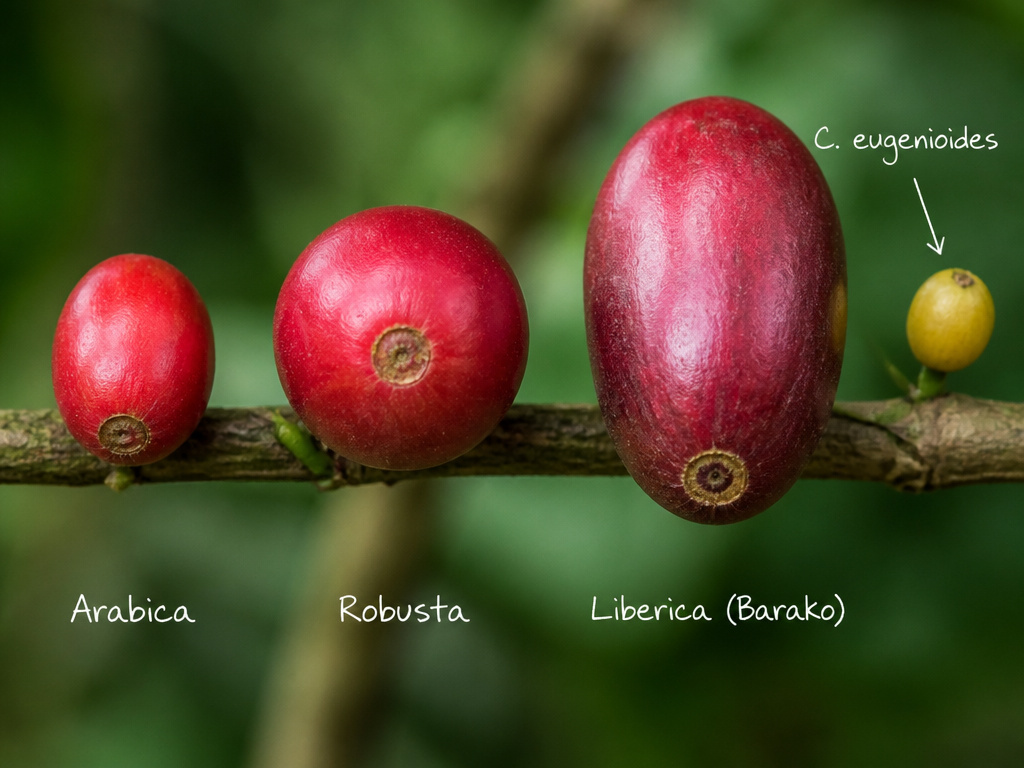
The Coffea genus is far bigger than the supermarket aisle suggests. Over 120 other species exist, mostly uncultivated. A few are commercially grown on a tiny scale, and others hold genetic keys to the industry’s future.
Coffea liberica is the third-most cultivated species. It produces larger cherries and beans with a smoky, woody flavor profile that’s an acquired taste. It’s grown in parts of Southeast Asia, like the Philippines, where it’s known as Barako.
The real intrigue lies in the wild species, particularly from Madagascar. Coffea eugenioides and several others (C. humblotiana, C. labatii) are naturally low in or completely lack caffeine. This isn’t a processing trick; it’s their genetic blueprint. Researchers are intensely interested in these plants. They offer a path to naturally caffeine-free coffee and, crucially, a source of pest resistance. A low-caffeine plant shouldn’t survive insects, yet these do, meaning they have other, unknown defense mechanisms.
I first tasted a coffee made from Coffea eugenioides at a specialty convention. The sample was tiny, incredibly expensive, and tasted nothing like Arabica. It was floral and tea-like, with almost no bitterness. It proved the flavor potential locked away in species we never farm.
These species are not yet farmed at scale. They exist in genebanks, 775 accessions of C. eugenioides and others are preserved, waiting for the day climate change or disease forces the industry to look beyond its two main stars.
How Climate Change is Reshaping Cultivation
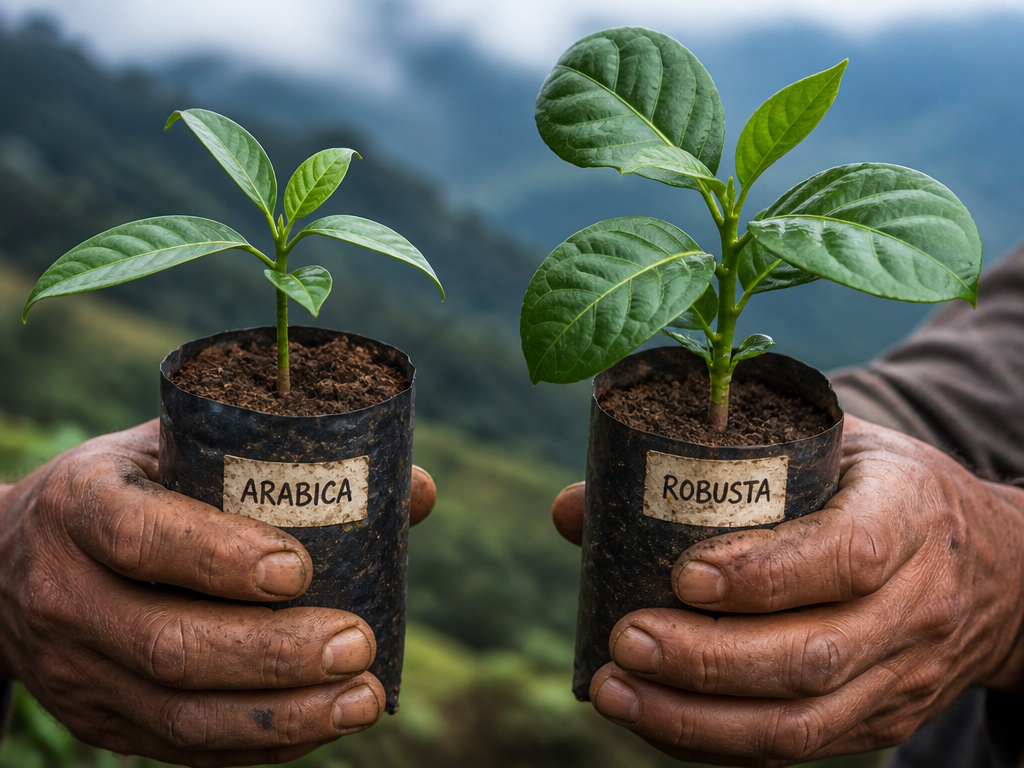
The map of where coffee grows is being redrawn. Arabica’s need for cool temperatures makes it acutely vulnerable. A warming climate pushes viable farmland uphill. There’s only so much mountain.
This pressure is making variety selection the most critical decision a producer makes. It’s no longer just about flavor or yield. It’s about survival. Will a traditional heirloom variety like Typica survive the warmer, wetter conditions of the next 20 years? Or must a farmer switch to a new, more resilient hybrid?
The World Coffee Research varieties catalog documents 55 Arabica and 47 Robusta varieties for this exact reason. It’s a global database for farmers to find plants that will work for their changing local conditions. Choosing the wrong variety means losing the farm.
Common mistake: Believing coffee farming is static. Replacing a hectare of trees means 3-4 years of lost income before new plants produce. For a smallholder, that’s a bet-the-farm decision, not an agronomic tweak.
The future of your morning cup depends on these choices. The industry is responding by developing climate-resistant cultivars and exploring the hardier wild species in its genetic library. The goal is to keep Arabica’s quality on the map, literally.
From Species to Your Cup: A Consumer’s Guide
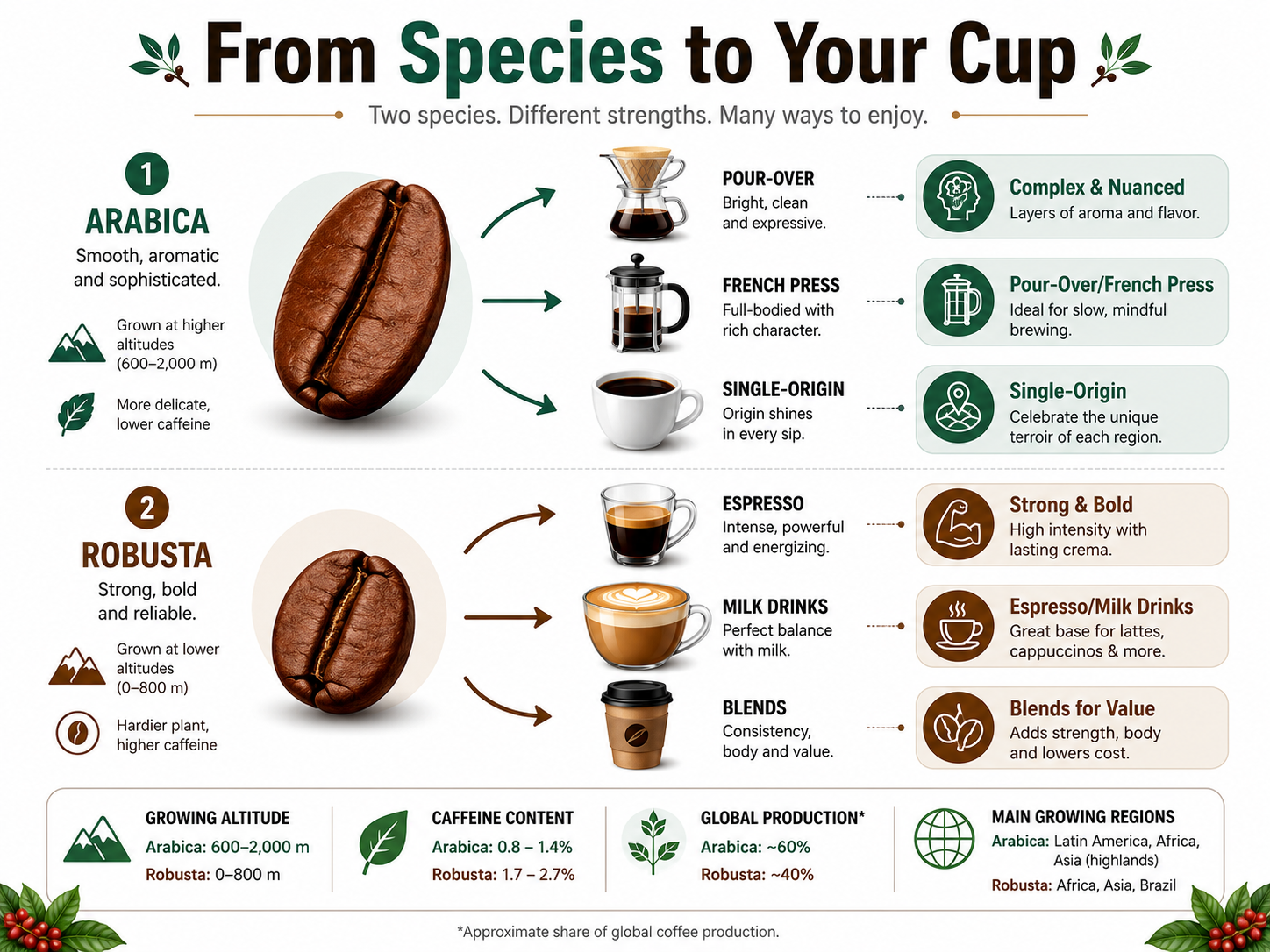
You don’t need a botany degree to shop smarter. The labels already tell you most of what you need to know.
If a bag says “100% Arabica,” you’re holding the potential for specialty-grade, complex flavors. Look for additional variety names like Gesha, Bourbon, or Catuai for more specific expectations. These are all subtypes of Arabica. A Gesha, for instance, is famous for its intense floral and jasmine notes and commands premium prices.
If you’re buying espresso beans or instant coffee, you’re likely drinking a blend containing Robusta. This isn’t inherently bad, it provides the body and crema many people expect. The bitterness can be balanced with milk and sugar.
Your brewing method also plays a role. The intense, earthy notes of a Robusta-heavy blend can stand up well in a strong brewed coffee or a milk-based drink. The delicate acidity of a light-roast, single-origin Arabica shines brightest in a pour-over or French press.
Here’s a simple decision flow:
- For complex, nuanced flavors: Choose single-origin, 100% Arabica. Look for a roast date and a named variety or region.
- For strong, bold espresso with crema: A traditional Italian-style blend with some Robusta content is the classic choice.
- For everyday, cost-effective brewing: Many good-quality coffee blends mix Arabica and Robusta for balance and value.
The journey from a specific coffee species to the flavors in your cup is direct. The plant’s genetics set the ceiling. The farmer’s skill and the roaster’s craft determine how close it gets.
Frequently Asked Questions
What is the most expensive coffee species?
The highest prices are attached to specific varieties of the Arabica species, not different species. Gesha (or Geisha) Arabica from Panama regularly auctions for hundreds of dollars per pound. Novelty processing, like Kopi Luwak (made from beans eaten and excreted by civets), also commands high prices but is still based on Arabica or Robusta beans.
Can I grow Arabica or Robusta at home?
You can, with patience. Arabica is often grown as an ornamental houseplant in non-tropical climates but rarely produces enough cherries for a meaningful harvest. Robusta is even less suited to indoor cultivation due to its size and climate needs. Both require specific, stable tropical conditions to fruit properly.
Why does Robusta have more caffeine?
The caffeine is a natural pesticide. Robusta evolved in warmer, lower-altitude environments with more pests. The high caffeine concentration in its leaves and cherries is a toxic defense mechanism that deters insects and animals. Arabica, growing in cooler high-altitude zones with fewer pests, didn’t need this level of chemical defense.
Is Liberica coffee a different species?
Yes. Coffea liberica is a distinct third species, commercially cultivated on a much smaller scale than Arabica and Robusta. It’s known for its large bean size and a flavor profile often described as smoky, woody, and floral. It’s a cultural staple in parts of the Philippines and Malaysia.
How can I tell Arabica and Robusta beans apart?
Look at the bean shape. Arabica beans are longer, more oval, and have a sinuous center crease. Robusta beans are rounder, smaller, and have a straighter center crease. After roasting, Arabica often has a matte surface, while Robusta can appear drier and more uniform.
Before You Go
The world runs on two coffee species. Arabica gives us flavor and complexity, dominating the specialty scene despite its fragility. Robusta provides strength, resilience, and the economic foundation for the instant and blend market. That 98% duopoly is so complete we often forget the other 120 species in the genus.
Remember that your choice at the shelf has a direct line back to a farmer’s choice in a field. That choice is getting harder every year as climates shift. The future of coffee depends on the genetic diversity sitting in research catalogs and Madagascan forests, the very species we ignore today might save the industry tomorrow.
Start paying attention to the labels. Choose a single-origin Arabica to taste what the fuss is about. Try a robust espresso blend to understand the backbone of the business. Your palate is the final judge in a story that spans continents, chromosomes, and centuries of cultivation.
{
“@context”: “https://schema.org”,
“@type”: “HowTo”,
“name”: “How to Identify the World’s Most Common Coffee Species”,
“totalTime”: “PT10M”,
“tool”: [
{
“@type”: “HowToTool”,
“name”: “Whole coffee beans (Arabica and Robusta samples)”
},
{
“@type”: “HowToTool”,
“name”: “Magnifying glass or phone macro lens”
},
{
“@type”: “HowToTool”,
“name”: “Notepad for flavor and visual notes”
}
],
“step”: [
{
“@type”: “HowToStep”,
“name”: “Examine the bean shape”,
“text”: “Place beans side by side. Arabica beans are typically longer and more oval with a curved center crease. Robusta beans are rounder, smaller, and have a straighter center crease.”
},
{
“@type”: “HowToStep”,
“name”: “Compare roast appearance”,
“text”: “Under consistent roast levels, Arabica beans often have a matte, slightly oily surface. Robusta beans tend to look drier and more uniform in color.”
},
{
“@type”: “HowToStep”,
“name”: “Grind and smell”,
“text”: “Grind a small sample of each. Freshly ground Arabica often smells sweeter, with fruity or floral notes. Ground Robusta typically has a stronger, earthier, more peanutty aroma.”
},
{
“@type”: “HowToStep”,
“name”: “Brew and taste”,
“text”: “Brew each separately as a simple pour-over. Arabica will taste smoother, with higher acidity and complex flavor layers. Robusta will be more bitter, full-bodied, and have a distinct woody aftertaste.”
},
{
“@type”: “HowToStep”,
“name”: “Check the label or origin”,
“text”: “Confirm your findings. Single-origin specialty coffee is almost always 100% Arabica. Blends labeled for espresso or sold as instant coffee often contain Robusta.”
}
]
}
{
“@context”: “https://schema.org”,
“@type”: “FAQPage”,
“mainEntity”: [
{
“@type”: “Question”,
“name”: “What is the most expensive coffee species?”,
“acceptedAnswer”: {
“@type”: “Answer”,
“text”: “The highest prices are attached to specific varieties of the Arabica species, not different species. Gesha (or Geisha) Arabica from Panama regularly auctions for hundreds of dollars per pound. Novelty processing, like Kopi Luwak (made from beans eaten and excreted by civets), also commands high prices but is still based on Arabica or Robusta beans.”
}
},
{
“@type”: “Question”,
“name”: “Can I grow Arabica or Robusta at home?”,
“acceptedAnswer”: {
“@type”: “Answer”,
“text”: “You can, with patience. Arabica is often grown as an ornamental houseplant in non-tropical climates but rarely produces enough cherries for a meaningful harvest. Robusta is even less suited to indoor cultivation due to its size and climate needs. Both require specific, stable tropical conditions to fruit properly.”
}
},
{
“@type”: “Question”,
“name”: “Why does Robusta have more caffeine?”,
“acceptedAnswer”: {
“@type”: “Answer”,
“text”: “The caffeine is a natural pesticide. Robusta evolved in warmer, lower-altitude environments with more pests. The high caffeine concentration in its leaves and cherries is a toxic defense mechanism that deters insects and animals. Arabica, growing in cooler high-altitude zones with fewer pests, didn’t need this level of chemical defense.”
}
},
{
“@type”: “Question”,
“name”: “Is Liberica coffee a different species?”,
“acceptedAnswer”: {
“@type”: “Answer”,
“text”: “Yes. Coffea liberica is a distinct third species, commercially cultivated on a much smaller scale than Arabica and Robusta. It’s known for its large bean size and a flavor profile often described as smoky, woody, and floral. It’s a cultural staple in parts of the Philippines and Malaysia.”
}
},
{
“@type”: “Question”,
“name”: “How can I tell Arabica and Robusta beans apart?”,
“acceptedAnswer”: {
“@type”: “Answer”,
“text”: “Look at the bean shape. Arabica beans are longer, more oval, and have a sinuous center crease. Robusta beans are rounder, smaller, and have a straighter center crease. After roasting, Arabica often has a matte surface, while Robusta can appear drier and more uniform.”
}
}
]
}
