
The True Origin of Coffee: Where Does Coffee Come From?
Coffee’s true origin is a wild plant, Coffea arabica, born from a genetic accident 50,000 years ago in Ethiopian forests. It is a natural hybrid of Coffea canephora and Coffea eugenioides. Humans began foraging its berries centuries later, with cultivation starting in Yemen by the 10th century.
Coffee originated as the wild plant Coffea arabica in the highland rainforests of southeastern Ethiopia, the Boma Plateau in Sudan, and Mount Marsabit in Kenya. The species is a natural tetraploid hybrid of Coffea canephora (robusta) and Coffea eugenioides, an event estimated to have occurred around 50,000 years ago. Human consumption likely began with foraging for wild berries before 1400 CE, with cultivation documented in the Arab colony of Harar by the 10th century.
Most people think the story starts with a goat herder and a magical berry. The real origin is a genetic accident in an Ethiopian forest tens of thousands of years before humans showed up.
This guide maps coffee’s journey from a wild African shrub to a global commodity. We’ll separate the enduring myth from the botanical record, track its path along brutal trade routes, and explain how its genetic past shapes the cup in your hand today.
Key Takeaways
- The coffee plant Coffea arabica is a 50,000-year-old hybrid of two other species, Coffea canephora (robusta) and Coffea eugenioides.
- The popular Kaldi legend places discovery around 850 CE, but written records confirm cultivation in Harar, Ethiopia, by the 10th century.
- Coffee spread via the Ottoman Empire to Europe, with the first coffeehouse opening in Venice in 1645.
- European colonial powers established coffee plantations in Asia and the Americas using enslaved labor, with Brazil dominating exports by 1906.
- The modern “specialty coffee” movement, defined by quality and ethics, was formally named in 1974.
The Kaldi Legend vs. Botanical Reality
The story of Kaldi the goatherd is everywhere. In the 9th century, his goats ate red berries from a bush and started dancing. He tried them, felt the buzz, and brought them to a local monk. The monk, disapproving, threw the berries into a fire. The roasted beans were then salvaged, ground, and brewed, voilà, coffee.
It’s a great origin myth. It’s also almost certainly wrong.
The real story starts with botany, not folklore. The coffee species we drink most, Coffea arabica, is a genetic accident. It’s a tetraploid, meaning it has four sets of chromosomes. It resulted from the natural hybridization of two diploid species: Coffea canephora (what we now call robusta) and Coffea eugenioides. Scientists estimate this hybrid event happened roughly 50,000 years ago in the highland forests straddling modern-day Ethiopia, Sudan, and Kenya.
Human interaction came much later. Foraging for wild coffee berries in the undergrowth was likely happening for centuries before any written record. The first solid evidence points to the Arab colony of Harar in Ethiopia, where cultivation was established possibly before 575 AD. The physician Rhazes made the first written mention of coffee in the 10th century.
Common mistake: Believing the Kaldi myth is the full story, it obscures a 50,000-year natural history and the sophisticated agricultural knowledge of early Ethiopian and Yemeni cultivators.
TL;DR: Coffee the drink has a 1,200-year human history, but the Coffea arabica plant is a 50,000-year-old hybrid that predates civilization.
Coffee’s Genetic Family Tree
Three species matter commercially: Coffea arabica, Coffea canephora (robusta), and Coffea liberica. Arabica makes up about 57% of global production, robusta about 42%, and liberica less than 1%. The genetic quirks of arabica explain why it tastes the way it does, and why it’s so damn fussy to grow.
Arabica’s tetraploid genome (44 chromosomes) gave it a wider genetic palette than its diploid parents (22 chromosomes each). This complexity is linked to its more nuanced flavor profile but also to its weakness. It’s highly susceptible to disease and thrives only in a narrow band of high-altitude tropics known as the Bean Belt, between 25° N and 25° S latitude.
From that original wild hybrid, two main botanical varieties emerged once cultivation took hold in Yemen: Typica and Bourbon. These two varieties form the genetic foundation of almost every heirloom arabica grown today. When you drink a single-origin coffee from Ethiopia or Yemen, you’re tasting a direct descendant of those early Yemeni cultivars.
| Coffee Species | Chromosomes | Global Production Share | Key Flavor & Growing Traits |
|---|---|---|---|
| Coffea arabica | Tetraploid (44) | ~57% | Nuanced, acidic, aromatic. Grows at high altitude (>1000m), disease-sensitive. |
| Coffea canephora (Robusta) | Diploid (22) | ~42% | Strong, bitter, higher caffeine. Tolerates lower altitudes, more disease-resistant. |
| Coffea liberica | Diploid (22) | <1% | Woody, smoky, often used in blends. Grows in hot, wet lowlands. |
The choice between these species directly influences modern coffee flavor profiles. Blenders use robusta for body and caffeine kick; specialty purists chase the delicate notes of heirloom arabica.
From Wild Forest to Global Commodity
Coffee didn’t just walk out of Ethiopia. It was carried, traded, smuggled, and imposed. The journey from a regional stimulant to a global economic force is a history of religion, empire, and exploitation.
The Sufi monasteries of Yemen in the 1450s are where coffee’s ritual use crystalized. Monks used it to stay awake during long nights of prayer. From there, it moved into secular society within the Ottoman Empire. The first coffeehouses, places for socializing, business, and political debate, sprang up in Mecca, Damascus, and Istanbul. By 1511, religious authorities in Mecca were so concerned about its influence they put coffee on trial. It was deemed permissible, and the coffeehouse culture exploded.
Venice got its first coffeehouse in 1645. London followed in the 1650s, with over 80 establishments by 1663. King Charles II tried to ban them in 1675, fearing they fostered sedition. He failed. These spaces became the intellectual hubs of the Enlightenment. Voltaire allegedly drank 50 cups a day at Parisian cafés.
The Dutch East India Company broke the Yemeni monopoly by smuggling a coffee plant to Java in the late 17th century. This marked the beginning of colonial plantation agriculture. The model was simple and brutal: clear forest, plant coffee, import enslaved or indentured labor. This system was replicated across the Caribbean and Latin America.
By 1906, Brazil, a country with no native coffee plants, was exporting over 80% of the world’s coffee. This shift from geographic coffee origins to colonial commodity changed everything. Quantity trumped quality for decades, setting the stage for the later specialty coffee rebellion. The research in Scientific Reports on Brazilian coffee production details how this system consolidated, producing 69 million 60kg bags as recently as 2024.
The Birth of “Specialty Coffee” and Modern Standards
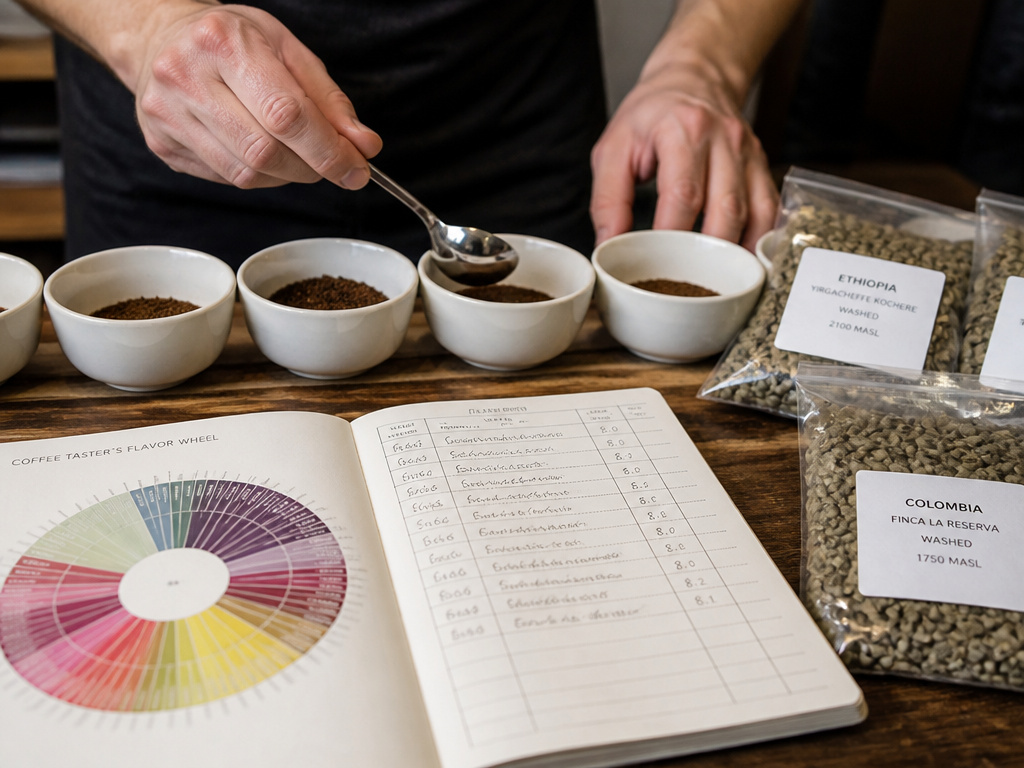
For most of the 20th century, coffee was a bulk commodity. The term “specialty coffee” was coined in 1974 by Erna Knutsen. She used it to describe high-quality green beans sold in small lots to dedicated roasters. It was a reaction against the bland, industrial blends dominating the market.
The movement formalized in 1982 with the founding of the Specialty Coffee Association (SCA). Their mission was to set quality standards and promote education. The current benchmark, SCA Standard 102-2024, provides the methods professionals use to assess green Coffea arabica. It covers everything from sample preparation to the precise tasting mechanics for scoring.
This standard enshrines the concept of terroir, the idea that soil, climate, and altitude directly impact flavor. A 2022 study in the journal Foods quantified this: coffee grown at high altitude (>1000 m) with lower rainfall (<1600 mm/year) typically yields a more aromatic, acidic cup with good body. Low-altitude, high-rainfall coffee tends toward grassiness and astringency.
The modern third-wave focus on coffee bean characteristics, traceability, and brewing methods is a direct result of this specialty revolution. It’s a return to valuing origin, not just as a story, but as a measurable quality in the cup.
How Terroir Shapes Your Morning Cup
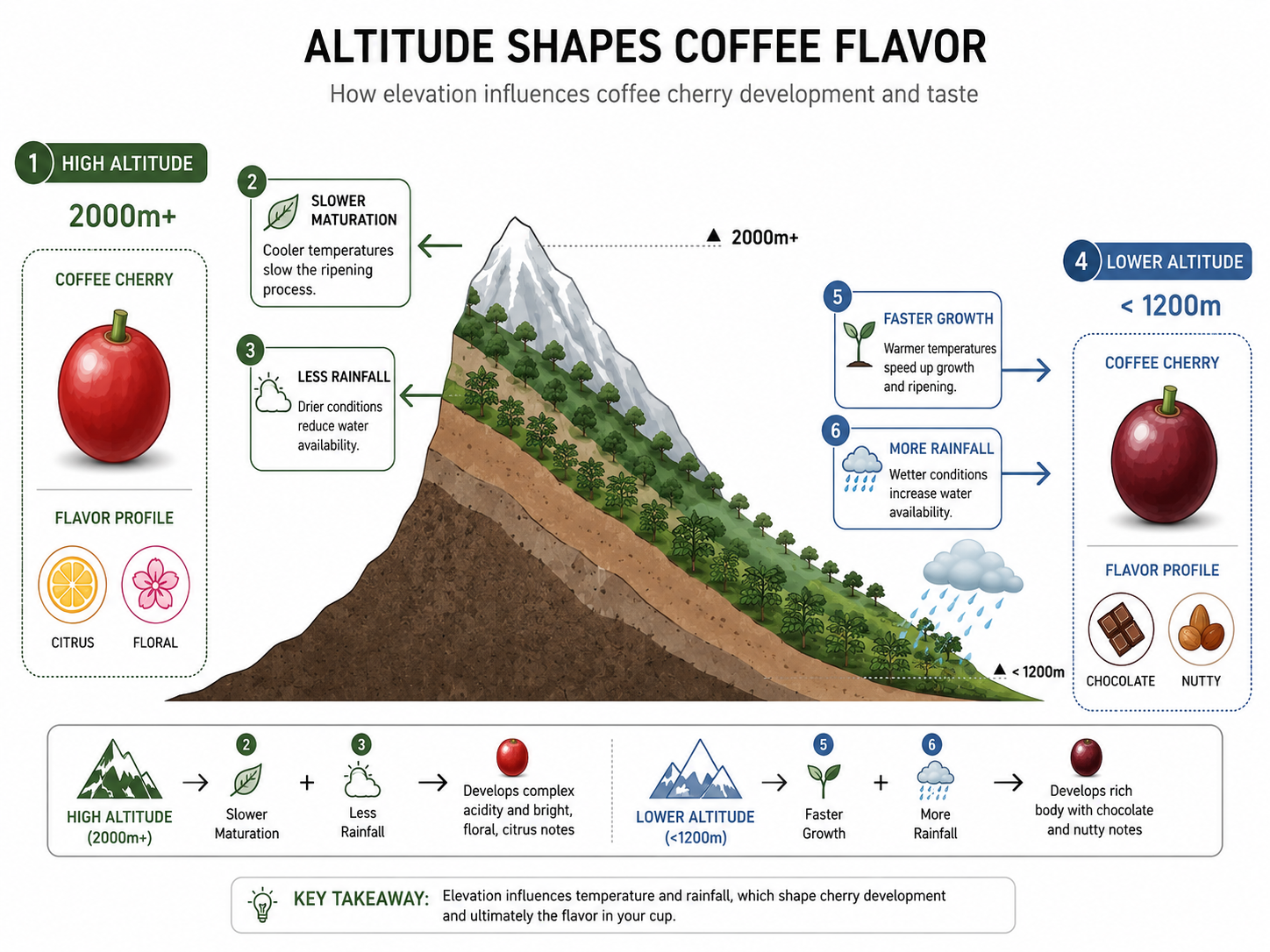
Terroir isn’t marketing. It’s environmental cause and effect. The same Coffea arabica var. Typica seed will produce wildly different coffee depending on where it’s planted.
Altitude is the biggest lever. Higher elevation means slower cherry maturation. The bean has more time to develop complex sugars. That translates directly to brighter acidity and more defined fruity or floral notes in the roast. Beans from Ethiopia’s Yirgacheffe region (grown above 2000m) are the classic example.
Rainfall matters almost as much. Too much water dilutes the concentration of flavors in the cherry. The Foods study pinpoints the sweet spot: under 1600 mm of annual rainfall. More than 2110 mm, and you start getting those grassy, under-ripe notes.
This is why single-origin coffees command a premium. You’re paying for a specific intersection of latitude, altitude, and microclimate. A blonde roast from a Kenyan high-altitude farm will crackle with citrus and wine-like acidity. A dark roast from a Brazilian lower-altitude estate will offer more chocolate and nutty notes. Neither is inherently better, they’re expressions of place.
I used to think terroir was pretentious. Then I cupped the same varietal from two farms on the same mountain, separated by just a few hundred meters in elevation. One was tart and tea-like. The other was full-bodied and sweet. The difference was the soil drainage and the morning mist pattern. Now I look for the altitude on the bag before the tasting notes.
Frequently Asked Questions
Did coffee really come from Ethiopia?
Yes, unequivocally. The wild Coffea arabica plant is native to a region spanning southeastern Ethiopia, the Boma Plateau in Sudan, and Mount Marsabit in Kenya. The earliest evidence of human cultivation comes from Harar, Ethiopia, by the 10th century.
Is the story about the goat herder Kaldi true?
It’s a foundational myth, not documented history. The tale of Kaldi discovering coffee around 850 CE is a popular legend that encapsulates coffee’s energizing effect. The historical record, including the comprehensive history found in All About Coffee by William H. Ukers, points to a more gradual process of foraging and domestication in the Ethiopian highlands and Yemen.
What’s the difference between Arabica and Robusta coffee?
Arabica (Coffea arabica) and Robusta (Coffea canephora) are two distinct species. Arabica is a tetraploid hybrid with 44 chromosomes, offering more nuanced, acidic flavors but is delicate and disease-prone. Robusta is a diploid with 22 chromosomes, delivering stronger, more bitter flavors with almost double the caffeine, and it’s much hardier. Robusta is one of arabica’s parent species.
How did coffee get from Ethiopia to the rest of the world?
Coffee traveled via trade routes across the Red Sea to Yemen by the 1400s. The Ottoman Empire then introduced it to Europe in the 1600s. European colonial powers (Dutch, French) subsequently smuggled plants to establish plantations in Java, the Caribbean, and the Americas, using enslaved labor to scale production into a global commodity.
What does “specialty coffee” actually mean?
The term was coined in 1974 to describe high-quality green coffee traded in limited quantities. It’s now defined by the Specialty Coffee Association (SCA), which sets rigorous grading standards. Coffee scoring 80+ points on a 100-point scale under SCA protocols is considered specialty grade, focusing on bean quality, traceability, and sustainable practices.
The Bottom Line
Coffee’s origin is a layered story. At the deepest level, it’s a 50,000-year-old genetic hybrid born in an African forest. The human chapter begins with Ethiopian and Yemeni cultivators, not a magical goat. Its spread across the globe is a map of trade, empire, and, for centuries, profound human exploitation.
Today, the specialty coffee movement is, in part, a corrective to that history, an attempt to return value, dignity, and attention to the place where it all began. When you sip a cup of high-grown Ethiopian brewed coffee, you’re tasting something close to the original wild fruit. You’re also tasting the outcome of a very long, very complicated journey.
{
“@context”: “https://schema.org”,
“@type”: “HowTo”,
“name”: “Trace the Origins of Coffee from Ethiopia to Your Cup”,
“totalTime”: “PT15M”,
“tool”: [
{
“@type”: “HowToTool”,
“name”: “Historical map of the Arabian Peninsula and East Africa”
},
{
“@type”: “HowToTool”,
“name”: “Genetic chart of Coffea species”
},
{
“@type”: “HowToTool”,
“name”: “Timeline of global trade routes”
}
],
“step”: [
{
“@type”: “HowToStep”,
“name”: “Start in Ethiopia’s Kaffa region”,
“text”: “Locate the tropical rainforests of southeastern Ethiopia, the Boma Plateau in Sudan, and Mount Marsabit in Kenya. This is the native range of wild Coffea arabica.”
},
{
“@type”: “HowToStep”,
“name”: “Follow the trade routes to Yemen”,
“text”: “Trace coffee’s journey across the Red Sea to the port of Al-Makha (Mocha) in Yemen, where cultivation and trade began in earnest by the 1400s.”
},
{
“@type”: “HowToStep”,
“name”: “Track the Ottoman expansion into Europe”,
“text”: “Map the establishment of coffeehouses in Venice (1645), Oxford, and London (1650s) as the Ottoman Empire introduced the beverage to European society.”
},
{
“@type”: “HowToStep”,
“name”: “Understand colonial cultivation”,
“text”: “Identify the shift to plantation farming in Java, the Caribbean, and Latin America, driven by European colonial powers and reliant on enslaved labor.”
},
{
“@type”: “HowToStep”,
“name”: “Recognize the modern specialty movement”,
“text”: “Pinpoint the 1974 coining of ‘specialty coffee’ by Erna Knutsen and the 1982 founding of the Specialty Coffee Association, which refocused on bean quality and ethical sourcing.”
}
]
}
{
“@context”: “https://schema.org”,
“@type”: “FAQPage”,
“mainEntity”: [
{
“@type”: “Question”,
“name”: “Did coffee really come from Ethiopia?”,
“acceptedAnswer”: {
“@type”: “Answer”,
“text”: “Yes, unequivocally. The wild Coffea arabica plant is native to a region spanning southeastern Ethiopia, the Boma Plateau in Sudan, and Mount Marsabit in Kenya. The earliest evidence of human cultivation comes from Harar, Ethiopia, by the 10th century.”
}
},
{
“@type”: “Question”,
“name”: “Is the story about the goat herder Kaldi true?”,
“acceptedAnswer”: {
“@type”: “Answer”,
“text”: “It’s a foundational myth, not documented history. The tale of Kaldi discovering coffee around 850 CE is a popular legend that encapsulates coffee’s energizing effect. The historical record, including the comprehensive history found in All About Coffee by William H. Ukers, points to a more gradual process of foraging and domestication in the Ethiopian highlands and Yemen.”
}
},
{
“@type”: “Question”,
“name”: “What’s the difference between Arabica and Robusta coffee?”,
“acceptedAnswer”: {
“@type”: “Answer”,
“text”: “Arabica (Coffea arabica) and Robusta (Coffea canephora) are two distinct species. Arabica is a tetraploid hybrid with 44 chromosomes, offering more nuanced, acidic flavors but is delicate and disease-prone. Robusta is a diploid with 22 chromosomes, delivering stronger, more bitter flavors with almost double the caffeine, and it’s much hardier. Robusta is one of arabica’s parent species.”
}
},
{
“@type”: “Question”,
“name”: “How did coffee get from Ethiopia to the rest of the world?”,
“acceptedAnswer”: {
“@type”: “Answer”,
“text”: “Coffee traveled via trade routes across the Red Sea to Yemen by the 1400s. The Ottoman Empire then introduced it to Europe in the 1600s. European colonial powers (Dutch, French) subsequently smuggled plants to establish plantations in Java, the Caribbean, and the Americas, using enslaved labor to scale production into a global commodity.”
}
},
{
“@type”: “Question”,
“name”: “What does \”specialty coffee\” actually mean?”,
“acceptedAnswer”: {
“@type”: “Answer”,
“text”: “The term was coined in 1974 to describe high-quality green coffee traded in limited quantities. It’s now defined by the Specialty Coffee Association (SCA), which sets rigorous grading standards. Coffee scoring 80+ points on a 100-point scale under SCA protocols is considered specialty grade, focusing on bean quality, traceability, and sustainable practices.”
}
}
]
}
