
Discover Where Coffee Comes From: A Journey from Bean to Cup
Coffee comes from the seeds of a fruit produced by evergreen shrubs or small trees in the Coffea genus, primarily Coffea arabica and Coffea canephora (Robusta). Its geographic origin is the ancient coffee forests of southwestern Ethiopia, from where it spread across the Arabian Peninsula before becoming a global commodity cultivated in the tropical “Bean Belt.”
Most people think the story ends with a goat herder and some energetic goats. They miss the 1,200 years of trade, politics, religion, and science that turned a wild forest plant into the world’s most traded agricultural commodity after crude oil.
This guide tracks coffee’s journey from its biological roots in Ethiopia to your morning cup. We will cover the plant’s botany, the legend of Kaldi, the pivotal spread through the Ottoman Empire, and how modern coffee production methods shape what you taste today.
Key Takeaways
- Coffee “beans” are actually the seeds inside a cherry-like fruit from plants in the Rubiaceae family, with over 130 species, though only two dominate global trade.
- The fabled Ethiopian goat herder Kaldi is a popular origin myth, but historical records confirm coffee’s cultivation and cultural use in Yemen by the 1400s.
- Coffee’s flavor is a product of terroir, a combination of geography, climate, and post-harvest processing, not just the roast.
- The global coffee industry was built on colonial plantation systems, and its modern structure still grapples with issues of equity and sustainability.
- Climate change directly threatens the equatorial “Bean Belt,” pushing research into hybrid species and resilient farming practices.
The Botanical Origin: Not a Bean, But a Seed
Calling it a coffee bean is a misnomer that sticks. You are drinking a processed seed.
The plant is a perennial evergreen shrub or small tree classified in the Rubiaceae family. The genus Coffea contains about 130 species, but the commercial world runs on just two: Coffea arabica (Arabica) and Coffea canephora, commercially known as Robusta. Arabica is the prize, making up 55–60% of the world’s coffee supply and prized for its nuanced acidity and complex flavors. Robusta, as the name hints, is hardier, higher in caffeine, and often used in blends and instant coffee.
Coffee (Coffea spp.) comprises perennial evergreen shrubs or small trees in the family Rubiaceae. The two main species grown for global consumption are Coffea arabica L. and Coffea canephora Pierre ex A.Froehner (Robusta coffee). (Pérez-Hernández et al., 2024)
The fruit is called a cherry. Each cherry typically holds two seeds, facing each other flat-side in. Those seeds are the green coffee beans you’d recognize before roasting. A rare single-seed cherry is called a peaberry, often separated and sold at a premium for its concentrated flavor.
TL;DR: Your coffee “bean” is the seed of a cherry from an evergreen shrub, with Arabica and Robusta being the two main species driving the global market.
The Legendary Birthplace: Ethiopia and the Kaldi Myth
Every origin story needs a myth. Ours has goats.
The tale goes that around 850 CE, an Ethiopian goat herder named Kaldi noticed his flock became unusually energetic after eating red berries from a certain bush. He tried the berries himself, felt the buzz, and brought them to a local monastery. A monk, disapproving of their stimulant effect, threw them into a fire. The roasted beans released a captivating aroma, leading to the first crude brewing.
It is a good story. It is almost certainly not true in any historical sense, but it points to a truth: humans discovered coffee’s effects through observation in the wild. The real history is less fabled but more fascinating. Long before the 1400s, people in the region of Kaffa in southwestern Ethiopia were foraging for wild coffee. They consumed it as a food, often mixing the berries with animal fat for energy, or brewing a tea from the leaves.
The plant’s native environment is the understory of Ethiopian forests. The high caffeine content in its leaves and seeds likely evolved as a natural pesticide. That same chemical defense became the stimulant we crave. From these forests, coffee began its long journey, not as a cultivated crop, but as a traded curiosity.
The Journey Out of Africa: Mocha, Mecca, and the Ottoman Empire
Coffee did not become a global phenomenon in Africa. It became one in Yemen.
By the 1450s, upon returning from Ethiopia, a Sufi mystic in Yemen recommended coffee to help worshippers stay awake during long nocturnal rituals. This religious endorsement was the spark. Cultivation began in the Yemeni mountains, and the port city of Al-Makha, anglicized as Mocha, became the sole export point. For centuries, Mocha was synonymous with coffee.
The beverage moved north into the heart of the Ottoman Empire. By the early 1500s, Constantinople (Istanbul) was full of coffeehouses, called qahveh khaneh. They were social hubs for conversation, music, and political debate. Authorities grew suspicious.
Common mistake: Assuming coffee was always widely accepted. In 1511, it was put on trial in Mecca by a religious court concerned it was an intoxicant. Scholars ultimately deemed it permissible, a ruling that allowed coffee culture to flourish.
This legal victory was critical. Coffeehouses spread to Damascus, Aleppo, and Cairo. The Ottoman Empire controlled the trade fiercely, forbidding the export of fertile beans to maintain monopoly. The beans were boiled or partially roasted before export to prevent germination.
It was a Dutch trader who finally smuggled a live coffee plant out of the port of Mocha in 1616. That single plant is the progenitor of most coffee grown in the Americas today. The Dutch began cultivation in their colony of Ceylon (Sri Lanka) and later in Java, Indonesia. “Java” entered the lexicon as another nickname for coffee.
| Era | Key Event | Significance |
|---|---|---|
| Pre-1400s | Foraging in Ethiopia | Indigenous consumption as food/tea |
| 1450s | Sufi adoption in Yemen | Coffee becomes linked to ritual and cultivation begins |
| 1511 | Mecca coffee trial | Religious approval removes a major barrier to spread |
| 1616 | First live plant smuggled from Mocha | Breaks Arabian monopoly, enables New World cultivation |
| 1650s | First coffeehouses in London | Coffee enters European public and intellectual life |
Crossing Continents: Coffee Comes to Europe and the Americas

Europe’s first encounter was through travelers. The German physician Leonhard Rauwolf mentioned coffee in his writings in 1582. The first European coffeehouse opened in Venice in 1645. When coffee reached England, it fueled not just individuals but the Enlightenment itself.
London’s first coffeehouse opened in 1652. By 1663, there were over 80. They were called “penny universities” because for a penny, you could get a coffee and engage in scholarly debate. King Charles II tried to ban them in 1675, fearing sedition, but public outcry forced him to back down. In Paris, cafes like Café Procope hosted Voltaire and Diderot. Voltaire supposedly drank 50 small cups a day.
The beverage crossed the Atlantic early. The first coffee license in North America was granted to Dorothy Jones in Boston in 1670. William Penn bought green coffee beans from New York merchants in 1683. But coffee remained a relative luxury compared to tea, until the Boston Tea Party of 1773 made tea unpatriotic and coffee the American drink of choice.
Cultivation in the New World was a darker story. European empires established plantations in Java, Ceylon, and later the Caribbean and Latin America. This system was built on enslaved and exploited labor. Vast forests were cleared, indigenous populations displaced. By 1906, Brazil alone was supplying over 80% of the world’s coffee, a dominance built on immense scale and often brutal labor practices. This history is the unshakable foundation of the modern global coffee cultivation guide.
TL;DR: Coffee’s spread was a mix of trade, smuggling, and colonial expansion, transforming it from a Middle Eastern luxury to a European intellectual catalyst and, finally, a mass commodity produced in the Americas.
The Bean Belt and Modern Cultivation
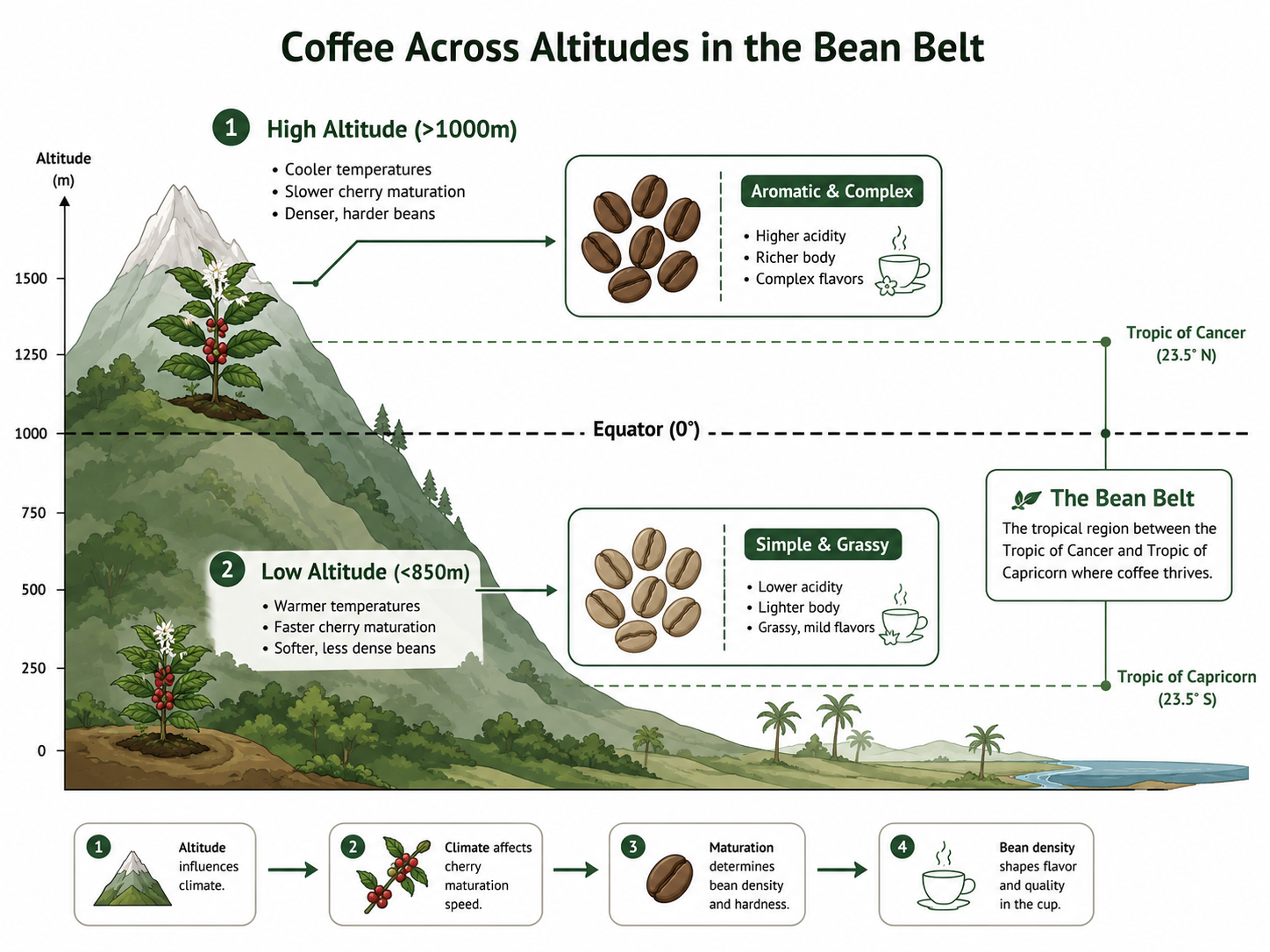
Today, coffee does not grow just anywhere. It thrives in the “Bean Belt,” a band around the equator between the Tropics of Cancer and Capricorn (roughly 25°N and 25°S latitude). This region provides the ideal combination of steady warmth, ample rainfall, and high altitude.
Altitude is a primary driver of quality within this belt. High-altitude growth (above 1,000 meters) in cooler temperatures slows bean development, leading to denser, harder beans with more concentrated sugars and complex acids. Coffee from these regions is often described as aromatic, acidic, and full-bodied. Low-altitude coffee (below 850 meters) matures faster, producing softer, less dense beans associated with more bitterness and simpler, sometimes grassy flavors.
The concept of terroir, the complete natural environment in which a coffee is grown, is paramount. A 2022 study in the journal Foods defined it as the sum of soil, topography, climate, and biodiversity. But unlike wine, coffee’s terroir isn’t fixed at harvest. Post-harvest processing, whether the cherry is sun-dried (natural), washed, or honey processed, happens in the country of origin under local conditions and massively influences the final cup. This means processing is part of coffee’s terroir.
Roasting typically occurs in the country of consumption, not production. While terroir is considered fixed once green beans are shipped, an inappropriate roast can destroy its characteristics, whereas a skilled roast highlights them. (Rao & Fuller, 2022)
| Factor | High-Quality Association | Lower-Quality Association |
|---|---|---|
| Altitude | > 1000 meters | < 850 meters |
| Rainfall | < 1600 mm/year | > 2110 mm/year |
| Outcome | Aromatic, acidic, full-bodied | More bitter, grassy, astringent |
TL;DR: Quality coffee is a product of its specific place (terroir) and post-harvest processing, with high-altitude, lower-rainfall regions generally producing more complex and desirable flavors.
From Seed to Cup: Processing, Roasting, and Global Trade
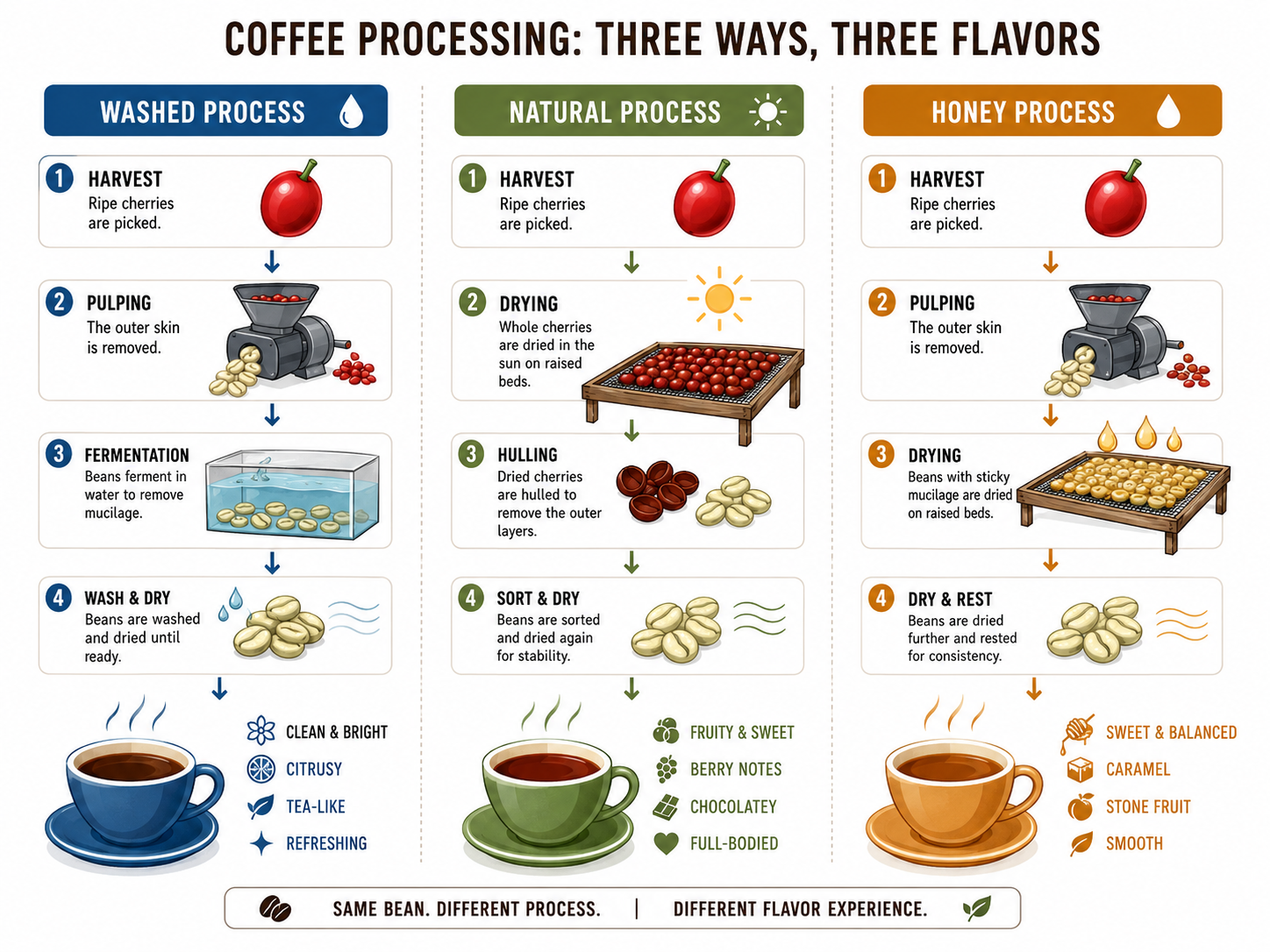
Once harvested, the coffee cherry must be processed to remove the fruity pulp and reach the green bean. The three main methods create wildly different flavor profiles in your single-origin coffee.
- Washed (Wet) Process: The pulp is mechanically removed, and the beans are fermented in water tanks to break down the remaining mucilage before washing and drying. This method highlights the bean’s inherent acidity and clarity, often yielding cleaner, brighter cups.
- Natural (Dry) Process: Whole cherries are dried in the sun, allowing the fruit to ferment around the bean. This imparts intense fruitiness, sweetness, and body, but risks funky, fermented flavors if not meticulously managed.
- Honey (Pulped Natural) Process: A middle ground. The skin is removed, but some sticky mucilage (the “honey”) is left on during drying. It offers a balance of body and sweetness with more control than the natural process.
After processing and milling, the green beans are bagged and shipped worldwide. Roasting is almost always done in the consuming country. This is where chemistry takes over: the Maillard reaction and caramelization develop the flavors, aromas, and brown color we associate with coffee. A light roast preserves more of the origin character; a dark roast imposes more of the roast’s own flavors.
The journey creates a complex supply chain with persistent challenges. Most coffee is sold as a commodity on futures markets, where the price has little to do with quality or sustainable production costs. This system often leaves farmers vulnerable. In response, the specialty coffee movement and direct trade models have emerged, emphasizing quality, transparency, and paying farmers premiums. Certifications like Fair Trade and Rainforest Alliance aim to address social and environmental issues, though their effectiveness is debated.
Common mistake: Believing a dark roast denotes stronger caffeine content or higher quality. Dark roasting actually burns off caffeine and can obscure the nuanced flavors of a high-quality, high-altitude bean. The “strength” is about flavor intensity, not stimulant power.
Frequently Asked Questions
Did coffee really come from Ethiopia?
Yes, unequivocally. While the Kaldi legend is folklore, botanical and historical evidence confirms Coffea arabica is indigenous to the southwestern highland forests of Ethiopia. It was there that the plant evolved and where humans first encountered it.
What’s the difference between Arabica and Robusta beans?
Arabica beans are generally oval with a sinuous crease, prized for their sweeter, more complex flavors with higher acidity. Robusta beans are rounder with a straight crease, contain almost double the caffeine, and taste stronger, harsher, and more bitter. Arabica dominates the specialty market, while Robusta is common in instant coffee and espresso blends for crema and caffeine kick.
Why is some coffee so expensive?
Price reflects rarity, labor, and logistics. Gesha varieties or competition-winning lots from specific farms are scarce. Processing methods like natural or anaerobic fermentation are labor-intensive. Civet coffee (Kopi Luwak) and Black Ivory Coffee (made from beans digested by elephants) involve costly, low-yield animal processing. Ultimately, you pay for story, perceived exclusivity, and intensive manual labor.
How does where coffee is grown affect its taste?
Terroir is everything. Soil minerals affect nutrient uptake. Altitude and temperature control bean density and sugar development. Rainfall patterns influence cherry development. A Kenyan coffee grown in volcanic soil at high altitude will taste bright and winey. A Brazilian coffee from lower, rolling hills will taste nuttier and chocolatey. This is the core appeal of exploring geographic coffee origins.
What is the “Bean Belt”?
The Coffee Bean Belt is the geographical zone between the Tropics of Cancer and Capricorn where climate conditions are suitable for coffee cultivation. It includes parts of Central and South America, Africa, and Asia. This belt provides the consistent warmth, but not extreme heat, and seasonal rainfall that coffee plants need.
Is the coffee industry sustainable?
It faces significant challenges. Conventional monoculture farming can lead to deforestation and soil depletion. Climate change is shrinking viable land in the Bean Belt and increasing pests. Price volatility threatens farmer livelihoods. Sustainable practices like shade-growing, organic farming, and direct trade models exist, but scaling them across a commodity-driven industry is an ongoing struggle.
The Bottom Line
Coffee’s origin is a layered story. It begins biologically in the Ethiopian understory as a seed inside a cherry. It traveled as a cultural artifact, a religious aid, a political talking point, and a colonial commodity. Where your coffee comes from today is a specific point on a map within the Bean Belt, a place where altitude, soil, and climate conspire to create a unique flavor profile.
That profile is then shaped by human hands, by the farmer’s harvest, the mill’s chosen coffee production process, and finally, the roaster’s craft. Understanding this journey does more than satisfy curiosity. It changes how you taste. You stop just drinking “coffee” and start tasting a place, a process, and a history.
Seek out that information on your next bag. Look for the country, the region, the process. Try a washed Ethiopian Yirgacheffe next to a natural Brazilian Santos. The difference is the story, and it is all right there in the cup.
{
“@context”: “https://schema.org”,
“@type”: “HowTo”,
“name”: “How to Trace the Origin of Your Coffee”,
“totalTime”: “PT15M”,
“tool”: [
{
“@type”: “HowToTool”,
“name”: “A bag of roasted coffee beans”
},
{
“@type”: “HowToTool”,
“name”: “A smartphone or computer with internet access”
}
],
“step”: [
{
“@type”: “HowToStep”,
“name”: “Identify the species”,
“text”: “Check your coffee bag for the species, usually listed as Arabica (Coffea arabica) or Robusta (Coffea canephora). Arabica accounts for about 60% of global supply and is typically associated with higher quality.”
},
{
“@type”: “HowToStep”,
“name”: “Locate the geographic origin”,
“text”: “Look for a country, region, or farm name on the packaging. This is the coffee’s terroir. Coffee grows in the ‘Bean Belt’ between 25°N and 25°S latitude.”
},
{
“@type”: “HowToStep”,
“name”: “Research the processing method”,
“text”: “Note if it’s washed, natural, or honey processed. This post-harvest step, often done in the country of origin, significantly impacts flavor and is part of the coffee’s terroir story.”
},
{
“@type”: “HowToStep”,
“name”: “Consider the roast date and profile”,
“text”: “A lighter roast preserves more of the origin’s inherent flavors. Roasting occurs in the consuming country, and an inappropriate roast can obscure the terroir characteristics.”
}
]
}
{
“@context”: “https://schema.org”,
“@type”: “FAQPage”,
“mainEntity”: [
{
“@type”: “Question”,
“name”: “Did coffee really come from Ethiopia?”,
“acceptedAnswer”: {
“@type”: “Answer”,
“text”: “Yes, unequivocally. While the Kaldi legend is folklore, botanical and historical evidence confirms Coffea arabica is indigenous to the southwestern highland forests of Ethiopia. It was there that the plant evolved and where humans first encountered it.”
}
},
{
“@type”: “Question”,
“name”: “What’s the difference between Arabica and Robusta beans?”,
“acceptedAnswer”: {
“@type”: “Answer”,
“text”: “Arabica beans are generally oval with a sinuous crease, prized for their sweeter, more complex flavors with higher acidity. Robusta beans are rounder with a straight crease, contain almost double the caffeine, and taste stronger, harsher, and more bitter. Arabica dominates the specialty market, while Robusta is common in instant coffee and espresso blends for crema and caffeine kick.”
}
},
{
“@type”: “Question”,
“name”: “Why is some coffee so expensive?”,
“acceptedAnswer”: {
“@type”: “Answer”,
“text”: “Price reflects rarity, labor, and logistics. Gesha varieties or competition-winning lots from specific farms are scarce. Processing methods like natural or anaerobic fermentation are labor-intensive. Civet coffee (Kopi Luwak) and Black Ivory Coffee (made from beans digested by elephants) involve costly, low-yield animal processing. Ultimately, you pay for story, perceived exclusivity, and intensive manual labor.”
}
},
{
“@type”: “Question”,
“name”: “How does where coffee is grown affect its taste?”,
“acceptedAnswer”: {
“@type”: “Answer”,
“text”: “Terroir is everything. Soil minerals affect nutrient uptake. Altitude and temperature control bean density and sugar development. Rainfall patterns influence cherry development. A Kenyan coffee grown in volcanic soil at high altitude will taste bright and winey. A Brazilian coffee from lower, rolling hills will taste nuttier and chocolatey. This is the core appeal of exploring geographic coffee origins.”
}
},
{
“@type”: “Question”,
“name”: “What is the \”Bean Belt\”?”,
“acceptedAnswer”: {
“@type”: “Answer”,
“text”: “The Coffee Bean Belt is the geographical zone between the Tropics of Cancer and Capricorn where climate conditions are suitable for coffee cultivation. It includes parts of Central and South America, Africa, and Asia. This belt provides the consistent warmth, but not extreme heat, and seasonal rainfall that coffee plants need.”
}
},
{
“@type”: “Question”,
“name”: “Is the coffee industry sustainable?”,
“acceptedAnswer”: {
“@type”: “Answer”,
“text”: “It faces significant challenges. Conventional monoculture farming can lead to deforestation and soil depletion. Climate change is shrinking viable land in the Bean Belt and increasing pests. Price volatility threatens farmer livelihoods. Sustainable practices like shade-growing, organic farming, and direct trade models exist, but scaling them across a commodity-driven industry is an ongoing struggle.”
}
}
]
}
