
Where Does Arabica Coffee Come From? Origin & Global Journey
Arabica coffee comes from the species Coffea arabica, which is native to the highland rainforests of southwestern Ethiopia and the Boma Plateau in South Sudan. Every Arabica plant grown worldwide traces its genetics back to seeds taken from this region, primarily via Yemen, beginning in the 17th century.
Most people think “Arabica” means the beans come from Arabia. That’s a historic mix-up. The name stuck because the beans first entered global trade through Yemen, but the plant itself has never grown wild there.
This guide cuts through the trade routes and brand stories to show you the plant’s actual home, its unique genetic fingerprint, and the surprisingly narrow path it took to reach your cup. You’ll learn why its origin still dictates its flavor, its vulnerabilities, and its price.
Key Takeaways
- The only wild, native populations of Coffea arabica exist in the forests of southwestern Ethiopia and South Sudan’s Boma Plateau.
- Arabica is a natural allotetraploid, a genetic accident that makes it self-fertile and different from every other coffee species.
- The global spread started with seeds smuggled from Yemen to Europe, with documented failures like a 1699 batch wiped out by an earthquake in Batavia.
- Over 97% of Brazil’s vast coffee crop descends from just two Ethiopian varieties: Typica and Bourbon.
- The link between origin and flavor is mechanical: high-altitude, slow growth in volcanic soil directly creates the complex sugars and acids we taste as fruity, floral notes.
The True Origin: Ethiopia’s Rainforests and South Sudan’s Boma Plateau
Forget the map of modern coffee-producing nations. To find where Arabica coffee comes from, you look to a specific slice of East Africa. The Royal Botanic Gardens, Kew, states the native range is Southern Ethiopia and South Sudan. Primary sources like a World Agroforestry Centre PDF note the name may even derive from the Kefa region in Ethiopia.
Coffea arabica is indigenous to the afromontane rainforests of southwestern Ethiopia and southeastern South Sudan. Genetic studies confirm this region as the center of origin and diversity for the species, with all cultivated Arabica tracing back to a tiny genetic pool exported from here and Yemen.
The Boma Plateau in South Sudan is a confirmed native site. There’s also Mount Marsabit in northern Kenya, but recent studies suggest those trees are naturalized, likely planted long ago from Ethiopian seeds, not truly wild. The distinction matters. Native means the plant evolved there over millennia, developing the genetic diversity that breeders now scramble to preserve. Naturalized just means it grows well there now.
This region isn’t just a dot on a map. It’s a specific ecosystem: high-altitude, tropical rainforests. The soil, climate, and biodiversity of these forests shaped the coffee plant’s fundamental biology. The slow growth caused by cooler highland temperatures allows more time for complex sugars to develop in the cherry. That’s not marketing. It’s botany.
TL;DR: Wild Arabica coffee only grows natively in Ethiopia’s southwestern highlands and South Sudan’s Boma Plateau. Every other Arabica plant on Earth is a descendant.
A Genetic Accident: What Makes Arabica Unique
Arabica isn’t just another coffee plant. It’s a genetic outlier. Most coffee species, like Robusta (Coffea canephora), are diploid. They have 22 chromosomes (2n = 2x = 22) and are generally self-incompatible, needing cross-pollination from another plant.
Arabica is a natural allotetraploid. It has 44 chromosomes (2n = 4x = 44). This likely happened from a chance hybridization between two other diploid coffee species in the wild Ethiopian forests thousands of years ago. The result is a self-fertile plant. An Arabica flower can pollinate itself, which leads to more genetic consistency but also less diversity over generations.
This genetic quirk explains two things every coffee drinker should know. First, it’s why Arabica breeds true. A Typica seed will grow into a Typica plant. This stability allowed early traders to carry a few seeds and reliably establish a crop. Second, it’s the root of Arabica’s celebrated “clean” flavor. The biochemical pathways in this tetraploid plant produce fewer bitter-tasting compounds like chlorogenic acids compared to Robusta.
But there’s a trade-off. That same genetic uniformity is Arabica’s biggest weakness. A disease that attacks one plant can often attack them all. The famous coffee leaf rust fungus has devastated monoculture Arabica farms because the plants lack the genetic toolbox to fight it off. In its native Ethiopian forests, wild Arabica plants show more resistance, a diversity now being mined by scientists to save the global crop.
| Genetic Trait | Coffea arabica (Arabica) | Coffea canephora (Robusta) | Impact on Flavor & Farming |
|---|---|---|---|
| Chromosome Count | 44 (Allotetraploid) | 22 (Diploid) | Arabica’s sugars develop differently, leading to more complex acidity and fruit notes. |
| Self-Fertility | Self-fertile | Mostly self-incompatible | Makes Arabica easier to propagate but reduces genetic diversity over time, increasing disease risk. |
| Caffeine Content | ~1.2–1.5% | ~2.2–2.7% | Lower caffeine contributes to Arabica’s milder, less bitter taste profile. |
| Ideal Climate | 15–24°C, high altitude | 20–30°C, lower altitude | Arabica’s need for cooler temps restricts it to specific highland geographies, limiting where it can grow well. |
The Great Migration: From Ethiopian Forests to Global Farms
The journey from an Ethiopian forest to a Brazilian estate is a tale of botany, colonialism, and sheer luck. It didn’t happen all at once. It progressed in documented waves, with literal shipwrecks and earthquakes altering the timeline.
The first move was likely the shortest. Sometime before the 15th century, coffee plants or seeds crossed the Red Sea from Ethiopia to Yemen. This is where the name “Arabica” solidified in trade. For centuries, Yemen controlled the world’s supply.
The breakout began in the 17th century. The Dutch, trying to break the monopoly, got seeds from Yemen. Their first attempt in 1690 failed. A second batch sent to Batavia (now Jakarta) initially succeeded, only to be wiped out by an earthquake in 1699. They tried again.
From the Netherlands, a coffee plant became a royal gift. After the 1714 Utrecht peace treaty, the mayor of Amsterdam gave one to France’s King Louis XIV. It was planted in the Jardin des Plantes in Paris. That single plant, and its offspring, changed the hemisphere. A seedling from that Parisian garden was sent to the French colony of Martinique in 1723.
From Martinique, the Typica variety spread: to Jamaica in 1730, Santo Domingo in 1735, Cuba in 1748, and then to Costa Rica in 1779 and El Salvador by 1840. Meanwhile, the Bourbon variety (named for Bourbon Island, now La Réunion) had a separate, slower journey. French attempts to establish it there succeeded only after multiple tries in 1708, 1715, and 1718. Bourbon didn’t leave the island until the mid-19th century, reaching Brazil around 1860.
Common mistake: Thinking Brazil always grew coffee. Arabica only reached northern Brazil in 1727 and southern Brazil between 1760 and 1770. The nation’s dominance was built on these late-arriving Ethiopian descendants.
This historical bottleneck is why the genetics are so narrow. World Coffee Research notes that in Brazil, which grows 40% of the world’s coffee, 97.55% of cultivars descend from just Typica and Bourbon. Your morning cup has less genetic variation than a cheetah.
Why Origin Dictates Flavor and Price
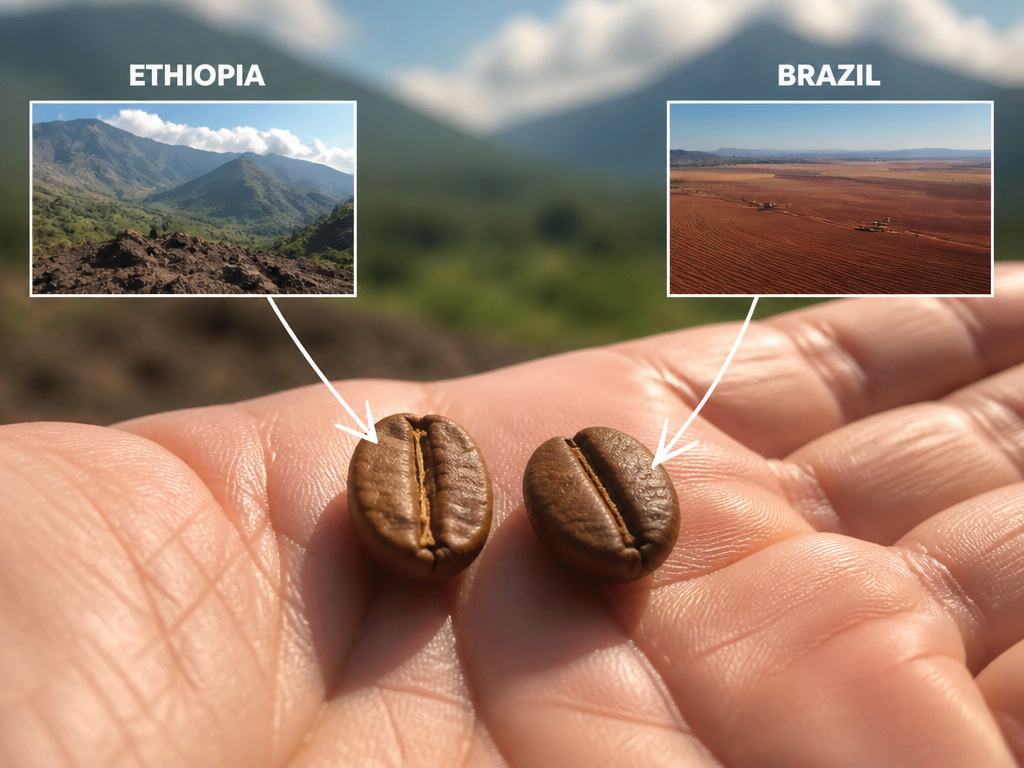
A coffee plant grown in Brazil tastes different from the same plant grown in Ethiopia. This isn’t just branding. It’s a direct result of the physical and chemical environment, the terroir. The factors baked into the plant’s native home still control the bean in your grinder.
Elevation is the master variable. Arabica thrives between 1,200 and 2,200 meters. At these heights, cooler temperatures force the cherry to mature slowly, sometimes over 9 months. This extended ripening allows more complex carbohydrates to break down into nuanced sugars and acids. A study on wild Ethiopian coffee found bean size and weight varied directly with location, influenced by local soil properties like pH and available phosphorus.
Soil matters just as much. The volcanic, well-drained soils of the Ethiopian highlands and other prime regions like the Colombian Andes are rich in minerals. These nutrients are absorbed by the plant and influence the bean’s mineral content, which in turn affects how heat transfers during roasting and the final flavor compounds.
The 7-Step Chain from Origin to Flavor Profile:
- High Altitude & Cool Climate: Slows cherry maturation.
- Extended Ripening: Increases sugar development and acid complexity within the seed.
- Volcanic/Mineral-Rich Soil: Provides specific nutrients that alter bean composition.
- Specific Harvest Method: Hand-picking only ripe cherries (common in Kenya/Ethiopia) versus strip-picking entire branches (common in Brazil).
- Processing Method: Washed, natural, or honey processing dramatically changes sugar contact and fermentation.
- Roast Profile: Light roasts preserve origin characteristics; dark roasts mask them with roast flavors.
- Grind & Brew: Extraction either highlights or muddles the delicate acids and sugars developed in steps 1-3.
This is why single-origin coffees command a premium. They are the unblunted expression of one place’s specific conditions. A single-origin coffee from Yirgacheffe, Ethiopia, will taste recognizably floral and tea-like. A bean from the same genetic stock grown in the flat, warmer fields of Minas Gerais, Brazil, will taste nuttier and heavier. The plant remembers where it was grown.
From Single Origin to Your Cup
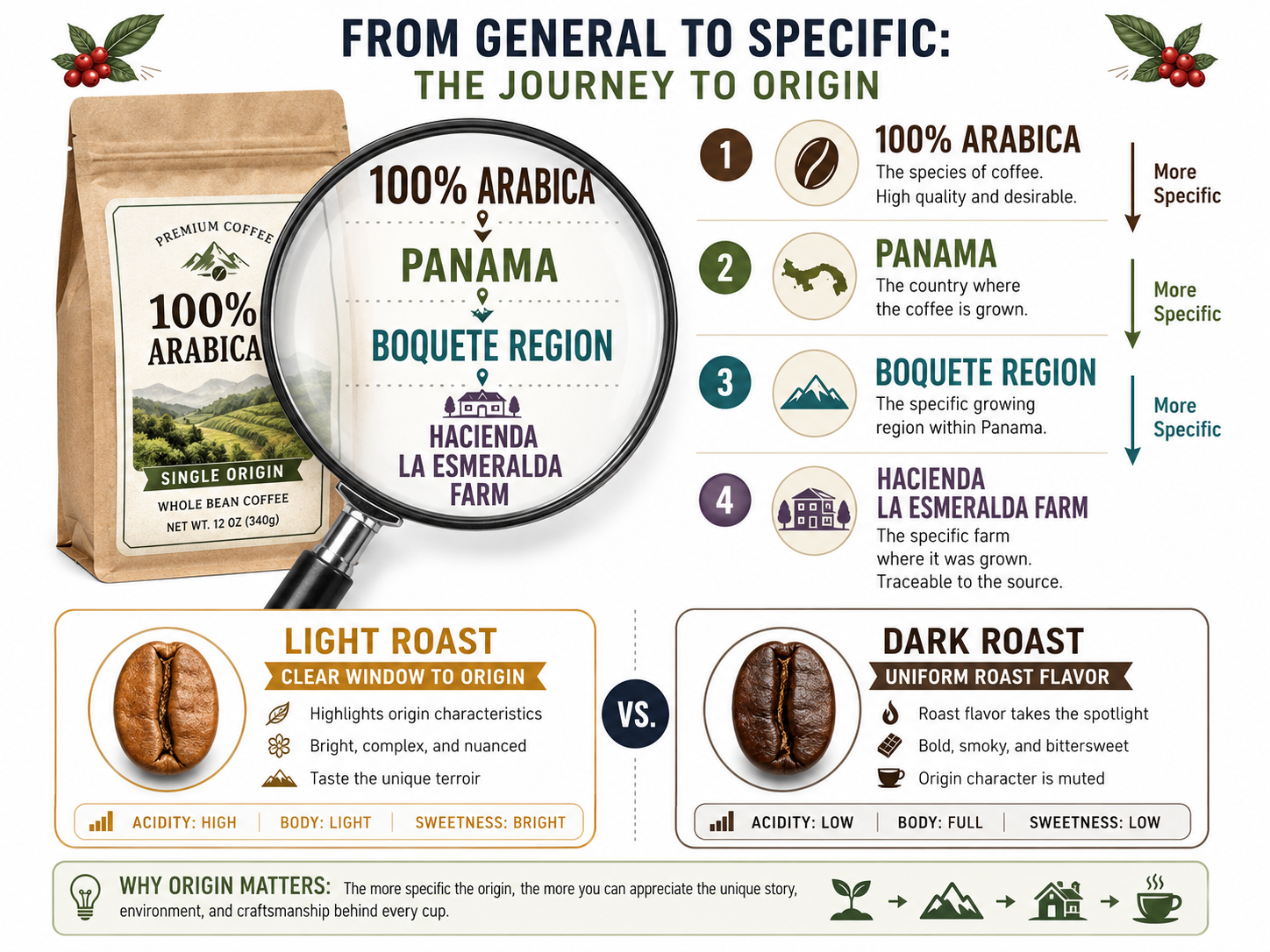
Understanding where Arabica coffee comes from changes how you buy it. The label is a story waiting to be decoded.
First, look past “100% Arabica.” That’s a bare minimum, a commodity baseline. Look for a country. Then, look for a region. Then, look for a farm or cooperative name. Each step deeper is a step closer to the specific plot of land that grew your beans. A “Panama Boquete” is more specific than “Panama,” and a “Panama Hacienda La Esmeralda” tells you exactly which mountain slope.
This specificity is what defines true single-origin coffees. Their flavors are a direct report from that soil and climate. Blends exist to create a consistent flavor year-round by mixing beans from different origins, smoothing out the variations that make single-origins exciting and variable.
The roasting level is the final interpreter. Light roasts are like a clear window. They let the origin’s intrinsic flavors, bright acidity, floral notes, specific fruit tones, shine through. This is why specialty roasters often use lighter profiles for high-end single-origins. Dark roasts are more like a filter. They apply a strong, uniform taste of roast (chocolate, smoke, bitterness) that can cover up a bean’s subtleties or defects. This makes them popular for coffee blends and commodity coffee.
I default to light roasts for any bag that lists a specific farm. If the roaster went to the trouble to source that specifically, a dark roast burns away the story they paid for. The one exception is for milk drinks, a medium-dark roast can stand up to the fat and sweetness better.
Your brewing method is the last variable. A pour-over with a burr grinder producing consistent grounds will highlight clarity and distinct origin notes. An espresso machine, with its high pressure and often darker roast, emphasizes body and intensity. Matching your gear to the bean’s story gets you the most from it.
TL;DR: Buy coffee labeled with a specific country, region, and farm. Pair light roasts with pour-over methods to taste the origin. Use darker roasts and espresso for blended, chocolatey profiles.
The Future of Arabica: Conservation and Climate
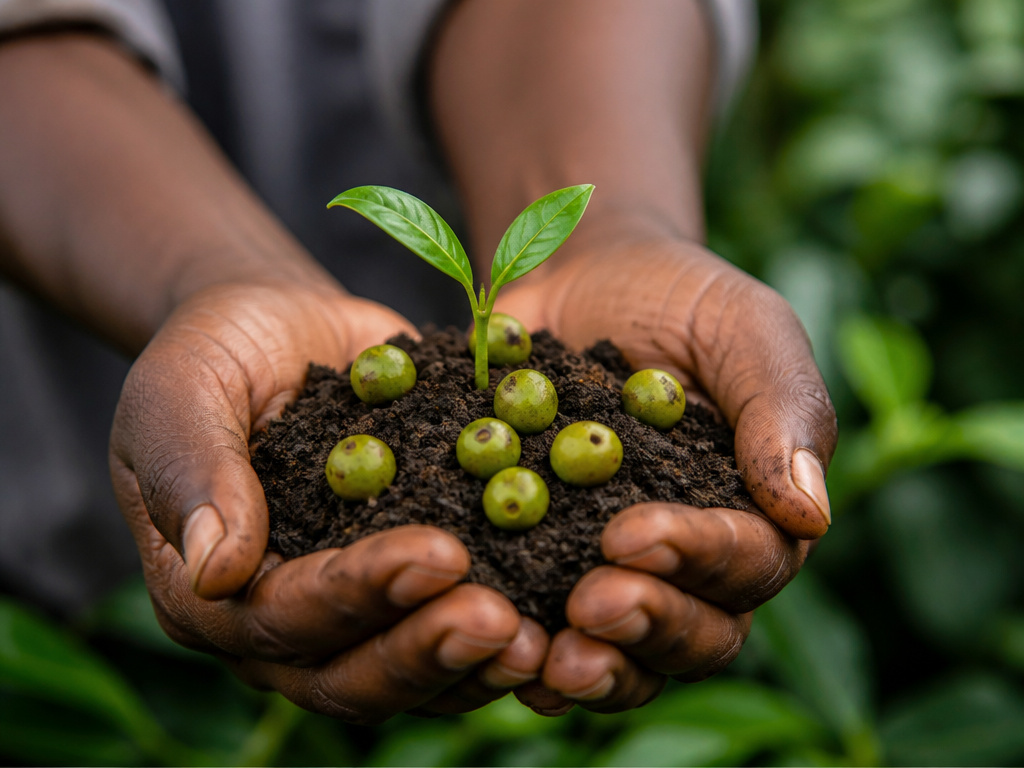
The forests of southwestern Ethiopia are more than a historic site. They are a living genetic bank. The wild Arabica plants there possess traits, like disease resistance or drought tolerance, that are barely present in the cultivated global crop. As climate change pushes temperatures up in traditional coffee belts, and diseases like leaf rust spread, these wild genes are our best hope for developing new, resilient varieties.
The problem is those forests are shrinking. Deforestation for agriculture and development threatens the wild populations. Conservation isn’t about preserving a museum piece; it’s about securing the raw material needed for coffee’s future. Organizations like World Coffee Research are cataloging this genetic diversity, but in-situ conservation, protecting the actual forests, is critical.
For the coffee drinker, this means the story of origin is becoming a story of sustainability. Buying coffee from roasters or importers who support direct trade, farm-level relationships, and environmental stewardship in origin countries isn’t just ethical. It’s an investment in keeping the diverse flavors of coffee alive. The cup you enjoy today depends on the health of those Ethiopian forests yesterday.
Frequently Asked Questions
Is all Arabica coffee from Ethiopia?
No. While Ethiopia is the genetic homeland, Arabica is now cultivated in over 50 countries across Latin America, Africa, and Asia. However, all these plants are descendants of seeds originally taken from Ethiopia (via Yemen). The unique flavors of Ethiopian coffees come from the native heirloom varieties still growing there.
What’s the difference between Arabica and Colombian coffee?
“Arabica” is the species of coffee plant. “Colombian” refers to coffee grown in the country of Colombia. All coffee grown in Colombia is Arabica, but not all Arabica is Colombian. It’s a category vs. origin label. You can explore the nuances of Arabica vs Colombian coffee to understand how geography shapes the bean within the same species.
Why does single-origin Arabica cost more?
Single-origin coffee costs more due to lower, more variable yields, meticulous hand-picking, specialized processing (like the washed process), and the direct relationships roasters pay for. A large, mechanized Brazilian farm producing commodity blend coffee operates at a completely different scale and cost structure than a small Ethiopian co-op harvesting heirloom varieties by hand.
Can I taste the difference between origins?
Absolutely. With a little practice, you can. Try a comparative tasting: brew an Ethiopian light roast coffee next to a Colombian or Sumatran. Ethiopia often tastes floral, tea-like, or citrusy. Colombia tends toward balanced, nutty, or chocolate notes. Sumatra is famous for earthy, spicy, and full-bodied flavors. The difference is in the soil, altitude, and processing.
How should I brew single-origin Arabica to best taste its origin?
Use a method that highlights clarity, like a pour-over (V60 or Chemex) or a careful batch of drip coffee. Start with a light or medium roast. Grind the beans fresh with a quality burr grinder for even extraction. This minimizes bitterness and lets the bean’s inherent fruity, floral, or acidic notes come forward. Save the French press or espresso machine for blends or darker roasts where body is the goal.
Before You Go
Arabica coffee’s story starts in a specific patch of African rainforest. Its journey to your mug was paved with botanical curiosity, colonial trade, and lucky breaks. That history isn’t just trivia, it’s written in the plant’s DNA and steeped in every cup.
When you choose a bag of coffee now, you’re choosing the next chapter. Pick a single-origin, learn its place on the map, and brew it to highlight its voice. That’s how you taste millennia of evolution and centuries of human endeavor, one sip at a time. The bean remembers where it came from. So should we.
{
“@context”: “https://schema.org”,
“@type”: “HowTo”,
“name”: “How to Trace the True Origin of Your Arabica Coffee Beans”,
“totalTime”: “PT15M”,
“tool”: [
{
“@type”: “HowToTool”,
“name”: “A bag of specialty coffee with origin details”
},
{
“@type”: “HowToTool”,
“name”: “A world map or globe”
},
{
“@type”: “HowToTool”,
“name”: “A notebook for tasting notes”
}
],
“step”: [
{
“@type”: “HowToStep”,
“name”: “Check the label for a specific region”,
“text”: “Look for a country and often a region or cooperative name on your coffee bag. Single-origin coffees from Ethiopia or Yemen are closest to the plant’s genetic birthplace.”
},
{
“@type”: “HowToStep”,
“name”: “Understand the coffee’s genetic heritage”,
“text”: “Recognize that all Arabica coffee is a natural allotetraploid, a genetic quirk from its Ethiopian ancestors that makes it self-fertile and distinct from other coffee species.”
},
{
“@type”: “HowToStep”,
“name”: “Trace the historical migration path”,
“text”: “Follow the documented journey: from Ethiopia/Yemen in the 1600s, to European botanical gardens, then to the Caribbean, and finally to Central and South America.”
},
{
“@type”: “HowToStep”,
“name”: “Taste for terroir”,
“text”: “Brew the coffee and note flavors like floral, fruity, or wine-like notes. These are hallmarks of high-altitude, wild-grown Arabica from its native highland forests.”
}
]
}
{
“@context”: “https://schema.org”,
“@type”: “FAQPage”,
“mainEntity”: [
{
“@type”: “Question”,
“name”: “Is all Arabica coffee from Ethiopia?”,
“acceptedAnswer”: {
“@type”: “Answer”,
“text”: “No. While Ethiopia is the genetic homeland, Arabica is now cultivated in over 50 countries across Latin America, Africa, and Asia. However, all these plants are descendants of seeds originally taken from Ethiopia (via Yemen). The unique flavors of Ethiopian coffees come from the native heirloom varieties still growing there.”
}
},
{
“@type”: “Question”,
“name”: “What’s the difference between Arabica and Colombian coffee?”,
“acceptedAnswer”: {
“@type”: “Answer”,
“text”: “\”Arabica\” is the species of coffee plant. \”Colombian\” refers to coffee grown in the country of Colombia. All coffee grown in Colombia is Arabica, but not all Arabica is Colombian. It’s a category vs. origin label. You can explore the nuances of Arabica vs Colombian coffee to understand how geography shapes the bean within the same species.”
}
},
{
“@type”: “Question”,
“name”: “Why does single-origin Arabica cost more?”,
“acceptedAnswer”: {
“@type”: “Answer”,
“text”: “Single-origin coffee costs more due to lower, more variable yields, meticulous hand-picking, specialized processing (like the washed process), and the direct relationships roasters pay for. A large, mechanized Brazilian farm producing commodity blend coffee operates at a completely different scale and cost structure than a small Ethiopian co-op harvesting heirloom varieties by hand.”
}
},
{
“@type”: “Question”,
“name”: “Can I taste the difference between origins?”,
“acceptedAnswer”: {
“@type”: “Answer”,
“text”: “Absolutely. With a little practice, you can. Try a comparative tasting: brew an Ethiopian light roast coffee next to a Colombian or Sumatran. Ethiopia often tastes floral, tea-like, or citrusy. Colombia tends toward balanced, nutty, or chocolate notes. Sumatra is famous for earthy, spicy, and full-bodied flavors. The difference is in the soil, altitude, and processing.”
}
},
{
“@type”: “Question”,
“name”: “How should I brew single-origin Arabica to best taste its origin?”,
“acceptedAnswer”: {
“@type”: “Answer”,
“text”: “Use a method that highlights clarity, like a pour-over (V60 or Chemex) or a careful batch of drip coffee. Start with a light or medium roast. Grind the beans fresh with a quality burr grinder for even extraction. This minimizes bitterness and lets the bean’s inherent fruity, floral, or acidic notes come forward. Save the French press or espresso machine for blends or darker roasts where body is the goal.”
}
}
]
}
