
Cold Brew Coffee Guide: What Type of Coffee Should You Use?
To make cold brew, use any coffee bean you have. Arabica or Robusta, light or dark roast, but grind it coarse (around 0.71 mm particle size) and use a strong 1:5 coffee-to-water ratio for a concentrate. Steep it for 6–7 hours at room temperature or 10–12 hours in the fridge.
Most guides get this wrong. They tell you to buy “special cold brew beans” or insist on a 12–24 hour steep. That wastes money and over-extracts bitter compounds. The real choice is about matching roast level to the flavor profile you want, and knowing when the extraction actually stops.
This guide walks through why bean type is less important than grind and ratio, what roast level does to acidity, and how to pick a bean based on the cold brew character you’re aiming for.
Key Takeaways
- You can use any coffee bean for cold brew. The myth of “special cold brew beans” is marketing; your daily beans work fine.
- A coarse, consistent grind from a burr grinder is mandatory. A blade grinder’s uneven chunks create bitter over-extraction and sludge.
- Roast level dictates flavor more than origin. Dark roasts yield chocolatey, low-acidity cups; light roasts produce brighter, more floral notes but can taste thin.
- The extraction reaches equilibrium at 6–7 hours for room-temp brewing, not the commonly cited 12–24 hours. Going longer pulls out bitter, rubbery notes.
- Cold brew concentrate is strong. Dilute it with water, milk, or a dairy alternative like almond milk to your preferred strength.
The Roast Level That Flips the Script
Roast level is the single biggest variable you control. Origin matters, but roast changes the chemical extraction.
Dark roasts are the default for cold brew. The longer roasting process breaks down more of the acids present in the green bean. A 2017 study in Scientific Reports using Kona Typica beans found that dark roast cold brew samples brewed at 4°C had a pH between 5.40 and 5.63, higher, meaning less acidic, than their hot-brewed counterparts. That’s the “smooth” taste everyone talks about. It’s not magic; it’s chemistry. The low acidity lets chocolate and nutty flavors dominate.
Light roasts are the counterintuitive pick. They retain more of their origin’s natural acids. In a cold brew, those acids don’t extract as aggressively as in hot water, but they do show up. The result is a brighter, more tea-like cup. A 2021 Specialty Coffee Association experiment with three different origin coffees each roasted to three levels found that light roast cold brews were statistically significantly more floral and less bitter than chilled hot brews. Less bitter. That’s the surprise.
Medium roast cold brew sits in the middle, balanced, approachable, and a safe starting point if you’re experimenting with a new bean.
Common mistake: Using a light roast with a standard coarse grind and 24-hour steep, the extended time pulls out woody, bitter compounds that clash with the bean’s bright notes, creating a muddled, unpleasant cup.
The trade-off is body. Light roast cold brew often tastes thinner. Dark roast gives that heavy, syrupy texture people associate with the method. If you want a cold brew that stands up to milk or cream, start with a medium or dark roast. If you’re drinking it black and want nuance, try a light roast from a high-quality single-origin coffee.
TL;DR: Dark roast for classic, smooth, chocolatey cold brew; light roast for brighter, floral, tea-like cups; medium roast for a balanced middle ground.
Bean Type: Arabica vs. Robusta
The species matters, but not as much as roast or grind.
Arabica beans are the default for specialty coffee. They generally have more nuanced flavor profiles, fruity, floral, winey, and lower bitterness. In cold brew, those delicate notes can still emerge, especially with lighter roasts. A 2019 study in PMC evaluated Colombian specialty Arabica coffee beans from Huila and Nariño for cold brew, finding that Nariño samples had higher titratable acidity. That regional variation within a single species shows origin plays a role, but the species sets the ceiling.
Robusta beans (Canephora) are harder, more bitter, and contain more caffeine. They add body and a sharper, more earthy note. The same 2021 MDPI Foods study that tested Arabica also included Canephora beans. In a blind tasting, the Robusta cold brews were ranked lower for flavor but higher for body and intensity. Use them if you want a punchier, more aggressive concentrate, or if you’re blending to add structure.
You can absolutely use a coffee blend. Many espresso blends contain a portion of Robusta for crema and body. That blend will work fine for cold brew, yielding a stronger, more robust cup. A pure single-origin coffee will give you clearer, more distinct flavors.
The choice here is about intent. Want a smooth, nuanced, floral cup? Go Arabica. Want a strong, bold, heavy cold brew that cuts through milk? Consider a blend with Robusta, or a pure Robusta bean.
| Bean Type | Best For Cold Brew | Risk If Used Wrong |
|---|---|---|
| Arabica | Nuanced, floral, low-bitterness cups. Ideal for drinking black. | Can taste thin or weak if paired with a dark roast and coarse grind. |
| Robusta (Canephora) | Adding body, intensity, and a sharper, earthy note. Good for milk drinks. | Overwhelming bitterness if steeped beyond 7 hours; not pleasant black. |
| Blend (Arabica + Robusta) | Balanced strength and body; common in pre-ground “espresso” blends. | Muddy flavor if the blend is poorly constructed; hard to diagnose. |
The Grind That Controls Sediment
Grind size is non-negotiable. You need a coarse, consistent grind.
Target a particle size around 0.71 mm. That’s the optimized mesh size identified in a 2023 PMC study for cold brew extraction. It’s coarse enough that the slow, cold water doesn’t over-extract bitter compounds from the fine particles, but not so coarse that you under-extract and get a weak brew.
A burr grinder is the only tool that gets you this consistency. Blade grinders smash beans into uneven chunks, some dust, some boulders. The dust over-extracts quickly, turning bitter and contributing to sludge. The boulders under-extract, leaving weak, watery notes. That inconsistency is why your cold brew sometimes tastes great and sometimes tastes like mud.
If you don’t own a grinder, buy whole beans and have the shop grind them coarse specifically for cold brew. Do not use pre-ground coffee intended for automatic drip machines, it’s too fine. That fine grind will over-extract in cold water, producing a bitter, astringent concentrate within a few hours.
Before you start: Using a blade grinder or fine pre-ground coffee for cold brew introduces fine sediment that can clog filters and over-extract bitter compounds, ruining the batch. A burr grinder set coarse is the only reliable method.
The grind also affects filtration. A consistent coarse grind passes cleanly through a paper filter or metal mesh. A inconsistent grind from a blade grinder leaves a layer of fine silt that either clouds your brew or requires multiple filtration stages. You’ll spend 20 minutes filtering instead of 2.
TL;DR: Grind coarse (0.71 mm) and consistently using a burr grinder. Fine or inconsistent grind causes bitterness and sediment.
Extraction Time: The 6-Hour Truth
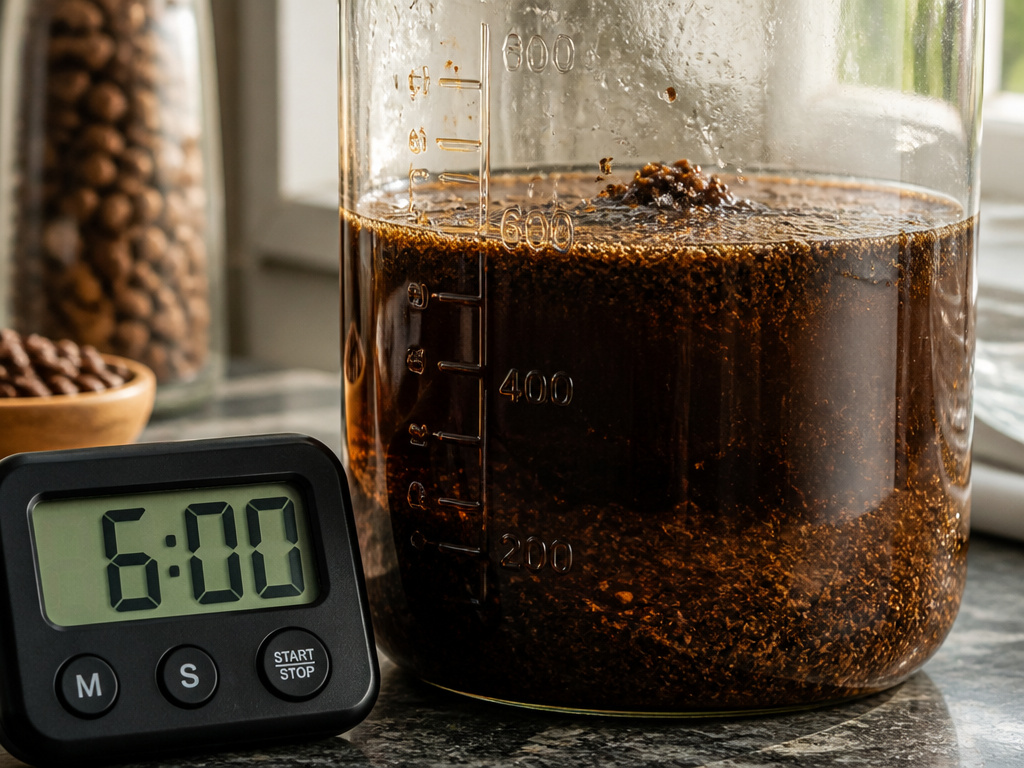
The standard advice is 12 to 24 hours. That’s too long.
Research from Scientific Reports shows caffeine and chlorogenic acid concentrations reach equilibrium according to first-order kinetics between 6 and 7 hours in all cold brew samples. After that, extraction plateaus. Going longer doesn’t make it stronger or better, it starts pulling out undesirable, bitter, and rubbery compounds.
The Specialty Coffee Association’s dynamic data supports this, stating cold brews are “done” within 6 hours for room temperature brewing and 10 to 12 hours for fridge temperature. Sensory attributes cease to change appreciably after those points.
Here’s what happens after the equilibrium point:
1. Bitter notes increase. Compounds like quinic acid and certain phenolic compounds continue to leach out slowly, adding a harsh edge.
2. The floral and fruity notes fade. The delicate aromatics that extracted early get overshadowed by the later, heavier compounds.
3. The texture can become slightly oily. Over-extraction can pull out more lipids, giving the brew a slick feel.
Steeping in the fridge slows everything down. The 10–12 hour window is safe because the cold temperature drastically reduces extraction speed. But even there, 24 hours is unnecessary.
I left a batch steeping for 24 hours in the fridge using a light roast Ethiopian. By day two, the bright lemon and floral notes were gone, replaced by a vague woody bitterness. It wasn’t undrinkable, but it wasn’t the bean I’d paid for.
Common mistake: Steeping for 24 hours because a recipe said so, you lose the bean’s signature flavors and introduce bitterness, turning a nuanced coffee into a generic, harsh concentrate.
If you want a stronger concentrate, increase the coffee-to-water ratio, not the time. A 1:5 ratio steeped for 7 hours will be more intense and flavorful than a 1:8 ratio steeped for 24 hours.
Water Ratio and Temperature
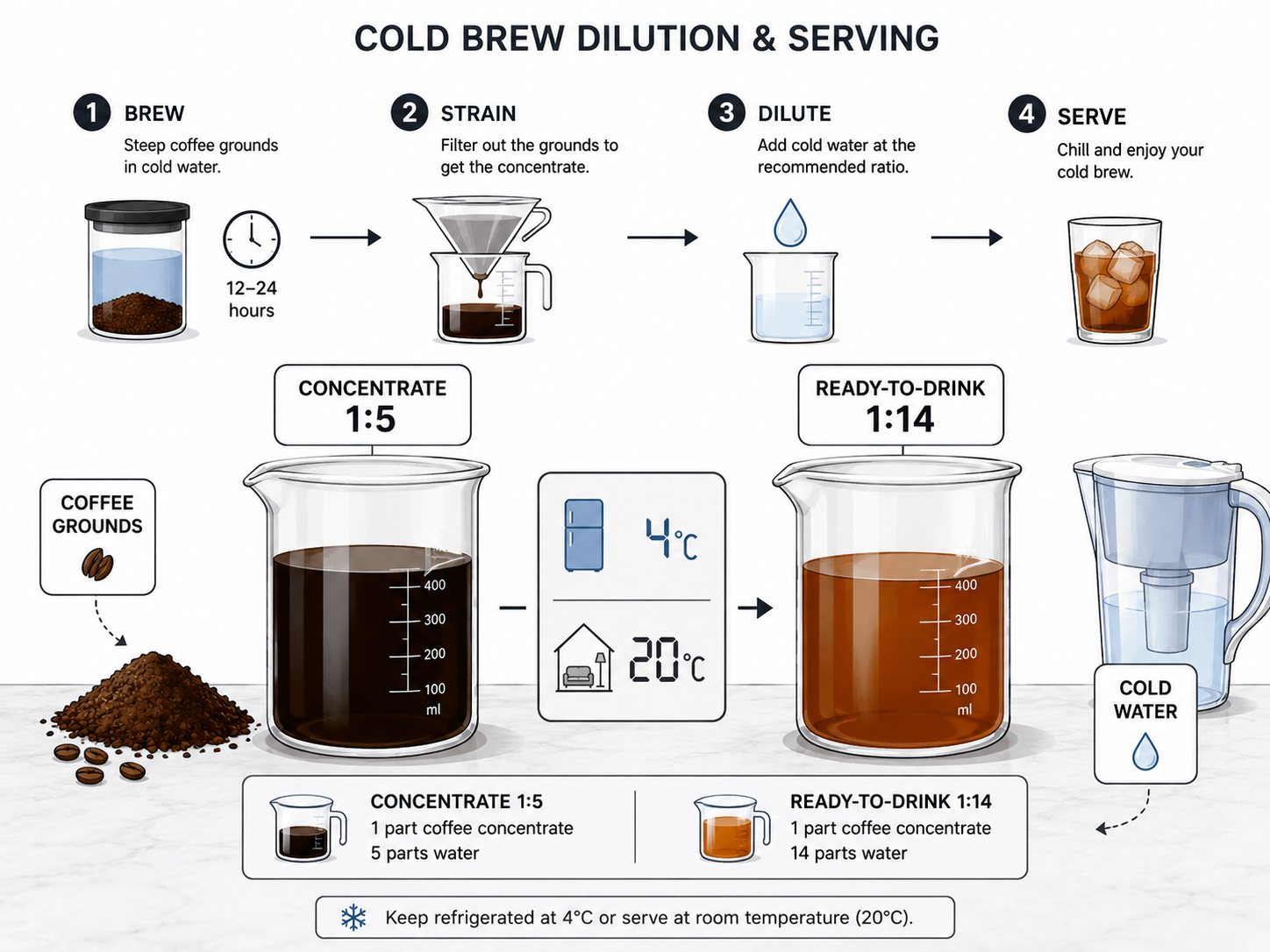
Cold brew is a concentrate. You control strength with ratio, not time.
The classic starting ratio for a concentrate is 1:5 (one part coffee to five parts water). That produces a strong brew you’ll dilute later with water, milk, or a dairy alternative like almond milk. For a ready-to-drink brew, use a 1:14 ratio. The 2023 PMC optimization study confirmed 1:14 as ideal for direct consumption.
Water temperature is simpler: cold. Use filtered water, not tap. Tap water minerals can interfere with extraction and leave off-flavors. Room temperature water (around 20°C) extracts faster, hitting equilibrium in 6–7 hours. Refrigerator temperature (4°C) extracts slower, taking 10–12 hours.
There’s a sensory difference beyond time. The SCA research found that cold brews (brewed at 4°C) had a more reddish color than chilled hot brews. That color effect is potentially important as reddish hues are often associated with sweetness in sensory perception. Your cold brew might literally look sweeter.
The water-to-coffee ratio also affects pH. Using more coffee (a stronger ratio) in cold water can slightly raise the pH, making the brew taste even smoother and less acidic. It’s a small effect, but it’s there.
TL;DR: Use a 1:5 ratio for a concentrate, 1:14 for ready-to-drink. Use cold, filtered water. Room temp brews faster (6–7 hrs); fridge temp brews slower (10–12 hrs).
Choosing Your Beans: A Practical Guide
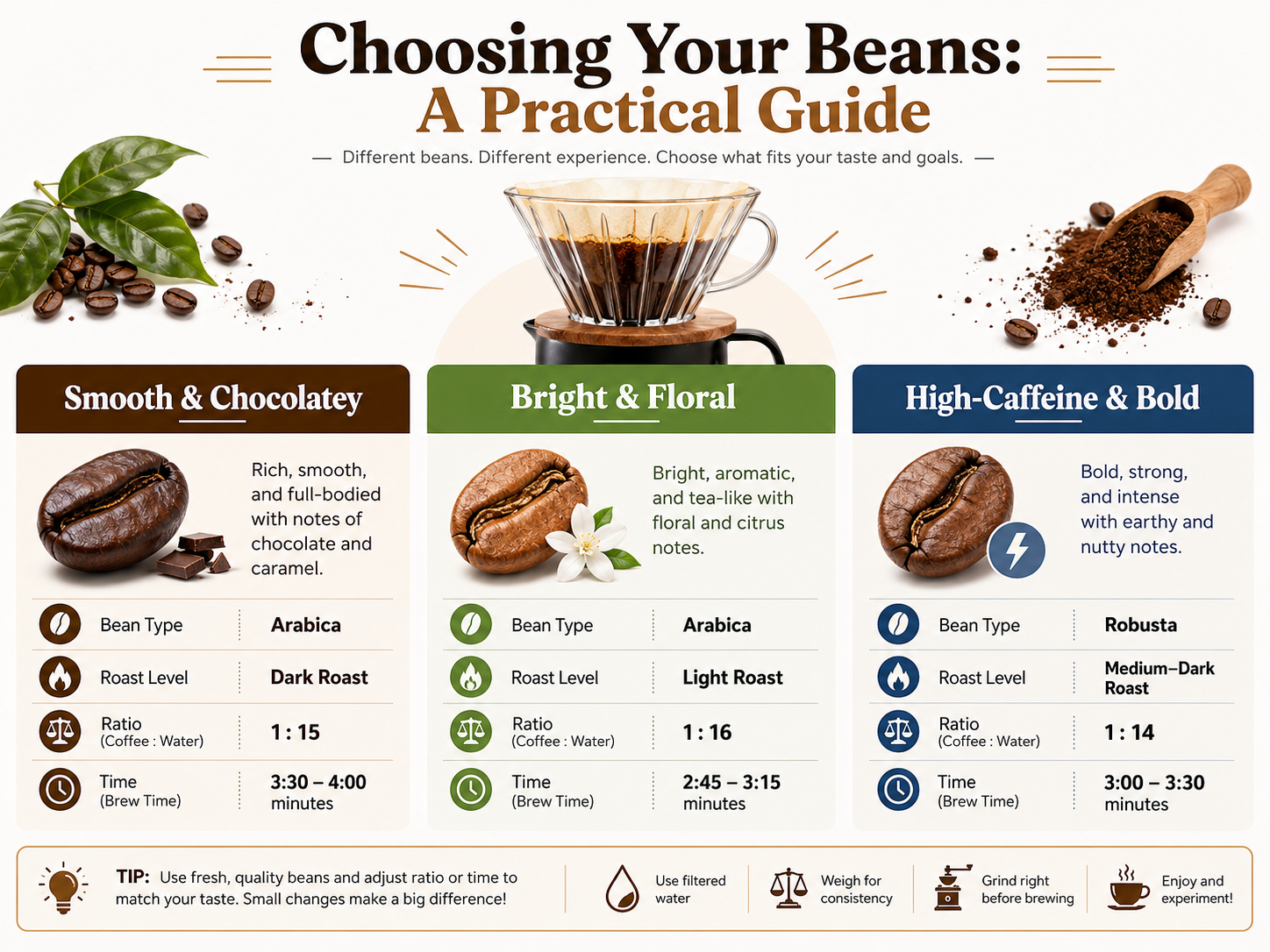
You don’t need a special bean. You need a bean that matches your goal.
If you want a classic, smooth, chocolatey cold brew that stands up to milk:
– Bean Type: Arabica or a blend with some Robusta.
– Roast Level: Medium or dark.
– Origin: Anything you like. Brazil, Colombia, Sumatra.
– Grind: Coarse (0.71 mm target).
– Ratio: 1:5 for concentrate.
– Time: 7 hours room temp, 12 hours fridge.
If you want a bright, floral, tea-like cold brew to drink black:
– Bean Type: Arabica, preferably a single-origin coffee.
– Roast Level: Light or blonde roast coffee.
– Origin: East African (Ethiopia, Kenya), some Central American.
– Grind: Coarse, but you can go slightly finer than 0.71 mm to increase extraction of acidic compounds, experiment.
– Ratio: 1:14 for ready-to-drink.
– Time: 6 hours room temp max.
If you want a high-caffeine, intense cold brew:
– Bean Type: Robusta (Canephora).
– Roast Level: Medium or dark.
– Origin: Vietnamese, Indian.
– Grind: Coarse.
– Ratio: 1:5 for concentrate.
– Time: 7 hours room temp.
| Goal | Bean Recommendation | Key Adjustment | Watch Out For |
|---|---|---|---|
| Smooth, chocolatey, with milk | Dark roast Arabica or blend | Use a 1:5 ratio | Can become overly bitter if steeped beyond 7 hours |
| Bright, floral, black | Light roast single-origin Arabica | Use a 1:14 ratio, shorter steep (6 hrs) | Tastes thin if grind is too coarse; loses nuance if steeped too long |
| High-caffeine, bold | Robusta (medium/dark roast) | Use a 1:5 ratio | Overwhelming bitterness if not diluted well; not for subtle palates |
| Balanced, versatile | Medium roast blend | Start with 1:8 ratio, adjust | Blend components can clash if poorly selected |
Your daily brewed coffee beans are fine. Your espresso blend is fine. The gear, grind, ratio, time, is what turns them into good cold brew.
Frequently Asked Questions
Does cold brew have more caffeine than regular coffee?
Yes, but not by a crazy margin. Because you use a much higher coffee-to-water ratio (like 1:5 versus 1:15 for drip), the concentrate is stronger. A cup of diluted cold brew might have slightly more caffeine than a cup of drip, but you won’t feel a dramatic difference. For a detailed comparison, see our article on espresso caffeine versus coffee caffeine.
Can I use pre-ground coffee for cold brew?
You can, but you must buy it ground coarse specifically for cold brew. Pre-ground coffee for automatic drip machines is too fine. It will over-extract, becoming bitter and leaving excessive sediment. If you must use pre-ground, look for bags labeled “cold brew grind” or have a shop grind whole beans coarse for you.
Why is my cold brew bitter?
Three likely causes: your grind is too fine, you steeped it too long (beyond 7 hours at room temp), or you used a dark roast Robusta bean without diluting it enough. Check your grind first, it’s the most common culprit. A blade grinder creates fine dust that turns bitter fast.
What’s the difference between cold brew and iced coffee?
Iced coffee is hot-brewed coffee poured over ice. It retains the acidity and brightness of hot brewing. Cold brew is steeped exclusively in cold water, which results in a smoother, less acidic, and often sweeter-tasting cup. The cold brew caffeine content is typically higher due to the stronger concentration.
How long does cold brew last in the fridge?
Keep your cold brew concentrate in the fridge. It’s safe to drink for about 10 days, though the flavor will slowly fade after day 5. Store it in a sealed container. If you dilute it with water or milk, drink that diluted batch within 3 days.
Before You Go
You don’t need special beans. You need the right process.
Grind coarse with a burr grinder. Pick a roast level based on the flavor profile you want, dark for smooth chocolate, light for bright floral. Use a strong 1:5 ratio for a concentrate or 1:14 for ready-to-drink. Steep for 6–7 hours at room temperature, not 24. Filter it well.
The bean is just the starting point. The method is what turns it into the cold brew you actually enjoy. Start with whatever coffee you have on hand, even that espresso blend you use for your morning shot. Adjust the grind, ratio, and time from there.
{
“@context”: “https://schema.org”,
“@type”: “HowTo”,
“name”: “How to Choose Coffee for Cold Brew”,
“totalTime”: “PT10M”,
“tool”: [
{
“@type”: “HowToTool”,
“name”: “Burr grinder set to coarse setting”
},
{
“@type”: “HowToTool”,
“name”: “Large jar or cold brew system”
},
{
“@type”: “HowToTool”,
“name”: “Paper filter or cheesecloth”
}
],
“step”: [
{
“@type”: “HowToStep”,
“name”: “Select your bean type”,
“text”: “Use any coffee bean you like, but know Arabica beans generally produce a smoother, more floral cup, while Robusta beans add body and a sharper, more bitter note.”
},
{
“@type”: “HowToStep”,
“name”: “Choose a roast level”,
“text”: “Pick a medium or dark roast for classic chocolatey, low-acidity cold brew. Light roasts work but require a finer grind and yield a brighter, more tea-like result.”
},
{
“@type”: “HowToStep”,
“name”: “Grind coarse and consistently”,
“text”: “Set your burr grinder to a coarse setting, aiming for particles around 0.71 mm. A blade grinder creates inconsistent chunks that over-extract bitterness and leave fine sediment.”
},
{
“@type”: “HowToStep”,
“name”: “Mix with cold water”,
“text”: “Combine your coarse grounds with cold, filtered water using a strong 1:5 coffee-to-water ratio for a concentrate, or a 1:14 ratio for a ready-to-drink brew.”
},
{
“@type”: “HowToStep”,
“name”: “Steep and filter”,
“text”: “Let the mixture steep at room temperature for 6–7 hours, or in the fridge for 10–12 hours. Filter through a paper filter or fine mesh to remove all grounds.”
}
]
}
{
“@context”: “https://schema.org”,
“@type”: “FAQPage”,
“mainEntity”: [
{
“@type”: “Question”,
“name”: “Does cold brew have more caffeine than regular coffee?”,
“acceptedAnswer”: {
“@type”: “Answer”,
“text”: “Yes, but not by a crazy margin. Because you use a much higher coffee-to-water ratio (like 1:5 versus 1:15 for drip), the concentrate is stronger. A cup of diluted cold brew might have slightly more caffeine than a cup of drip, but you won’t feel a dramatic difference. For a detailed comparison, see our article on espresso caffeine versus coffee caffeine.”
}
},
{
“@type”: “Question”,
“name”: “Can I use pre-ground coffee for cold brew?”,
“acceptedAnswer”: {
“@type”: “Answer”,
“text”: “You can, but you must buy it ground coarse specifically for cold brew. Pre-ground coffee for automatic drip machines is too fine. It will over-extract, becoming bitter and leaving excessive sediment. If you must use pre-ground, look for bags labeled \”cold brew grind\” or have a shop grind whole beans coarse for you.”
}
},
{
“@type”: “Question”,
“name”: “Why is my cold brew bitter?”,
“acceptedAnswer”: {
“@type”: “Answer”,
“text”: “Three likely causes: your grind is too fine, you steeped it too long (beyond 7 hours at room temp), or you used a dark roast Robusta bean without diluting it enough. Check your grind first, it’s the most common culprit. A blade grinder creates fine dust that turns bitter fast.”
}
},
{
“@type”: “Question”,
“name”: “What’s the difference between cold brew and iced coffee?”,
“acceptedAnswer”: {
“@type”: “Answer”,
“text”: “Iced coffee is hot-brewed coffee poured over ice. It retains the acidity and brightness of hot brewing. Cold brew is steeped exclusively in cold water, which results in a smoother, less acidic, and often sweeter-tasting cup. The cold brew caffeine content is typically higher due to the stronger concentration.”
}
},
{
“@type”: “Question”,
“name”: “How long does cold brew last in the fridge?”,
“acceptedAnswer”: {
“@type”: “Answer”,
“text”: “Keep your cold brew concentrate in the fridge. It’s safe to drink for about 10 days, though the flavor will slowly fade after day 5. Store it in a sealed container. If you dilute it with water or milk, drink that diluted batch within 3 days.”
}
}
]
}
