
What Are Coffee Grounds Good For: Garden & Industrial Uses
Coffee grounds are good for composting, soil amendment, and industrial biorefinery products like oils, prebiotics, and activated carbon. The safe, productive path is composting them first, fresh grounds applied directly to soil inhibit seed germination and plant growth due to residual caffeine and phytotoxic compounds.
Most people think coffee grounds are a free fertilizer. They dump them straight onto their garden. That’s the mistake. Fresh grounds kill seedlings. They compact into a dense, airless mat. They can even injure worms in a vermicompost bin.
This guide covers the science-backed uses, the precise risks, and the industrial-scale applications that turn six million tons of annual waste into products.
Key Takeaways
- Fresh coffee grounds are phytotoxic, they suppress seed germination and plant growth at concentrations below 1%.
- For home gardening, compost coffee grounds first, limiting them to 20% of your pile’s volume.
- Industrially, spent coffee grounds are a source for lipids, carbohydrates, and phenolic compounds used in food, cosmetics, and environmental products.
- Adding grounds directly as mulch risks soil compaction and water retention issues.
- Vermicomposting with fresh grounds can harm or kill earthworms in confined bins.
Coffee Grounds as a Soil Amendment: The .095 vs .105 Trade-Off
Headlines call coffee grounds “black gold.” The reality is more complicated. Their value depends entirely on whether they are fresh or composted.
Before you start: Fresh coffee grounds contain caffeine and other phytotoxic compounds that inhibit plant growth. Applying them directly around seedlings or in seed beds can reduce germination rates by half. Always compost them first.
The Washington State University Extension guide states fresh grounds are demonstrably phytotoxic to various plants. Studies cited there show inhibition at very low concentrations. The mechanism is twofold: caffeine acts as a natural herbicide, and the grounds create a microbial environment that competes fiercely with plants for nitrogen.
That competition is the hidden problem. Grounds are rich in nitrogen, about 2% by volume, but that nitrogen isn’t immediately available to plants. Microbes in the soil scramble to break down the grounds, locking up nitrogen in the process. Your tomatoes get nothing for weeks.
Coffee grounds have a carbon-to-nitrogen (C:N) ratio around 20:1. Microbes need a C:N ratio closer to 30:1 to thrive, so adding grounds alone doesn’t create ideal compost, you must balance them with higher-carbon browns like leaves or straw.
TL;DR: Compost coffee grounds with other organic materials; never apply them fresh directly to soil, especially near seedlings.
Why Composting Works
Composting neutralizes the phytotoxins. The microbial activity during decomposition breaks down caffeine and phenolic compounds over 4–6 weeks. The finished compost is a stable, humus-like material that slowly releases nitrogen.
The WSU Extension gardening with coffee grounds publication is blunt: no more than 20% by volume of coffee grounds should be in a compost pile. More than that slows decomposition and can create an overly acidic, soggy mass.
That 20% rule isn’t arbitrary. It’s the threshold where grounds stop dominating the pile’s microbiology. They become a contributor, not a dictator.
| Material | Role in Compost | Risk if Overused |
|---|---|---|
| Fresh coffee grounds | Nitrogen source (green material) | Locks up nitrogen, creates acidic sludge |
| Dry leaves/straw | Carbon source (brown material) | Slows decomposition if used alone |
| Finished compost | Slow-release fertilizer | None – it’s the safe end product |
The Direct Application Trap
I tried the direct-application method on a bed of lettuce seedlings three years ago. I sprinkled a thin layer of fresh grounds around the plants as a mulch. Within five days, the seedlings stopped growing. Their leaves developed a pale, sickly yellow. By day ten, half of them had wilted and died. The survivors took three weeks to recover after I scraped the grounds away and watered heavily.
The grounds had compacted. They formed a crust that rain couldn’t penetrate. Water pooled on top, then evaporated, leaving the soil underneath dry. The lettuce roots were stranded.
Common mistake: Applying fresh coffee grounds as a standalone mulch – the fine particles compact into a dense layer that blocks water and air, drowning roots within two weeks.
That compaction risk is documented. The fine texture of grounds, when applied thickly, interferes with moisture and air movement. It’s like laying a sheet of wet paper over your soil.
From Waste to Product: The Industrial Scale
What happens to the 6.7 million tons of spent coffee grounds produced globally each year? Most go to landfill. A fraction enters home compost. The real frontier is industrial valorization, transforming waste into sellable products.
A ScienceDirect techno-economic assessment of coffee grounds study modeled a multi-product biorefinery. The most balanced configuration, producing oil, prebiotic carbohydrates, and iron-functionalized hydrochar, showed positive economics at a feed capacity of 10 tons per batch. The payback time was three years.
That’s the scale where coffee grounds become genuinely good for something beyond your garden.
What’s Inside Spent Grounds
The composition table below is drawn from peer-reviewed analyses. It shows why industry is interested.
| Component | Percentage (Dry Weight) | Primary Industrial Use |
|---|---|---|
| Lipids | ~15% | Oil extraction for biofuels, cosmetics |
| Carbohydrates | Up to 62% | Prebiotic fibers, bioethanol, activated carbon |
| Protein | 13.6% | Animal feed supplements (after detoxification) |
| Phenolic compounds | 4.6–9.9 mg/g | Antioxidant extraction for food & cosmetics |
| Minerals (K, Mg, P) | Significant concentrations | Soil amendment after processing |
Lipids include linoleic, palmitic, stearic, and oleic acids. These can be extracted and refined. Carbohydrates, mainly cellulose and hemicellulose, are structural fibers that can be processed into prebiotic ingredients or converted into biofuels.
The NCBI PMC research article on coffee grounds details food science applications. It also flags safety hurdles: microbiological contaminants (bacteria, mold) and acrylamide from high-temperature roasting. Contaminant levels in spent grounds are typically below safety thresholds, but they necessitate processing for food use.
TL;DR: Spent coffee grounds are a feedstock for oils, prebiotics, and activated carbon at industrial scale; home use is a tiny fraction of their potential.
The Home Gardener’s Scale vs. The Factory
Your kitchen collects maybe a pound of grounds a week. A single coffee shop generates 50 pounds a day. A roastery deals in tons.
The home use is about diversion from landfill and slow nutrient release. The industrial use is about volume, chemistry, and economics.
They are two different answers to “what are coffee grounds good for.” One is a soil amendment with strict rules. The other is a biorefinery input with a three-year payback period.
The Hidden Risks in Common Advice
YouTube tutorials and blog posts often skip the caveats. They show someone pouring grounds around roses or mixing them with cinnamon for a “powerful fertilizer.” That advice misses three critical failures.
Vermicomposting Can Kill Worms
Vermicomposting, using worms to break down organic matter, is a popular small-scale method. Coffee grounds are often recommended as a worm food.
They can injure or kill earthworms in confined bins. The caffeine and acidic environment stress worms. In a open garden bed, worms can escape. In a plastic bin, they cannot.
If you vermicompost, introduce grounds slowly. Monitor the worm population. A sudden mass addition can cause a die-off.
I added two cups of fresh grounds to a healthy worm bin one winter. The next morning, a dozen worms had climbed the walls trying to escape. Several were dead at the bottom. I removed half the grounds, and the population stabilized after a week.
The pH Myth
Many gardeners assume coffee grounds are acidic. Experimental studies show pH levels ranging from mildly acidic (pH 6.5) to somewhat alkaline (pH 8.0). The pH is not stable. It changes with the coffee variety, roast level, and brewing method.
Applying grounds to “acidify soil for blueberries” is unreliable. The pH impact is negligible on most soils. If you need acidic soil, use sulfur or pine needles.
The Pest Repellent Fiction
There is no published evidence that coffee grounds repel or kill garden pests like slugs or ants. Nor is there science showing they attract beneficial animals like earthworms.
Any pest control effect is anecdotal. It’s not a reliable strategy.
How to Use Coffee Grounds Correctly: A Step-by-Step Method
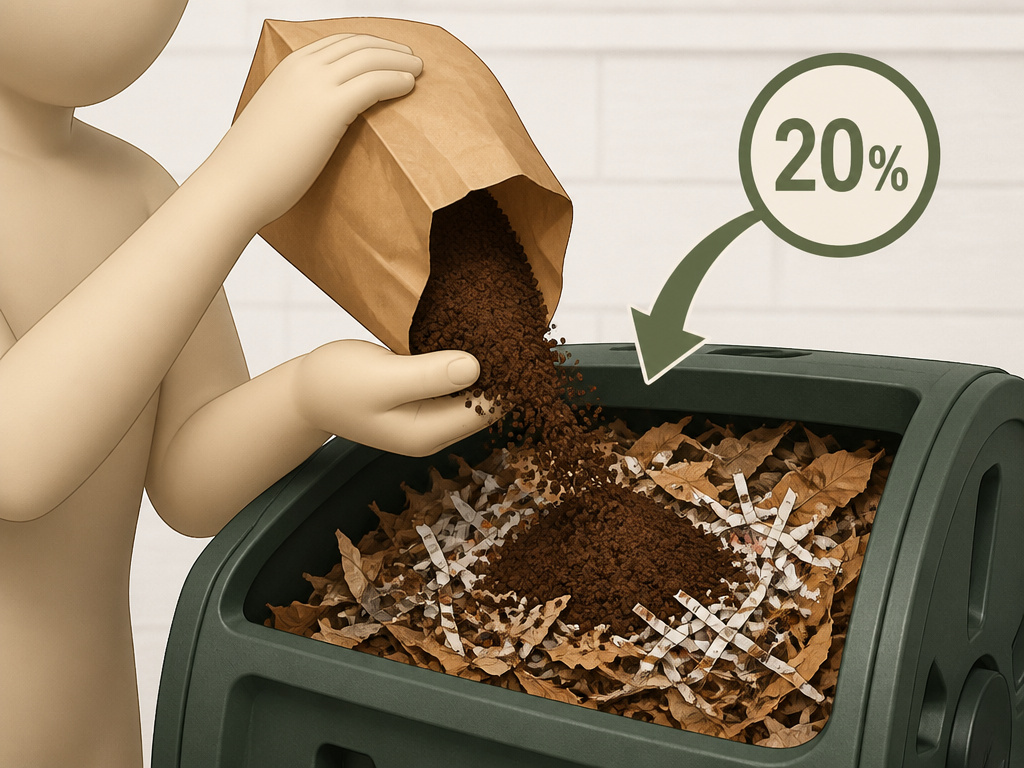
Follow this sequence to avoid the failures above.
- Collect and dry. Store spent grounds in a breathable container, a paper bag or open bowl. Let them dry out. Wet grounds mold within three days and compact more easily.
- Add to compost. Mix dried grounds into your compost pile or tumbler. Keep the ratio under 20% by volume. Balance them with dry leaves, straw, or shredded paper.
- Wait for full decomposition. Let the compost process complete. This takes 4–6 weeks in a hot pile, longer in a cold system. The finished compost will be dark, crumbly, and smell earthy.
- Apply compost to soil. Spread the finished compost around established plants, tomatoes, shrubs, perennials. Avoid direct contact with seedlings or seeds.
- Inspect for compaction. If you use composted grounds as a top dressing, monitor the soil surface. If it forms a crust, rake it lightly to break the layer.
Skip the drying step and you’ll find a slimy, moldy mass in your collection container by day four. That mold then goes into your compost, spreading through the pile.
TL;DR: Dry grounds, compost them under 20% volume, wait for completion, then apply only to established plants.
When to Absolutely Avoid Coffee Grounds
- Seed beds and seedlings. Fresh grounds suppress germination. Even composted grounds can be too dense for delicate seedling roots.
- Vermicomposting bins. Introduce grounds sparingly and watch worm behavior.
- As a standalone mulch. They compact and block water.
- On alkaline-loving plants. The pH effect is unpredictable, but it’s not zero.
Frequently Asked Questions
Are fresh coffee grounds good for plants?
No. Fresh coffee grounds inhibit seed germination and plant growth due to residual caffeine and phytotoxic compounds. They also tie up nitrogen as microbes break them down. Always compost them first.
Can I use coffee grounds in my vegetable garden?
Yes, after composting. Mix composted grounds into the soil around established vegetables like tomatoes, peppers, and squash. Do not place them directly near seeds or seedlings.
Do coffee grounds acidify soil?
Not reliably. The pH of spent grounds varies from slightly acidic to somewhat alkaline. The effect on soil pH is minimal. For reliable acidification, use sulfur or pine needle mulch.
How much coffee grounds can I add to my compost pile?
Limit coffee grounds to 20% of your compost pile’s volume. Exceeding this ratio can slow decomposition and create an acidic, soggy environment.
Are coffee grounds good for roses?
Composted coffee grounds can be beneficial as a slow-release nitrogen source mixed into soil around roses. Fresh grounds applied directly may compact and hinder water penetration.
The Bottom Line
Coffee grounds are good for composting and industrial biorefining. They are not good as a direct fertilizer.
The safe path is straightforward: dry them, compost them under the 20% limit, and use the finished product on established plants. The industrial path is about extracting lipids, carbohydrates, and phenolics at scale.
Ignore the myths about acidity and pest control. Follow the science on phytotoxicity and compaction. Your garden, and the six million tons of annual waste, will benefit.
{
“@context”: “https://schema.org”,
“@type”: “HowTo”,
“name”: “How to Use Coffee Grounds Safely in Your Garden and Beyond”,
“totalTime”: “PT15M”,
“tool”: [
{
“@type”: “HowToTool”,
“name”: “Container for collecting spent grounds”
},
{
“@type”: “HowToTool”,
“name”: “Compost bin or tumbler”
},
{
“@type”: “HowToTool”,
“name”: “Soil pH test kit”
},
{
“@type”: “HowToTool”,
“name”: “Measuring scoop”
}
],
“step”: [
{
“@type”: “HowToStep”,
“name”: “Collect and dry grounds”,
“text”: “Store spent grounds in a breathable container to dry them out. Wet grounds compact faster and mold within three days.”
},
{
“@type”: “HowToStep”,
“name”: “Mix into compost”,
“text”: “Add dried grounds to your compost pile at a ratio no higher than 20% by volume. They are a nitrogen-rich green material.”
},
{
“@type”: “HowToStep”,
“name”: “Apply composted material”,
“text”: “Wait until the grounds have fully composted, then mix the finished compost into garden soil around established plants, avoiding seedlings.”
},
{
“@type”: “HowToStep”,
“name”: “Test soil pH”,
“text”: “Check your soil’s pH before and after adding composted grounds. The pH impact is negligible on most soils, but alkaline soils can shift.”
}
]
}
{
“@context”: “https://schema.org”,
“@type”: “FAQPage”,
“mainEntity”: [
{
“@type”: “Question”,
“name”: “Are fresh coffee grounds good for plants?”,
“acceptedAnswer”: {
“@type”: “Answer”,
“text”: “No. Fresh coffee grounds inhibit seed germination and plant growth due to residual caffeine and phytotoxic compounds. They also tie up nitrogen as microbes break them down. Always compost them first.”
}
},
{
“@type”: “Question”,
“name”: “Can I use coffee grounds in my vegetable garden?”,
“acceptedAnswer”: {
“@type”: “Answer”,
“text”: “Yes, after composting. Mix composted grounds into the soil around established vegetables like tomatoes, peppers, and squash. Do not place them directly near seeds or seedlings.”
}
},
{
“@type”: “Question”,
“name”: “Do coffee grounds acidify soil?”,
“acceptedAnswer”: {
“@type”: “Answer”,
“text”: “Not reliably. The pH of spent grounds varies from slightly acidic to somewhat alkaline. The effect on soil pH is minimal. For reliable acidification, use sulfur or pine needle mulch.”
}
},
{
“@type”: “Question”,
“name”: “How much coffee grounds can I add to my compost pile?”,
“acceptedAnswer”: {
“@type”: “Answer”,
“text”: “Limit coffee grounds to 20% of your compost pile’s volume. Exceeding this ratio can slow decomposition and create an acidic, soggy environment.”
}
},
{
“@type”: “Question”,
“name”: “Are coffee grounds good for roses?”,
“acceptedAnswer”: {
“@type”: “Answer”,
“text”: “Composted coffee grounds can be beneficial as a slow-release nitrogen source mixed into soil around roses. Fresh grounds applied directly may compact and hinder water penetration.”
}
}
]
}
