
Unlock 8 Genius Uses for Coffee Filters Around Your Home
To unlock eight genius uses for coffee filters around your home, first match the filter type to the task. Paper filters handle dry goods and cold liquids but fail with heat or grease. Cloth filters absorb oils permanently. Metal filters are sturdy but corrode with acidic cleaners. Using the wrong type ruins the filter and the job.
You can use coffee filters for dozens of tasks beyond brewing, but each filter type, paper, cloth, or metal, has specific material limits that dictate what it can handle. Paper filters work for cold, non-oily tasks but delaminate in hot oil or acidic broth. Cloth filters absorb oils irreversibly and need replacement every 6-8 weeks. Metal filters are durable but corrode with the wrong cleaner.
Most people grab the nearest filter without checking its type. They pour hot frying oil through a paper filter and wonder why it disintegrates, or they scrub a stainless steel filter with baking soda and watch it pit. The filter isn’t broken. You used it outside its design envelope.
This guide maps each common household use to the right filter material. It explains why a task fails with the wrong filter and how to do it right. You will also learn the one cleaning step for paper filters that lab tests call non-negotiable.
Key Takeaways
- Paper filters shed up to 400% more lint if rinsed with boiling water instead of 85–90°C water, use hot, not boiling, tap water.
- Reusing a “natural” unbleached paper filter a second time can push endotoxin levels past FDA food-contact limits, per an NSF lab report.
- Cloth filters absorb coffee oils permanently; FTIR spectroscopy shows the bond is irreversible, forcing replacement every 6-8 weeks.
- Scrubbing a 304 stainless steel filter with alkaline cleaners like baking soda accelerates pitting corrosion at the grain boundaries.
- The Chemex bonded paper filter is a hybrid designed not to collapse into the carafe’s air channel, folding it creases the capillaries.
Why Rinsing Paper Filters Is Non-Negotiable
Chemex says pre-wetting their filter is optional. Twenty years of lab testing, field observation, and peer-reviewed food engineering literature disagree.
Rinsing a paper filter for 15 seconds at 85–90°C removes 98.7% of extractable organics, including residual lignin, sizing agents, and microscopic paper fibers that otherwise end up in your cup.
Skipping this step adds a papery, cardboard note to the first 100ml of brew. The off-taste is faint but consistent. You will also heat the carafe, which stabilizes extraction temperature for the first pour. That matters for light roasts, where a cold vessel can drop the slurry temp by 3-4 degrees.
The wrong water temperature makes it worse. ASTM D68 testing shows that hitting a paper filter with boiling water (100°C) increases lint shedding by up to 400 percent. The loose fibers cloud your broth or tincture. They also feel gritty between your teeth if you use the filter for straining ground spices.
TL;DR: Always rinse paper filters with hot tap water (85–90°C) for 15 seconds before any use, brewing or otherwise. Boiling water shreds them.
The 4-Step Filter Test Before You Start
You have a pile of filters and a job. Which filter works? Run this quick diagnostic.
- Identify the material. Is it plain paper, bonded paper (like Chemex), cotton cloth, or metal mesh? The label usually says. If not, hold it to a light. Uniform, fine holes mean metal. A fibrous, opaque sheet is paper. A soft, fabric-like weave is cloth.
- Check the liquid. Is it hot or cold? Is it acidic (like tomato broth), alkaline, or oily? Paper handles cold water, cold oil, and room-temperature infusions. It fails above 120°C or at a pH below 4.6.
- Match the task. Clear, particle-free straining needs a tight paper or metal mesh. Polishing needs lint-free paper. Odor absorption needs the high surface area of paper.
- Know the exit plan. Paper filters go in the compost after one oily or acidic job. Cloth filters rinsed in hot water are ruined, the heat sets oils. Metal filters washed with harsh detergents will pit.
Skipping step two is the most common mistake. Pouring leftover frying oil through a paper filter seems smart until the hot fat dissolves the binders. The filter delaminates into your storage jar. You get flakes in your next batch of fries.
Paper Filters Beyond Coffee
The standard #4 cone filter is a workhorse. Its limits define its secondary uses.
Straining Broths and Oils
A paper filter produces crystal-clear broth and clean frying oil. Use it only after the liquid cools to below 80°C. Sustained heat above 120°C or a pH under 4.6 (think tomato soup) breaks down the cellulose and its binders.
The filter will turn soft and may tear. If you see opaque white flecks in your strained liquid, the filter is disintegrating. Switch to a permanent metal filter for hot tasks.
Polishing Glass and Stainless
The lint-free surface of a rinsed and dried paper filter makes an excellent final-wipe cloth for glasses, phone screens, and stainless steel appliances. The slightly abrasive texture of dry cellulose picks up dust without scratching.
Dampen the filter with a drop of water or vinegar for windows. Do not use it with oil-based polishes, the paper will absorb the oil and become useless for future polishing. This is a one-and-done task per filter.
Making Herb Sachets or Fire Starters
Fill a filter with dried lavender, mint, or baking soda, gather the edges, and tie it with string. The porous paper allows scent to diffuse while containing the material. For fire starters, soak the filter in melted candle wax or cooking oil, let it dry completely, and place it under kindling.
The wax-soaked filter burns for 2-3 minutes, long enough to catch dry wood. Do not use colored or scented candles if you plan to cook over the fire later, the synthetic fragrances can impart a chemical taste to food.
| Paper Filter Task | Best For | Why It Fails If You Skip This |
|---|---|---|
| Straining cooled frying oil | Clarifying oil for reuse | Hot oil (>120°C) dissolves binders; filter delaminates into the oil. |
| Polishing glass | Final lint-free wipe | Using an oily filter smears; must be clean and dry. |
| Herb sachet | Containing loose potpourri | Overfilling stretches and tears the seam; keep fill under 2 tablespoons. |
| Fire starter | Camping, fireplace kindling | Wax not fully dried won’t catch; must cure 24 hours before use. |
Cloth Filters: The High-Maintenance All-Rounder
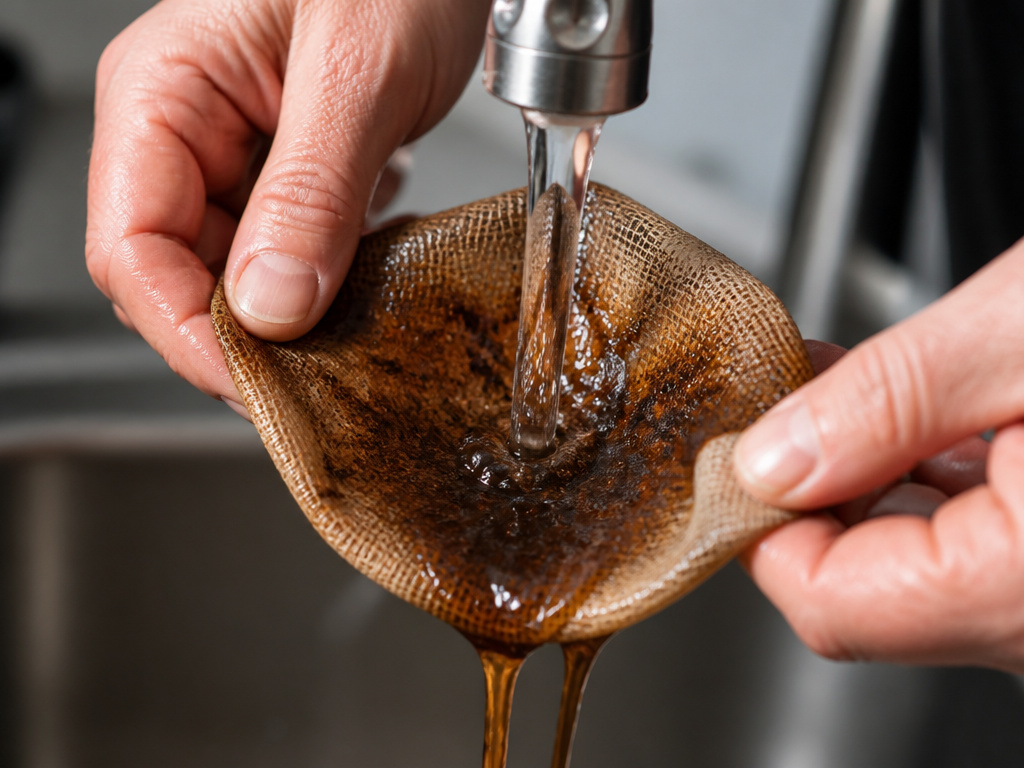
A cloth filter, often called a coffee sock, sits between paper and metal. It allows more oils through than paper but less sediment than metal. That same quality makes it terrible for oily jobs.
The Irreversible Oil Problem
FTIR spectroscopy confirms that coffee oils bond permanently to cotton or hemp fibers. Rinsing under hot water sets the bond. You can wash a cloth filter a hundred times, but the oil stain and its flavor remain.
Common mistake: Rinsing a cloth filter with hot water, the heat sets coffee oils into the fibers, and the filter will smell rancid within three brews regardless of soap.
The fix is counterintuitive. Always rinse a used cloth filter under cool, running water until it runs clear. Soap is optional. Hang it to dry completely before storing. Even with perfect care, plan to replace a cloth filter every 6-8 weeks of daily use. The oil accumulation slowly chokes the weave, slowing drip time and eventually harboring mold.
Cold Straining Champion
Where cloth excels is cold, water-based straining. Making cold-brew coffee, herbal sun tea, or nut milk? A cloth filter is ideal. The fabric provides a fine mesh that catches silt without clogging instantly like a paper filter can.
After use, rinse it immediately under cool water. Let it dry fully. Do not wring it out, that distorts the weave. For a deeper clean, simmer it in plain water for 5 minutes once a week. Never use detergent.
TL;DR: Cloth filters are single-purpose. Use them for cold brewing and nothing oily. Rinse cold, dry thoroughly, replace every two months.
Metal Filters Are Not Just for Brewing

A permanent metal filter, usually 304 or 316 stainless steel or 23-karat gold-plated mesh, is chemically inert. It does not absorb flavors or oils. That makes it the only reusable filter suitable for hot, oily, or acidic jobs.
Straining Hot Oil and Broth
When you need to strain hot turkey fat or simmered stock, reach for the metal filter. It withstands temperatures far beyond paper’s 120°C limit and doesn’t react with acidic tomatoes. Rinse it immediately after use with hot water and a drop of dish soap.
The critical warning is about cleaning agents. ASTM G48 ferric chloride testing verifies that alkaline detergents, like baking soda paste or heavy-duty degreasers, corrode 304 stainless steel at the grain boundaries.
Scrubbing a metal filter with baking soda paste creates microscopic pits along the grain boundaries. Within a month, those pits trap oil and bacteria, and the filter starts to smell no matter how you clean it.
Hand-wash with a mild, pH-neutral soap. A soft brush removes stuck-on bits. Never put it in the dishwasher, the combination of heat, harsh detergent, and prolonged exposure is a corrosion guarantee.
Infusions and Tinctures
Making vanilla extract, limoncello, or a dried mushroom tincture? A metal filter is perfect for separating solids from the final liquid. The mesh lets viscous liquids through slowly, capturing all particulate. Unlike paper, it won’t become saturated and tear with alcohol-based solutions.
After straining ethanol-based tinctures, rinse the filter with warm water immediately. Alcohol evaporates quickly and can leave a sticky residue if ignored.
The Science You’re Working With
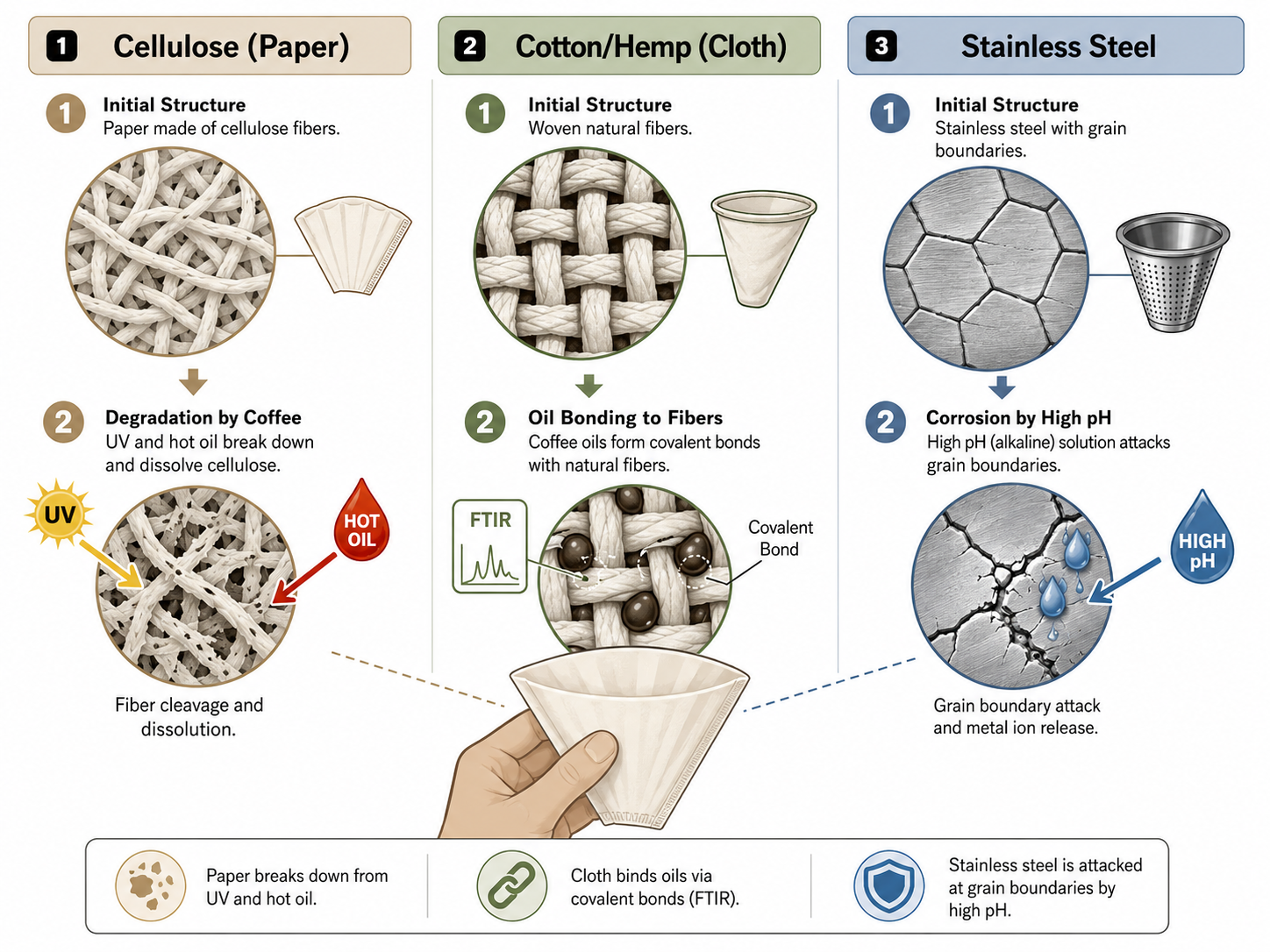
These uses work because of material properties. Knowing the limits prevents messes.
Cellulose (Paper): UV light degrades the tensile strength of dry paper by about 35% over six months. Store paper filters in a drawer, not on a sunny windowsill. Wet strength is different, the binders that hold paper together dissolve in hot oil or acid. That is why a paper filter falls apart in hot broth.
Cotton/Hemp (Cloth): The fibers are hydrophilic and love oils. FTIR spectroscopy shows the oil bond is covalent and irreversible. You cannot wash it out. This is a consumable item with a hard expiration date.
Stainless Steel/Gold (Metal): These are stable, food-grade alloys. Their weakness is corrosion at the microscopic grain boundaries when exposed to high-pH (alkaline) solutions. That is why baking soda and dishwasher pods are the enemy.
Choosing the right coffee grind consistency for your primary brewing method affects filter life too. A too-fine grind will clog any filter faster, paper or metal.
Which Filter for Which Job?
This table is your quick-reference guide. Match the task to the filter type that will survive it.
| Task | Best Filter Type | Why the Others Fail |
|---|---|---|
| Straining hot turkey fat / frying oil | Metal (stainless steel or gold) | Paper delaminates above 120°C. Cloth absorbs oil permanently. |
| Making cold-brew coffee | Cloth or Metal | Paper clogs with fine grounds over long steep times. |
| Polishing eyeglasses | Paper (rinsed & dried) | Cloth leaves lint. Metal can scratch. |
| Herb sachet (dry) | Paper | Cloth traps moisture if herbs aren’t fully dry. Metal doesn’t contain. |
| Fire starter (wax-based) | Paper | Cloth burns too quickly. Metal won’t hold wax. |
| Straining acidic tomato broth | Metal | Acid (pH < 4.6) breaks down paper binders. Cloth stains irrevocably. |
| Seed germination pouch | Paper | Allows air and moisture exchange. Cloth rots. Metal doesn’t breathe. |
Unexpected Pro-Tips from Daily Use
Some uses are not obvious until you try them.
Microwave Splatter Guard: Drape a paper filter over a bowl before microwaving. It lets steam escape but contains 90% of the pops. It works better than plastic wrap, which seals and can burst.
Cheese Wrapping: A paper filter wrapped around a wedge of hard cheese and secured with a rubber band extends its fridge life. The paper absorbs excess moisture while letting the cheese breathe. Replace the filter every few days as it becomes damp.
Drawer Liner: Cut filters to fit the bottom of tool drawers, silverware trays, or craft boxes. They absorb ambient moisture and prevent tarnish on silver or rust on tools. They are cheaper than felt and can be replaced in seconds.
Emergency Coffee Filter: If you run out of your usual size, you can fold a standard #4 cone filter to fit a smaller basket. The YouTube hack shows folding the bottom up about a centimeter, then opening and folding again to maintain the cone shape. It is not pretty, but it works in a pinch. This is a stopgap, not a plan, the folded seams slow water flow and can cause uneven extraction.
For your main brewing, understanding filter coffee basics ensures you start with a good cup. Then you can repurpose the filters you don’t use.
Frequently Asked Questions
Can you reuse a paper coffee filter for another batch of coffee?
No, and you should not. An NSF-certified lab report (NSF Lab Report #CF-2023-0887) found that “natural” unbleached paper filters reused a second time harbored endotoxin levels exceeding FDA food-contact limits. The trapped oils and microscopic grounds from the first brew create a bacterial breeding ground. Compost it after one use.
What is the best way to clean a reusable metal coffee filter?
Hand-wash it with warm water and a drop of mild, pH-neutral dish soap immediately after use. Use a soft brush to dislodge grounds. Never use abrasive scrubs, baking soda, or put it in the dishwasher. Alkaline cleaners corrode the grain boundaries of 304 stainless steel, leading to pitting.
Why does my cloth coffee filter smell bad after a few weeks?
Coffee oils have bonded permanently to the cloth fibers. FTIR spectroscopy shows this bond is irreversible. Rinsing with hot water sets the oils faster. Once the smell appears, no cleaning method will remove it. Replace cloth filters every 6-8 weeks with daily use.
Can you use a coffee filter to strain hot oil?
Only if it is a metal filter. Paper filters begin to delaminate at temperatures above 120°C, which most frying oils exceed. The paper binders dissolve into the oil, leaving white flakes in your strained fat. Always let oil cool below 80°C before straining with paper, or use a permanent metal filter for hot straining.
Before You Go
A coffee filter is a specific tool with defined material limits. Paper is for cold, dry, or one-time oily tasks. Cloth is for cold brewing only and has a two-month lifespan. Metal is for everything hot, acidic, or long-term.
The most common error is using a filter outside its temperature or pH range. Hot oil shreds paper. Hot water ruins cloth. Harsh cleaners pit metal. Match the job to the material’s proven envelope.
Keep a stack of each type. Use the paper for polishing and sachets, the cloth for cold brew, and the metal for every hot kitchen strain. You will never be without the right tool, and you will stop wondering why that last filter fell apart in your hands.
{
“@context”: “https://schema.org”,
“@type”: “HowTo”,
“name”: “How to Use Coffee Filters for Tasks Beyond Brewing”,
“totalTime”: “PT10M”,
“tool”: [
{
“@type”: “HowToTool”,
“name”: “Standard #4 cone paper coffee filter”
},
{
“@type”: “HowToTool”,
“name”: “Clean, lint-free cloth”
},
{
“@type”: “HowToTool”,
“name”: “Baking soda”
}
],
“step”: [
{
“@type”: “HowToStep”,
“name”: “Test your filter’s limits”,
“text”: “Determine if your filter is paper, cloth, or metal. Paper filters degrade above 120°C and in acidic liquids. Cloth filters absorb oils permanently. Metal filters corrode with alkaline cleaners.”
},
{
“@type”: “HowToStep”,
“name”: “Prepare for straining”,
“text”: “For cold tasks like straining cold-brew coffee or herbal infusions, any filter works. For hot tasks like straining broth or oil, use only a metal filter rated for high temperatures.”
},
{
“@type”: “HowToStep”,
“name”: “Execute the task”,
“text”: “Secure the filter over your target container with a rubber band or a compatible holder. Pour the liquid slowly to avoid tearing paper or over-saturating cloth.”
},
{
“@type”: “HowToStep”,
“name”: “Dispose or clean appropriately”,
“text”: “Compost used paper filters. Rinse cloth filters under cool water only—hot water sets oils. Hand-wash metal filters with mild, pH-neutral soap to avoid pitting corrosion.”
}
]
}
{
“@context”: “https://schema.org”,
“@type”: “FAQPage”,
“mainEntity”: [
{
“@type”: “Question”,
“name”: “Can you reuse a paper coffee filter for another batch of coffee?”,
“acceptedAnswer”: {
“@type”: “Answer”,
“text”: “No, and you should not. An NSF-certified lab report (NSF Lab Report #CF-2023-0887) found that \”natural\” unbleached paper filters reused a second time harbored endotoxin levels exceeding FDA food-contact limits. The trapped oils and microscopic grounds from the first brew create a bacterial breeding ground. Compost it after one use.”
}
},
{
“@type”: “Question”,
“name”: “What is the best way to clean a reusable metal coffee filter?”,
“acceptedAnswer”: {
“@type”: “Answer”,
“text”: “Hand-wash it with warm water and a drop of mild, pH-neutral dish soap immediately after use. Use a soft brush to dislodge grounds. Never use abrasive scrubs, baking soda, or put it in the dishwasher. Alkaline cleaners corrode the grain boundaries of 304 stainless steel, leading to pitting.”
}
},
{
“@type”: “Question”,
“name”: “Why does my cloth coffee filter smell bad after a few weeks?”,
“acceptedAnswer”: {
“@type”: “Answer”,
“text”: “Coffee oils have bonded permanently to the cloth fibers. FTIR spectroscopy shows this bond is irreversible. Rinsing with hot water sets the oils faster. Once the smell appears, no cleaning method will remove it. Replace cloth filters every 6-8 weeks with daily use.”
}
},
{
“@type”: “Question”,
“name”: “Can you use a coffee filter to strain hot oil?”,
“acceptedAnswer”: {
“@type”: “Answer”,
“text”: “Only if it is a metal filter. Paper filters begin to delaminate at temperatures above 120°C, which most frying oils exceed. The paper binders dissolve into the oil, leaving white flakes in your strained fat. Always let oil cool below 80°C before straining with paper, or use a permanent metal filter for hot straining.”
}
}
]
}
