
Should You Put Coffee in the Freezer? The Definitive Guide
Freezing coffee works only if you follow a strict protocol: portion fresh beans into 1-2 week supplies, vacuum-seal or remove all air, and store them in a stable freezer at -18°C (0°F) or colder. Thaw each portion sealed overnight on the counter before opening. Break any of these rules and you introduce moisture that ruins the beans.
The universal mistake is treating the freezer like a pantry. People shove the whole bag in and out daily. That daily temperature swing pulls humid air into the cold beans. Ice crystals form on the surface. The result is a muted, stale cup that tastes like the freezer smells.
This guide covers the science, the exact steps that work, and the scenarios where freezing is a waste of time. We’ll look at what the research actually says, why your dark roast needs the cold more than your light roast, and how a roaster like George Howell has been doing this since 2001.
Key Takeaways
- Freezing only benefits freshly roasted, high-quality coffee you can’t consume within 2-3 weeks. Stale or low-grade beans won’t improve.
- Portioning is non-negotiable. Freeze beans in 1-2 week batches in vacuum-sealed or airless bags. Never freeze and thaw the same main bag repeatedly.
- Dark roasts degrade faster at room temperature, so they benefit more from freezing than light roasts, according to a 2023 consumer perception study.
- Thaw sealed. Always move a frozen portion to the counter the night before you need it and let it come to room temperature while still sealed.
- Grind from frozen if you must use beans immediately, as frozen beans produce a more consistent particle size. But this is a last-resort method.
The Science of Staling: What Freezing Actually Does
Coffee staling is a chemical race against time. Oxidation and the loss of volatile aromatic compounds start the moment roasting stops. Freezing doesn’t stop this process. It just slows it down dramatically.
A 2023 study in Scientific Reports found that roasted coffee stored at 20°C (68°F) aged the fastest, while samples kept at -10°C (14°F) and 10°C (50°F) chambers performed similarly well in preserving key quality parameters.
The magic number for a home freezer is -18°C (0°F). At that temperature, the degassing and oxidation processes crawl. Research from the Specialty Coffee Association suggests degassing nearly halts at -25°C (-13°F). Your kitchen freezer won’t get that cold, but -18°C is good enough to buy you months, not weeks.
The enemy isn’t the cold. It’s moisture. Your freezer is a desert. Air moisture condenses and freezes on the walls. When you introduce warm, humid room air to a bag of frozen beans, that moisture condenses on the beans like dew on a cold can. Those microscopic water droplets are where flavor compounds dissolve and get washed away. They also invite ice crystal formation inside the bean’s cellular structure, which can rupture cell walls upon thawing.
TL;DR: Freezing slows staling chemistry but introduces a moisture risk. The entire method is designed to manage that trade-off.
When Freezing Coffee Makes Sense (And When It Doesn’t)
Freezing is a tool, not a default. Use it for specific situations. Ignoring the rules turns your freezer into a flavor-destroying machine.
The Three Scenarios Where You Should Freeze Coffee
- You bought in bulk. You found a fantastic single-origin lot and bought a kilo, but you only go through 250g a week. Portion and freeze three quarters of it. This is the primary use case.
- You’re preserving a seasonal or limited-release coffee. Some roasters, like Passenger Coffee, have released lots frozen for years. In 2016, they offered a Kenyan coffee harvested that year but frozen upon arrival, showcasing the technique’s long-term potential.
- You primarily drink dark roast coffee. A consumer perception study on frozen roasted coffee found that dark roast coffee showed more dramatic negative changes at room temperature over 9 weeks compared to light roast samples. If you prefer darker profiles, freezing is a stronger hedge against rapid staling.
When Freezing Is a Waste of Time
Common mistake: Freezing already stale or low-quality beans, you are preserving disappointment. Nothing good will happen, and you’ll waste bagging effort.
- The coffee is more than 3-4 weeks off roast. Freezing locks in the current state. It doesn’t reverse staling.
- You’ll finish the bag within two weeks. The hassle and risk outweigh the minuscule freshness gain.
- The green coffee quality was mediocre to begin with. A Royal Coffee research project on freezing green coffee suggested the practice might be more beneficial for the highest-scoring lots and less so for moderate- to low-scoring specialty arabica coffees. Garbage in, garbage out, frozen.
- You don’t have a stable, seldom-opened freezer. A freezer door opened constantly fluctuates in temperature. That fluctuation encourages condensation every time you reach in.
If your situation doesn’t match the “should” list, just store the beans in a cool, dark cupboard in an airtight container. It’s simpler and safer.
The Right Way to Freeze Coffee
This is the procedure that separates success from a bag of frosty, flavorless beans. Missing one step usually means failure.
Before you start: Work with freshly roasted coffee (within 5-7 days of roast). Have a kitchen scale, portion bags, and a permanent marker ready. The entire process should take under ten minutes.
Step 1: Portion for 1-2 Weeks of Use
Weigh out how much coffee you’ll use in 7-14 days. For a daily drinker using 20g per day, that’s 140g to 280g. Portioning is critical because you will never refreeze thawed beans. Thaw only what you’ll use immediately.
| Brew Frequency | Daily Dose | 1-Week Portion | 2-Week Portion |
|---|---|---|---|
| Daily drinker | 18-22g | 126-154g | 252-308g |
| Weekends only | 30-40g | 60-80g (2 weekends) | 120-160g (4 weekends) |
| Occasional espresso | 18g per shot | 126g (7 shots) | 252g (14 shots) |
I portion 250g bags for my weekly consumption. That’s a comfortable amount that thaws overnight and doesn’t linger opened for more than 6 days. Any longer and the last cups lose their pop.
Step 2: Choose Your Barrier
You need to block air and moisture. Not all barriers are equal.
- Vacuum Sealer (FoodSaver type): Best. Removes nearly all air. The Royal Coffee study used FoodSaver brand vacuum-sealed bags for their frozen green coffee test batches. This is the gold standard for long-term storage (3+ months).
- Heavy-Duty Freezer Bags (Ziploc type): Good. Squeeze out as much air as possible before sealing. The Royal Coffee study also tested Ziploc bags, which performed adequately over shorter periods. Fold the top over several times and press.
- Original Bag with One-Way Valve: Worst. The valve lets air out, but it also lets moist freezer air in. Do not rely on it.
- Mason Jar: Risky. Glass can crack if the contents expand. If you use one, leave significant headspace and don’t tighten the lid fully until frozen solid.
Label every bag with the roast date and coffee type. You will forget in three months.
Step 3: Freeze Correctly
Place your sealed portions in the back of the freezer, away from the door. This spot has the most stable temperature. The goal is to avoid the thermal cycling that happens every time you open the freezer for ice cubes or frozen peas.
A stable freezer is key. The Perfect Daily Grind industry article notes that for optimal results, you should use a freezer that is not opened regularly. A dedicated beverage fridge or chest freezer is ideal, but the back of your kitchen freezer works if you’re mindful.
Step 4: Thaw Sealed, Grind Immediate
This is the most violated rule. Do not open a bag of frozen beans.
The night before you need a new portion, move one sealed bag from the freezer to your counter. Let it sit, still sealed, for 8-12 hours. This brings the beans slowly to room temperature without letting humid air inside. If you open it cold, condensation forms instantly.
What if you forget to thaw? Grind from frozen. This isn’t ideal, but it’s better than thawing an open bag. Frozen beans are more brittle, leading to a more consistent grind size with fewer super-fine particles. Some argue this can even improve cup clarity. Use your burr grinder for this, not a blade chopper. A blade grinder will pulverize frozen beans unevenly.
Once opened, use that portion within a week. Never refreeze.
What About Freezing Ground Coffee?
Don’t.
Grinding increases surface area exponentially. All those new surfaces are ready to oxidize and absorb moisture and foreign smells. Freezing ground coffee is like shredding a document before trying to preserve it. The PMC coffee storage research article on green and roasted coffee quality parameters focuses on whole beans for a reason, they have a protective cellular structure. Grinding destroys that.
If you must freeze ground coffee, say, for a camping trip, use the same extreme protocol: vacuum-seal a single-dose portion and don’t open it until you’re ready to brew. Even then, expect a noticeable drop in vibrancy compared to freshly ground beans.
Freezing Green vs. Roasted Coffee Beans
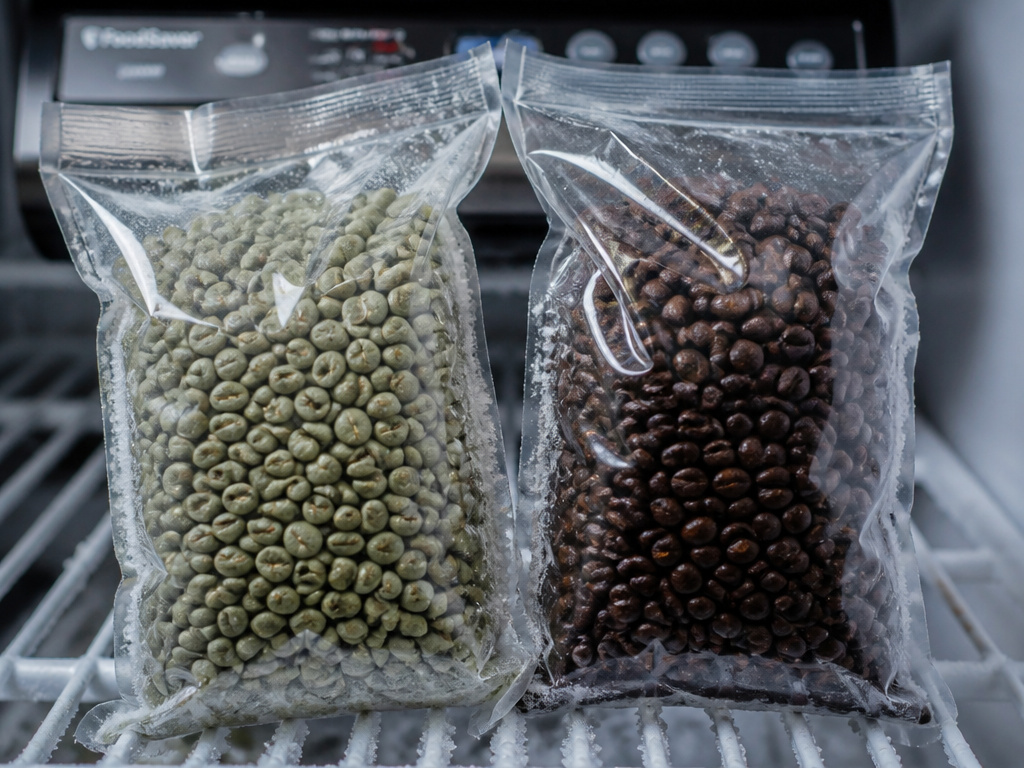
The rules change before the roaster.
Freezing green (unroasted) coffee is a common industry practice for preserving prized lots from one harvest to the next. George Howell has been doing it since 2001. The Royal Coffee study between December 2022 and June 2023 evaluated the sensory impact of freezing green coffee in Ziploc and vacuum-sealed bags versus a control at room temperature.
Their finding was nuanced. Freezing may be more beneficial for the highest-quality green coffee, and less beneficial for moderate- to low-scoring lots. Furthermore, the processing method (Natural vs. Washed) had a greater impact on final quality after freezing than the packaging type. This means a beautifully processed Natural might freeze better than a mediocre Washed, regardless of the bag.
For home roasters, the principle is similar: freeze only excellent, well-processed green beans you want to save. Use vacuum sealing. And recognize that the flavor profile of light roasts and delicate single-origin coffee can be more susceptible to subtle changes over very long frozen storage.
The Biggest Freezing Mistakes (And Their Consequences)
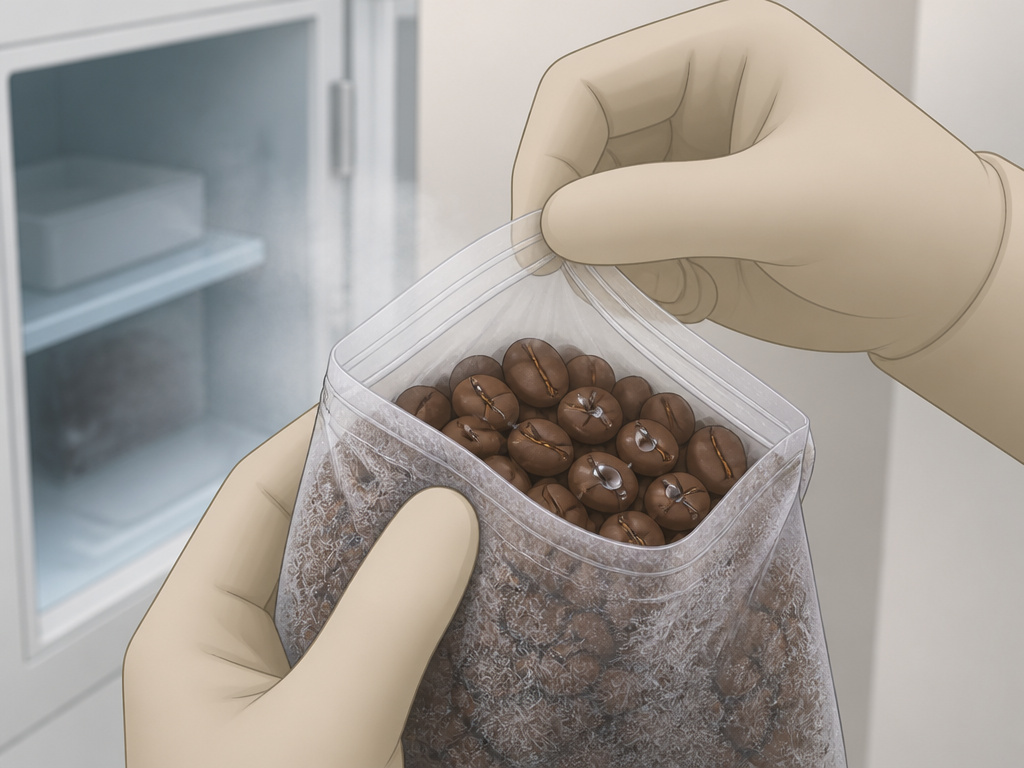
Knowing what not to do is half the battle.
Mistake 1: Freezing the whole bag and taking it out daily. Consequence: Each time you open the freezer, warm air rushes into the bag and condenses on the cold beans. Within two weeks, your coffee tastes like yesterday’s freezer-burned vegetables. The flavor is flat and muted.
Mistake 2: Thawing in the bag but opening it cold. Consequence: Visible condensation forms on the beans within minutes. This water immediately begins dissolving soluble flavor compounds and promoting oxidation. Your first brew from that bag will be the best, and each subsequent one worse.
Mistake 3: Using a flimsy bag or not removing air. Consequence: Air contains oxygen and moisture. Over months, even a small amount will stale the beans through oxidation and ice crystal formation. You’ve wasted the freezer space.
Mistake 4: Freezing for too short a time. Consequence: If you’re only storing coffee for 10 days, the complexity of freezing isn’t worth the minimal freshness gain. Just keep it in an airtight container in a cupboard.
Common mistake: Refreezing thawed beans, the repeated temperature cycling concentrates moisture inside the bean structure. The second freeze-thaw cycle turns the beans spongy and dull, killing any remaining brightness.
Frequently Asked Questions
Does freezing kill the flavor of coffee?
No, when done correctly, freezing preserves flavor by dramatically slowing staling reactions. The flavor killer is moisture intrusion from improper technique, opening frozen bags, not sealing properly, or thawing incorrectly.
How long can you keep coffee in the freezer?
Vacuum-sealed, high-quality roasted coffee can maintain peak flavor for 3-6 months in a stable freezer. Green coffee can last over a year. Beyond that, while safe, flavors will slowly degrade and mute.
Can you freeze coffee in its original bag?
You can, but you shouldn’t. The one-way valve designed for degassing also allows moist freezer air to seep in over time. For any storage longer than a few weeks, transfer to a dedicated air-tight barrier.
Does freezing work better for dark or light roasts?
Research indicates it works better for dark roasts. The 2023 consumer perception study found dark roast coffee stored at room temperature degraded more noticeably over 9 weeks than light roast coffee. Freezing acts as a stronger preservative for the more fragile dark roast flavor compounds.
Is it okay to grind frozen coffee beans?
Yes, and it can be beneficial. Frozen beans are more brittle, leading to a more consistent grind size in a burr grinder. This can reduce fines and potentially lead to more even extraction. Just dose straight from the freezer into your grinder.
Before You Go
Freezing coffee isn’t a magic trick. It’s a logistics tool for extending the life of a surplus of great beans. The method is strict: portion, seal, freeze stable, thaw sealed. Break any link in that chain and you’ll lose more flavor than you save.
Use it for your extra kilo of that fantastic single-origin Arabica, your precious dark roast, or a seasonal lot you want to savor slowly. Don’t use it for your daily driver that you’ll finish in a week. And never, ever put a half-empty bag in and out of the freezer day after day. That’s a surefire way to turn a vibrant brewed coffee into a sad, muted cup.
Your freezer is a pause button, not a rewind button. It keeps good coffee good. It never makes bad coffee better.
{
“@context”: “https://schema.org”,
“@type”: “HowTo”,
“name”: “How to Freeze Coffee Beans Correctly”,
“totalTime”: “PT10M”,
“tool”: [
{
“@type”: “HowToTool”,
“name”: “Vacuum sealer or thick freezer bag”
},
{
“@type”: “HowToTool”,
“name”: “Kitchen scale”
},
{
“@type”: “HowToTool”,
“name”: “Permanent marker”
}
],
“step”: [
{
“@type”: “HowToStep”,
“name”: “Portion the coffee”,
“text”: “Weigh out 1-2 week supplies of coffee beans (e.g., 250g) using a kitchen scale.”
},
{
“@type”: “HowToStep”,
“name”: “Remove air”,
“text”: “Place each portion into a thick freezer bag, squeeze out all air, and seal. For best results, use a vacuum sealer.”
},
{
“@type”: “HowToStep”,
“name”: “Label and freeze”,
“text”: “Write the roast date and bean type on the bag with a permanent marker. Place the sealed bags in the back of a stable freezer.”
},
{
“@type”: “HowToStep”,
“name”: “Thaw sealed”,
“text”: “The night before you need a new portion, move one sealed bag from the freezer to your counter. Let it thaw completely, still sealed, for 8-12 hours.”
},
{
“@type”: “HowToStep”,
“name”: “Grind immediately”,
“text”: “Open the thawed bag, grind the beans, and brew. Do not return thawed beans to the freezer.”
}
]
}
{
“@context”: “https://schema.org”,
“@type”: “FAQPage”,
“mainEntity”: [
{
“@type”: “Question”,
“name”: “Does freezing kill the flavor of coffee?”,
“acceptedAnswer”: {
“@type”: “Answer”,
“text”: “No, when done correctly, freezing preserves flavor by dramatically slowing staling reactions. The flavor killer is moisture intrusion from improper technique, opening frozen bags, not sealing properly, or thawing incorrectly.”
}
},
{
“@type”: “Question”,
“name”: “How long can you keep coffee in the freezer?”,
“acceptedAnswer”: {
“@type”: “Answer”,
“text”: “Vacuum-sealed, high-quality roasted coffee can maintain peak flavor for 3-6 months in a stable freezer. Green coffee can last over a year. Beyond that, while safe, flavors will slowly degrade and mute.”
}
},
{
“@type”: “Question”,
“name”: “Can you freeze coffee in its original bag?”,
“acceptedAnswer”: {
“@type”: “Answer”,
“text”: “You can, but you shouldn’t. The one-way valve designed for degassing also allows moist freezer air to seep in over time. For any storage longer than a few weeks, transfer to a dedicated air-tight barrier.”
}
},
{
“@type”: “Question”,
“name”: “Does freezing work better for dark or light roasts?”,
“acceptedAnswer”: {
“@type”: “Answer”,
“text”: “Research indicates it works better for dark roasts. The 2023 consumer perception study found dark roast coffee stored at room temperature degraded more noticeably over 9 weeks than light roast coffee. Freezing acts as a stronger preservative for the more fragile dark roast flavor compounds.”
}
},
{
“@type”: “Question”,
“name”: “Is it okay to grind frozen coffee beans?”,
“acceptedAnswer”: {
“@type”: “Answer”,
“text”: “Yes, and it can be beneficial. Frozen beans are more brittle, leading to a more consistent grind size in a burr grinder. This can reduce fines and potentially lead to more even extraction. Just dose straight from the freezer into your grinder.”
}
}
]
}
