
Is Coffee Grown in the US? The 4.2 Million-Pound Answer
Yes, coffee is grown in the United States, with Hawaii producing a commercial-scale 4.2 million pounds in 2024. California and Florida host experimental farms, while Puerto Rico’s industry is recovering from hurricanes. The real story isn’t geography, it’s a tight intersection of strict labeling laws, punishing labor costs, and a climate window that’s just now widening.
Most people assume US coffee farming is a niche hobby. They picture a single potted plant, not multi-million pound harvests governed by laws that just changed in 2024. That legal shift, from the old 10% blend rule to a coming 51% mandate, is rewriting the economics of your bag of Kona blend right now.
Here’s where the beans actually come from, what the labels legally mean, and why a 5-ounce bag of Californian coffee can cost fifty dollars.
Key Takeaways
- Hawaii is the only true commercial producer, with 4.2 million pounds grown in 2024, and its labeling laws (Act 198) now require exact blend percentages on packaging.
- A bag labeled “100% Kona” must contain only Kona beans; a “Kona Blend” must state the precise percentage of Kona coffee, with that minimum rising to 51% in July 2027.
- Experimental farms in California and Florida operate at extreme cost due to US labor rates, making their small-batch, ultra-premium coffee a luxury product.
- The primary US coffee-growing climate requires USDA hardiness zones 10B through 11, meaning consistent warmth with no frost, a band that climate change may slowly expand.
- High domestic production costs have historically encouraged blending with cheaper imported beans, a practice the new Hawaii laws are designed to curb and clarify for consumers.
The Short Answer: A Map of American Coffee
Coffee cultivation in the US is a story of one heavyweight, a couple of ambitious rookies, and a recovering veteran. The plant itself, Coffea arabica, is picky. It needs average temperatures between 60°F and 80°F (15°C and 27°C) and soaks up at least 60 inches of rain a year. That climate sweet spot translates to USDA hardiness zones 10B through 11, places without frost.
Hawaii owns the commercial category. The rest are experiments or revivals.
Coffee plants (Coffea arabica) are tropical evergreen shrubs originating in the highlands of southeast Ethiopia. For successful cultivation, they require USDA hardiness zones 10B through 11, which provide the frost-free conditions, consistent warmth, and high annual rainfall necessary for flowering and cherry development.
This map isn’t static. Agronomists in Florida are actively testing varieties, seeing if a warming climate can nudge the state into the coffee belt. It’s a long-term bet. For now, if you’re drinking coffee grown on US soil, it almost certainly started in Hawaiian volcanic soil.
TL;DR: US coffee grows where it’s warm and wet year-round: Hawaii commercially, and experimentally in California and Florida.
The Commercial Core: Hawaii and Its 4.2 Million Pounds
Hawaii isn’t just a coffee-growing state; it’s a coffee-regulating state. The 2024 harvest yielded 4.2 million pounds of green coffee. The Kona district on the Big Island gets the fame, but coffee grows on Maui, Kauai, Oahu, and Molokai too.
The number that matters more than the harvest weight might be 51. That’s the coming minimum percentage of Hawaii-grown beans required in any blend labeled as such, thanks to Act 198. The law landed on July 1, 2024, and the clock is ticking.
Common mistake: Assuming “Kona Blend” means mostly Kona coffee. Under the old law, a blend could be as little as 10% Kona. Under Act 198, that floor rises to 51% on July 1, 2027. The label must show the percentage today.
The law is specific. If a package says “All Hawaiian” or “100% Hawaiian,” every bean inside must be grown and processed in Hawaii. For blends, the label must list the percentage by weight from each geographic origin. You’ll see “60% Kona, 40% Colombian” or an aggregate like “40% Foreign-Grown Coffee.”
This transparency costs money. Hawaiian farming is labor-intensive on steep volcanic slopes. Paying US wages to hand-pick cherries is why pure Kona coffee commands a premium. Blending with less expensive Central American beans was the workaround for decades. The new law doesn’t lower the cost, it just forces honesty onto the package, phasing out the old 10% blends entirely.
| Hawaii Coffee Labeling (Act 198 – Effective July 1, 2024) | What It Means | Consumer Takeaway |
|---|---|---|
| “100% Hawaiian” / “All Hawaiian” | Every bean grown & processed in Hawaii. | The premium, terroir-driven product. |
| Blend with Geographic Names | Must list % by weight (e.g., “60% Kona, 40% Colombian”). | You see exactly what you’re paying for. |
| Aggregate “X% Foreign-Grown” | Allows a simpler label for multi-origin blends. | Still shows the Hawaii content upfront. |
| Current Minimum Blend % | 10% Hawaii-grown (until July 1, 2027). | Old stock may still be on shelves. |
| Future Minimum Blend % (2027+) | 51% Hawaii-grown. | Drastically reduces diluted “label blends.” |
The goal is to protect the value of the Hawaii origin name. For a roaster, the math just changed. A true 51% Hawaii blend by 2027 will be a significantly more expensive product to create. That shift is already changing how blenders source and price.
TL;DR: Hawaii grows millions of pounds under a new law that mandates blend transparency, ending the era of 10% “Kona” blends by 2027.
Beyond Hawaii: The Experimental States
Outside Hawaii, US coffee farming is a frontier. The climates in Southern California and South Florida can work, but the economics are brutal. This isn’t broad-acre agriculture; it’s intensive, small-plot horticulture.
California’s effort is largely synonymous with one company: Frinj Coffee. They work with a network of about 30 small farms, mostly around San Diego. The model is experimental and ultra-premium. The coffee is so scarce and costly to produce that it’s marketed as a luxury good. Singer Jason Mraz’s partnership with Frinj led to a famously priced $50 bag for just 5 ounces.
Why so expensive? Labor. Every step from pruning to picking is done by hand at US wage rates. There’s no economy of scale. The USAFacts coffee import analysis shows America’s coffee supply is built on imports from large, lower-cost producers. Competing on price is impossible. These farms compete on novelty, story, and a specific terroir.
Florida’s story is different. Researchers at the University of Florida are actively studying coffee as a potential future crop. The UF/IFAS coffee growing guide lays out the realities for the home landscape: it’s possible in the southernmost parts of the state, but it’s a long-term project with no commercial guarantee. They’re testing varieties for disease resistance and yield in a humid, subtropical environment that isn’t a traditional coffee highland.
| Region | Status | Scale | Key Challenge | Price Point |
|---|---|---|---|---|
| Hawaii | Commercial & Regulated | Millions of lbs/yr | High labor cost, land price | Premium to Super-Premium |
| California | Experimental / Niche | Few dozen acres | Prohibitively high labor cost | Ultra-Premium (Luxury) |
| Florida | Research & Hobby | Single-acre plots | Climate suitability, disease pressure | Not commercially established |
| Puerto Rico | Recovering Industry | Historically significant | Hurricane destruction, infrastructure | Rebuilding market presence |
Then there’s Puerto Rico. It has a deep coffee history, but hurricanes Maria and Fiona decimated crops and processing infrastructure. Recovery is slow. The island’s coffee, when it can be found, is a taste of a resilient but struggling industry.
TL;DR: California and Florida farms are proof-of-concept operations where production costs make coffee a luxury curio, not a commodity.
Why Isn’t There More US-Grown Coffee?
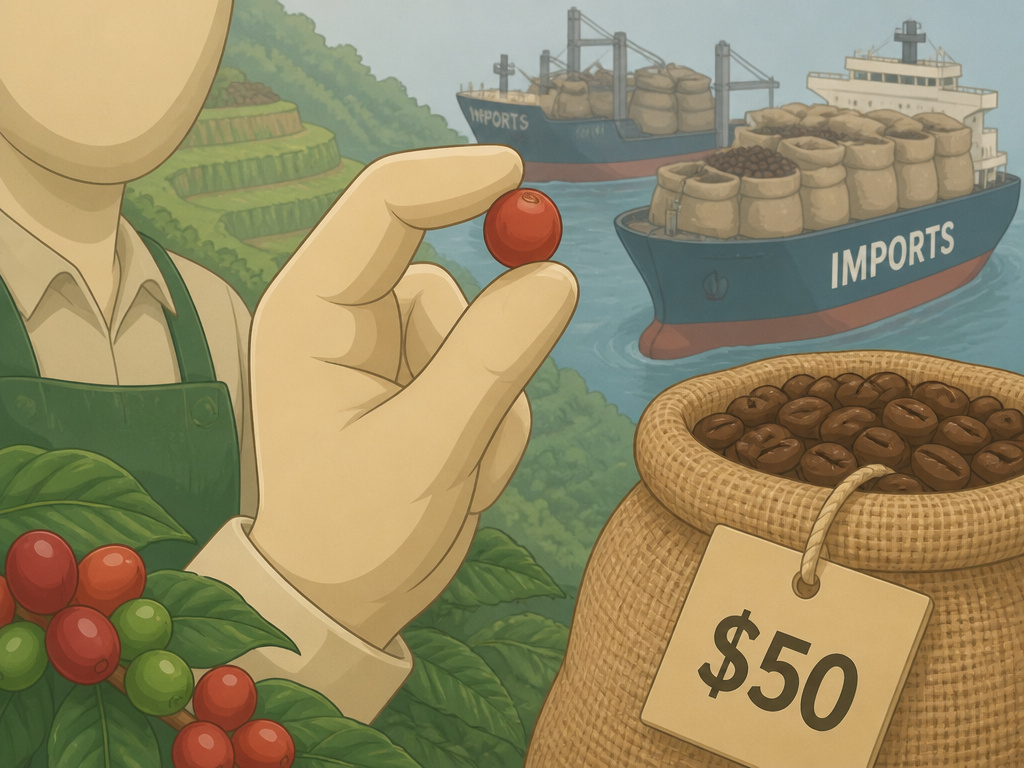
The barriers are simple to list and hard to overcome: climate, cost, and competition.
First, the suitable land is tiny. The USDA hardiness zone requirement locks out the continental US except for slivers of coastline. Even there, microclimates and soil matter. Coffee likes volcanic soil, consistent moisture, and specific altitudes. Hawaii has it. The mainland patches do not.
Second, the cost structure is upside down. The global coffee market runs on labor costs in countries like Brazil, Vietnam, and Colombia. Mechanized harvesting on flat land keeps prices low. In the US, you’re hand-picking on hillsides. That $50 bag from California isn’t a markup, it’s the actual cost of production. No one is going to start a large-scale farm when they cannot possibly compete on price with imported green beans.
Finally, there’s consumer habit. The American market is built on imported coffee blends and single-origin coffees from established world regions. Creating demand for a new, hyper-expensive domestic origin is a marketing mountain to climb. It’s easier for roasters to source reliable, cheaper Arabica beans from South America and focus on coffee roast types and flavor profiles their customers already know.
The emergence of these experimental farms is less about changing the global supply and more about research and branding. They’re learning what’s possible as climates shift, and they’re selling an exclusive story. It’s not a threat to the import model; it’s a fascinating sidebar.
TL;DR: Limited viable land, crippling labor costs, and a market saturated with cheaper imported beans make large-scale US coffee farming economically unviable.
How to Identify and Taste US-Grown Coffees

If you want to seek out American coffee, you need to become a label detective. The information is there, but you have to look past the marketing.
For Hawaiian coffee, the label is legally required to tell you the truth. Look for the specific geographic designation. Kona, Ka’u, Maui Mokka. The phrase “100%” is protected. For blends, the percentage of Hawaiian coffee must be stated. If you don’t see a percentage, be skeptical. A well-stocked specialty shop should be able to tell you the farm or cooperative.
For mainland US coffee, you’re in the realm of direct-to-consumer storytelling. Brands like Frinj in California are the main players. They’ll talk about their partner farms, the specific varietals (like Geisha), and the experimental processing methods. Expect to buy online, not off a supermarket shelf.
Taste-wise, Hawaiian coffees often have a signature profile: lower acidity, a smooth body, and notes of nuts, chocolate, and sometimes a subtle fruitiness. Kona is known for its balanced, clean cup. Californian coffees, given their experimental nature, can be all over the map, some are intensely floral and tea-like, others more classic. They are conversation pieces, often highlighting what’s possible when coffee is grown outside its traditional belt.
When you brew these coffees, treat them like the specialty products they are. Use a burr grinder for proper coffee grind consistency, pay attention to your water quality (maybe even check your Breville filter cartridge), and use a method that highlights clarity, like a pour-over. The goal is to taste the place, not mask it with dark roasting or poor technique.
I bought a bag of a noted California-grown coffee once, a Geisha varietal. I brewed it with my standard pour-over recipe. The cup was undeniably complex, jasmine, bergamot, but also thin and tea-like. It was fascinating, a technical achievement. I haven’t bought another bag. For fifty dollars, I want a coffee that satisfies my daily craving, not just my curiosity.
That’s the real test. Novelty wears off. The coffees that endure, like the best Kona lots, offer both unique origin character and drinkability. Your home grinding equipment and brewing water quality will matter more with these subtle, expensive beans than with your daily workhorse blend.
TL;DR: Read Hawaiian labels for percentages; buy mainland coffee direct for its story. Brew with care to judge if the unique taste is worth the premium price to you.
Frequently Asked Questions
What US state grows the most coffee?
Hawaii grows the vast majority of US coffee, with a harvest of 4.2 million pounds in 2024. No other state comes close to this commercial scale.
Can you grow a coffee plant at home in the US?
Yes, as a potted ornamental plant, if you can replicate its needs. It requires a very warm, humid, frost-free environment (USDA zones 10B-11), bright indirect light, and acidic, well-draining soil. Getting it to flower and produce viable cherries indoors is extremely difficult and unlikely in most home settings.
Why is Hawaiian coffee so expensive?
The high cost is driven by US labor rates for hand-picking, limited land on volcanic slopes, and the global premium for its recognized quality and name. Strict labeling laws also protect its value, preventing dilution with cheaper beans.
Is Starbucks coffee grown in the USA?
No, Starbucks sources its coffee beans from over 30 countries around the global coffee belt, primarily in Latin America, Africa, and Asia. They do not use US-grown coffee for their core blends and products.
What does “100% Kona Coffee” mean?
By Hawaii state law (Act 198), “100% Kona Coffee” means every coffee bean in the package was grown in the Kona district on the Big Island of Hawaii. There can be no blending with beans from any other geographic origin.
The Bottom Line
Coffee is grown in the United States, but on two distinct tiers. Hawaii operates as a genuine, regulated agricultural industry, producing millions of pounds under laws that are getting stricter to protect its name. The mainland. California and Florida, hosts expensive experiments pushing biological and climatic boundaries.
For the drinker, this means two things. You can reliably find authentic, terroir-driven Hawaiian coffee if you learn to read the new labels. And you can taste the frontier of American coffee farming for a premium that reflects its staggering production cost, not just its rarity. The 4.2 million pounds from Hawaii is the reality. The fifty-dollar bag from California is the research project. Both are part of the answer, but only one is built to last.
