
How to Make Filter Coffee at Home Using the Classic Drip Method
This post contains affiliate links. As an Amazon Associate, we earn from qualifying purchases.
To make filter coffee, you need hot water between 90-96°C (195-205°F), a medium-coarse grind, and a coffee-to-water ratio of 1:16, that’s about 20 grams of coffee for 320ml of water. The water must contact the grounds for 4-5 minutes in a drip machine or 15-20 minutes in a South Indian press to extract the right balance of flavors without bitterness.
Most guides treat filter coffee as a single method. They miss the split between fast American drip and slow South Indian decoction. The wrong grind for your chosen path guarantees a muddy or weak cup.
This guide walks through both. You will get the specs for a clean automatic drip and the hands-on ritual for a frothy kapi. We will cover the tools, the two core techniques, and the mistakes that ruin each one.
Key Takeaways
- Use a burr coffee grinder for a consistent medium-coarse grind; a blade grinder creates fine dust that clogs filters and over-extracts in under a minute.
- The National Coffee Association’s Golden Ratio is 55 grams of coffee per liter of water (a 1:18 ratio). For stronger drip coffee, tighten that to 60g per liter (a 1:16 ratio).
- Pre-wet paper filters with hot water before adding coffee. Skipping this leaves a papery taste in the entire brew because the dry fibers absorb the coffee’s aromatic oils first.
- For South Indian filter coffee, a 20% chicory blend is traditional; it adds body and a caramel-like sweetness but over 40% chicory makes the decoction taste woody and thin.
- Water temperature is non-negotiable. Below 90°C (194°F), the extraction is sour and weak. Above 96°C (205°F), it scalds the grounds and pulls harsh bitterness into the cup within the first minute of contact.
The Two Paths to Filter Coffee: Drip vs. Decoction
Filter coffee is not one thing. The automatic drip machine on your counter and the steel press in a South Indian kitchen achieve different results. One aims for clarity and speed, the other for intensity and texture.
The drip coffee method runs hot water through a bed of grounds once. Contact time is short, usually four to five minutes. The goal is a clean, balanced cup you can drink a full mug of. The decoction method used for South Indian kapi is a slow steep. Grounds sit in hot water for 15 to 20 minutes, producing a thick concentrate mixed with hot milk. This is not a stronger version of drip coffee. It is a different drink.
The Specialty Coffee Association’s brewing standard targets an extraction yield between 18% and 22% of the coffee’s mass. This range, measured as Total Dissolved Solids (TDS) of 1.15% to 1.35%, defines a balanced cup for drip or pour-over methods. South Indian decoction runs far higher, often exceeding 2.0% TDS, because it’s designed to be diluted.
Choosing your path first dictates every variable that follows: grind size, brew time, and equipment.
TL;DR: Drip coffee is a quick, single-pass brew for a clean cup. South Indian filter coffee is a slow steep that makes a concentrate for mixing with milk.
The Tools You Actually Need
You do not need expensive gear. You need the right tool for your chosen method. Using a drip machine filter in a South Indian press will leak grounds. Using a fine espresso grind in a drip machine will clog it.
For the drip path, the essentials are a grinder, a scale, and a brewer. A standard paper filter in a cone or basket shape works. The brand of drip machine matters less than its ability to heat water to the correct temperature. Many cheap machines brew at 85°C (185°F). That is too low.
For the decoction path, you need the specific apparatus. A South Indian coffee filter press has four parts: a bottom collector cup, an upper chamber with a perforated base, a plunger sieve that sits on the coffee, and a lid. That is the only tool that makes true kapi. A French press or AeroPress will not substitute.
| Tool | Drip Method Purpose | Decoction Method Purpose |
|---|---|---|
| Burr Grinder | Creates even medium-coarse particles for even extraction. | Creates a slightly finer grind to resist the long steep without turning to mud. |
| Gooseneck Kettle | Allows precise, slow pouring for even saturation in manual pour-over. | Not required. A regular kettle for pouring hot water is fine. |
| South Indian Filter Press | Not used. | The essential vessel for the slow percolation and collection of the coffee concentrate. |
| Paper Filters | Traps fines and oils for a clean cup; bleached coffee filters remove the paper taste faster than unbleached. | Not used. The press uses its own metal sieve. |
| Digital Scale | Weighs coffee and water to hit the 1:16 ratio accurately. | Weighs coffee for consistency; water can be measured by volume. |
The grinder is the most critical investment. A blade coffee grinder smashes beans into uneven chunks and powder. The powder over-extracts and becomes bitter before the chunks have given up their flavor. A burr grinder crushes beans between two surfaces to a uniform size. That consistency is what makes the brewing time predictable.
TL;DR: For drip coffee, you need a burr grinder, scale, and a cone with paper filters. For South Indian coffee, you must have the specific four-part filter press.
Coffee, Water, and Ratios: The Three Variables You Control
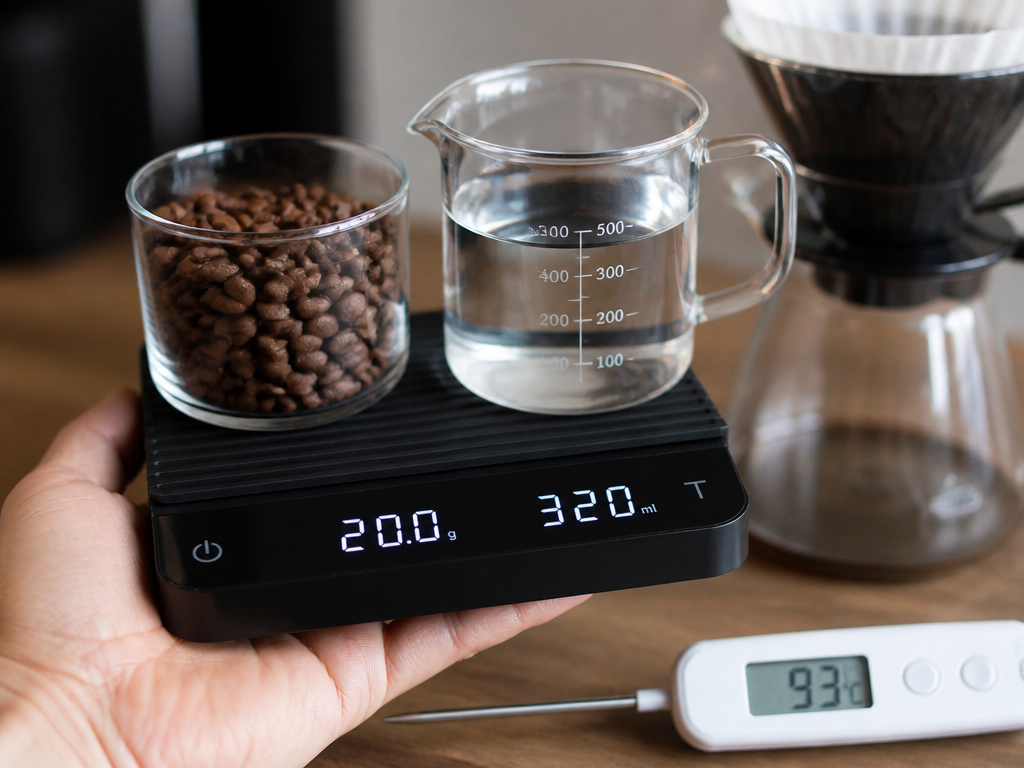
The coffee and water are the only ingredients. Their quality and proportion decide everything.
Start with fresh beans. Stale beans baked months ago will not produce a fragrant cup no matter your technique. For drip coffee method, a medium roast Arabica coffee bean works well. It offers balance. For South Indian style, a dark roast blend often includes chicory. The chicory adds a round, slightly sweet body and cuts acidity.
The water must be good. If your tap water tastes of chlorine or minerals, it will taste in your coffee. Use filtered water. The temperature is a fixed gate. The National Coffee Association states optimal extraction happens between 90-96°C (195-205°F). This is not a suggestion.
Common mistake: Using boiling water (100°C / 212°F) straight from the kettle, the grounds scorch on contact, releasing astringent compounds that make the entire pot taste harsh and dry.
The ratio is your strength lever. The SCA and NCA recommend a starting point of 55g of coffee per liter of water (a 1:18 ratio). That produces a lighter, more tea-like cup. Most home drinkers prefer a 1:16 ratio, which is 62.5g per liter. For one large mug (about 320ml), use 20g of coffee.
For South Indian decoction, the ratio is inverted because you are making a concentrate. A typical press uses 3 heaped tablespoons (about 20-25g) of coffee for 200-250ml of water. That yields 60-80ml of thick decoction, enough for two strong coffees when mixed with milk.
The Step-by-Step Drip Coffee Process
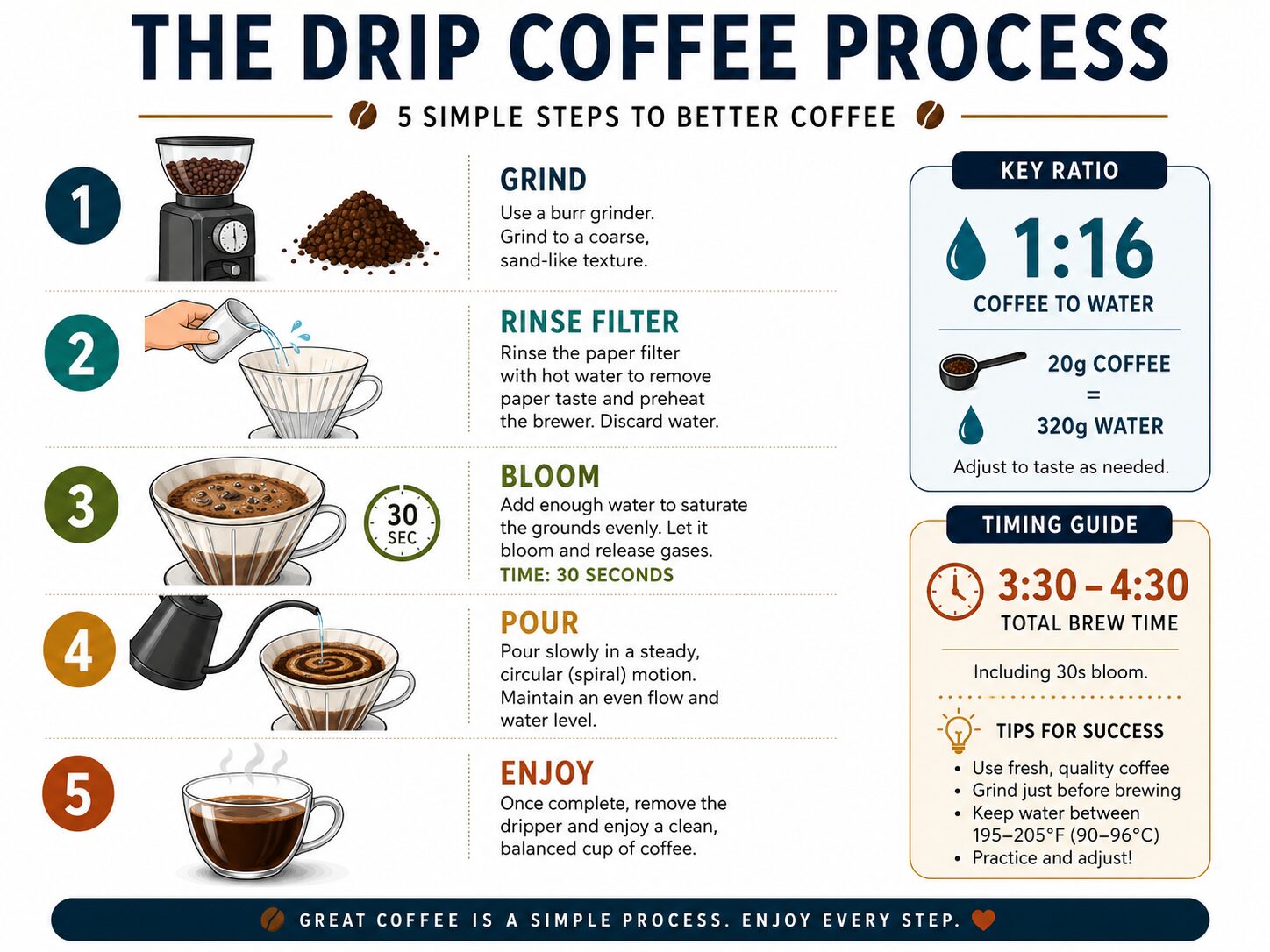
This process works for an automatic drip machine or a manual pour-over like a Hario V60. The principles are identical.
- Grind your coffee. Set your burr coffee grinder to a medium-coarse setting. The particles should look like coarse sand, not powder. For 500ml of water, grind 31g of coffee (for a 1:16 ratio).
- Prepare the filter. Place a paper filter in your cone or machine basket. Rinse it thoroughly with hot water from your kettle. This accomplishes two things: it heats the brewing vessel and washes away the paper taste. Discard the rinse water.
- Add coffee and start the bloom. Place the grounds in the damp filter. Start your timer. Pour just enough hot water (92-96°C) to saturate all the grounds, roughly twice the weight of the coffee. Wait 30 seconds. The coffee will bubble as carbon dioxide escapes. This bloom phase prevents gas from blocking water contact later.
- Pour the remaining water. After the bloom, pour the rest of your water in a slow, steady spiral. Keep the water level consistent. Aim to finish pouring by the 1:30 mark. The total contact time, from first pour until the last drop drips through, should be between 3:30 and 4:30 minutes.
- Serve immediately. Drip coffee is at its best right after brewing. It starts losing aromatic compounds and developing stale flavors as it sits on a hot plate.
I used to skip the bloom when using a cheap drip machine, thinking the machine’s spray arm did the job. The coffee always tasted hollow, like the flavor was missing a layer. Adding a manual 30-second bloom before letting the machine run fixed it. The machine just cannot wet the grounds evenly enough on its own.
If your brew finishes too fast (under 3 minutes), your grind is too coarse. If it takes longer than 5 minutes and tastes bitter, your grind is too fine.
Brewing South Indian Filter Coffee (Kapi)
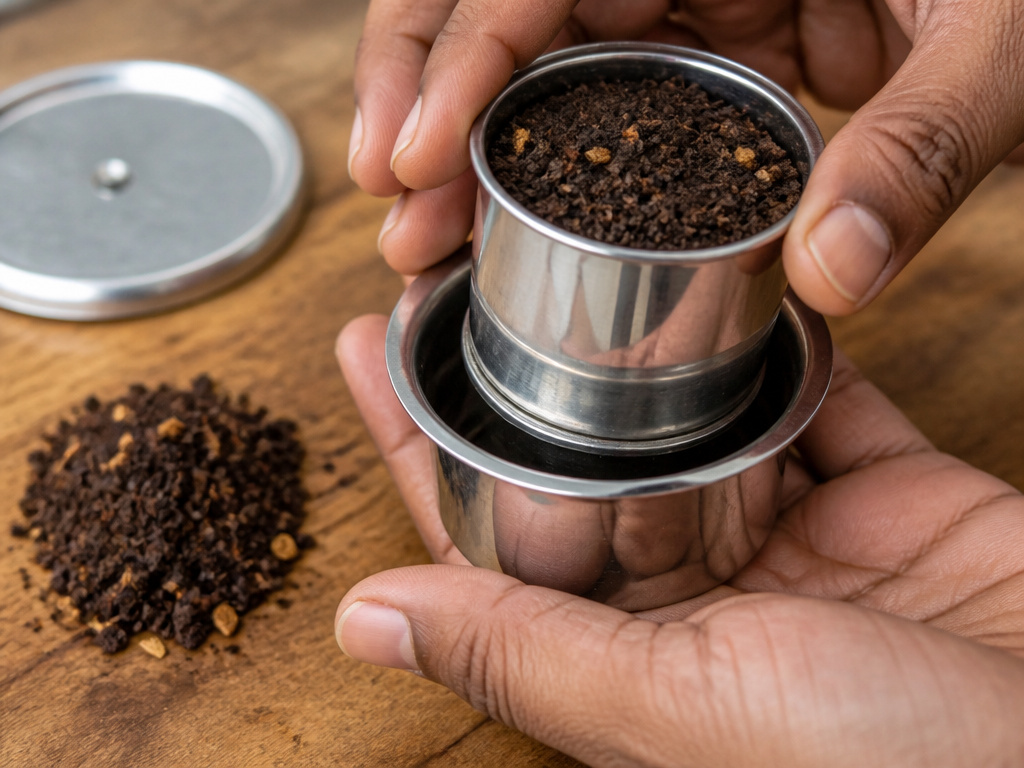
This is a ritual, not a quick fix. The result is filter coffee flavor in its most potent and traditional form.
Before you start: The press parts get very hot. Assemble it by holding the base collector, not the upper chamber. Have your milk heating separately while the decoction brews.
- Prepare the coffee blend. Use a dark roast coffee ground for filter, or a traditional blend with 20-30% chicory. Do not use an espresso grind; it will be too fine and muddle the decoction. Add 3 heaped tablespoons (20-25g) to the upper chamber of the press.
- Tamp, but don’t brick. Use the plunger sieve to press down lightly on the grounds. You are just settling them and creating a level bed. One or two gentle presses is enough.
> Common mistake: Compressing the coffee into a dense puck, the water cannot permeate evenly, and you get a weak decoction from the edges while the center stays dry. - Assemble and add water. Place the collector cup down, then the chamber with coffee, then the sieve plunger on top of the coffee. Boil water, then let it sit for 45 seconds to drop to about 93°C (200°F). Pour 200-250ml of water slowly over the sieve.
- Cover and wait. Place the lid on the press. Leave it undisturbed for 15-20 minutes. You will hear the slow drip into the collector. Do not shake or disturb it.
- Mix the kapi. The decoction in the collector will be dark and syrupy. Heat full-fat milk until frothy. For one cup, pour 30-45ml of decoction into a davara tumbler. Add sugar to taste (1-2 tsp is traditional). Pour 120-150ml of hot milk into the tumbler from a height of about 30cm (12 inches). The pouring mixes and creates a light froth. Serve immediately, often by pouring back and forth between the tumbler and a wide saucer to cool and aerate.
The decoction can be made hours in advance, even the night before. The brewed concentrate stays stable at room temperature for a day.
Why Your Last Batch Tasted Off: A Diagnostic Table
Coffee brewing is a system. When the output is wrong, one of the inputs is wrong. Use this table to match the problem to the likely cause.
| Symptom in the Cup | Most Likely Cause | The Immediate Fix |
|---|---|---|
| Sour, sharp, lacking sweetness | Under-extraction. Water too cold, grind too coarse, or brew time too short. | Increase water temperature to 94°C, use a finer grind setting, or increase contact time. |
| Bitter, harsh, drying aftertaste | Over-extraction. Water too hot, grind too fine, or brew time too long. | Lower water temp to 92°C, use a coarser grind, or shorten contact time. |
| Muddy, gritty texture | Fines in the grind from a blade grinder, or a torn paper filter. | Use a burr grinder, or ensure your paper filter is seated without tears. |
| Flat, stale, or papery taste | Stale coffee beans, or failure to pre-rinse a paper filter. | Use freshly roasted beans (within 3 weeks of roast date). Always pre-wet filters with hot water. |
| Weak decoction, not thick | Coffee puck tamped too hard, or the chicory blend percentage is too high (over 40%). | Press the grounds only lightly to settle. Use a blend with 20-30% chicory max. |
Frequently Asked Questions
What’s the difference between filter coffee and regular coffee?
“Regular coffee” is an ambiguous term, often meaning automatic drip coffee. All filter coffee is coffee brewed by passing water through a filter containing ground coffee. This includes drip machines, pour-overs, and the South Indian press. So, most “regular” coffee is a type of filter coffee.
Can I make filter coffee without a machine?
Yes. The South Indian filter press is a manual, machine-free device. For standard drip-style coffee, you can use a manual pour-over cone (like a Hario V60 or Kalita Wave) placed directly over your mug. You just need the cone, a paper filter, ground coffee, and a kettle.
Is filter coffee healthier than instant coffee?
Filter coffee made from freshly ground beans contains more antioxidants and beneficial compounds than instant coffee, which is heavily processed. Additionally, paper filters trap cafestol, a compound in coffee oils that can raise LDL cholesterol. Unfiltered methods like French press leave those oils in the cup.
How fine should I grind coffee for a filter?
For drip or pour-over methods, a medium-coarse grind is ideal, it should resemble coarse sand. For a South Indian filter press, use a grind slightly finer than that, but not as fine as espresso. The goal is to allow a slow drip without clogging the metal sieve.
Why does my filter coffee taste bitter?
Bitterness is almost always a sign of over-extraction. The most common culprits are water that is too hot (over 96°C / 205°F), a grind that is too fine, or letting the water contact the grounds for too long. Check your variables one by one, starting with grinding coarser.
Can I reuse coffee filters?
Paper filters are designed for single use. Reusing them will result in a clogged filter, uneven extraction, and off-flavors from old coffee oils. Reusable metal or cloth filters exist, but they require thorough cleaning after each use to prevent oil buildup and rancidity.
The Bottom Line
Good filter coffee is about matching your method to your goal. Want a clean, bright morning cup? Master the drip or pour-over with a precise ratio and a proper bloom. Craving something rich, frothy, and traditional? Commit to the 20-minute steep of the South Indian press.
Remember the fixed rules: water at 90-96°C, a consistent grind from a burr grinder, and fresh beans. The variables, ratio, brew time, blend, are your playground. Start with the standards, then adjust to your taste. Your third cup will be better than your first. Your tenth will be where you want it.
{
“@context”: “https://schema.org”,
“@type”: “HowTo”,
“name”: “How to Make Filter Coffee Using a South Indian Filter Press”,
“totalTime”: “PT25M”,
“supply”: [
{
“@type”: “HowToSupply”,
“name”: “Fresh coffee beans, medium-coarse grind”
},
{
“@type”: “HowToSupply”,
“name”: “Filtered water”
},
{
“@type”: “HowToSupply”,
“name”: “Optional: Chicory blend (20% mix)”
}
],
“tool”: [
{
“@type”: “HowToTool”,
“name”: “South Indian coffee filter press (4-part)”
},
{
“@type”: “HowToTool”,
“name”: “Kettle with temperature control”
},
{
“@type”: “HowToTool”,
“name”: “Burr coffee grinder”
}
],
“step”: [
{
“@type”: “HowToStep”,
“name”: “Grind and load the coffee”,
“text”: “Grind 20g of coffee beans to a medium-coarse consistency, slightly finer than French press. Add it to the upper chamber of the filter press. Tap the chamber to settle the grounds, but do not compress them into a brick.”
},
{
“@type”: “HowToStep”,
“name”: “Assemble and add water”,
“text”: “Place the collector cup at the bottom, then the chamber with coffee, then the plunger sieve. Boil water, then let it cool for 30 seconds to 92-96°C (198-205°F). Pour 300ml of water slowly over the coffee bed.”
},
{
“@type”: “HowToStep”,
“name”: “Steep and collect decoction”,
“text”: “Place the lid on the press. Let it steep and percolate for 15-20 minutes. A thick, dark coffee concentrate (decoction) will drip into the collector cup.”
},
{
“@type”: “HowToStep”,
“name”: “Mix with hot milk and sugar”,
“text”: “Heat full-fat milk until it froths. For one serving, pour 30-45ml of decoction into a davara tumbler. Add 1-2 teaspoons of sugar. Pour in 150ml of hot milk from a height to mix and froth. Serve immediately.”
}
]
}
{
“@context”: “https://schema.org”,
“@type”: “FAQPage”,
“mainEntity”: [
{
“@type”: “Question”,
“name”: “What’s the difference between filter coffee and regular coffee?”,
“acceptedAnswer”: {
“@type”: “Answer”,
“text”: “\”Regular coffee\” is an ambiguous term, often meaning automatic drip coffee. All filter coffee is coffee brewed by passing water through a filter containing ground coffee. This includes drip machines, pour-overs, and the South Indian press. So, most \”regular\” coffee is a type of filter coffee.”
}
},
{
“@type”: “Question”,
“name”: “Can I make filter coffee without a machine?”,
“acceptedAnswer”: {
“@type”: “Answer”,
“text”: “Yes. The South Indian filter press is a manual, machine-free device. For standard drip-style coffee, you can use a manual pour-over cone (like a Hario V60 or Kalita Wave) placed directly over your mug. You just need the cone, a paper filter, ground coffee, and a kettle.”
}
},
{
“@type”: “Question”,
“name”: “Is filter coffee healthier than instant coffee?”,
“acceptedAnswer”: {
“@type”: “Answer”,
“text”: “Filter coffee made from freshly ground beans contains more antioxidants and beneficial compounds than instant coffee, which is heavily processed. Additionally, paper filters trap cafestol, a compound in coffee oils that can raise LDL cholesterol. Unfiltered methods like French press leave those oils in the cup.”
}
},
{
“@type”: “Question”,
“name”: “How fine should I grind coffee for a filter?”,
“acceptedAnswer”: {
“@type”: “Answer”,
“text”: “For drip or pour-over methods, a medium-coarse grind is ideal, it should resemble coarse sand. For a South Indian filter press, use a grind slightly finer than that, but not as fine as espresso. The goal is to allow a slow drip without clogging the metal sieve.”
}
},
{
“@type”: “Question”,
“name”: “Why does my filter coffee taste bitter?”,
“acceptedAnswer”: {
“@type”: “Answer”,
“text”: “Bitterness is almost always a sign of over-extraction. The most common culprits are water that is too hot (over 96°C / 205°F), a grind that is too fine, or letting the water contact the grounds for too long. Check your variables one by one, starting with grinding coarser.”
}
},
{
“@type”: “Question”,
“name”: “Can I reuse coffee filters?”,
“acceptedAnswer”: {
“@type”: “Answer”,
“text”: “Paper filters are designed for single use. Reusing them will result in a clogged filter, uneven extraction, and off-flavors from old coffee oils. Reusable metal or cloth filters exist, but they require thorough cleaning after each use to prevent oil buildup and rancidity.”
}
}
]
}
