
Dating an Antique Coffee Grinder: Patents, Styles & Brands
To date an antique coffee grinder, you need three pieces of evidence: a manufacturer’s mark, a patent date, and the style of construction. Match the mark to a company’s known production period, use the patent date as the earliest possible year, and let the materials and design narrow the window. Missing one piece makes the others more critical.
Most people start by guessing based on how old something looks. They see rust and assume 1800s. That’s a fast way to misdate a 1950s reproduction by thirty years. The real age is in the details you have to hunt for.
This guide walks through the detective work. We’ll cover how to find hidden marks, interpret patent dates, and use construction clues to pin down when your grinder was actually made. We’ll also tackle the tricky cases where the usual evidence is missing.
Key Takeaways
- A patent date (e.g., “Pat. 1886”) is a starting point, not the manufacture date. The grinder was made on or after that year.
- The Arcade Manufacturing Company’s “Crystal” line with its glass hopper wasn’t introduced until 1905. A glass hopper on an Arcade grinder means it’s 20th century, not 19th.
- Replacement handles, knobs, or a fresh coat of paint can make a grinder appear decades younger. Always check for inconsistencies in wear and material.
- For unmarked grinders, the joinery tells the story: dovetailed wood construction points to pre-1920s hand assembly, while stapled or glued boxes are later.
- Cast iron was the dominant material for major American manufacturers until the 1930s, when lighter metals and composites began to appear.
The Three-Step Identification Process
Dating isn’t guesswork. It’s a process of elimination built on three pillars. You need the maker, the legal protection date, and the physical build. One pillar can support the others if something is missing.
Start with a good light and a magnifying glass. Dust and grime hide the best clues.
The most reliable method for dating a marked antique coffee grinder involves cross-referencing the manufacturer’s imprint with known company operational dates, treating any stamped patent date as a terminus post quem (earliest possible date), and using construction materials, specifically the shift from all-cast-iron bodies to those incorporating glass or tin hoppers, as a secondary chronological filter.
First, find the maker. Look on the base, the back of the main casting, inside the hopper, or on the front plate below the crank. Marks are often raised cast letters, not stamped. They get filled with paint and dirt.
Common Maker Marks and Their Date Ranges:
| Manufacturer | Typical Mark | Active in Coffee Mills | Key Dating Clue |
|---|---|---|---|
| Enterprise Mfg. Co. | “Enterprise Mfg. Co. Phila. PA. U.S.A.” | 1870 – early 1900s | Often includes a patent date. Early models feature a “double wheel” design. |
| Arcade Mfg. Co. | “Arcade Mfg. Co. Freeport, IL” | 1889 – 1940 | The “Crystal” line with glass hopper debuted in 1905. Model numbers like “No. 135” help. |
| Charles Parker Co. | “Charles Parker Co. Meriden, CT” | 1873 – 1905 | Known for intricate, detailed castings. A patent date is usually present. |
| Wrightsville Hardware Co. | “Wrightsville Hardware Co.” | 1880 – 1920 | Look for a model number alongside the name. |
| Peugeot Frères | “Peugeot Frères” with lion logo | 1840 – present | The “G1” box grinder model was introduced in 1879. |
Second, decode any patent date. This is not the date it was made. It’s the date the design was patented, so your grinder was made after that. If it says “Pat. Jan. 12, 1886,” the grinder is from 1886 or later. You can verify these dates through the United States Patent and Trademark Office database or dedicated collector resources.
Third, analyze the construction. The materials don’t lie. An all-cast-iron body with a heavy, ornate design is almost certainly pre-1900. The introduction of a glass hopper, like on the Arcade Crystal, is a firm marker of post-1905 production. The feel matters, too. A box grinder with dovetailed joints indicates hand craftsmanship common before the 1920s. One held together with staples or modern screws is a red flag for later repair or a newer piece.
TL;DR: Find the mark, note the patent, study the build. The truth is in the combination.
What If There Are No Marks?
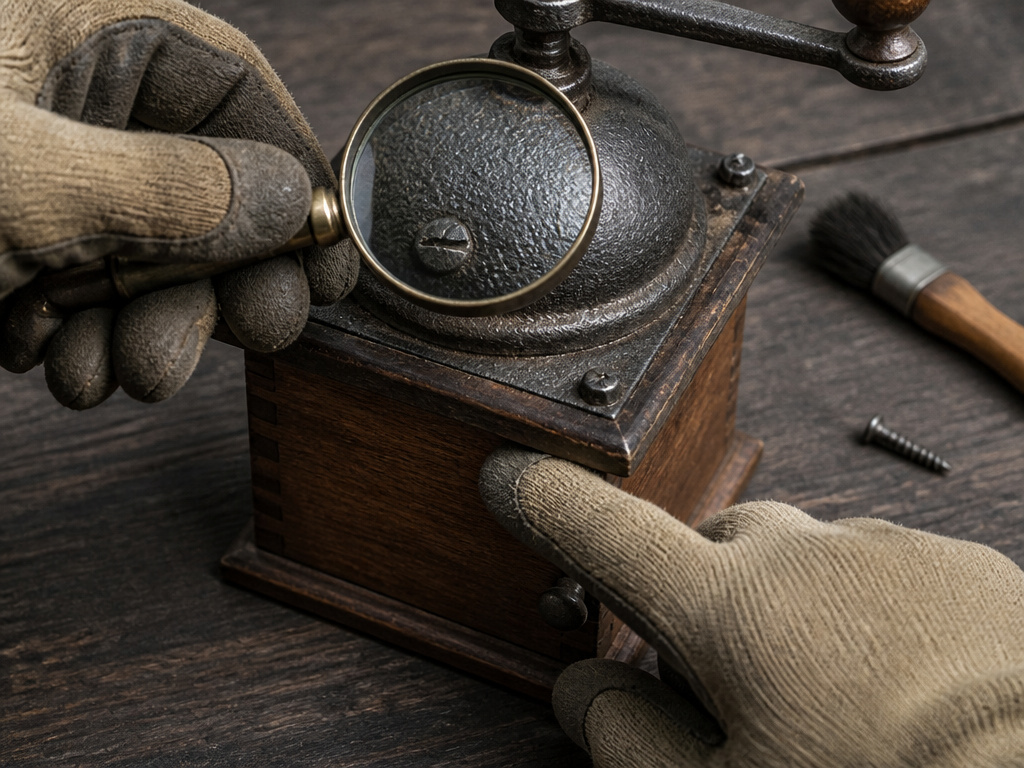
Unmarked grinders are common, especially from small regional manufacturers or stores that sold generic units. This is where you become an archaeological detective. You rely entirely on style, materials, and craftsmanship.
Common mistake: Assuming an unmarked, all-cast-iron grinder is “Civil War era.” Many simple cast-iron grinders were produced well into the 1920s for farm and institutional use. Without a mark, you need sharper clues.
First, determine the type. Is it a wall-mounted grinder, a lap box, or a tabletop model? Wall-mounted models with a single mounting hole and simple lines were workhorses from the 1880s through the 1930s. Fancy lap boxes with detailed castings and decorative trim peaked in popularity in the late 1800s.
Look at the wood. Is it part of the construction? A wooden box with dovetail joints is a sign of pre-industrial, hand-cut work, likely pre-1920. If the wood is thin, plywood, or joined with obvious machine-cut staples, you’re looking at a mid-20th century piece or a replacement part.
Examine the metal finish. Is it a rough, sand-cast texture? That’s typical of 19th and early 20th-century foundry work. A smoother, more uniform casting suggests later manufacturing techniques. Check the hardware. Slotted flat-head screws were standard until Phillips heads became common in the 1930s. A mix of screw types often points to repair.
This is where knowledge of grinder construction across eras pays off. The mechanism inside, the burr grinder history of conical versus flat iron plates, evolved slowly, but the housing tells the faster-moving story of industrial design.
Dating by Major Manufacturer
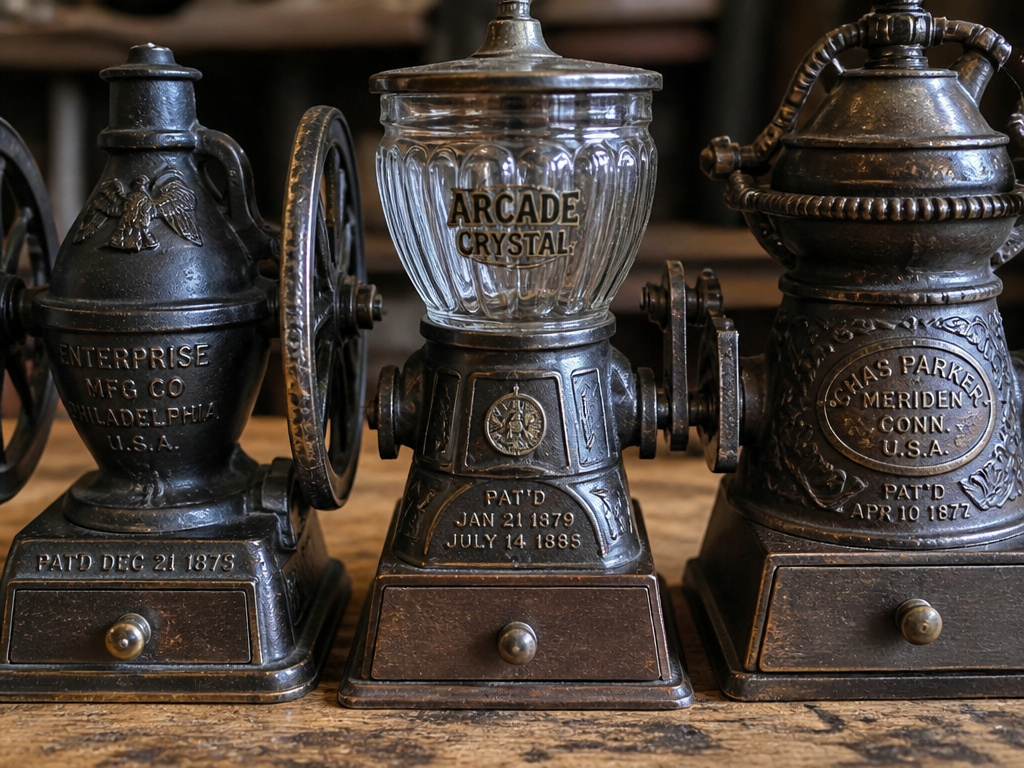
When you have a mark, your job is easier. You just need to know that company’s timeline. Here are the big names and what to look for.
Enterprise Manufacturing Company grinders are some of the most collected. They are almost always marked. If you see “Enterprise Mfg. Co. Phila. PA. U.S.A.,” you have a piece from their 1870-early 1900s run. Many include a patent date. Their early “double wheel” models are particularly sought after. The casting is usually robust and high quality.
Arcade Manufacturing Company is famous for its Crystal line. That glass hopper is a definitive marker. If your Arcade grinder has a glass hopper, it cannot be older than 1905. They made wall-mounted models (like the common No. 135) and box grinders. Arcade stopped coffee mill production in 1940 due to WWII material restrictions, so that’s your end date.
Charles Parker Company grinders are works of art. The castings feature intricate scrollwork and floral patterns. They are almost always marked with the company name and a patent date, as their operation was shorter (1873-1905). The presence of a Parker mark instantly places your grinder in the late Victorian era.
Peugeot Frères, the French maker, has a long history. Their early coffee grinders, marked with the lion logo and “Peugeot Frères,” can date back to the mid-1800s. The iconic Peugeot G1 box grinder hit the market in 1879. Unlike many American companies, Peugeot’s production continued, so you must use style cues to date pre- and post-war models.
TL;DR: A manufacturer’s mark is a direct line to a history book. Know the company’s operational dates and any signature model releases, like the 1905 Arcade Crystal.
Spotting Reproductions and Restorations
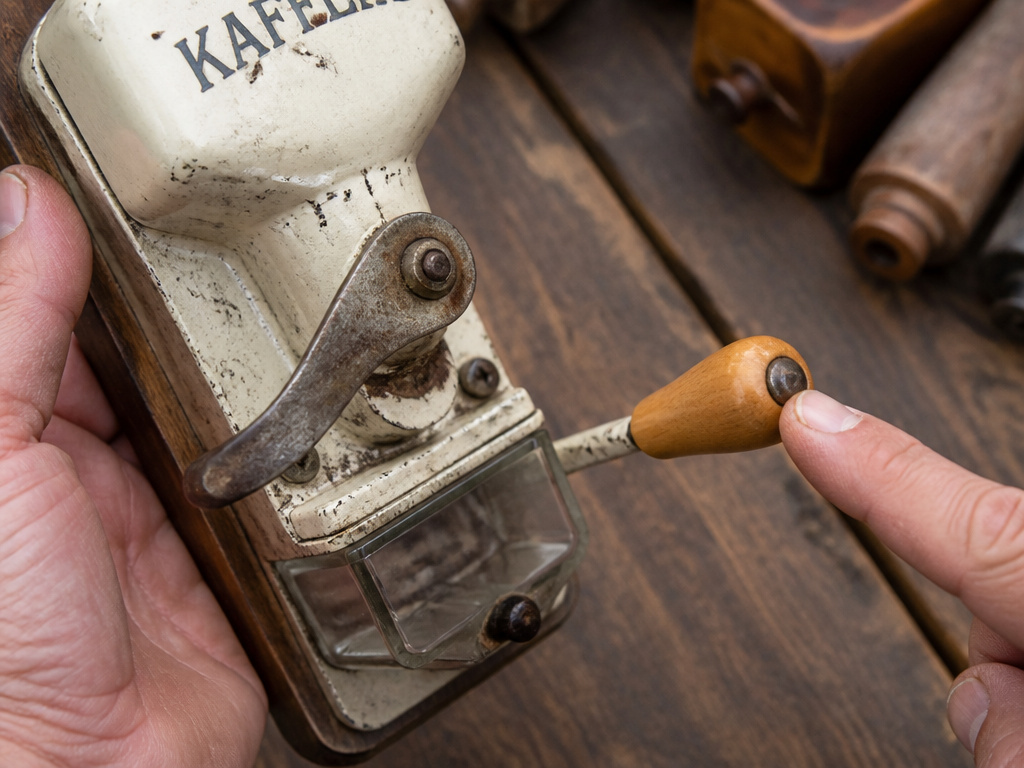
Not everything that looks old is old. The market has reproductions, and well-meaning owners often “improve” pieces with new parts. You must separate original age from the age of the components.
A full restoration with a repainted body and new handle looks beautiful but can obscure original details and dramatically affect value. The key is inconsistency.
I bought a “circa 1890” wall grinder at a flea market. The body was right, but the crank handle was too perfectly smooth. After a week of research, I found an identical handle for sale as a reproduction on a woodworking site. The grinder itself was likely from the 1910s, but the new handle made it look like a fresh antique. Now I always feel the wood for wear that matches the grinder’s age.
Look for signs of recent painting. Is the paint uniformly thick, filling in the crisp details of the casting? Does it chip in a way that reveals a different color underneath? Original paint, if it survives, is usually thin and worn in specific spots, around the crank, on the corners.
Inspect the hardware. Are all the screws the same type and show consistent aging? One shiny new screw among four rusted ones is a tell. Replacement parts like wooden knobs or drawer pulls may be made from different wood or lack the patina of the main box.
Listen to the coffee grinder collector community. Forums are full of side-by-side comparisons of original versus restored versus fake. A replaced catch cup or a re-nickled finish doesn’t make it a fake, but it does change its story from a pristine antique to a restored functional piece.
TL;DR: Judge each part individually. Uniform wear suggests originality. Mismatched materials, fresh paint, or new hardware point to restoration or reproduction.
Regional Variations and Special Cases
American manufacturers dominate the conversation, but coffee was ground everywhere. European and regional American grinders follow different rules.
European grinders, especially from France, Germany, and England, often used different materials. You might find grinders with tin or brass hoppers instead of glass or iron. The design aesthetics are distinct, more ornate, with different shaping. A Peugeot grinder has a different “feel” than an Enterprise. Research requires region-specific resources.
Smaller regional American manufacturers, like the Wrightsville Hardware Company, produced grinders that might not have widespread recognition. Their dating relies heavily on local history and comparing against known examples. A grinder marked for a specific small-town hardware store is a special piece of social history, even if it’s harder to pin to an exact year.
Then there are the true oddballs. Grinders built into furniture, promotional grinders given away by coffee brands, or military-issue models. These are dated by association. A grinder built into a 1920s Hoosier cabinet is from the 1920s. A promotional grinder for “A&P Coffee” can be dated by the branding style of that company’s advertising eras.
Understanding the broader context of historical coffee varieties and traditional coffee types can provide cultural clues about when certain grinders were in use.
The Tools You Need (And What Happens If You Skip Them)
You don’t need much, but the right tools keep you from missing clues or damaging the piece.
- A Bright, Adjustable Light: A good LED work light or a strong flashlight. Shadow hides detail. Skipping this means you might miss a faint, grime-filled stamp on the bottom.
- Magnification: A jeweler’s loupe (10x is perfect) or a strong magnifying glass. Patent dates and small maker marks are tiny. Without it, “1886” can look like a scratch.
- Soft, Lint-Free Cloths: Microfiber or cotton cloths for gentle dusting. Never use water, solvent, or steel wool first. Abrasives destroy original finish and value.
- Notepad and Pencil: Document everything you see, marks, measurements, oddities. Memory fails. Relying on memory leads to conflating details from different grinders later.
- A Digital Camera or Smartphone: Take clear, well-lit photos from all angles. These are for your records and for seeking help online. Blurry photos get you nowhere.
Leaning over a grinder in dim light with your naked eye is how you date it wrong. The process rewards patience and good light.
Frequently Asked Questions
How can I tell if my antique coffee grinder is valuable?
Age alone doesn’t determine value. Rarity, condition, manufacturer, and desirability do. A pristine, marked Arcade Crystal in working order is worth more than a common, rusted-unmarked wall grinder. Complete, original pieces with clear patent dates from sought-after makers like Parker or early Enterprise command the highest prices. Always check completed auctions on collector sites for real-world comps.
What does a patent date mean on a coffee grinder?
patent date is the date the design was legally registered with the government. It is the earliest possible date your grinder could have been manufactured. The grinder was made on or after that date, sometimes years later. It is a crucial starting point, not the end of your research.
I found a number on my grinder. Is that a model number or a date?
It’s likely a model number. Manufacturers like Arcade (e.g., Model No. 135) used them. Dates are almost always preceded by “Pat.” (for patent) or are formatted like “Jan. 12, 1886.” A standalone three-digit number is a model identifier. You can cross-reference this number with coffee maker manuals or collector guides for that brand to learn more about its specific production run.
Can I still use my antique coffee grinder to grind coffee?
You can, but with caveats. First, ensure it’s clean and free of rust or old, rancid coffee oils. Second, understand it will produce a less consistent grind than a modern burr coffee grinder. This is fine for methods like French press but not ideal for espresso. Using it gently preserves the mechanism. It’s a functional piece of history.
Where is the best place to look for the maker’s mark?
Check every surface. Common spots include the flat base, the vertical back plate, the front casting below the crank handle, and inside the empty hopper. Marks are often cast into the metal and filled with decades of paint, so gentle cleaning and angled light are key. On box grinders, look on the bottom of the wood box or the iron end plates.
Before You Go
Dating an antique coffee grinder is a puzzle. The answer isn’t a single year but a range defined by the maker’s lifespan, the patent on the design, and the materials used to build it. Start with the obvious marks, respect the patent date as a floor, and let the construction materials, the shift from iron to glass, from hand-cut dovetails to machine staples, guide you to the right era.
When the marks are gone, you become the expert. You learn to read the wood, the screws, the wear patterns. You understand that a replaced handle tells its own story. This isn’t just about assigning a date; it’s about reconstructing the object’s journey from a factory floor to your hands. That story is the real value.
