
Learn How to Crush Coffee Beans for the Perfect Cup at Home
To crush coffee beans for the perfect cup, use a burr grinder, not a blade. Set it to a uniform particle size matching your brew method: coarse for French press, medium for drip, fine for espresso. Weigh whole beans first. This precise grind controls extraction, preventing a sour or bitter, unbalanced cup.
Most people get this wrong because they use a blade grinder. Those whirling blades chop beans into a random mix of powder and boulders. Every cup becomes a lottery of over and under-extraction. You can follow a perfect recipe with terrible grounds and still get a sour, bitter mess.
This guide walks through why uniformity matters, picks the right tool, and maps every grind setting to its brewer. It also covers what to do when the standard rules break, like grinding for Turkish coffee or dealing with flavored beans.
Key Takeaways
- Blade grinders destroy flavor consistency by creating uneven particles; a burr grinder is the only tool for the job.
- Grind size must match brew time: coarse for long immersion (French press), fine for fast extraction (espresso).
- Weigh beans before grinding, not after. Volume measurements vary wildly with bean density and roast.
- Burrs wear out. High-volume commercial burrs need replacement after 1,000–2,000 kg of coffee.
- Flavored beans will ghost your grinder. Clean thoroughly after use or dedicate a cheap grinder to them.
Why Uniformity Is Everything
Coffee extraction is a timed chemical process. Water dissolves flavors from the surface of coffee particles. If those particles are all different sizes, the small ones over-extract and turn bitter while the large ones under-extract and stay sour. A uniform grind gives every particle roughly the same surface area, so they all release their flavors in sync.
Common mistake: Using a blade grinder for quality coffee, the inconsistent particle size guarantees simultaneous sour and bitter notes in the same cup, regardless of brew method.
The physical mechanism is simple. A blade spins and randomly impacts beans, fracturing them into whatever size fits between the blades at that millisecond. A burr grinder crushes beans between two precisely aligned surfaces. The distance between those surfaces, the grind setting, determines the maximum particle size. Everything gets sheared to that dimension or smaller.
TL;DR: Uniform particle size from a burr grinder allows even extraction. Blade grinders create a chaotic mix that brews into a muddled, unbalanced cup.
The Right Tool for the Job: Burr vs. Blade
This isn’t a preference. It’s physics. The burr grinder vs blade grinder debate is settled for anyone chasing flavor.
| Grinder Type | Mechanism | Particle Consistency | Best For | Risk If Used for Coffee |
|---|---|---|---|---|
| Burr Grinder | Crushes beans between two aligned surfaces (burrs) | High uniformity; adjustable size | All coffee brewing | Neglecting burr cleaning leads to flavor transfer and skewed settings. |
| Blade Grinder | Chops beans with spinning propeller blades | Very inconsistent; dust and boulders | Spices, nuts | Guarantees uneven extraction, masking the true flavor of single-origin coffee. |
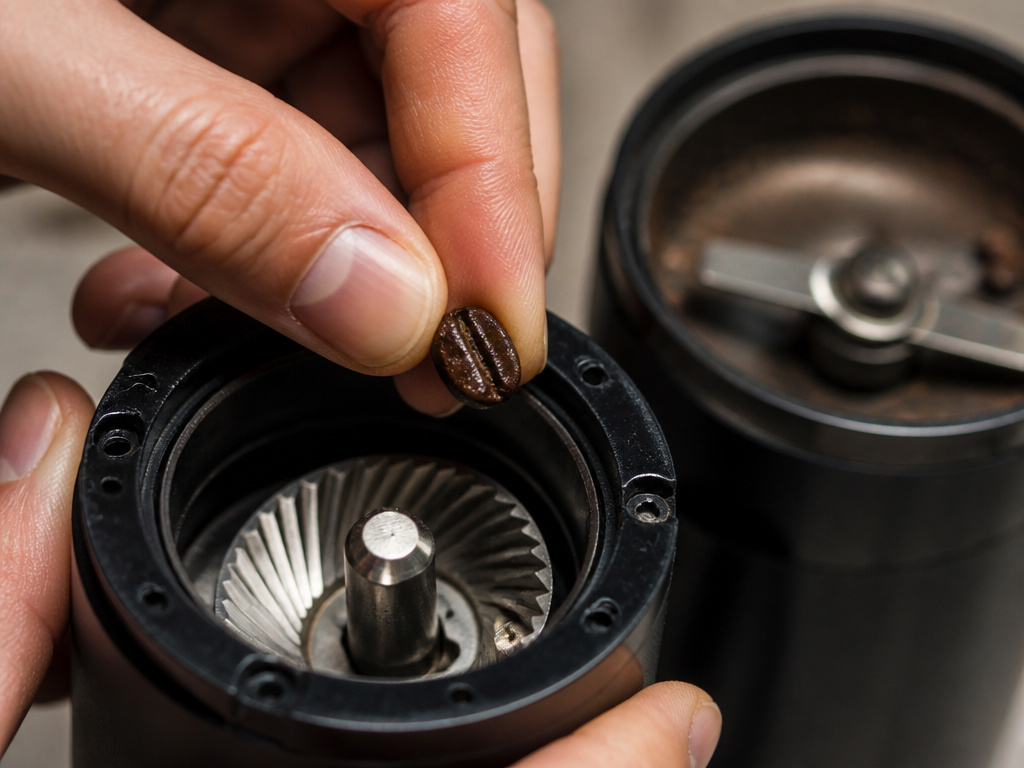
Burr grinders come in two main designs. Conical burrs look like a ring with a cone inside; they’re generally quieter and handle small home doses well. Flat burrs are two parallel rings; they often produce a slightly more uniform particle distribution prized in cafes. The Baratza Sette 270Wi uses a 40mm conical burr set. The Mahlkönig EK43 uses 98mm flat burrs.
I ran a Baratza Sette for about 18 months before the plastic gear in the gearbox sheared. The motor would whir, but the burrs wouldn’t turn. Baratza shipped a metal gear revision kit. That gearbox issue is well-documented for 2017–2018 models. Newer units have the fix.
Manual grinders like the Comandante C40 MK4 Nitro Blade use a 39mm conical burr set and are perfect for travel or single servings. Their limitation is effort, grinding fine enough for espresso by hand takes real torque.
TL;DR: Buy a burr grinder. Accept no substitutes. A manual model works if you brew occasionally; an electric model is necessary for daily espresso.
Choosing Your Crush: The Grind Size Spectrum
Grind size is your primary control over extraction time. A fine grind has more surface area, so water extracts flavors quickly. A coarse grind has less surface area, requiring longer contact time. Match the size to your brewer’s typical water-to-coffee contact duration.
Here are the core settings, from largest to smallest particle size.
- Extra Coarse: Looks like rough sea salt. Use only for cold brew, which steeps for 12–24 hours. Grinding this coarse on a home burr grinder often produces more fines than desired, it’s at the edge of most machines’ adjustment range.
- Coarse: Similar to breadcrumbs. The standard for French press and percolators. The particles are large enough to be held back by a mesh screen.
- Medium-Coarse: The sweet spot for Chemex and other large pour-over brewers. It allows a 4–5 minute drawdown without clogging the thick filter.
- Medium: The default for automatic drip machines. It’s the most common pre-ground size because it works acceptably across many home brewers.
- Medium-Fine: Ideal for V60 and most cone pour-overs. It creates a slight resistance to water flow, extending the brew to 2.5–3.5 minutes for balanced extraction.
- Fine: Looks like table salt. Used for espresso and moka pots. The fine particles create the pressure resistance needed for proper espresso extraction.
- Extra Fine: Powdery, almost like flour. Reserved for Turkish coffee, which is boiled with the grounds. Most home grinders struggle here; they heat up or clog.
Setting a grinder for Turkish coffee often requires multiple passes at the finest setting, with cooling pauses between to prevent heat buildup from roasting the grounds a second time.
The exact click or number on your grinder doesn’t matter. What matters is the resulting brew time. If your pour-over finishes in 90 seconds, grind finer. If your espresso shot takes 40 seconds to yield 36 grams, grind coarser. Let the clock guide you.
The Step-by-Step Process for Perfect Grounds
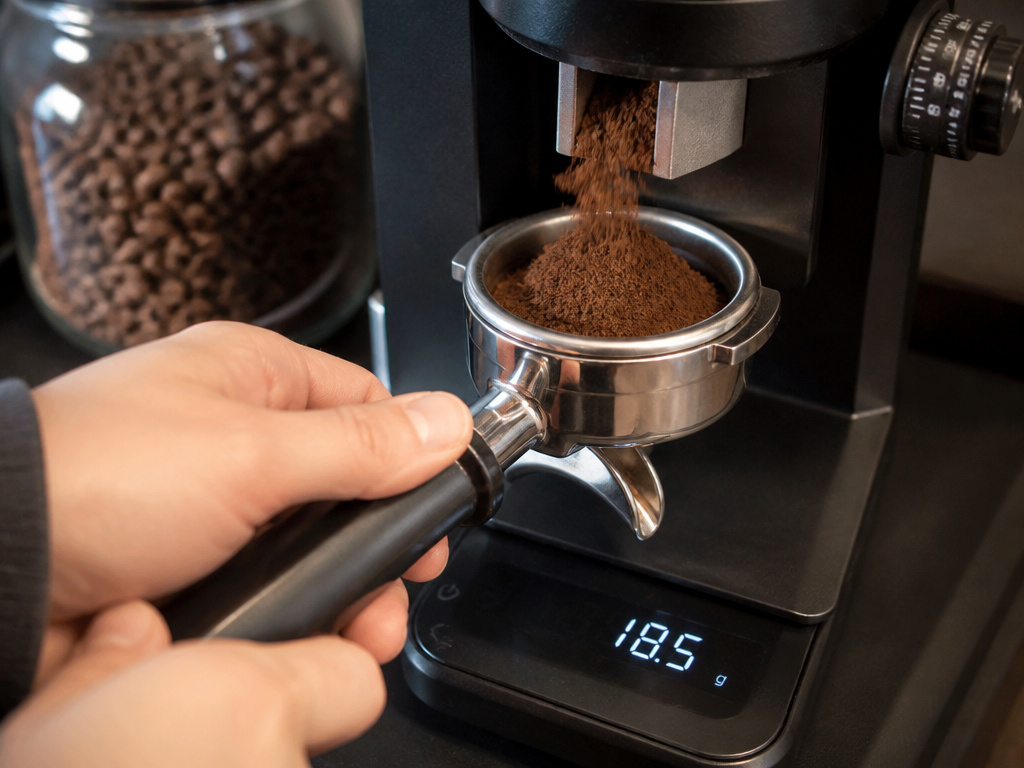
Before you start: Unplug any electric grinder before cleaning or adjusting burrs. The burrs are sharp, handle them by the edges, not the cutting surfaces. Ground coffee dust can be a respiratory irritant; don’t lean directly over the exit chute.
- Weigh the whole beans. Place your portafilter or a small cup on a digital scale, tare it, and add your target dose. For a double espresso, that’s 18–20 grams. For a pour-over, it’s often 22–24 grams. Weighing after grinding is inaccurate because static cling keeps grounds stuck inside the grinder.
- Set the grind size. Adjust the dial or collar based on your brewer. When in doubt, start in the middle of your grinder’s range and adjust based on brew time after your first attempt. Write down the successful setting for that coffee.
- Grind directly into the target. Dump the weighed beans into the grinder’s hopper or chamber. Place your brewing vessel, portafilter, dripper, French press, under the exit chute. Run the grinder. This minimizes oxygen exposure and contains the mess.
- Tap and settle. Gently tap the side of the portafilter or vessel to collapse any grounds pyramid and create a level bed. For espresso, this is the step before tamping.
- Clean immediately. Turn off and unplug the grinder. Use a dedicated brush to sweep out any grounds from the burr chamber and exit chute. This prevents old, stale grounds from mixing into your next batch. It also stops oily blonde roast beans from hardening on the burrs.
Skipping the cleaning step lets oils polymerize. Within a week, the buildup changes the effective distance between the burrs, making your fine setting act like a medium setting. The calibration drifts, and your shots run fast.
When the Standard Rules Break
Not every bean or brewing tradition follows the flowchart.
Turkish coffee demands that extra-fine, flour-like consistency. Most home burr grinders can’t reach it without modification or serious patience. The friction heats the burrs, which can scorch the coffee. Some enthusiasts use a dedicated hand mill or even a blade grinder with a pulsing technique, accepting the inconsistency as part of the tradition.
Flavored beans (vanilla, hazelnut) coat beans in volatile oils. These oils will coat your grinder’s burrs and interior plastic. The flavor will ghost into the next several batches of unflavored coffee. If you must grind them, do it last before a full grinder disassembly and cleaning with grinder tablets. Better yet, use a separate, cheap blade grinder.
Cryogenic grinding is an industrial edge case. Chilling beans with liquid nitrogen makes them more brittle, allowing for a finer, more uniform particle size with less heat. You won’t do this at home, but it’s the reason some commercial ultra-fine powders exist.
A PMC study on bean origin and grinding found that bean density and temperature significantly impact grinding energy and particle distribution. Denser, lighter roasted beans require more force and produce more fines at the same setting. This is why a recipe’s grind setting is a starting point, not a law.
Static, Retention, and Other Annoyances
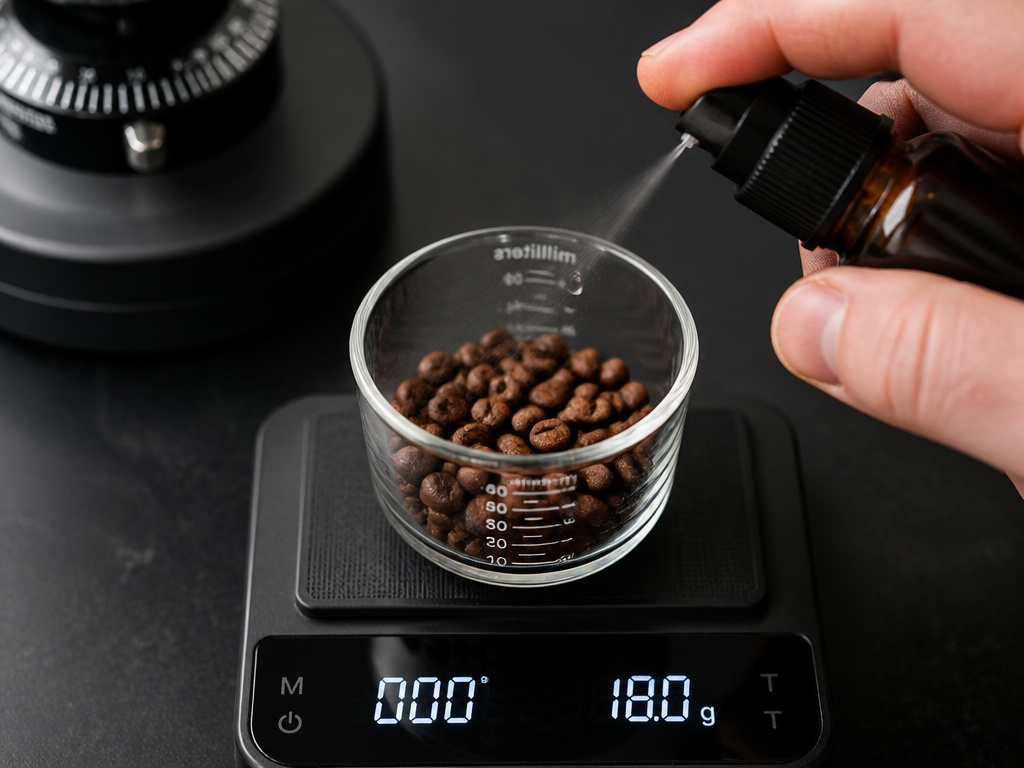
Ground coffee is insulative and loves to stick to everything via static electricity. This is retention, grounds left inside the grinder after it stops spinning. A high-retention grinder wastes coffee and adds stale grounds to your next brew.
Single-dose grinding, weighing each portion of beans immediately before grinding, solves retention. There’s no hopper full of beans oxidizing, and you clean the chamber between doses.
The PMC electrostatic charging mitigation study offers a practical fix: spritzing whole beans with a single tiny drop of water before grinding (the “Ross Droplet Technique”). The moisture neutralizes static, drastically reducing mess and retention. Use a spray bottle with a fine mist and one trigger pull for an 18-gram dose.
Some grinders, like certain Mazzer models, are notorious for retaining 3–5 grams of coffee in their labyrinthine chutes. You have to purge that by running a few extra grams of beans through before your actual dose. It’s wasteful. Modern “zero-retention” designs like the Niche Zero or Baratza Sette address this with straight, vertical chutes and aggressive anti-static design.
Maintaining Your Crusher
Burrs are consumable parts. They dull. A dull burr crushes beans less cleanly, producing more fines at every setting and raising the perceived bitterness of your cup. How fast they dull depends on usage and bean hardness.
| Grinder Type | Typical Burr Material | Expected Service Life (Home Use) | Signs of Dull Burrs |
|---|---|---|---|
| Entry-Level Electric | Hardened steel | 2–5 years | Increased grinding time, more audible “crunching,” muddy bitterness in light roasts. |
| High-End Conical | Hardened steel or titanium-coated | 5–8 years | Loss of clarity in espresso; shots taste flat even when dialed in by time. |
| Commercial Flat (e.g., EK43) | Hardened steel | 1,000–2,000 kg of coffee | Inability to achieve a cohesive espresso puck; pour-over tastes simultaneously weak and astringent. |
Cleaning is the daily maintenance. Every few weeks, disassemble the burr chamber according to your manual. Brush out all loose grounds. Soak the removable burr in a dedicated grinder cleaning tablet solution (like Urnex Grindz) to dissolve baked-on oils. Rinse thoroughly and dry completely before reassembly.
Never use water or soap on the grinder’s motor housing or electronics. And never assume your Braun coffee maker manual covers grinder maintenance, they’re different appliances with different needs.
TL;DR: Clean burrs weekly with a brush, deep-clean monthly. Expect to replace burrs every few years of daily use. Dull burrs make every coffee taste bland and harsh.
Frequently Asked Questions
Can I crush coffee beans without a grinder?
You can, but you won’t like the results. A rolling pin, mortar and pestle, or hammer will produce wildly inconsistent particles. It’s exhausting work. For a true emergency, a clean pepper mill can approximate a coarse grind. For exploring alternative grinding methods, a high-powered blender is the next best option, but pulse it carefully to avoid pure dust.
Does the type of coffee bean affect how I crush it?
Yes. Denser, hard Arabica coffee beans from high altitudes often require a finer grind setting than softer, less dense beans to achieve the same extraction time. Dark roasts are more brittle and produce more fines at a given setting than light roasts. You must redial your grinder when you switch beans.
How fine should I grind for espresso?
The grind should be fine enough that 18 grams of coffee yields 36 grams of liquid espresso in about 28 seconds. The grounds should feel like soft sand, not powder. If the shot runs too fast (under 25 seconds), grind finer. If it drips slowly and yields under 36 grams in 35 seconds, grind coarser.
Why does my ground coffee smell better than it tastes?
Aroma compounds are volatile. The grinding process releases them explosively. If you smell intense fragrance at the grinder but the brewed cup tastes flat, those aromas escaped into the air instead of staying in the coffee. Grind directly into a sealed container or your brewer to capture more of them. The Springer water content in roasted coffee study directly links moisture loss during grinding to aroma volatility.
Can I pre-crush coffee beans to save time?
No. Ground coffee stales in minutes due to increased surface area exposed to oxygen. Pre-grinding, even the night before, sacrifices freshness and nuance. The whole point of a home grinder is to crush beans seconds before brewing. If time is the constraint, consider a faster grinder, not pre-ground coffee.
The Bottom Line
Crushing coffee beans is the most important step you control. Get it wrong, and the best beans, water, and technique can’t save the cup. Invest in a decent burr grinder, it hurts once, then serves you for years. Match the grind size to your brewer’s clock, not a guess. Weigh your beans. Clean your gear.
The difference between a blade-chopped mess and a uniformly crushed dose is the difference between generic brown liquid and a cup with distinct acidity, sweetness, and body. It’s that simple. And that hard. Your grinder isn’t a peripheral. It’s the cornerstone.
