
Your Guide on How to Choose Coffee Beans by Flavor & Roast
To choose coffee beans by flavor and roast, start with the roast date, then match the roast level to your brewer, and finally decode the processing method. Fresh beans peak 7–21 days post-roast. Light roasts suit pour-overs for acidity, dark roasts suit espresso for body, and processing (washed, natural) dictates fruit or funk intensity.
Most people walk into a shop, see a wall of bags with beautiful labels, and grab the one whose tasting notes sound like dessert. They ignore the three lines of text that actually predict what’s in the cup: the roast date, the processing method, and the density specification hidden behind words like “high grown.” The bag that promises blueberry and chocolate often delivers dust and regret because the beans were roasted for a different brewer six months ago.
This guide cuts through the tasting-note poetry. We’ll map the specs on the bag to the gear on your counter and the flavors in your cup.
Key Takeaways
- The roast date is the single most important number on the bag. Beans are at their best 7 to 21 days after roasting. After six weeks, the vibrant highs are gone regardless of origin.
- Your grinder dictates your bean choice more than your brewer does. A blade grinder turns light roast beans into dust and boulders, muting their nuance. Stick to dark roasts if you’re using a blade.
- Processing method, washed, natural, honey, anaerobic, overrides origin flavor. A washed Ethiopian tastes bright and tea-like. A natural Ethiopian from the same farm tastes like blueberry jam.
- Density matters. High-density beans (often from high altitudes) require a finer grind and more heat during roasting to develop properly. They also produce more chaff, which a good roaster removes.
- The Specialty Coffee Association’s Green Coffee Classification requires zero primary defects and no more than five secondary defects per 350g sample for a “specialty” grade. That’s your quality floor.
The First Question to Ask Before Buying Any Beans
Look at the bottom of the bag. If there’s no “roasted on” date, put it back. A “best by” date is a corporate guess. A roast date is a fact.
Coffee is a fresh agricultural product, not a shelf-stable commodity. The complex volatile compounds that create aroma and flavor begin decaying the moment the roasting drum stops. A Scientific Reports coffee storage study tracked this degradation, showing measurable drops in key quality markers within weeks when beans are exposed to oxygen and light. That “best by” date a year from now is about food safety, not flavor.
Coffee beans peak between 7 and 21 days after roasting. Before day 7, they’re still off-gassing carbon dioxide, which can block water during brewing and cause uneven extraction. After day 21, the decline is gradual but steady. By week six, you’ve lost the top notes, the jasmine, the bergamot, the specific citrus zest.
TL;DR: No roast date, no sale. The clock starts ticking the day the beans come out of the roaster.
Roast Level Is a Tool, Not a Personality Quiz
Light, medium, dark. These aren’t just colors. They’re recipes for how much heat energy the roaster poured into the bean, and that energy changes what your brewer can pull out.
| Roast Level | Agtron Color Range | Best For Brewing | Flavor Profile | Grind Note |
|---|---|---|---|---|
| Light | 65–55 | Pour-over, AeroPress, Siphon | High acidity, floral, tea-like, citrus | Very hard, dense; requires a consistent burr grind |
| Medium | 55–45 | Drip, Clever Dripper, Some Espresso | Balanced, nutty, chocolate, caramel | Forgiving; works with blade or burr |
| Dark | Below 45 | Espresso, French Press, Moka Pot | Low acidity, bold body, smoky, bitter | Brittle, oily; easier for blade grinders to crush evenly |
Light roasts are barely cooked. The bean’s internal structure is still dense and hard, which is why they sound like little marbles when you pour them. That density requires a precise, consistent grind, the kind only a burr grinder provides. A blade grinder smashes light roast beans into an inconsistent mix of dust and chunks. The dust over-extracts and turns bitter, the chunks under-extract and taste sour. You get a muddy, unbalanced cup that misses the point entirely.
Dark roasts are cooked longer. The sugars caramelize, the oils migrate to the surface, and the bean structure becomes more brittle. That brittleness is a gift if you’re using a blade grinder. The blades can crush it into a more even particle distribution than they can with a rock-hard light roast. The trade-off is you lose the origin’s nuance. A dark roast from Ethiopia will taste more like the roast itself than the Yirgacheffe terroir.
I bought a bag of expensive blonde roast beans for my first blade grinder. The tasting notes promised strawberry and honeysuckle. What I got was a thin, sour, bitter mess. I blamed the beans. The problem was the grinder. Switching to a dark roast for that machine fixed the balance immediately.
TL;DR: Match your roast to your grinder first, your brewer second. Light for burr, dark for blade, medium if you’re not sure.
Why Your Grinder Dictates Your Bean Choice
Your grinder is the first piece of equipment that touches the bean. It decides more about your cup than your $300 kettle or your gooseneck pouring technique.
A burr grinder crushes beans between two abrasive surfaces. It produces particles of roughly the same size. Consistency is the goal. With uniform particles, water extracts flavor evenly. You can dial in a light roast for a pour-over and actually taste the peach note the roaster wrote on the bag.
A blade grinder is a propeller that chops beans randomly. It produces a wild mix of powder, medium chunks, and whole beans. Water rushes through the powder and over-extracts it, while it barely touches the chunks. The result is a cup that’s simultaneously bitter and sour. It masks subtle flavors.
| Grinder Type | Ideal Roast Level | Why It Works | Risk If Mismatched |
|---|---|---|---|
| Blade | Dark | Brittle bean structure chops more evenly; roast-forward flavor masks inconsistency. | Light roasts produce uneven dust/chunk mix, yielding a sour-bitter muddle. |
| Budget Burr | Medium to Dark | Improved consistency over blade; can handle darker, oilier beans without clogging. | Very light roasts may still be too hard, causing grind slippage and heat buildup. |
| Precision Burr | Any, especially Light | Consistent particle size unlocks nuanced acidity and floral notes in light roasts. | Oily dark roasts can gum up the burrs and require more frequent cleaning. |
If you’re committed to a blade grinder, your bean choice narrows. Stick to dark roasts. Their oily, brittle nature is more forgiving. If you want to explore the world of light-roasted, single-origin Arabica vs Colombian coffee, invest in a burr grinder first. The burr vs blade grinders debate ends there.
Common mistake: Buying a light roast for a blade grinder, the inconsistent grind mutes the bright notes and amplifies the sour ones, making a $20 bag taste like a $5 bag.
Decoding the Label: Processing Is the Secret Sauce
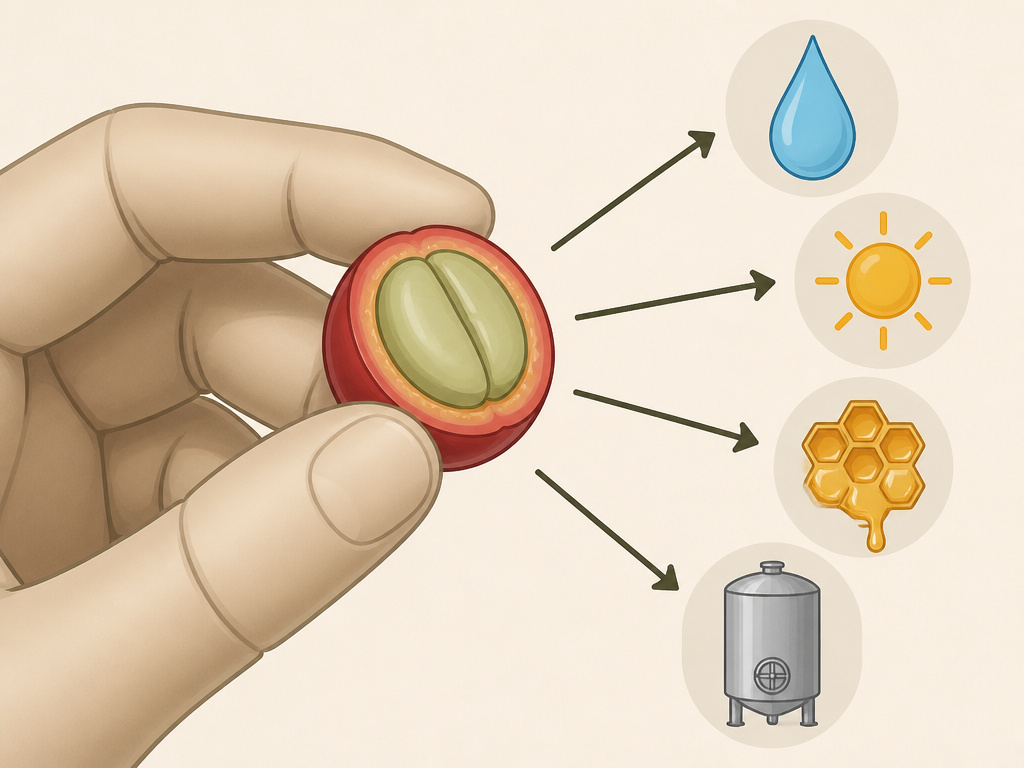
Origin gets the headline. Processing writes the story. This is the step most bag labels gloss over, and it’s the one that changes everything.
After the coffee cherry is picked, the seed inside, the bean, needs to be separated from the fruit. How that’s done defines the processing method.
- Washed (or Wet Process): The fruit pulp is removed immediately, and the bean is fermented in water tanks before being washed clean and dried. This produces a clean, bright, acidic cup where the bean’s inherent flavor shines. Think of it as the most “transparent” method.
- Natural (or Dry Process): The whole cherry is dried in the sun with the fruit still intact. The bean absorbs sugars and fruit flavors from the fermenting pulp. The result is a heavy-bodied, intensely fruity, sometimes funky cup. It’s the “biggest” flavor.
- Honey (or Pulped Natural): A middle ground. Some fruit pulp is left on the bean during drying, giving more sweetness and body than washed but more clarity than natural.
- Anaerobic Fermentation: This newer method seals the cherries in an oxygen-free tank to ferment. It can produce wild, wine-like, or lactic-acid flavors (think yogurt or sour candy). It’s a deliberate deviation from tradition.
A washed Ethiopian Yirgacheffe will taste like lemongrass and jasmine tea. A natural Yirgacheffe from the same farm will taste like blueberry pie. The bean is the same. The process is different.
TL;DR: The word “natural” on a bag means expect big, fruity body. “Washed” means expect clean, bright acidity. This clue matters more than the country of origin.
Single-Origin vs. Blend: What You’re Actually Paying For
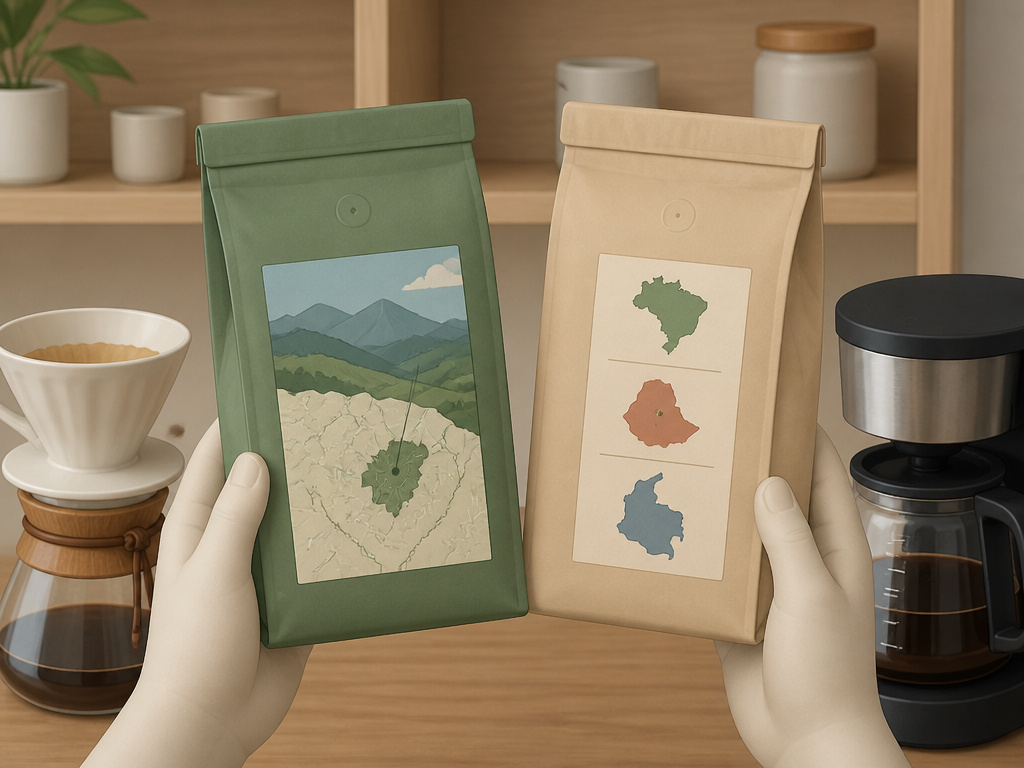
This is the romance versus the engineering debate.
A single-origin coffee comes from one farm, region, or country. You’re tasting the specific soil, climate, and varietal of that place. It’s a snapshot. It’s also less predictable, a bad harvest year means a bad bag. The flavor profile can be intense and specific, sometimes challenging.
A blend is a roaster’s recipe. They combine beans from different origins to create a consistent, balanced flavor profile year-round. A blend might use a Brazilian bean for body, a Guatemalan for brightness, and a Sumatran for earthy depth. The goal is harmony and reliability.
I keep both on my shelf. The single-origin is for the weekend pour-over when I want to pay attention. The blend vs single-origin workhorse is for the Tuesday morning auto-drip when I just need a good, consistent cup.
The choice isn’t about quality. It’s about experience. Do you want a journey or a destination?
The Specs Behind the Story: Density, Defects, and Data
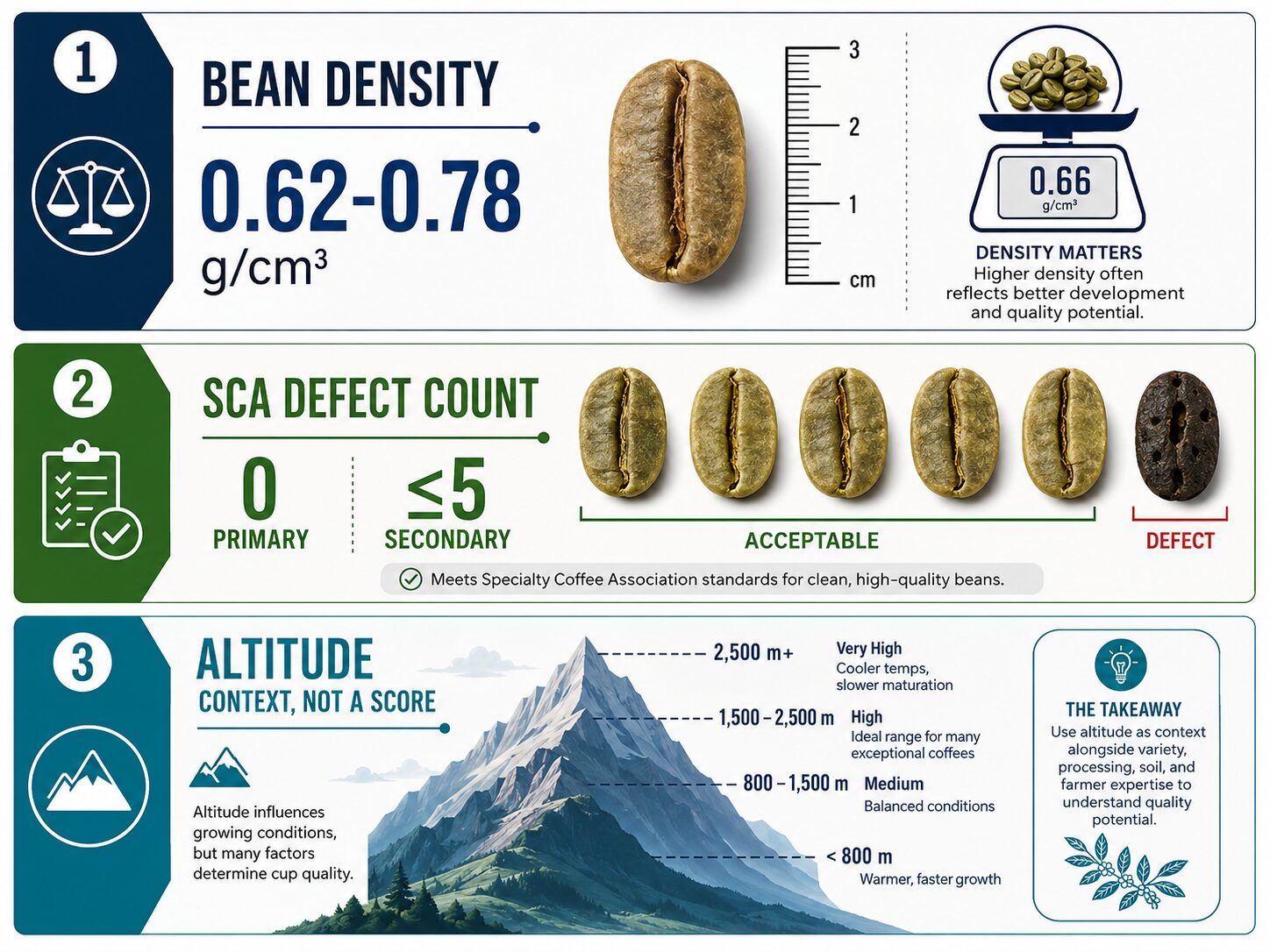
Past the marketing poetry, real specs tell you about quality and how to brew.
Bean Density: Measured in grams per cubic centimeter (g/cm³), density indicates how hard the bean is. Arabica beans typically range from 0.62 to 0.72 g/cm³, while denser Robusta beans hit 0.70 to 0.78 g/cm³. High-density beans (often from high altitudes) are harder. They require more heat during roasting to develop and a finer, more consistent grind during brewing. They also produce more chaff, the papery skin that comes off during roasting. A good roaster removes it all; a lazy one leaves it in the bag, where it tastes like burning paper in your cup.
SCA Defect Count: The Specialty Coffee Association’s Green Coffee Classification is the industry standard for quality. For a coffee to be graded “specialty,” it must have zero primary defects (like full black beans or severe insect damage) and no more than five secondary defects (like partial blacks or broken beans) per 350-gram sample. A roaster buying at this grade is paying for quality. If they advertise an SCA score (like 84+), they’re telling you it scored well in a blind tasting. It’s a credible signal.
Altitude: Higher altitude generally means slower bean development, which can mean more complex sugars and acidity. But it’s not a guarantee of quality. It’s one piece of the terroir puzzle, not the answer.
Common mistake: Chasing the highest altitude number on a bag, a poorly processed high-altitude bean can taste worse than a well-processed lower-altitude one. Altitude is context, not a score.
How to Taste What You Buy (The Three-Sip Method)
You’ve bought the beans. Now verify your choice.
- Smell the grounds. Right after grinding, get your nose in the bag. Do you smell what the label promised? If it said “blueberry” and you smell dirt, something’s off, maybe stale beans, maybe a bad roast.
- Taste it black first. Brew a cup with nothing added. Take three sips. The first sip is shock. The second sip is analysis. The third sip is judgment. Look for balance. Is it just sour? Just bitter? Or is there a sweetness between them?
- Note the aftertaste. Swallow. Wait fifteen seconds. What flavor lingers? A good coffee’s finish is clean and pleasant, not ashy or metallic.
If it tastes overwhelmingly sour, your grind might be too coarse or your water too cool. If it’s bitter and hollow, your grind might be too fine or your water too hot. The bean itself should give you a fighting chance.
Storing Beans So They Don’t Die in the Bag
You paid for freshness. Don’t kill it on your counter.
- Keep them airtight. Oxygen is the enemy. The moment you open the bag, transfer beans to a sealed container. The valve on coffee bags lets CO2 out but doesn’t keep O2 from creeping in over time.
- Keep them dark. Light degrades flavor compounds. A ceramic or opaque canister beats a glass jar.
- Keep them cool. But not cold. The fridge is a humid, odor-filled disaster for coffee. The freezer can work for long-term storage of unopened bags, but you must thaw the entire bag completely before opening to prevent condensation from ruining the beans. For daily beans, a cool, dark cupboard is perfect.
A PMC coffee storage conditions article confirms that temperature and atmospheric exposure are the two biggest factors in preserving roasted coffee quality. Your kitchen counter fails on both counts.
TL;DR: Airtight, dark, cool. Not the fridge.
Frequently Asked Questions
What’s the most important thing to look for on a coffee bag?
The roast date. Everything else, origin, processing, tasting notes, is secondary to freshness. Beans are at their peak 7 to 21 days after that date.
Are expensive single-origin beans always better?
Not always. A well-crafted blend can be a more balanced and enjoyable daily drinker. Single-origin coffees offer unique, terroir-driven flavors that can be spectacular but also sometimes challenging or one-dimensional.
How does bean processing affect caffeine content?
It doesn’t in any meaningful way. The caffeine difference between light and dark roasts is negligible. The roast level affects flavor and solubility, not stimulant content.
Can I use espresso beans for drip coffee?
You can, but you might not want to. “Espresso roast” beans are typically roasted darker to withstand high-pressure extraction and produce crema. In a drip machine, that dark roast can taste bitter and ashy. It’s better to use a medium or medium-dark roast labeled for drip or filter brew.
Why does my coffee sometimes taste sour or bitter?
Sour usually means under-extraction: your grind is too coarse, your water isn’t hot enough, or your brew time is too short. Bitter usually means over-extraction: your grind is too fine, your water is too hot, or your brew time is too long. The bean itself sets the potential; your grind and technique realize it.
Before You Go
Choosing coffee beans isn’t about finding the most exotic label. It’s about matching three practical things: the roast date to your consumption rate, the roast level to your grinder, and the processing method to the flavor experience you want. Ignore the poetry, read the specs. A washed light roast from a recent roast date, ground in a decent burr grinder, will beat a six-month-old “premium” dark roast chopped in a blade grinder every single time. Your gear is part of the recipe. Buy for the system you actually have, not the one you see on social media. Start with the date, match the roast to your machine, and let the origin details be the surprise.
