
How Much Does a Coffee Scoop Weigh? Fixing Your Brew Ratio
A standard coffee scoop holds 2 tablespoons, which manufacturers label as 10 grams of ground coffee. That 10-gram figure is a rough average for medium-roast, medium-grind beans. Your actual scoop weight varies wildly, a scoop of dark roast can be 7 grams, a scoop of espresso grind can be 14 grams. That difference ruins your brew ratio before the water even hits the grounds.
Most guides treat the scoop as a universal measuring cup. They tell you one scoop per cup and send you off. The problem isn’t the scoop. It’s the assumption that volume equals weight. A scoop of fluffy dark roast weighs less than a scoop of dense light roast. A scoop of fine espresso grind packs tighter and weighs more than a scoop of coarse French press grind. Using volume alone guarantees your coffee will be too weak or too strong half the time.
This guide breaks down what “2 tablespoons” means for specific machines like the Cuisinart DCC-3200 and the Bonavita BV1900TS. It shows you how to convert scoops to grams for any brew method, and explains why the pros in forums like Home-Barista.com ditch the scoop entirely for a $20 digital scale.
Key Takeaways
- A “standard” coffee scoop is 2 tablespoons, but its weight varies from 7 to 14 grams depending on your bean’s roast level and grind size.
- The Specialty Coffee Association’s Golden Cup Standard is 55 grams of coffee per liter of water, or about 12 grams per 200ml cup, not one scoop.
- Manufacturer scoops, like the Cuisinart CGS-1, are designed for their machines’ water reservoirs; using that scoop in a different brewer throws the ratio off.
- For consistent coffee, weigh your scoop once with your usual beans to learn its true weight, then use that number to calculate scoops per batch.
- Espresso and pour-over demand gram-scale precision; a scoop is useless for these methods because the required dose (18-20g) is too sensitive to volume variance.
What Does 2 Tablespoons Actually Mean?
The plastic scoop tucked in your coffee maker’s box holds 2 tablespoons. That’s 30 milliliters. Every manual from Hamilton Beach to Cuisinart says this. The National Coffee Association (NCA) echoes it, recommending 2 tablespoons (10 grams) per 6 ounces of water for a balanced brew.
Technical snippet: A standard coffee scoop volume is 2 tablespoons (approx. 30 ml). Manufacturers equate this to 10 grams of ground coffee, a figure derived from medium-roast, medium-grind beans at a typical density. This volumetric equivalence is the basis for all “one scoop per cup” instructions.
But grams are weight, tablespoons are volume. The 10-gram label is an average. It assumes your beans are a medium roast ground to a medium consistency, like a pre-ground bag from the supermarket. If your beans differ, the weight differs.
Your Black & Decker manual says “use one scoop.” Your Braun coffee maker guide says the same. They’re not lying. They’re giving you a volumetric rule that works for their machine’s water reservoir if you use average beans. The moment you switch to a single-origin light roast or a dark espresso blend, the rule breaks.
TL;DR: 2 tablespoons is a volume (30ml). The 10-gram weight attached to it is an average that fails with non-average beans.
Why Scoops Are Inconsistent (The Density Problem)
Coffee bean density changes with roast level and grind size. Dark roast beans expand during longer roasting, losing moisture and mass. They become lighter and more porous. A scoop full of dark roast weighs less. Light roast beans retain more moisture and cellular structure; they’re denser. A scoop of light roast weighs more.
Grind size compounds the issue. A fine grind, like for espresso, packs tightly into the scoop’s volume. You can fit more mass in the same space. A coarse grind, like for French press, sits loose. The same scoop volume holds less mass.
| Variable | Effect on Scoop Weight | Real-World Example |
|---|---|---|
| Dark Roast | Decreases weight (less dense) | A scoop of dark roast espresso beans may weigh only 7–8 grams. |
| Light Roast | Increases weight (more dense) | A scoop of light roast Ethiopian beans can weigh 12–13 grams. |
| Fine Grind | Increases weight (packs tight) | A scoop of espresso-ground coffee can hit 14 grams. |
| Coarse Grind | Decreases weight (sits loose) | A scoop of French press-ground coffee may be 8–9 grams. |
The difference between 7 grams and 14 grams in the same scoop is a 100% variance. That’s the margin between a weak, under-extracted cup and a bitter, over-extracted one. Using a scoop without knowing your beans’ actual weight is guessing.
Common mistake: Using the same number of scoops for dark roast and light roast, the dark roast brew will be under-extracted and sour because you’re using less coffee per water volume. The light roast brew will be over-extracted and bitter because you’re using more.
The forum veterans at Home-Barista.com have argued this for years. They call the scoop “the home brewer’s biggest crutch.” It creates inconsistency day to day, especially if you switch beans or grind settings on your burr coffee grinder. A blade coffee grinder produces an inconsistent grind size, which further amplifies the scoop’s unreliability.
Manufacturer Scoops vs. The Golden Ratio
Manufacturer scoops aren’t arbitrary. They’re calibrated for that machine’s water reservoir. The Cuisinart CGS-1 scoop included with the DCC-3200 is meant for its 12-cup capacity. Using that scoop in a different machine, like a Bonavita, misaligns the ratio.
The Bonavita BV1900TS manual specifies 55 grams of coffee for a full 8-cup (40 oz) carafe. That’s about 6.875 grams per 5-ounce cup. To hit that with a standard 2-tablespoon scoop, you’d need 8–9 scoops, depending on your beans’ density. If you blindly use the “one scoop per cup” rule, you’ll put in 8 scoops for 8 cups. That’s 80 grams if your scoop weighs 10 grams, 25 grams over the target. Your coffee will be strong, possibly bitter, and you’ll waste beans.
The Keurig My K-Cup universal reusable filter has a fill line that equates to about 10–12 grams. That’s the target for a single K-Cup serving. If your scoop of dark roast weighs 7 grams, you’re under-filling. The machine runs the same amount of water, resulting in a weak cup.
The industry standard, set by the Specialty Coffee Association (SCA), is the Golden Cup Standard: 55 grams of coffee per liter of water. For a standard 200ml cup, that’s about 12 grams. Not 10 grams. Not one scoop. The SCA defines this for optimal extraction, not for convenience.
Rule of thumb: If your coffee maker’s manual gives a gram weight (like Bonavita’s 55g), use a scale to match it. If it only gives scoops (like most Hamilton Beach models), weigh your scoop with your beans first to find the real gram equivalent.
TL;DR: Manufacturer scoops are machine-specific. The SCA Golden Ratio is 55g/L (12g per 200ml cup). Your scoop’s weight must be measured against these targets.
How to Convert Scoops to Grams for Your Brewer
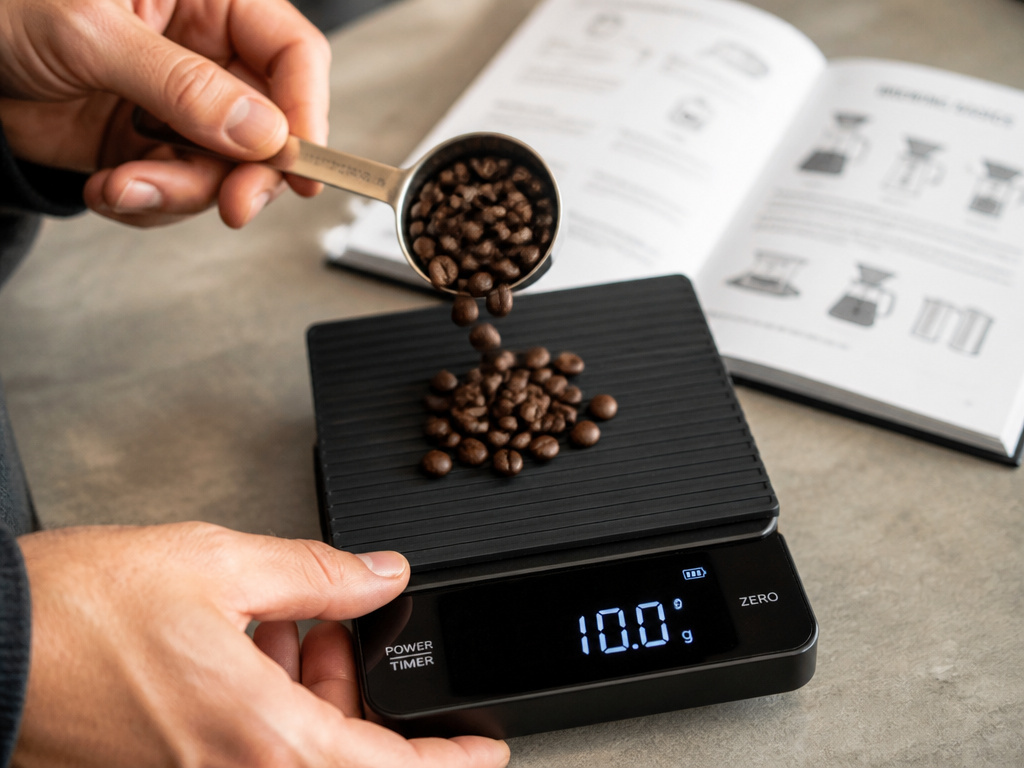
You don’t need to abandon the scoop. You need to calibrate it. This takes two minutes and a digital kitchen scale.
First, identify your target grams. Pull the manual for your machine. Look for a gram recommendation. If it only lists scoops, use the SCA standard of 55 grams per liter. For a common 12-cup drip maker (60 oz / 1.8 liters), that’s about 99 grams of coffee.
Second, weigh your scoop. Use your regular beans and your regular grind setting. Fill the scoop as you normally would, don’t tamp it down, don’t shake it loose. Place it on the scale. Note the number.
Third, do the math. Divide your target grams by your scoop’s weight. That’s how many scoops you need for a full batch.
Let’s say your target is 99 grams for a 12-cup pot. Your scoop of medium-roast, medium-grind coffee weighs 10 grams. You need 9.9 scoops, call it 10. Your scoop of dark roast, coarse-grind coffee weighs 8 grams. You need 12.4 scoops, call it 12.5. That’s a 25% difference in scoop count for the same pot of coffee.
| Brewer Model | Target Grams (Full Batch) | Scoops Needed if Scoop = 10g | Scoops Needed if Scoop = 8g |
|---|---|---|---|
| Bonavita BV1900TS (8-cup) | 55g | 5.5 | 6.9 |
| Generic 12-Cup Drip | 99g (SCA 55g/L) | 9.9 | 12.4 |
| Keurig My K-Cup (single) | 10–12g | 1 | 1.5 |
If your manual, like many Black & Decker manuals, only says “use 1 scoop per cup,” you’re flying blind. Weigh your scoop. Then apply the SCA ratio to your machine’s total water capacity to find your true target grams.
Before you start: Use a scale with 0.1g precision. A cheap $20 model works. Place it on a flat, stable surface. Taring the scale with an empty scoop first ensures you’re measuring just the coffee’s weight, not the scoop’s.
This method bridges the gap between volumetric convenience and weight precision. It’s why many pro baristas keep a scoop in their toolkit, but they know its exact weight for their current beans.
When to Ditch the Scoop Entirely
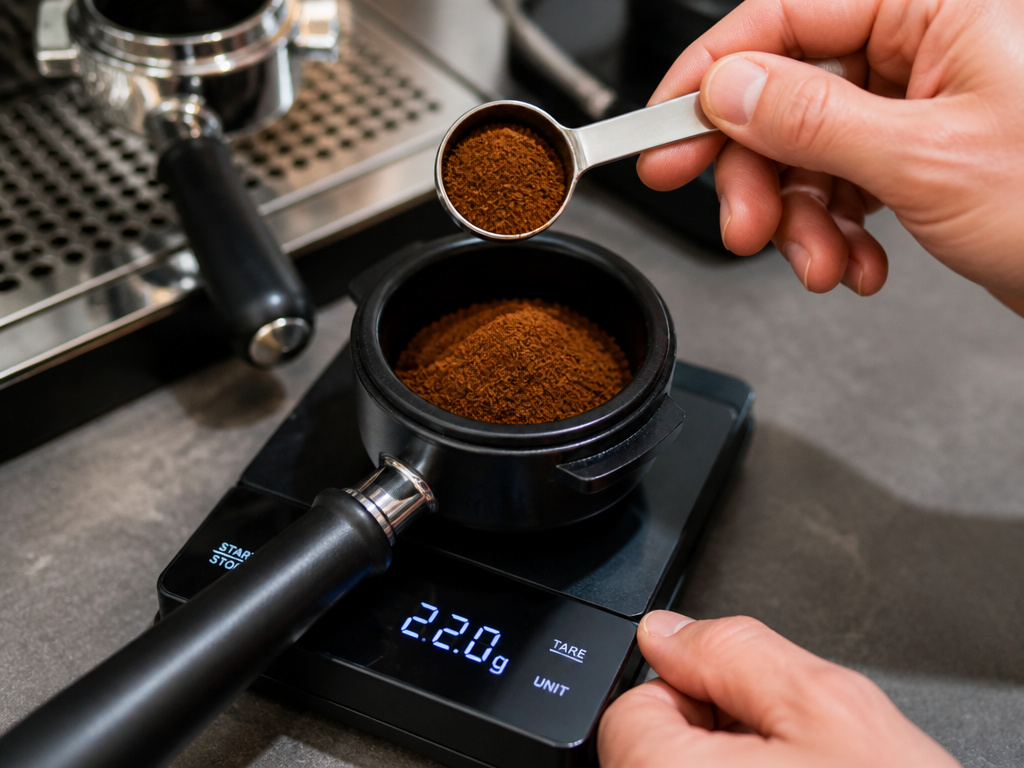
For espresso and pour-over, the scoop is not just inaccurate. It’s obstructive. These methods require dose precision within 1 gram. A scoop’s variance can be 3–4 grams. That’s enough to wreck an espresso shot or a pour-over bloom.
Espresso machines like those from Breville expect a 18–20 gram dose in the portafilter. A scoop might give you 14 grams with a coarse dark roast, or 22 grams with a fine light roast. Both are wrong. The 14-gram dose will run too fast, producing a weak, sour shot. The 22-gram dose will choke the machine, producing a bitter, over-extracted shot. You must use a scale.
Pour-over, like V60 or Chemex, also hinges on a precise coffee-to-water ratio. The typical ratio is 1:16 (62.5 grams per liter). A 1-gram variance changes the extraction noticeably. A scoop introduces that variance every time.
I won’t recommend a scoop for dialing in a new espresso machine. The visual feedback from a bottomless portafilter is honest, but if your dose is off by 3 grams because of scoop variance, you’ll chase grind adjustments forever and blame the machine. Found that out calibrating a Breville Barista Express. The manual said “use about 2 scoops.” About. That word cost me a week of sour shots.
The move to weighing is cheap. A digital kitchen scale costs less than a bag of specialty beans. It eliminates the roast-density and grind-size variables. You dose 18 grams every time, whether the beans are light or dark, fine or coarse. Your consistency improves overnight.
TL;DR: For espresso and pour-over, use a scale. The scoop’s variance is larger than the acceptable dose tolerance for these methods.
The Scoop’s Last Stand: Batch Brewing and Cold Brew
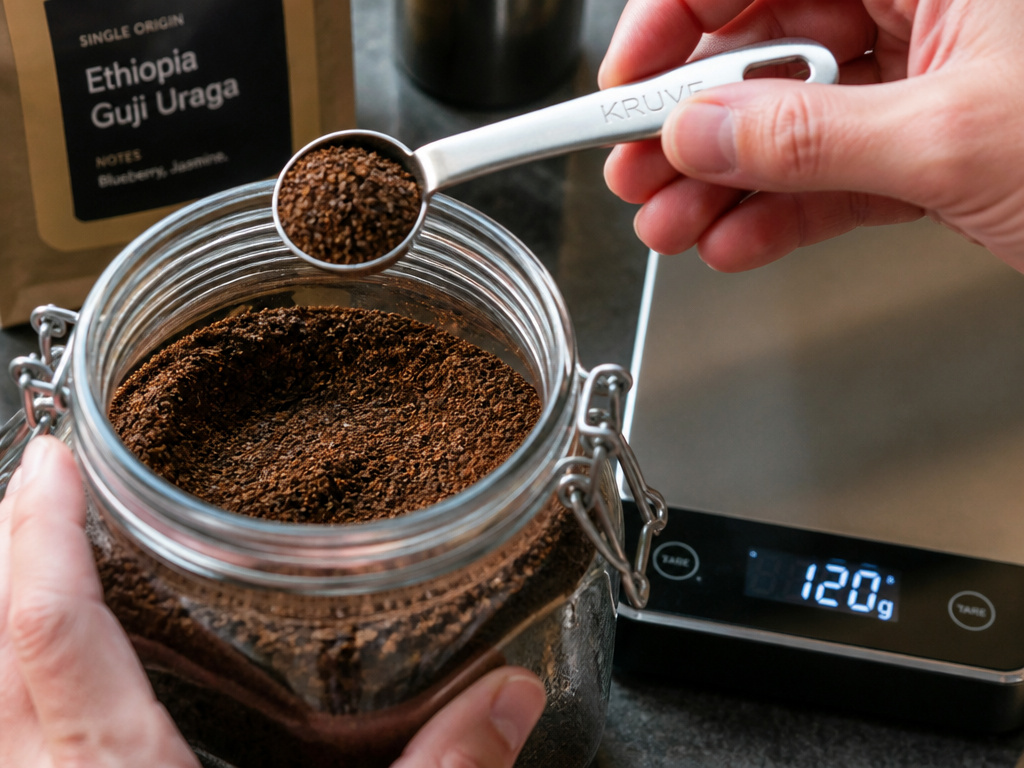
For large-batch drip brewing and cold brew, the scoop’s variance matters less. The large volume smooths out small errors. A 12-cup pot at 99 grams target might be 94 grams or 104 grams with scoop variance. The difference is subtle, often unnoticeable.
Cold brew uses a high coffee-to-water ratio (often 1:4) and steeps for 12–24 hours. A small weight error gets diluted over time and extraction. You can use a scoop here without catastrophe.
But even here, weighing saves money. If your scoop of expensive single-origin beans weighs 12 grams, and you use 10 scoops for a cold brew batch, you’re using 120 grams. If the recipe calls for 100 grams, you’ve wasted 20 grams of beans. Over a month, that’s a bag.
Weighing your scoop once for batch brewing establishes a reliable multiplier. You know your scoop is 11 grams. The recipe says 100 grams. You use 9 scoops. Simple.
Common mistake: Assuming a scoop is 10 grams for batch brewing, if your beans are dense light roast, you’ll over-dose by 10-20% and waste coffee without gaining noticeable quality.
The scoop remains a convenient tool for these high-volume, forgiving methods. But convenience shouldn’t cost you beans or brew quality. Know its weight.
Frequently Asked Questions
Is a coffee scoop 1 or 2 tablespoons?
standard coffee scoop is 2 tablespoons (30 ml). Some smaller scoops or measuring spoons are 1 tablespoon, but the plastic scoop included with coffee makers is almost universally 2 tablespoons.
How many grams is one coffee scoop?
Manufacturers label it as 10 grams. The real weight ranges from 7 grams for dark roast coarse grind to 14 grams for light roast fine grind. You must weigh your scoop with your specific beans to know.
How many scoops per cup of coffee?
Most machine manuals say one scoop per 6-ounce cup. The Specialty Coffee Association standard is 12 grams per 200ml cup. If your scoop weighs 10 grams, one scoop is slightly under. If your scoop weighs 8 grams, one scoop is significantly under.
Can I use a tablespoon instead of a coffee scoop?
Yes, a tablespoon is 15 ml. Two tablespoons equal one standard coffee scoop. The problem remains: volume doesn’t equal weight. Two tablespoons of dark roast will still weigh less than two tablespoons of light roast.
Why do coffee pros use scales instead of scoops?
Scales measure weight directly, eliminating variance from bean density and grind size. A scale ensures the same coffee-to-water ratio every time, which is critical for espresso, pour-over, and consistent drip brewing.
Before You Go
The coffee scoop is a volumetric tool designed for convenience, not precision. Its 10-gram label is an average that fails with any bean outside the average. To use it reliably, weigh it once with your usual beans and grind. That number becomes your multiplier for any recipe.
For methods where precision defines quality, espresso, pour-over, skip the scoop. Use a $20 digital scale. It pays for itself in saved beans and consistent cups within a month.
Manufacturer scoops like the Cuisinart CGS-1 are tuned for their specific machines. Using that scoop in another brewer misaligns the ratio. Always check your machine’s manual for a gram target, not just a scoop count.
The real answer to “how much is a coffee scoop” is on your scale, not in the manufacturer’s box.
{
“@context”: “https://schema.org”,
“@type”: “HowTo”,
“name”: “How to Measure Coffee Without a Scoop Using Weight”,
“totalTime”: “PT5M”,
“tool”: [
{
“@type”: “HowToTool”,
“name”: “Digital kitchen scale”
},
{
“@type”: “HowToTool”,
“name”: “Standard 2-tablespoon coffee scoop”
}
],
“step”: [
{
“@type”: “HowToStep”,
“name”: “Weigh Your Scoop”,
“text”: “Fill your scoop with your usual coffee grind and weigh it on a digital scale. Note the grams. This is your scoop’s actual weight, not the advertised 10 grams.”
},
{
“@type”: “HowToStep”,
“name”: “Apply the Golden Ratio”,
“text”: “For drip coffee, use 55 grams of coffee per liter of water (SCA standard). For a single cup, use 12 grams per 200ml.”
},
{
“@type”: “HowToStep”,
“name”: “Adjust for Roast and Grind”,
“text”: “Light roast and fine grind weigh more per scoop. Dark roast and coarse grind weigh less. Use your measured scoop weight to calculate how many scoops you need for your target grams.”
},
{
“@type”: “HowToStep”,
“name”: “Stop Using Scoops for Espresso”,
“text”: “Espresso requires precision. Use the scale directly to dose 18-20 grams into your portafilter, ignoring scoop volume entirely.”
}
]
}
{
“@context”: “https://schema.org”,
“@type”: “FAQPage”,
“mainEntity”: [
{
“@type”: “Question”,
“name”: “Is a coffee scoop 1 or 2 tablespoons?”,
“acceptedAnswer”: {
“@type”: “Answer”,
“text”: “standard coffee scoop is 2 tablespoons (30 ml). Some smaller scoops or measuring spoons are 1 tablespoon, but the plastic scoop included with coffee makers is almost universally 2 tablespoons.”
}
},
{
“@type”: “Question”,
“name”: “How many grams is one coffee scoop?”,
“acceptedAnswer”: {
“@type”: “Answer”,
“text”: “Manufacturers label it as 10 grams. The real weight ranges from 7 grams for dark roast coarse grind to 14 grams for light roast fine grind. You must weigh your scoop with your specific beans to know.”
}
},
{
“@type”: “Question”,
“name”: “How many scoops per cup of coffee?”,
“acceptedAnswer”: {
“@type”: “Answer”,
“text”: “Most machine manuals say one scoop per 6-ounce cup. The Specialty Coffee Association standard is 12 grams per 200ml cup. If your scoop weighs 10 grams, one scoop is slightly under. If your scoop weighs 8 grams, one scoop is significantly under.”
}
},
{
“@type”: “Question”,
“name”: “Can I use a tablespoon instead of a coffee scoop?”,
“acceptedAnswer”: {
“@type”: “Answer”,
“text”: “Yes, a tablespoon is 15 ml. Two tablespoons equal one standard coffee scoop. The problem remains: volume doesn’t equal weight. Two tablespoons of dark roast will still weigh less than two tablespoons of light roast.”
}
},
{
“@type”: “Question”,
“name”: “Why do coffee pros use scales instead of scoops?”,
“acceptedAnswer”: {
“@type”: “Answer”,
“text”: “Scales measure weight directly, eliminating variance from bean density and grind size. A scale ensures the same coffee-to-water ratio every time, which is critical for espresso, pour-over, and consistent drip brewing.”
}
}
]
}
