
How Long to Grind Coffee Beans: The Specs Most Brewers Miss
Grinding coffee beans takes between 10 and 40 seconds for a standard single-serving dose, but the exact time is set by your grinder’s motor speed, your chosen grind size, and your target dose weight, not by a universal clock.
Most people set a timer by guessing or use the grinder’s pre-set button. They get a different amount of coffee every morning. The cup strength wanders from weak to bitter across the week, and they blame the beans or the machine.
This guide breaks down the variables that actually decide grinding time. You’ll get the manufacturer specs for popular models, the science behind why size changes everything, and the method to lock in your personal perfect duration.
Key Takeaways
- Your grinder’s manual contains specific time ranges for each brew method, the Baratza Encore ESP manual says 10-15 seconds for espresso and 20-30 for French press.
- Weigh your beans before grinding. Time alone is unreliable because bean density, moisture, and roast level change how fast the grinder moves through them.
- Grind size is the primary driver of time. A fine espresso grind takes less time than a coarse French press grind for the same weight because the burrs have less distance to travel per particle.
- Ground coffee stales rapidly. A YouTube analysis notes it can lose up to 60% of its aroma within 15 minutes of grinding. Grind immediately before brewing.
- Manual grinders operate on effort, not time. A 20g dose at a medium setting takes about 45-60 seconds of steady cranking.
The Manufacturer Numbers You Can Actually Use
Start with your grinder’s manual. The engineers who built it tested it with coffee and published target times. These numbers are your baseline, not internet averages.
The Baratza Encore ESP manual states a grind time of “10-15 seconds for a 16-20g dose” at espresso fineness. For French press, it recommends “20-30 seconds” for the same dose. Breville is just as specific. Its Smart Grinder Pro manual includes a table suggesting “15-20 seconds” for espresso on setting 10 and “25-30 seconds” for drip on setting 30.
For a Baratza Encore ESP grinding a 20g dose, the manufacturer specifies 10-15 seconds for espresso, 20-30 seconds for drip, and 20-30 seconds for French press. These times assume a dry, medium roast bean and a clean burr set.
These specs exist because motor speed and burr geometry are fixed. The time window accounts for natural variation in bean hardness. Your job is to use these numbers as a starting point, then refine for your exact setup.
| Grinder Model | Brew Method | Suggested Time (for ~20g) | Source |
|---|---|---|---|
| Baratza Encore ESP | Espresso (Fine) | 10–15 seconds | Baratza Manual p.6 |
| Baratza Encore ESP | Drip (Medium) | 20–30 seconds | Baratza Manual p.6 |
| Breville Smart Grinder Pro | Espresso (Setting 10) | 15–20 seconds | Breville Manual p.10 |
| Breville Smart Grinder Pro | Drip (Setting 30) | 25–30 seconds | Breville Manual p.10 |
| OXO Brew Conical Burr | Adjustable (0-30s dial) | User-set, up to 30s | OXO Manual p.4 |
TL;DR: Pull your grinder’s manual online. Its time ranges are engineered starting points, not guesses.
Why Grind Size Dictates Time (Not the Other Way Around)

You do not choose a time and get a grind size. You choose a grind size, and the physics of the burrs dictates the time. Finer settings mean the burrs are closer together. Each bean shatters into more, smaller particles, but the burrs have less distance to travel to achieve that.
Think of it like chopping vegetables. Dicing an onion (fine grind) takes fewer knife strokes than roughly breaking it into chunks (coarse grind) because the blade moves a shorter distance each time. A study in the European Food Research and Technology journal on water content and grinding behavior confirms that particle size distribution is the direct mechanical output of burr geometry and spacing.
Common mistake: Grinding longer to make the grounds finer. This overheats the burrs, cooks the coffee oils, and produces a bitter, flat cup. The grind size setting controls particle size, not duration.
For a fixed 18g dose, an espresso grind might take 12 seconds on a Baratza. The same dose at a French press setting could take 28 seconds. The motor works longer because the burr travel path for each bean is longer. If your times are reversed, espresso taking 30 seconds, coarse taking 15, your grinder is likely clogged with stale oil or the burrs are misaligned.
The Dose-Weight Check That Beats Any Timer
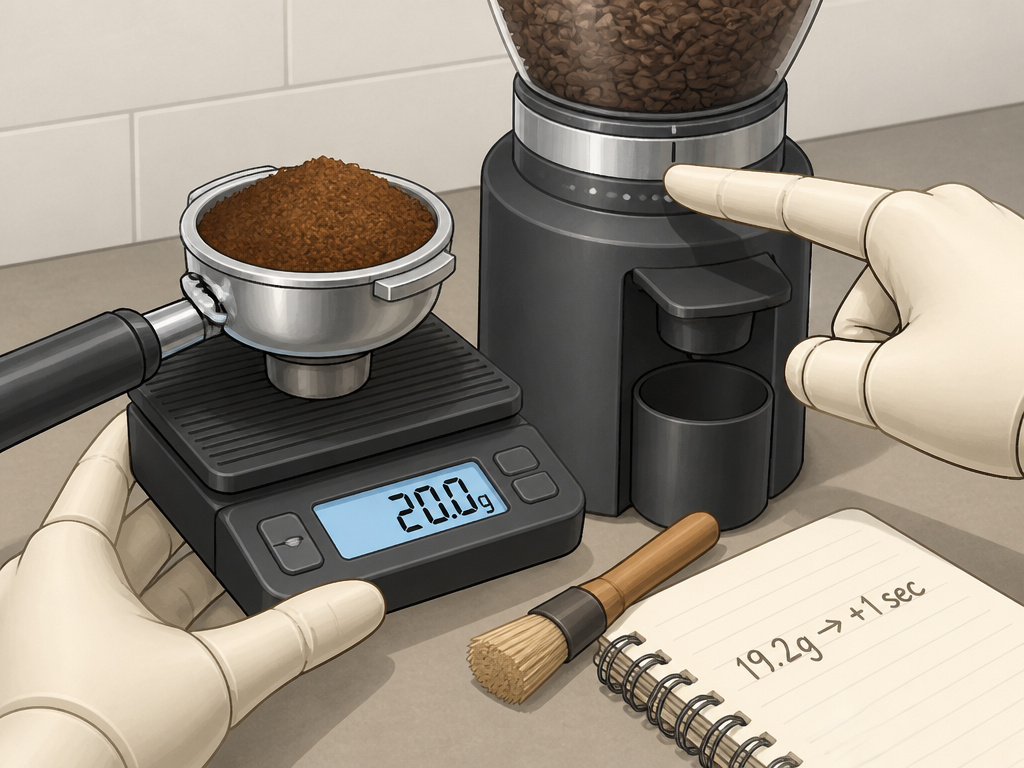
Timer buttons are convenient liars. Bean density varies by origin, roast, and moisture. A dark roast Colombian is less dense than a light roast Ethiopian. Eighteen grams of one fills the hopper differently than eighteen grams of the other. The grinder motor strains or sails through at different rates.
Weigh your whole beans before they go in. Tare your empty portafilter or dosing cup, add your target dose (e.g., 20g for pour-over), then grind. Weigh the output. It should match your input weight minus a tiny fraction retained in the chute.
If you ground for 20 seconds and got 19.2g, add a second next time. If you got 20.8g, subtract a second. This feedback loop takes three mornings to dial in. After that, your timed button delivers the same dose every day, regardless of the bean bag. This precision is why serious coffee setups always include a scale, it removes the last variable.
The four tools that replace guesswork:
- A 0.1g-resolution digital scale (the American Weigh Scales AMW-550 is a workhorse).
- Your grinder’s manual (search “[your grinder model] manual PDF”).
- A small brush to clear the chute after each grind for consistent retention.
- A notebook or phone note to record dose, time, and output weight for each new bean.
Electric vs. Manual: Two Different Worlds of Time

An electric burr grinder‘s time is about motor RPM and burr design. A manual grinder’s “time” is about arm speed and stamina. They are not comparable.
A Baratza Virtuoso+ might crush 20g for pour-over in 18 seconds. A 1Zpresso J-Max hand grinder will need about 45 seconds of vigorous cranking for the same dose and grind. The hand grinder isn’t slower; it’s using a different power source. The burr speed is directly tied to your wrist.
This matters for workflow. If you’re making espresso for two people back-to-back, a manual grind can be a genuine workout. For a single daily pour-over, the ritual is part of the charm. The grind quality from a high-end manual grinder often rivals electric units three times its price, because the burr alignment is simpler and more stable. Just budget the extra half-minute.
| Grinder Type | Power Source | Time for 20g (Medium Grind) | Primary Consideration |
|---|---|---|---|
| Electric Burr (Baratza Encore) | AC Motor | 18–25 seconds | Consistency, convenience, motor heat |
| Manual Burr (1Zpresso, Hario) | Human Arm | 45–60 seconds | Portability, quiet operation, no heat |
| Blade Grinder | AC Motor | 10–15 seconds (with pulses) | Uneven grind, high heat, inconsistent time |
TL;DR: Electric grinders measure time in seconds of motor runtime. Manual grinders measure time in seconds of sustained cranking effort.
The Staling Clock Starts at Zero
The most critical timing isn’t how long you grind, but how long the grounds sit before brewing. The moment beans fracture, their surface area explodes. Oxygen attacks the volatile aromatic compounds immediately.
One community video analysis puts a number on it: ground coffee can lose up to 60% of its aroma in just 15 minutes. That’s not a slow decline. It’s a cliff. The Springer Nature coffee grinding research on aroma retention details how increased surface area accelerates oxidation and staling reactions. This is the non-negotiable reason you grind immediately before brewing.
If you pre-grind for the week, you are drinking stale coffee. Full stop. An airtight container buys you a few days of drinkability, but it never tastes like fresh. The first morning after grinding is the peak. Every day after is a step down. This truth changes your routine more than any grind time adjustment.
How to Dial in Your Personal Grind Time
Forget generic charts. Follow this sequence once for each new bag of beans.
- Weigh your dose. Start with 18g for espresso, 20g for pour-over, 30g for a French press. Use your scale.
- Set your grind size. Use a reference, espresso should feel like powdered sugar, pour-over like table salt, French press like coarse breadcrumbs.
- Grind at your grinder’s manual time. For a Baratza Encore ESP doing pour-over, start at 25 seconds.
- Weigh the output. Write it down. If it’s 19.4g, your retention is 0.6g. That’s normal.
- Brew and taste. Note the flavor.
- Adjust time for dose, not taste. If you want 20.0g out and got 19.4g, increase grind time by 1-2 seconds next time. If the taste is off, change the grind size setting, not the time.
This separates dose management from extraction management. Time controls how much coffee you get. Grind size controls how fast water flows through it. A PMC study on coffee grinding effects confirms that extraction yield is far more sensitive to particle size than to minor variations in grind duration once the dose is fixed.
I used to chase flavor by twisting the timer dial. My morning dose would swing from 17g to 21g. The coffee was never the same twice. Now I lock the time for a perfect 18g output and only touch the grind size collar when the shot runs fast or slow. The routine takes the stress out.
Frequently Asked Questions
Why does my grinder take longer than the manual says?
Old, oily beans gum up the burrs and slow the process. Dark roasts are softer and can take slightly less time than hard light roasts. The most common fix is a grinder cleaning. Use Grindz tablets or disassemble to brush out compacted fines.
Can I use a blade grinder timer?
You can, but the result will be inconsistent. Blade grinders chop randomly, creating a mix of dust and boulders. Pulse in 3-5 second bursts, shaking the chamber between pulses, until the particles look roughly uniform. Total time is usually 10-15 seconds for a dose.
Does a more expensive grinder work faster?
Not necessarily. Speed comes from motor power and burr size. A high-end grinder prioritizes uniform particle size and low heat transfer, which sometimes means a slower, more controlled grind. The Breville Smart Grinder Pro and the Baratza Encore ESP have similar grind times for the same dose.
How do I time a hand grinder?
You don’t, practically. Focus on cranning at a steady, comfortable pace until the resistance disappears, that’s the sign all beans are through. For a 20g medium grind, this takes 45-60 seconds. Counting cranks (usually 300-400 for that dose) is more reliable than watching a clock.
Does freezing beans change grind time?
Yes. Frozen beans are more brittle and fracture differently, often producing more fine particles. They may grind slightly faster. Always let frozen beans warm to room temperature in a sealed container before grinding to avoid condensation.
The Bottom Line
Grinding time is a technical setting, not a mystery. Anchor it to your grinder’s manual and your scale’s readout. Let 20 seconds be the time that gives you 20.0 grams of perfectly sized grounds for your V60, not a random number on a dial. Remember that the clock on freshness starts ticking the second the burrs stop spinning. Grind, then brew. Immediately. That sequence, backed by a few weighed doses, kills more brewing inconsistency than any other single habit. Your machine and your beans will finally work together.
