
How Long Can Coffee Creamer Sit Out Before It Goes Bad?
Opened liquid coffee creamer can sit out at room temperature for a maximum of two hours. If the ambient temperature is 90°F (32.2°C) or higher, that safe window shrinks to just one hour. Unopened shelf-stable creamers and powdered varieties have different, much longer timelines.
Most people get this wrong because they treat the creamer bottle like a condiment. They leave it on the breakfast table all morning, or worse, on the counter overnight. Time and warmth are the enemies of dairy and dairy-like products, and the clock starts ticking the moment you break the seal.
This guide breaks down the rules by creamer type, shows you the physical signs of spoilage you can’t ignore, and explains why the official guidelines are stricter than your gut might tell you.
Key Takeaways
- The USDA’s “Danger Zone” rule is law for opened liquid creamer: two hours max under 90°F, one hour above it.
- Single-serve liquid cups are shelf-stable until opened; treat them like any opened liquid creamer after you pop the foil.
- Powdered creamer is the exception, it’s safe at room temperature for months because bacteria need moisture to grow.
- Your nose is a good first detector, but visible separation or mold means it’s gone, regardless of smell.
- Homemade creamers using real dairy, like half-and-half, follow the strictest timeline and spoil fastest.
The Universal 2-Hour Rule for Liquid Creamer
That two-hour limit isn’t a suggestion from the manufacturer. It’s the federal food safety standard. The USDA Food Safety and Inspection Service defines the “Danger Zone” as temperatures between 40°F and 140°F, where bacteria multiply rapidly.
Perishable foods should not be left out at room temperature for more than two hours. If the ambient temperature is above 90°F (32.2°C), this time limit is reduced to one hour.
This blockquote is the entire game. It applies to your opened bottle of Coffee-mate liquid creamer, your International Delight French Vanilla, and any other dairy or dairy-alternative liquid that says “refrigerate after opening” on the label. The countdown begins the moment you pour that first splash into your cup and leave the bottle on the counter.
The “why” is bacterial doubling time. In that Danger Zone, certain pathogens can double their population every 20 minutes. At the two-hour mark, a few harmless bacteria can become a colony large enough to cause gastrointestinal distress. You won’t see this growth. You might not even smell it immediately. But the risk is real and quantified.
TL;DR: Opened liquid creamer left out for over two hours (or one hour in heat above 90°F) is a food safety risk. Toss it.
Powdered vs. Liquid: The Shelf-Life Chasm
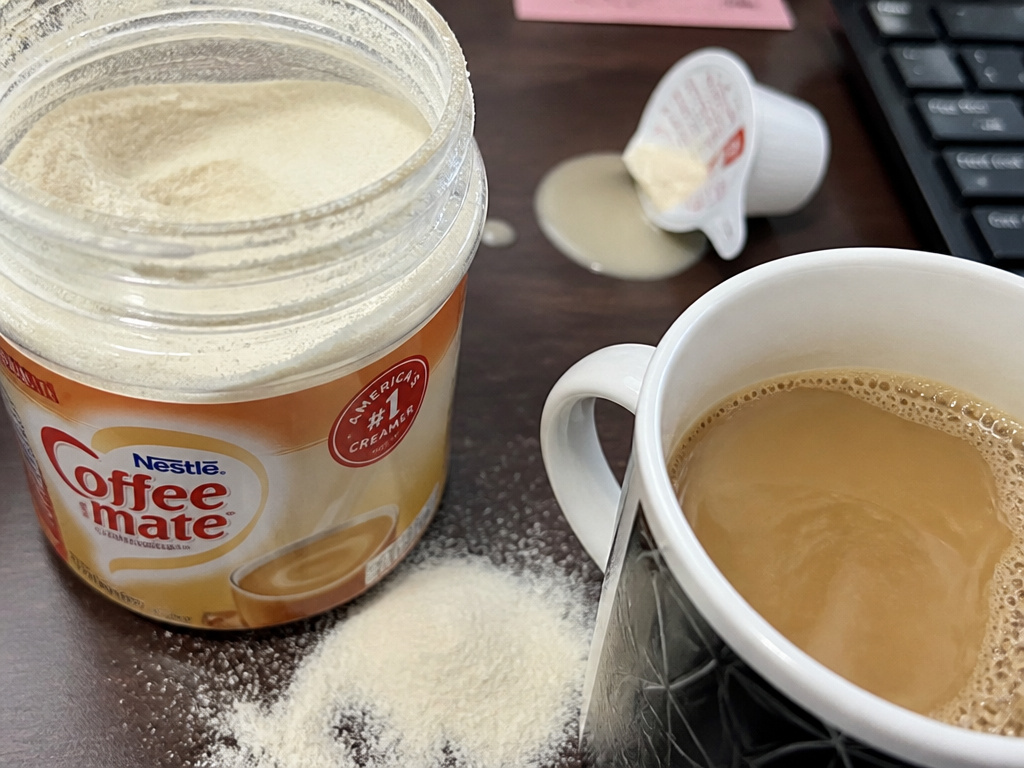
These two products live in different universes. Confusing them is how people make their worst mistakes.
| Creamer Type | Unopened Shelf Life (Pantry) | After Opening | Critical Differentiator |
|---|---|---|---|
| Liquid Creamer (Dairy or Non-Dairy) | Until “Best By” date (if shelf-stable) | Refrigerate. Use within 7-14 days. Max 2 hrs out of fridge. | Water content. Bacteria need water to grow. |
| Powdered Creamer | Several months past “Best By” date | Keep sealed in a cool, dry place. No refrigeration needed. | Minimal moisture. Essentially inert when dry. |
| Single-Serve Liquid Cups | Shelf-stable for months | Once pierced, treat as opened liquid creamer (2-hr rule). | UHT processed and sealed in a sterile environment. |
Powdered creamer, like Coffee-mate powder, is mostly oil, sweetener, and stabilizers dried into a solid. Without available water, microbiological activity grinds to a halt. You can leave the jar on your desk for a week without a second thought. The real enemy here is humidity clumping the powder, not spoilage.
Single-serve cups are a hybrid case. They undergo Ultra-High Temperature (UHT) processing and are sealed aseptically, which is why they can sit unrefrigerated on a diner counter. That sterility vanishes the second you tear the foil. The moment you open one but don’t use it all, you’ve introduced airborne contaminants and moisture. That little cup now obeys the same two-hour rule as the big bottle.
Common mistake: Assuming a single-serve creamer cup is still “shelf-stable” after you’ve opened it, the UHT protection is gone, and it spoils as fast as any other liquid left out.
When Your Senses Tell You It’s Gone Bad

Sometimes the creamer beats the clock. Sometimes it loses. Your primary tools are your eyes and nose.
First, look at it. Has it separated into a watery layer beneath a thicker, almost curdled-looking layer? That’s a strong visual fail. Do you see any fuzzy spots, especially around the cap or threads? That’s mold, and it means discard the entire container. Mold roots can spread invisibly through the liquid.
Next, the smell test. Open the bottle and take a cautious sniff. Fresh creamer has a mild, sweet, neutral scent. Spoiled creamer smells sour, tangy, cheesy, or just unmistakably “off.” Your brain’s pattern-matching here is usually excellent. Trust a strong negative signal.
If it passes the look and smell check but you’re still uneasy, a microscopic taste on a clean spoon is the final arbiter. Any sourness, bitterness, or strange flavor means it’s turning. Spit it out.
The most dangerous scenario is the creamer that looks and smells fine but has been sitting out for six hours on a warm day. This is where the time rule overrules your senses. Pathogens like Staphylococcus aureus can produce toxins that aren’t destroyed by heat and don’t alter taste or smell. You can’t sense them.
| Symptom | Likely Cause | What to Do |
|---|---|---|
| Sour smell, cheesy odor | Bacterial fermentation (lactic acid bacteria) | Discard immediately. |
| Visible separation, curdling | Protein breakdown, spoilage | Discard. Shaking won’t fix it. |
| Mold spots (any color) | Fungal growth | Discard the entire container. |
| No smell, but left out >4 hours | Potential pathogen overgrowth (risk) | Discard. Time is the indicator. |
What the Manufacturers Say (And Why It’s Shorter)

Nestlé and Danone aren’t being overly cautious. Their printed guidelines are a liability shield, but they’re based on stability testing.
Coffee-mate liquid creamer’s official guidance is to refrigerate after opening and use within 7-10 days. International Delight says “use within 7 days of opening.” These timelines assume ideal, consistent refrigeration. Every minute the product spends on your counter at 70°F chips away at that safe window.
Think of the “use within 7 days” as a freshness countdown that accelerates when the product is warm. A bottle left out for two hours on Monday might effectively lose two or three days of its refrigerated shelf life. The sugars and fats begin to oxidize, the emulsifiers can weaken, and bacterial loads start higher once it goes back in the fridge.
This is why the two-hour rule is absolute for safety, but the quality decline starts much sooner. Creamer left out for an hour might be safe but could taste slightly “flat” or less sweet by the end of the week.
The High-Temperature Exception You Must Know
The USDA’s specific caveat about 90°F (32.2°C) isn’t for deserts only. Think about a summer kitchen with the oven on, a sunny patio during a brunch, or the inside of a hot car. These environments hit that threshold easily.
At 90°F and above, bacterial replication isn’t just rapid, it’s explosive. The one-hour limit is the absolute outer boundary. In reality, in direct sun or a hot car, the interior of a creamer bottle can reach that temperature in minutes, not hours.
If you’re serving coffee outdoors on a hot day, keep the creamer in a bowl of ice or a small cooler. This isn’t fussiness. It’s the difference between the one-hour rule and a several-hour safety buffer. The same logic applies to understanding how other food rules work in extreme conditions, much like the specific allowances and restrictions outlined in any detailed stadium security screening procedure for public events.
Homemade Creamer: The Shortest Timeline of All
The DIY creamer recipe floating around YouTube, combining half-and-half with sweetened condensed milk, is delicious. It’s also a food safety sprint.
I made a batch of that vanilla homemade creamer and forgot it on the counter after breakfast. By dinner, just eight hours later, the smell when I opened the mason jar was unmistakably sour. The half-and-half had turned. That’s the speed of real dairy.
Because you’re using fresh, pasteurized dairy without the industrial stabilizers and preservatives of commercial products, the spoilage clock ticks fastest. These homemade versions should be treated like milk. They keep well in the fridge for up to two weeks only if they never leave the cold. If you take the jar out to use it, put it right back. If it sits out for two hours, consider it compromised.
This freshness is part of the appeal, but it demands discipline. It also illustrates why many seek out dairy-free creamer options like almond milk, which can have different, sometimes longer, stability profiles when handled properly.
Frequently Asked Questions
Can I put coffee creamer back in the fridge after it’s been out?
Yes, but only if it’s been out for less than two hours (or one hour above 90°F). Returning it to the fridge stops further bacterial growth but does not reverse any growth or spoilage that already occurred. It may shorten its total usable shelf life.
Does unopened coffee creamer need to be refrigerated?
Check the label. Most liquid creamers sold on the grocery shelf (not in the dairy case) are UHT-processed and are shelf-stable until opened. These do not need refrigeration until you open them. Creamers found in the refrigerated section must stay cold.
How can I tell if powdered creamer is bad?
Powdered creamer goes bad through moisture absorption and rancidity, not spoilage. Signs include hard clumps that won’t break apart, an oily or chalky texture, and a stale, cardboard-like smell. It won’t make you sick like spoiled liquid, but it will ruin your coffee’s flavor.
Why does my creamer sometimes smell funny right after opening?
Some non-dairy creamers contain compounds like sodium caseinate that can have a slight, inherent savory or sulfurous odor when first opened. This is usually normal and dissipates. A truly sour, rotten, or cheesy smell is the red flag.
Is it safe to use creamer that was left out overnight?
No. Overnight is typically 8-12 hours, far exceeding the two-hour safety limit. Discard it without tasting. The potential for toxin-producing bacterial growth is too high, a principle that underscores the importance of adhering to strict time limits, much like being aware of the specific caffeine content in your espresso to manage intake.
Before You Go
The rule is simple but rigid: two hours for opened liquid creamer on the counter, one hour in the heat. Powdered creamer doesn’t play by these rules, and single-serve cups switch teams the moment you open them. Your senses are good detectives for spoilage, but they are not infallible, the clock is the ultimate judge.
When the choice is between risking a stomach bug and wasting three dollars’ worth of creamer, the math is obvious. Toss it. Your coffee ritual deserves a fresh, safe start every time, whether you’re using a standard dairy creamer or exploring a specialty coffee oil for a different kind of boost. Implement this rule, and you’ll never have to wonder again.
