
How Big is a Cup of Coffee? From SCA Standards to Starbucks
A standard “cup” of coffee is 5 to 6 US fluid ounces, or about 150 to 180 milliliters, according to the Specialty Coffee Association’s Gold Cup standard. That’s the volume used for professional brewing ratios. Your morning mug, a Starbucks Tall, and a Keurig’s “8oz” setting are all different, larger volumes that still get called a “cup.”
The confusion starts in your own kitchen. You read a recipe calling for one cup of water per cup of coffee. You grab your favorite 12-ounce mug and fill it. You’ve just used double the intended water, guaranteeing a weak, underwhelming brew. Every brewing method has its own native volume, and missing that detail is the most common mistake in home coffee.
This guide maps the real sizes. We’ll start with the official standards, break down how Starbucks and your Keurig hijacked the term, and explain why an espresso isn’t served in a pint glass. You’ll know exactly how much coffee you’re actually drinking.
Key Takeaways
- The SCA Gold Cup standard defines a coffee “cup” as 5–6 fl oz (150–180 ml) for brewing ratios, not your mug’s capacity.
- Starbucks’ smallest size, the Short, is 8 fl oz, already larger than the standard, making their Grande (16 oz) equal to nearly three standard cups.
- Your automatic drip machine’s “cup” setting is typically 5–6 oz, but the carafe markings are often wrong; verify with a measuring cup.
- Espresso and Turkish coffee servings are 1–3 oz, served in small demitasse or fincan cups, making caffeine concentration much higher per ounce.
- Using the wrong water volume for your grounds, like treating a 12 oz mug as one cup, dilutes flavor and caffeine within the first sip.
The Official “Cup” vs. The Coffee “Cup”
A “cup” is a legally defined unit of volume. In the United States, it’s 8 US fluid ounces, or about 237 milliliters, for nutritional labeling and cooking. The National Institute of Standards and Technology (NIST) Handbook 44 provides the specifications for this legal measurement. That’s the cup you use in baking.
The ISO 3103:1980 standard for sensory evaluation of tea specifies a 150 ml (5.07 fl oz) serving cup. While for tea, this formalized small volume is the closest international standard to a defined “beverage cup” in a professional tasting context.
The coffee industry uses a different measure. The Specialty Coffee Association’s Gold Cup Standard sets the benchmark for brewing. It specifies using 55 grams of coffee per 1 liter of water. Doing the math, one standard coffee “cup” is 5 to 6 fluid ounces (150-180 ml). This smaller volume creates the correct extraction strength for balanced flavor. If you use an 8-ounce culinary cup of water with a single-scoop of grounds, your coffee will taste thin and sour.
TL;DR: For cooking, a cup is 8 oz. For brewing coffee correctly, a cup is 5-6 oz. Confusing the two makes bad coffee.
How Brewing Method Dictates Volume
The machine or method you use locks in your serving size before you even choose a mug. Each has a native output volume.
Drip Coffee Makers are the biggest offenders. The “cup” button or carafe line is notoriously unreliable. One manufacturer’s “12-cup” carafe might hold 60 ounces (if their cup is 5 oz), while another’s holds 96 ounces (if their cup is 8 oz). You must check the manual.
Single-Serve Pod Machines like Keurig define the cup by programming. A Keurig K-Elite offers brew sizes like 6, 8, 10, and 12 ounces. When you press “8oz,” it dispenses 8 fluid ounces of water through the pod. That’s your cup size, regardless of the mug you use.
Espresso Machines produce shots, not cups. A single shot is about 1 ounce (30 ml); a double is about 2 ounces (60 ml). These are served in demitasse cups, which are designed for this small, concentrated volume. Putting espresso in a large mug is culturally and functionally wrong, it cools too fast and loses its crema.
Manual Methods (Pour-over, French Press, AeroPress) give you control. Here, the “cup” in a recipe almost always means the 5-6 oz SCA standard. An AeroPress recipe calling for “1 cup” of water means 180 ml, not the full volume of the chamber.
| Brewing Method | Typical Serving Volume | What Gets Called a “Cup” |
|---|---|---|
| Automatic Drip | 5-6 fl oz (per machine “cup”) | The machine’s programmed serving. |
| Keurig / Pod | 6-12 fl oz (user-selected) | The button you press (e.g., “8oz”). |
| Espresso | 1-2 fl oz (per shot) | A “shot,” never a “cup.” |
| Pour-Over | 5-6 fl oz (per SCA standard) | The volume from the recipe’s “cup.” |
| Turkish Coffee | 2-3 fl oz | A “fincan” or small serving cup. |
Decoding Commercial Coffee Sizes
Walk into any cafe and the language changes completely. The “cup” disappears, replaced by proprietary size names that bear little relation to standard volumes.
Starbucks established the modern lexicon. Their size chart is its own universe:
– Short (8 fl oz): The closest to a true standard cup, but rarely advertised.
– Tall (12 fl oz): This is two standard coffee cups in one vessel.
– Grande (16 fl oz): The default “medium” is nearly three standard cups.
– Venti (20 fl oz hot, 24 fl oz cold): A hot Venti contains almost a full liter of liquid.
– Trenta (31 fl oz cold only): This is larger than the standard human stomach capacity.
Common mistake: Ordering a “large” expecting a standard 8oz cup, you’ll get a 20oz Venti, which contains more than triple the coffee volume, altering caffeine intake and flavor dilution dramatically.
Other chains follow similar scaling, often starting their “small” at 12 ounces. The result is that a commercial small drip coffee is often double the volume of a home-brewed standard cup. This shift has permanently altered public perception. When people ask “how big is a cup of coffee,” they are increasingly referring to a 12-16 oz takeaway mug, not a 6 oz diner serving.
This matters for caffeine tracking. A 16 oz brewed coffee from a cafe can easily contain 300+ mg of caffeine. If you log that as one “cup” (assuming 95 mg), your daily tally will be wildly off.
The Impact on Flavor and Caffeine
Volume is the invisible variable in your coffee’s strength. The SCA’s 55g-per-liter ratio exists for a reason. It produces an extraction strength between 1.15% and 1.35% total dissolved solids, the range where sweetness, acidity, and body balance.
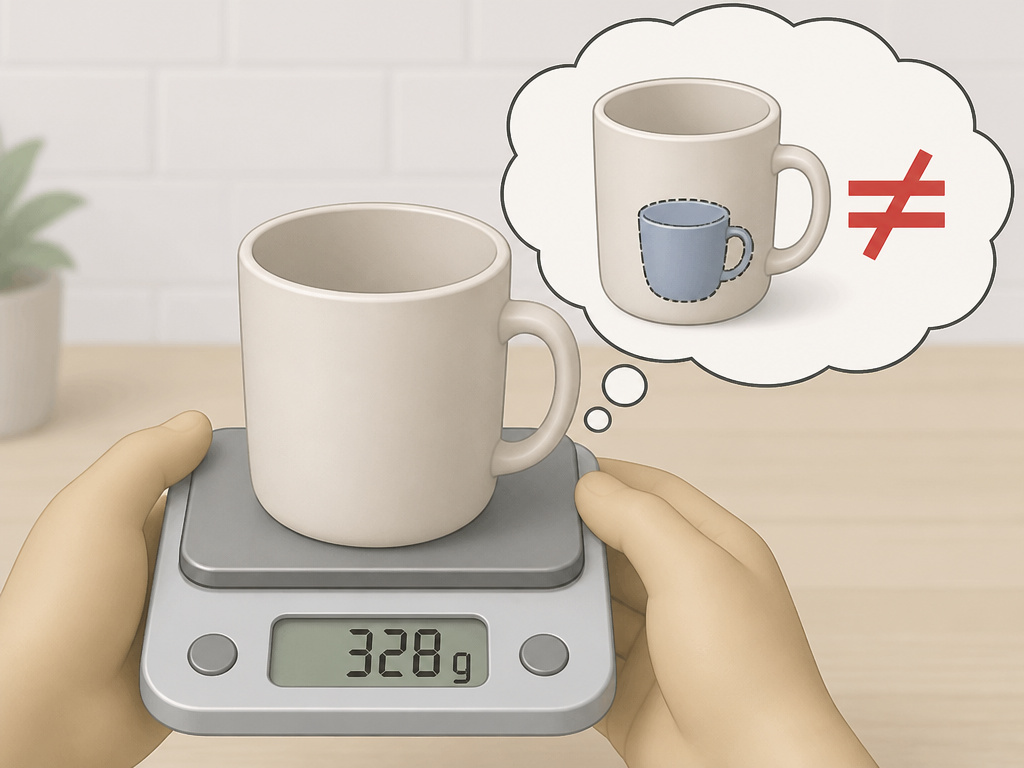
I once spent a week wondering why my morning pour-over tasted weak and flat. I was using a 350 ml recipe for my 12 oz (355 ml) mug, thinking they were equivalent. My scale revealed the mug held over 400 ml. I was diluting the brew by over 15% before the first sip. The fix was weighing the water output, not trusting the mug.
When you increase water volume without increasing coffee grounds, you over-extract the first part of the brew and under-extract the rest, leading to a hollow, bitter, and weak cup simultaneously. The flavor degradation is immediate.
Caffeine content is directly tied to the coffee-to-water ratio, not just the cup’s size. A properly brewed 6 oz cup using the SCA standard has a predictable caffeine range (80-100 mg). A 20 oz Starbucks Venti has roughly triple the coffee grounds and triple the water, so its caffeine content is also roughly triple (300+ mg).
| Scenario | Water Volume | Coffee Grounds | Likely Result |
|---|---|---|---|
| Following SCA Standard | 6 oz (180 ml) | 10 grams | Balanced flavor, expected caffeine. |
| Using a 12oz Mug as “1 Cup” | 12 oz (355 ml) | 10 grams | Weak, sour, under-caffeinated. |
| Cafe Medium (Grande) | 16 oz (473 ml) | ~30 grams | Strong, potentially bitter, high caffeine. |
| Keurig 8oz Setting | 8 oz (237 ml) | Pod-fixed (~10g) | Can be weak; depends on pod blend. |
TL;DR: Wrong water volume ruins flavor instantly and makes caffeine intake unpredictable. Always measure by weight or a verified volume, not by your mug.
How to Actually Measure Your Cup
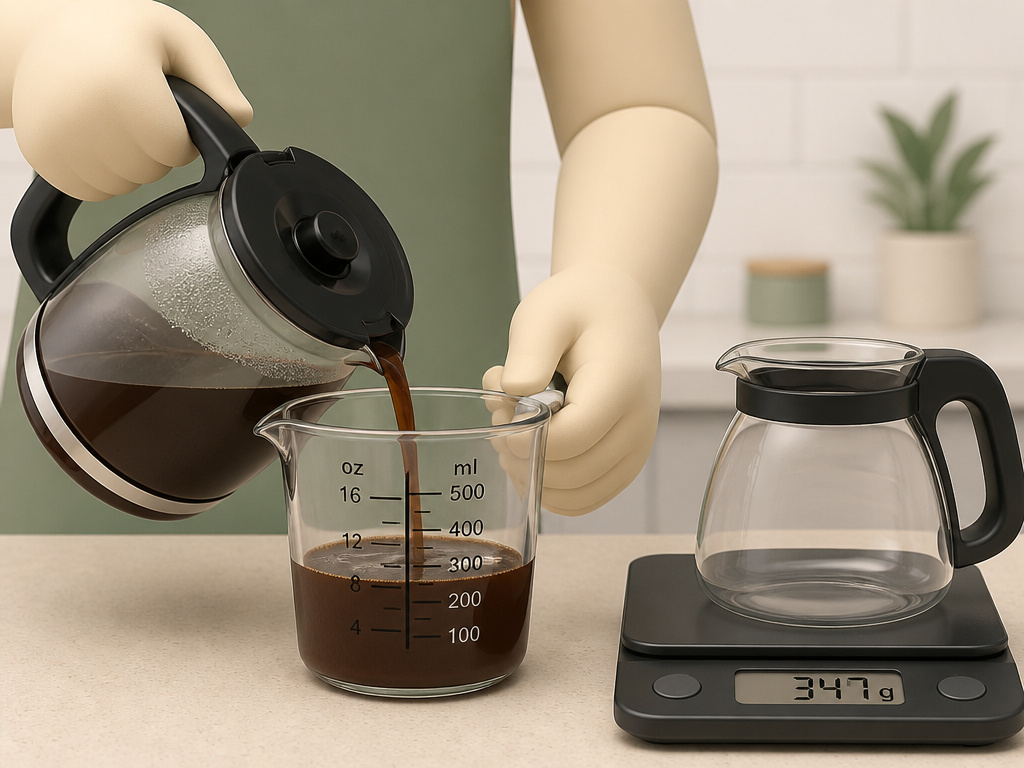
Forget the lines on your carafe and the height of your mug. Use these two reliable methods.
First, use a liquid measuring cup. After brewing, pour your coffee into a standard kitchen measuring cup. This tells you the true volume you produced. Do this once for your drip machine on its “4-cup” setting. You might find it delivers 24 oz (so its “cup” is 6 oz) or 32 oz (so its “cup” is 8 oz). Now you know.
Second, and more accurate, weigh your water. One milliliter of water weighs one gram. If your recipe calls for 360 ml of water (about two SCA cups), weigh out 360 grams. This eliminates the ambiguity of meniscus lines and curved carafes. A small kitchen scale is the best tool for consistent coffee.
For pod systems, trust the machine’s programmed volume but verify the output once. For a Keurig K-Cup brewer, run an 8oz cycle into a measuring cup. If it dispenses 7.5 oz, you know to adjust your expectations.
Common mistake: Assuming a “12-cup” carafe means twelve 8-ounce mugs. It almost always means twelve 5-ounce servings (60 oz total). Filling an 8-ounce mug from it gives you 1.6 “cups” of coffee, throwing off every recipe you try to scale.
When you want a true standard drip coffee serving, aim for 5-6 ounces of water per serving. For a stronger cafe-style brewed coffee volume, you might prefer a ratio that uses more grounds for the same 5-6 oz water, or simply accept the larger 12 oz serving as your personal “cup.”
Frequently Asked Questions
Is a cup of coffee 6 or 8 oz?
For brewing according to industry standards, it’s 6 oz (180 ml). For US culinary measurement, it’s 8 oz (237 ml). Always check the context, a coffee recipe uses 6 oz, a cake recipe uses 8 oz.
Why is a Starbucks cup so big?
Starbucks’ size inflation started with the Grande (16 oz) becoming the default “medium.” Larger volumes increase perceived value and allow for more milk, syrup, and ice in customized drinks. Their smallest, the 8 oz Short, is still bigger than the standard coffee cup.
How much coffee is in a Keurig cup?
Keurig “cup” refers to the water volume you select, typically 6, 8, 10, or 12 ounces. The amount of ground coffee inside the pod is fixed (usually 9-12 grams). A larger water setting with the same pod makes a weaker drink.
How many ounces is a standard coffee mug?
standard home coffee mug typically holds 8 to 12 US fluid ounces. This is why the confusion persists, your mug is bigger than the “cup” used to brew the coffee that fills it.
What is a demitasse cup?
demitasse is a small cup used for serving espresso and Turkish coffee. It typically holds 2 to 3 fluid ounces (60-90 ml), perfectly sized for concentrated coffee servings.
The Bottom Line
A “cup of coffee” is a term with three distinct definitions: the 5-6 oz brewing standard, the 8 oz culinary unit, and the 12+ oz commercial reality. The definition that matters is the one your brewer or recipe uses. Ignoring this difference is the fastest way to brew a disappointing pot.
Measure your water independently of your machine’s promises. Understand that your favorite espresso drink sizes and your morning brewed coffee volume operate on different scales. When you control the volume, you control the strength, the flavor, and your caffeine intake. Start with the SCA’s 6-ounce cup as your baseline, and adjust from there to match your own taste, not the size of your mug.
