
French Press Water to Coffee Ratio: A Complete Brewing Guide
The French press water to coffee ratio is the weight of coffee grounds to the weight of water, typically between 1:12 and 1:17. A 1:15 ratio is a reliable starting point: for every 1 gram of coffee, use 15 grams of water. This means 30 grams of coffee for a 450ml (15 oz) press.
Most people get this wrong by trusting volume measurements like scoops or tablespoons. A scoop of dark roast is heavier than a scoop of light roast. Volume is inconsistent. Your ratio shifts every time you brew.
This guide breaks down why the ratio is a range, how your grind changes the math, and what the manuals from OXO and Bodum actually say. You will get a method that works for any press size.
Key Takeaways
- Manufacturer specs disagree: OXO recommends a 1:11.8 ratio, while Bodum suggests a milder 1:15.7.
- Your grind size is a hidden variable. A fine grind over-extracts at a 1:15 ratio, making the cup bitter. A coarse grind under-extracts, making it weak.
- The extended steep method (wait 8 total minutes, don’t plunge) produces a cleaner, sweeter cup by letting more sediment settle.
- For cold brew in a French press, use a concentrated 1:4 to 1:8 ratio because you steep for 12-24 hours.
- Always use a scale. A $20 digital scale eliminates the guesswork from scoops and tablespoons.
The Core Ratio Range (and Why It’s a Range)
You will see ratios from 1:12 to 1:17. That is not a mistake. It is a lever for strength and extraction. A 1:12 ratio uses more coffee per water, yielding a heavier, more intense cup. A 1:17 ratio uses less coffee, creating a lighter, more tea-like body.
The middle ground, a 1:15 ratio, balances body and clarity. For a standard 34 oz (1 liter) press, that is about 67 grams of coffee to 1000 grams of water.
A 1:15 coffee-to-water ratio by weight is the specialty coffee baseline for immersion brewing. It provides enough coffee mass to fully saturate and extract soluble flavors without overwhelming the water’s capacity, which typically maxes out at an 18–22% extraction yield.
Manufacturers do not agree on this. Their manuals reveal a clear split. The OXO Brew 8-cup French press manual specifies 4 tablespoons (roughly 20g) of coffee per 8 fl oz (236g) of water. That is a 1:11.8 ratio. Bodum’s Chambord 12-cup manual suggests one rounded tablespoon per 4 oz of water, which works out to about a 1:15.7 ratio.
| Manufacturer & Model | Recommended Ratio | Translated Weight Ratio | Resulting Cup Profile |
|---|---|---|---|
| OXO Brew (8-cup) | 4 tbsp per 8 fl oz | 1:11.8 | Strong, robust, heavier body |
| Bodum Chambord (12-cup) | 1 tbsp per 4 fl oz | ~1:15.7 | Milder, smoother, lighter body |
OXO is designing for a consumer who wants a bold, diner-style coffee. Bodum is aiming for a more approachable, European-style cup. Neither is wrong. Your preference decides.
TL;DR: The ratio spectrum runs from strong (1:12) to mild (1:17). Start at 1:15 and move in either direction based on your preferred coffee’s roast level and your desired strength.
The Grind Size Variable
Your ratio is meaningless without the right grind. Think of grind size as a multiplier on your extraction speed. A fine grind has more surface area. It extracts faster. A coarse grind has less surface area. It extracts slower.
If you use a fine grind with a 1:15 ratio, you will likely over-extract. The water pulls out bitter, astringent compounds before the four-minute steep is done. The cup tastes harsh. If you use a coarse grind with the same 1:15 ratio, you risk under-extraction. The water cannot pull enough sweetness and acidity from the large particles. The cup tastes weak and sour.
The fix is to pair your ratio with the corresponding grind. For a stronger 1:12 ratio, use a coarser grind to slow extraction down and avoid bitterness. For a milder 1:17 ratio, use a slightly finer grind to speed extraction up and avoid sourness. For the standard 1:15, a true medium-coarse grind is the target.
Common mistake: Using pre-ground “French press” grind from the store, it is almost always too coarse and leads to weak, underwhelming coffee regardless of your ratio.
This is why a burr coffee grinder is non-negotiable for consistency. Blade grinders produce a mix of dust and boulders. You cannot dial in a ratio when half your coffee is over-extracting and the other half is under-extracting. The result is a muddy, confused cup every time.
A Simple 3-Step Ratio Method
This method works for any French press size. You need a scale, a grinder, and a timer.
- Weigh. Place your empty French press on the scale. Tare it to zero. Add your coffee grounds. For a 1:15 ratio, multiply your desired water weight in grams by 0.067. Example: 500g water * 0.067 = 33.5g coffee. Tare the scale again.
- Grind and Bloom. Grind your beans to a medium-coarse consistency. Add them to the press. Heat water to 200°F (93°C). Pour just enough water to saturate all the grounds, about twice the weight of the coffee. Wait 30 seconds. This bloom releases carbon dioxide.
- Pour, Steep, and Separate. After the bloom, pour the remaining water to your target weight. Start a 4-minute timer. When it goes off, give the crust of grounds a gentle stir with a spoon. Now wait another 4 minutes. Do not plunge. The grounds will settle to the bottom. Place the lid on and press the plunger only until it is just below the surface of the liquid, trapping the sediment bed. Pour immediately.
The extended wait is the key. Most guides tell you to plunge at 4 minutes. That forces the fine sediment, the silt, back into suspension. Waiting the extra 4 minutes lets nearly all of it settle. Your final cup is remarkably clean, sweet, and free of grit.
The best coffee bean types for French press are often medium to dark roast blended coffee designed for full immersion. Their chocolatey, nutty notes shine without the paper filter that absorbs oils.
When to Deviate: Cold Brew and Light Roasts
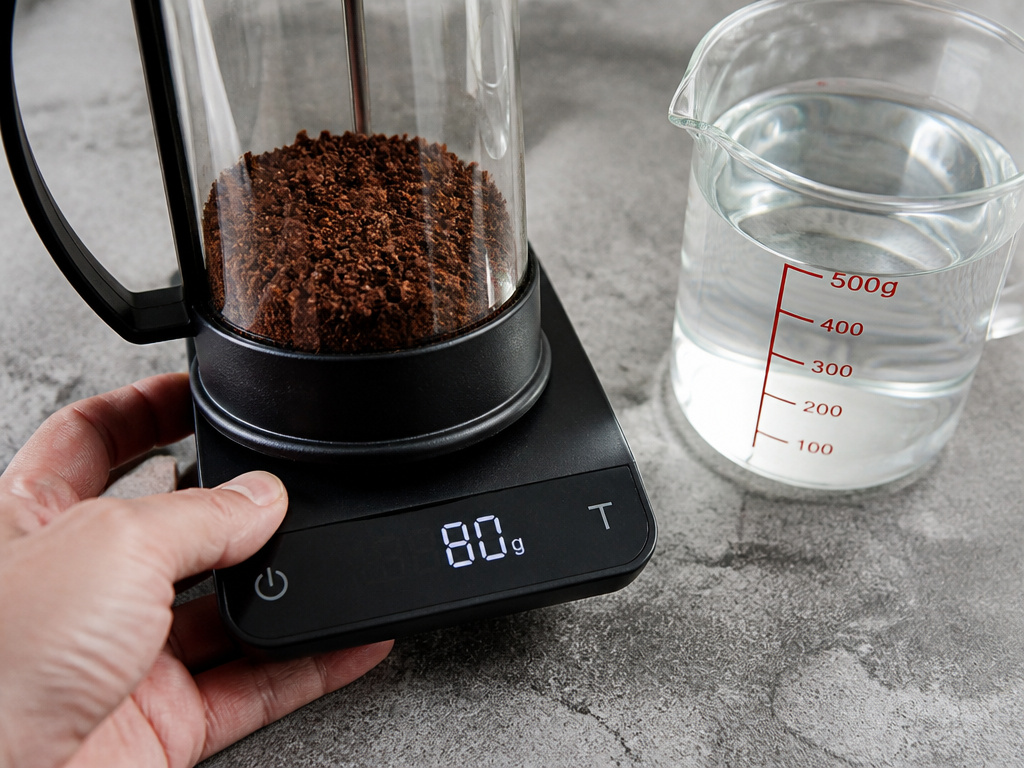 The standard ratio breaks for two specific cases: cold brew and very light roasts.
Cold brew in a French press is a concentrate. You steep for 12 to 24 hours in cold water. Extraction is slow and inefficient. You must use a much higher coffee-to-water ratio, typically between 1:4 and 1:8. A common formula is 80 grams of coarse ground coffee to 500 grams of cold water. After steeping, you dilute the concentrate with water or milk to taste.
Light roasts, like a blonde roast coffee, are denser and harder to extract. A 1:15 ratio with a four-minute steep often yields a sour, acidic cup. You have two options. First, use a slightly finer grind to increase extraction surface area. Second, increase your ratio to 1:14 or even 1:13 to add more coffee mass, which gives the water more to work with. A hotter brew temperature (205°F / 96°C) can also help.
Tools That Make Ratio Foolproof
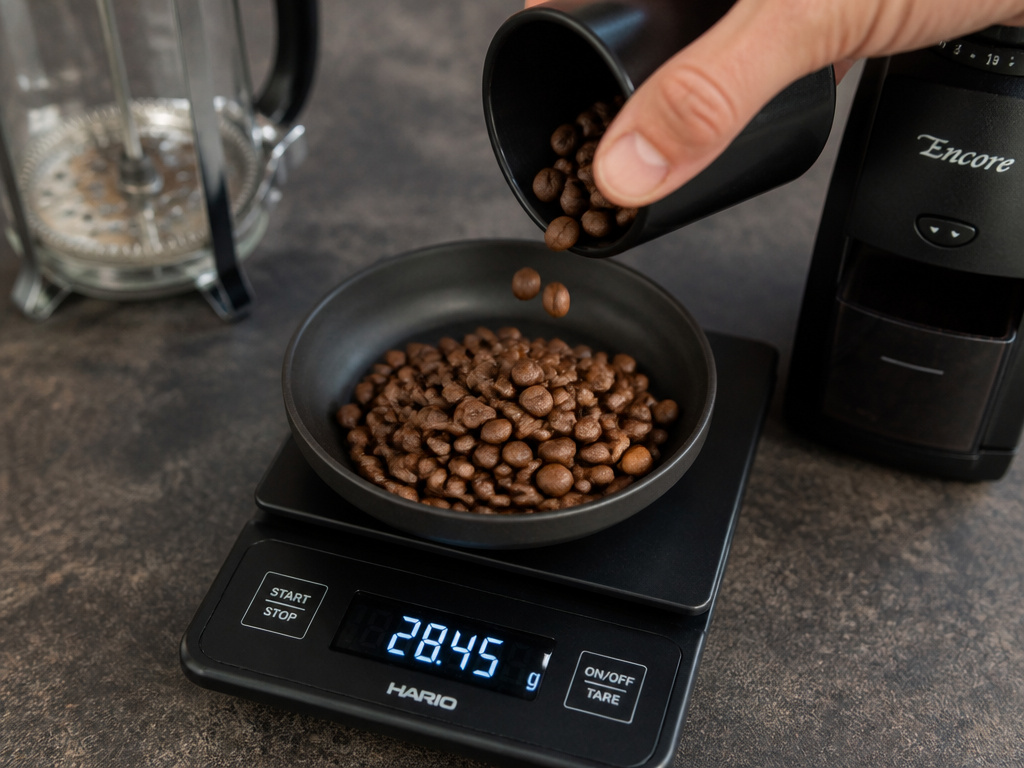 Your technique is only as good as your tools. These three items remove variables.
- Digital Kitchen Scale: This is the most important tool. It makes ratio a guarantee, not a guess. Look for one that measures in 0.1-gram increments and has a tare function.
- Burr Grinder: Consistency is everything. A manual or electric burr grinder gives you uniform particles, which means even extraction. This is more critical than buying expensive beans.
- Gooseneck Kettle: While not essential, a gooseneck gives you precise control over your pour. You can saturate the grounds evenly during the bloom, which prevents dry clumps that extract poorly.
If you lack a proper grinder, be cautious with grinding coffee beans in a blender. It can work in a pinch for a coarse grind, but you will get a lot of fine powder. Compensate by using a slightly coarser ratio and being meticulous with the extended steep time to let those fines settle.
Frequently Asked Questions
What is the best French press ratio for a 4-cup press?
For a 4-cup press (typically 500ml or 17 oz), use the same 1:15 ratio. That means 33 grams of coffee to 500 grams of water. The method does not change with size; only the quantities scale.
Can I use tablespoons instead of a scale?
You can, but your results will vary wildly. A tablespoon of a dense light roast can weigh 50% more than a tablespoon of a fluffy dark roast. Your ratio will be different every time. A scale costs less than two bags of specialty coffee.
Why does my French press coffee taste bitter with the right ratio?
Bitterness is usually a sign of over-extraction. The most likely culprit is your grind is too fine for your steep time. Try a coarser grind setting. Alternatively, your water might be too hot. Let it sit off the boil for 30 seconds before pouring.
How does French press ratio compare to drip coffee?
drip coffee machine typically uses a ratio around 1:16 or 1:17. The French press ratio is often stronger (1:12 to 1:15) because the metal filter allows oils and fine particles into the cup, which adds body and perceived strength. A side-by-side taste test reveals the French press as heavier and more textured.
The Bottom Line
The perfect French press ratio is the one you prefer, but it starts with a scale and a 1:15 benchmark. Remember that grind size is your adjustment knob, finer for lighter roasts, coarser for darker roasts. Ignore the volume measurements on the side of your press and the conflicting manufacturer advice. Weigh your coffee, weigh your water, and give the extended steep method a try. The difference is not subtle. You will get a cup that is clean, sweet, and exactly as strong as you intended.
