
Names for Espresso Coffee Machine Parts | Common Failure Points
An espresso coffee machine’s parts are named for their function in moving, heating, and pressurizing water. The core assembly is the group head, portafilter, and basket. The pressure system includes the pump, boiler, and over-pressure valve (OPV). The steam system uses a separate boiler or heat exchanger, a wand, and a tip. Support parts are the drip tray, water reservoir, and control electronics.
Most guides list parts but skip the numbers that matter. They tell you a boiler heats water. They don’t tell you a Breville BES920XL brew boiler holds 0.45 liters and its solenoid valve fails around month twenty. That specific failure timeline changes how you maintain the machine.
This guide names every part with the specs and failure modes owners actually report. You will learn what each piece does, what it’s really called in a service manual, and what happens when it wears out.
Key Takeaways
- The group head is the heated metal block you lock the portafilter into. Its gasket fails every 1–2 years, causing leaks during the shot.
- The over-pressure valve (OPV) regulates brew pressure. Factory settings on entry machines like the Gaggia Classic Pro are often 12–15 bar, but the universal owner mod sets it to 9 bar for proper extraction.
- The three-way solenoid valve releases pressure post-brew. It’s a common point of failure, with Breville Dual Boiler owners reporting replacements at 18–24 months.
- Boiler capacity directly affects recovery time. A 0.45L brew boiler (Breville BES920XL) refills and heats faster than a 2.1L steam boiler (ECM Synchronika), but it also runs out of steam for back-to-back milk drinks.
- Basket depth must match shower screen clearance. A deeper precision basket (VST/IMS) can touch the screen in a standard portafilter, causing immediate channeling.
The Core Brewing Assembly (Group Head to Basket)
This is where water meets coffee. Every part here must seal perfectly under 9 bars of pressure. A leak in this assembly means a weak, fast shot.
The group head, a heated metal block containing the shower screen, delivers pressurized water from the brew boiler. The portafilter, a handled basket holder, locks into the group head via a bayonet or lug system. The filter basket, a perforated metal cup holding 18–22 grams of coffee, sits inside the portafilter.
The group head is the circular, often brass, block protruding from the machine’s front. It’s threaded internally to accept the portafilter. Inside, the shower screen, a fine metal mesh, distributes water evenly. That screen gets clogged with coffee oils. Clean it monthly with a blind basket and cleaner, or water will jet through the puck in one spot.
You lock the portafilter into the group head. Its handle can be plastic, wood, or metal. The critical detail is the locking lugs. Forcing it can cross-thread the group head. The repair involves removing the entire assembly.
Inside the portafilter sits the filter basket. Sizes are 51mm, 54mm, or the cafe-standard 58mm. Basket depth matters.
| Basket Type | Best For | Risk If Mismatched |
|---|---|---|
| Standard single/double | Everyday shots | Less extraction clarity |
| Precision (VST, IMS) | Light roasts, profiling | Can contact shower screen, causing channeling |
| Pressurized (dual-wall) | Pre-ground coffee | Hides grind flaws, produces false crema |
A precision basket has more, laser-cut holes. It demands a perfect grind and tamp. Using one in a portafilter not designed for its extra depth is a classic edge case. The basket rim sits higher, and the shower screen screws into the coffee puck on lock-in. You will see a circular imprint. The shot channels immediately.
TL;DR: The group head, portafilter, and basket must seal as one pressurized chamber. A worn group gasket leaks down the portafilter handle. A clogged shower screen jets water. A too-deep basket touches the screen.
The Boiler & Pump System
These parts create pressure. The pump pushes, the boiler heats, and the OPV regulates. Getting these names wrong means you cannot diagnose low pressure or temperature swings.
Home machines use a vibratory pump (a loud buzz) or a rotary pump (a quiet hum). The vibratory type is cheaper and common on machines like the Gaggia Classic. It pulses to build pressure. The rotary type, found on prosumer models like the ECM Synchronika, runs smoothly off a direct water line or internal tank. Rotary pumps last longer but cost more.
The boiler heats the water. You have three main types: 1. Single Boiler: Heats water for brewing, then you switch it to steam mode. It’s slow for making multiple milk drinks. 2. Heat Exchange (HX): A single boiler with a internal tube. Steam-ready water surrounds the brew-water tube, allowing simultaneous brew and steam with some temperature management nuance. 3. Dual Boiler: Separate boilers for brew and steam, like the Breville BES920XL (0.45L brew, 0.95L steam) or ECM Synchronika (0.75L brew, 2.1L steam). This gives precise, independent temperature control.
The over-pressure valve (OPV) is a critical safety and quality part. It bleeds off excess pressure from the pump to protect the system. Here is where owner wisdom clashes with factory specs.
Common mistake: Running a machine with its factory OPV setting of 12-15 bar, this produces harsh, over-extracted espresso with excessive channeling. The fix is a 9-bar spring mod, which the entire espresso grind consistency community recommends.
The OPV is often a simple spring-loaded valve near the pump outlet. On the Gaggia Classic Pro, the spring is easily swapped. On other machines, it may be an adjustable screw.
TL;DR: The pump creates pressure, the boiler creates heat, and the OPV caps the pressure at 9 bar. A failing vibratory pump loses power; scale in a boiler kills the heating element; a stuck OPV gives zero pressure or too much.
Steam & Water Delivery
 This system froths milk and provides hot water. It shares parts with the brew circuit but operates at higher temperatures and often lower pressure.
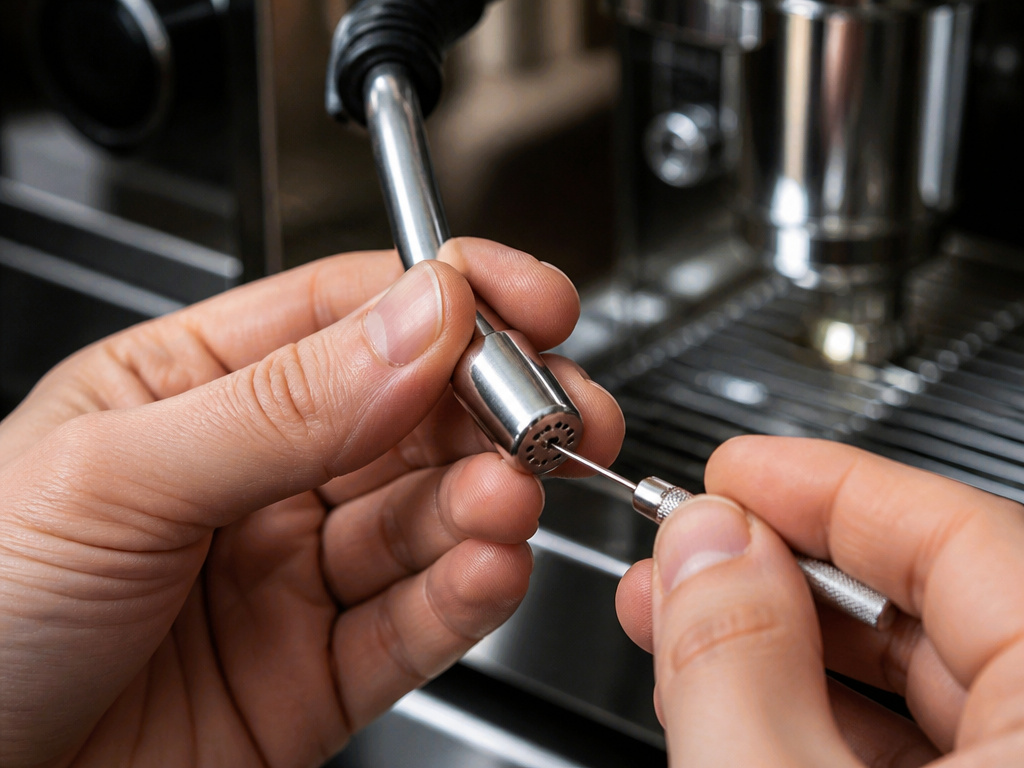
The steam wand is a stainless steel pipe connected to the steam boiler or heat exchanger. At its end, a steam tip with tiny holes injects steam into milk. The tip design, four holes versus one, changes the texture and speed of frothing. It gets clogged with milk residue. Poke the holes with a wire after every use.
A steam valve controls the flow. It can be a manual knob or an electronic switch. Turning it on opens a path from the steam boiler to the wand. The boiler pressure for steam is higher, often 1–1.5 bar.
Many machines also have a hot water spout. This dispenses water directly from the steam boiler for Americanos or tea. It uses a separate valve, sometimes called a hot water tap. This spout can scale up quickly because the water is not constantly flowing like in the brew circuit.
I ignored the hot water spout on a machine for a year. When I finally used it, the water trickled out brown with scale. Flushing the spout weekly with the wand prevents that.
For machines with automatic milk frothing, like some Breville models, there is an additional air intake tube and a thermoblock or auxiliary heater. These are more complex and harder to clean.
TL;DR: The steam wand and hot water spout draw from the steam boiler. The steam tip holes clog with milk. The hot water spout scales up if unused. Both need weekly flushing.
Internal Valves & Control Electronics
 Behind the panels are the parts that manage water flow, safety, and timing. Knowing these names helps when you hear a strange click or see an error code.
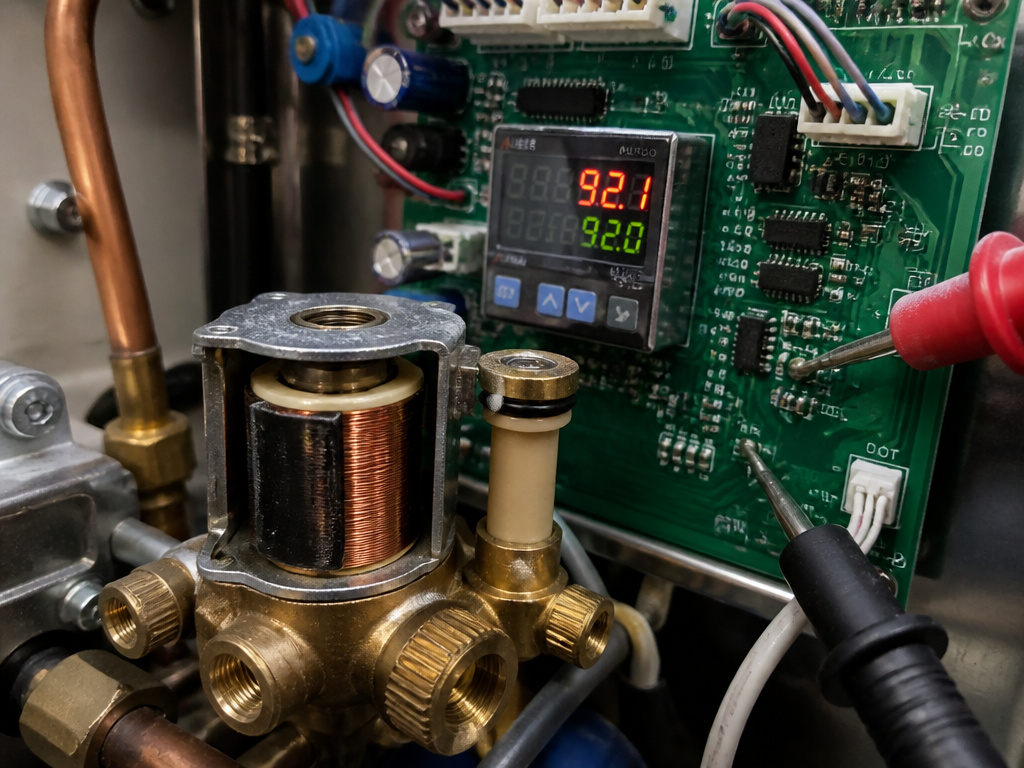
The three-way solenoid valve is the source of the satisfying “click-thunk” after you finish a shot. It’s an electrically operated valve that releases pressure from the group head back into the drip tray. This prevents the portafilter from being dangerously pressurized when you remove it.
This valve fails. According to a Home-Barista forum thread from March 2015, Breville Dual Boiler owners reported solenoid failures around 18–24 months. The specific part number was SP0001804. Symptoms include no pressure release, water dripping from the group when off, or the machine not building pressure.
The thermostat or PID controller regulates boiler temperature. A simple thermostat cycles the heating element on and off. A PID (Proportional-Integral-Derivative) controller does it more precisely, minimizing temperature swings. It’s a small circuit board often visible inside the machine.
The main control board is the brain. It runs programmed shot times, activates the solenoid, and manages heating cycles. It’s sensitive to water damage. A leak from a failed gasket above it can fry the board.
Here is a quick diagnostic table for internal part failures:
| Symptom | Likely Failed Part | Typical Timeline |
|---|---|---|
| No pressure build-up | Pump or clogged OPV | 3–5 years (pump) |
| Post-shot dripping from group | Three-way solenoid valve | 1.5–2 years |
| Machine not heating | Thermostat, heating element, or thermal fuse | Variable |
| Error code, machine dead | Main control board (often from water leak) | After a major leak event |
TL;DR: The solenoid valve releases puck pressure and fails around two years. The thermostat or PID controls temperature. The main board controls everything and dies if it gets wet.
Support & Frame Components
 These parts don’t make coffee, but the machine doesn’t work without them. They are the most replaced items due to wear and tear.
The drip tray catches spills and purge water. It’s a removable plastic or metal tray. Its full sensor, on some machines, can get clogged with coffee grime. Empty it daily.
The water reservoir is a removable plastic tank. Its placement, front, side, or rear, affects the machine’s footprint. The reservoir has a float valve or electronic sensor to signal low water. Scale can jam the float.
The cup warmer is the heated top plate. It uses waste heat from the boilers. Don’t expect it to actually heat cups from room temperature; it just keeps them warm.
The pressure gauge or sight glass shows boiler pressure. On simpler machines, it’s a cosmetic gauge. On prosumer models, it’s a true pressure reading that helps you monitor pump and OPV health. A gauge that never moves indicates a failed pump or a blocked line.
The machine’s frame and side panels provide structure and aesthetics. They also house sound-damping material around noisy vibratory pumps.
TL;DR: The drip tray and water reservoir need daily and weekly attention, respectively. The pressure gauge is a vital diagnostic tool if it’s real. The cup warmer is mostly for show.
Frequently Asked Questions
What is the most important part for espresso quality?
The group head and filter basket combination is the most important. Everything before it delivers water; everything after collects coffee. If the shower screen doesn’t distribute evenly or the basket holes are inconsistent, even perfect pressure and temperature won’t save the shot. This is why consistent espresso grind from a good burr grinder is non-negotiable.
Why does my machine make a loud clicking sound after brewing?
That’s the three-way solenoid valve activating. It redirects leftover pressure in the group head and portafilter down into the drip tray. This is normal. If the sound disappears and water drips from the group for a minute after the shot, the solenoid is likely stuck open or failing.
What is the difference between a 15-bar and a 9-bar machine?
The “15-bar” label refers to the pump’s maximum pressure capability, not the brewing pressure. All quality espresso is brewed at approximately 9 bars of pressure at the coffee puck. An over-pressure valve (OPV) reduces the pump’s output to this level. A machine without a proper OPV or with a poorly set one will brew at the pump’s max pressure, which is terrible for extraction.
How often should I replace the shower screen and group gasket?
Replace the silicone group gasket every 12–18 months, or as soon as you see water leaking around the portafilter during a shot. The shower screen can last years with regular cleaning. Soak it in espresso machine cleaner every month to prevent clogging.
Can I use any portafilter on my machine?
No. Portafilters are specific to group head size and locking mechanism (e.g., 58mm with a standard lug, or 54mm with a Breville-specific bayonet). Using an incompatible portafilter will not lock in correctly, creating a dangerous pressure leak. Always check your appliance user manuals for part compatibility.
The Bottom Line
Knowing the real names for espresso machine parts changes how you maintain it. You stop thinking “something’s leaking” and start identifying a worn group head gasket. You hear a missing click and suspect the solenoid valve. This knowledge turns frustration into a fixable diagnosis.
Remember the specifics: the OPV should be set to 9 bar, not the factory 15. The solenoid valve often fails around the two-year mark. And the basket depth must clear the shower screen. Your machine is a collection of these precise, named components. Treating them as such is what separates a working appliance from a consistently great espresso brewer.
