
Your De’Longhi Coffee Machine Manual PDF: Essential Guide
Your De’Longhi coffee machine manual PDF provides factory specs but lacks critical maintenance logic. It won’t explain why the descaling prompt triggers early or how to silence a screaming grinder. This gap leads to preventable damage from scale in the thermoblock or grinder failure from coffee dust.
Most people download the PDF, skim the safety warnings, and never open it again. They assume the machine’s automated prompts are infallible. That assumption costs them a repair bill when scale silently builds up in the thermoblock or the grinder bearings fail from dust.
This guide walks you through the official manual source, then shows you the settings that matter, the maintenance the manual understates, and the fixes for the noises and leaks it doesn’t mention.
Key Takeaways
- Your model number is the key. It’s on a physical sticker on the machine, not on the box.
- The official descaling prompt is a minimum suggestion. In hard water areas, you need to descale manually every 4-6 weeks.
- Always adjust the grind setting while the grinder is running. Turn the dial in tiny increments, one notch at a time.
- A leaking bottom often points to a failed internal O-ring or hose clamp, a common issue on older Magnifica S models.
- For a De’Longhi Dedica, programming the shot volume requires holding the button during extraction until your target weight is reached.
Where to Find Your Official De’Longhi Manual
The only source for a guaranteed correct manual is De’Longhi’s own website. Third-party sites host outdated or mismatched files. Your first step is locating the model number on your machine.
Look for a white or silver sticker on the bottom, back, or side panel. For super-automatics like the Dinamica series, you might need to slide out the drip tray or bean hopper. The number starts with prefixes like ECAM, EC, or DEDICA. Write it down exactly, including any dots or slashes.
Now go to delonghi.com/en-us/manuals/. This is the primary source for all user guides and documentation. Use the search bar on that page. Enter your full model number.
The De’Longhi Dinamica Plus ECAM37095TI has a 1.8-liter water tank, a 300-gram bean container, and a pump rated for 19 bars of pressure. Its manual specifies a ground coffee capacity for 14 single espresso shots in the bypass doser.
If your model appears, click it and download the PDF. Bookmark it. If it doesn’t appear, try a broader search like “Dinamica Plus” and visually match your machine’s control panel to the images in the manual list. This process is similar to finding a Braun coffee maker manual or any other appliance’s official guide.
TL;DR: The model number sticker is on the machine itself. Use it on the official De’Longhi manuals page to get the right PDF.
The Critical Settings Your Manual Mentions (And How to Adjust Them)
Your manual lists settings. It rarely explains their long-term impact. Three settings dictate your machine’s health and your coffee’s taste.
Water Hardness (1-4): This is not a suggestion. It’s a calibration for the descaling alert. Set it wrong and the machine will either descale too often, wasting solution, or too late, letting scale build up. The manual says to base it on your local water. That’s vague.
Check your municipal water quality report online for the “grains per gallon” or “ppm” hardness number. Match it to the manual’s chart. If you use a filter, know that a standard carbon filter doesn’t soften water. You need a softening filter. If you use third-party filters, be aware they can alter flow rate and confuse the machine’s internal calculations, a noted edge case.
Grind Adjustment: The manual for the Dinamica Plus states: “Adjust the grind setting only when the grinder is operating.” This is because the burrs need to be moving to avoid jamming. Owner forums add a critical layer: make minuscule changes. Turn the dial one click. Run three shots through it. Then decide if you need another click.
Going from “5” to “1” in one move can choke the burrs with fine powder. You’ll hear a high-pitched whine. That’s the motor straining. Do it repeatedly and you stress the grinder’s bearings, a leading cause of the loud grinding failures reported in 2021-2022.
Auto-Off Timer: This saves energy. On a Dedica, you can set it to 9, 30, or 180 minutes. The manual doesn’t tell you that if you’re in a pattern of making a shot, steaming milk, and cleaning up, a 9-minute timer might shut the machine off before you’re done steaming. Choose 30 minutes as a practical default. It gives you time to work without wasting heat all afternoon.
What the Manual Gets Wrong: The Descaling Debate
Here is where the manufacturer’s advice and real-world experience diverge sharply. Your De’Longhi manual says to descale when the machine prompts you. The prompt is based on an algorithm using your water hardness setting and an internal counter.
Many repair technicians and long-term owners descale monthly, regardless of the prompt.
Common mistake: Waiting for the descaling prompt in a hard-water area, scale forms in the thermoblock’s tiny waterways first. By the time the machine alerts you, flow is already restricted and your shots run cooler and slower.
The thermoblock in a Dedica heats water almost instantly, in about 35 seconds. Scale insulates it. The heater works harder, cycles more, and fails sooner. A manual descaling every 4-6 weeks with De’Longhi’s own solution (or a certified citric acid alternative) prevents this. The machine’s counter is a guideline, not a law.
| Descaling Factor | Manual’s Stance | Real-World Advice |
|---|---|---|
| Frequency | When machine prompts | Every 1-2 months in hard water; before storage |
| Solution | Use De’Longhi brand | De’Longhi brand is safest; citric acid works but may void warranty |
| Process | Follow on-screen steps | Run extra rinse cycles after to eliminate taste residue |
This proactive approach is a form of Breville appliance care that applies to any machine with a heated pathway. Scale is the universal enemy.
TL;DR: The descaling prompt is a minimum. In hard water, descale manually every month to protect the thermoblock and pump.
Programming Your Machine Beyond the Basics

The manual shows you how to save a coffee strength or milk foam setting. The community has figured out the nuances that make those settings actually work.
Programming Shot Volume (Dedica & Similar): The manual might say “press and hold to program.” The YouTube tutorial from a dedicated user shows the precise method. Place your cup on a scale. Tare it. Press and hold the 1-cup button. The shot starts. Keep holding until the scale reads your target output weight, say, 36 grams for a double. Release the button. The machine saves that volume. This turns a vague “medium shot” into a repeatable 36-gram pour.
Resetting to Factory Defaults: Need a clean slate? On a Dedica, enter the settings menu (press steam button until lights flash), then open the steam knob. Press the leftmost button. All lights will flash. Close the steam knob. This is the hard reset the manual mentions but buries in troubleshooting. It clears any corrupted volume or temperature settings.
Temperature Adjustment: Higher isn’t always better. A “High” temperature setting on a super-automatic might extract more from dark roasts but burn lighter roasts, lending a bitter edge. The manual lists the option but not the strategy. Treat it like a grinder comparison guide, the tool enables control, but you need to know your beans. Start at medium.
Troubleshooting: When the Machine Talks Back
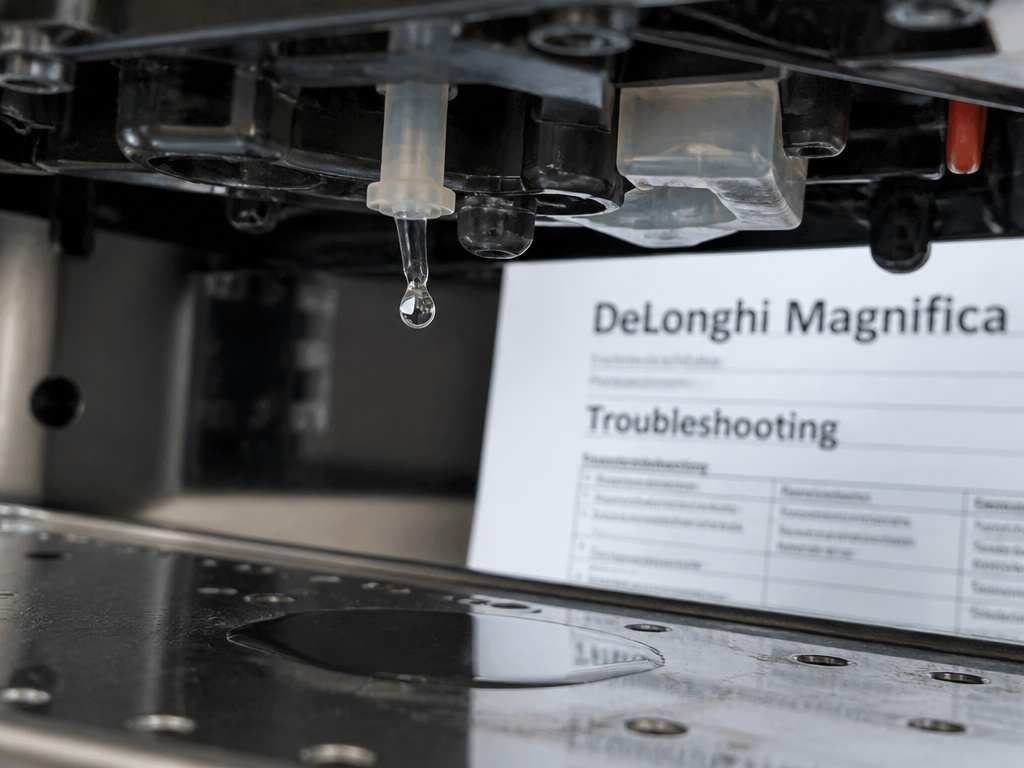
The manual has a troubleshooting table. It’s generic. These are the specific failures owners report, with timelines.
Water Leaking from the Bottom: This plagued the Magnifica S (ECAM 22.110.B) around 2018-2020. The manual says “contact service.” The likely cause is a perished internal O-ring or a loose plastic hose clamp. After 1-2 years of heat cycles, the rubber degrades. You’ll see a puddle under the machine, not from the drip tray. The fix often requires partial disassembly to reach the water distribution block, a job for the patient, with a service manual.
Grinder is Excessively Loud or Whining: A new grinder hums. A failing one screams. If your ECAM series grinder gets dramatically louder after 18-24 months, it’s often bearing wear from fine dust ingress or burr misalignment. The manual says “do not put oily beans” as a prevention. The cure is a grinder cleaning kit (brushes, vacuum) used every 50 bags of beans. If it’s already loud, a replacement grinder unit is the typical repair.
Machine Won’t Descale / Error Code: If the descaling cycle errors out, the manual says “call support.” First, check the obvious: Is the water tank full with fresh water? Is the descaling container properly seated under both the brew unit and steam wand outlets? On some models, you need two containers. Missing the steam wand outlet will trigger a sensor error.
I ignored a faint dripping sound from my older Magnifica for a week. The leak was internal, onto the base plate. By the time I unplugged it, the mineral deposits had already etched a permanent stain into the metal. Now I check under the machine every time I clean the drip tray.
These issues underscore why having your manual is just the start. Understanding the machine’s troubleshooting resources, even for other brands, builds a better mental model for diagnostics.
Upgrades and Mods the Manual Doesn’t Cover

De’Longhi designs machines for reliability with standard parts. Enthusiasts swap parts for performance.
Non-Pressurized Portafilter (Dedica): The included portafilter has a pressurized basket. It’s forgiving for pre-ground coffee. For fresh, high-quality beans, a non-pressurized basket (51mm) lets you control extraction directly. You’ll need a proper grinder, a capable burr vs blade grinder comparison shows why burrs are mandatory here. The manual obviously doesn’t recommend this. It changes the pressure dynamics completely.
Precision Tamper: The stock plastic tamper is a placeholder. A 51mm metal tamper with a level base ensures even compression. Uneven tamping is the main cause of channeling, where water races through one side of the puck. This turns a potential Americano vs drip coffee quality shot into a sour, weak mess.
Water Filtration: The manual pushes De’Longhi-branded filters. Third-party compatible filters work, but their flow rate can differ. A slower filter might trick the machine into thinking the water tank is empty. A faster one might not soften enough. If you go third-party, note the model compatibility exactly. It’s similar to selecting the correct Bunn compatible filters for your brewer.
| Upgrade | Purpose | Risk if Incompatible |
|---|---|---|
| Non-pressurized basket | Better extraction control | Requires very fine, consistent grind; can choke machine |
| Precision tamper | Even puck density | Wrong size (e.g., 53mm) won’t fit, damages basket |
| Third-party water filter | Cost saving | Altered flow triggers false errors; may not soften adequately |
TL;DR: Upgrades like a non-pressurized basket unlock potential but demand a good grinder and technique. The manual won’t help you here.
Frequently Asked Questions
How do I find my De’Longhi model number?
Look for a white or silver sticker on the bottom, back, or side of the machine. You may need to remove the drip tray or water tank. The number starts with letters like ECAM, EC, or DED.
My machine is prompting to descale, but I just descaled it last month. Why?
Your water hardness setting is likely too low for your actual water. Enter the settings menu and increase the hardness number by one level (e.g., from 2 to 3). This recalibrates the internal counter. Also, ensure you’re using the correct descaling solution and running the full cycle.
Can I use a generic descaling solution instead of De’Longhi’s?
You can, but verify it’s citric acid-based and formulated for coffee machines. Vinegar is too acidic and can damage internal seals. Using a non-approved solution may void your warranty, so check your terms.
The grinder is making a loud rattling noise. What’s wrong?
First, ensure no foreign object (a rock, a coin) is in the bean hopper. If clear, the noise likely indicates worn grinder bearings or burr misalignment. This is a common failure point after 18-24 months of heavy use. Cleaning might help slightly, but a replacement grinder unit is often the permanent fix.
How do I program a double shot on my De’Longhi Dedica?
Place your cup on a scale. Press and hold the 2-cup button. Keep holding it until the scale reaches your desired output weight (e.g., 60 grams for a double lungo). Release the button. The machine saves that volume for future use.
Where can I buy replacement parts like O-rings or water tanks?
The official De’Longhi parts website is the best source for guaranteed compatibility. You can also find common parts like tanks and drip trays through authorized appliance parts dealers. Use your exact model number when searching.
Before You Go
Your De’Longhi manual is the rulebook. Your experience is the strategy guide. Download the correct PDF from the official site using your model number. Set the water hardness with intent, not a guess. Descale before the machine asks you to, especially if your water leaves spots on glass.
Listen to the machine. A new leak or a changed sound is a message. The troubleshooting section is a starting point, but the real answers often lie in owner forums and repair logs. Whether you’re pulling simple shots or exploring the differences between a blend vs single origin bean, the manual gives you control. Your attention to its subtle cues gives you longevity. Keep the PDF handy, but trust what the machine tells you between the lines.
