
Cold Brew vs Iced Coffee: The Truth on Caffeine & Acidity
Cold brew vs iced coffee differs in caffeine and acidity due to brewing temperature. Cold brew steeps in cold water for 12+ hours, yielding a low-acid, high-caffeine concentrate. Iced coffee is hot-brewed then chilled, retaining a brighter, more acidic flavor with typically less caffeine per ounce.
Most comparisons stop at “cold brew is smoother.” They skip the measurable why, the pH shift, the caffeine punch, the shelf-life science that decides which one fits your morning. Picking the wrong method for your beans or your stomach turns a refreshing drink into a chore.
Here’s how the two methods actually work, what the data says about their taste and strength, and how to choose based on your coffee, your schedule, and your gut.
Key Takeaways
- Cold brew’s lower acidity (pH ~6.7) is measurable, not just a tasting note, making it gentler on sensitive stomachs than iced coffee (pH ~5.1).
- Iced coffee highlights origin character like fruit and florals better than cold brew, which mutes volatile aromatics in favor of chocolate and nut notes.
- Cold brew concentrate can have more caffeine per ounce, but a standard serving, diluted, often matches or slightly exceeds a cup of iced coffee.
- Plan ahead for cold brew (12-24 hours); make iced coffee instantly. Cold brew keeps for a week in the fridge. Iced coffee tastes best within hours.
- Grind coarse for both, but the ratio is opposite. Iced coffee uses a normal brewing ratio (e.g., 16:1). Cold brew uses a much stronger ratio (4:1 to 8:1) to compensate for low extraction.
Extraction 101: Why Temperature Changes Everything
Coffee brewing is the process of dissolving soluble compounds from ground beans into water. Heat is the accelerator. Hot water, around 93°C (200°F), aggressively pulls out a wide range of compounds: bright acids, fruity aromatics, and bitter oils. Cold water is lazy. It slowly coaxes out sugars, some caffeine, and fewer acids over many hours.
This isn’t an opinion. A 2019 study in Scientific Reports by Rao et al. confirmed cold brew has “significantly lower titratable acidity” than hot brew. The researchers measured it. The Specialty Coffee Association (SCA) defines brew standards for hot extraction, which directly inform the quality of iced coffee since it starts hot. No such universal standard exists for cold brew, which is why home results vary wildly.
The method defines the result before you taste it. Iced coffee is a snapshot of hot coffee, frozen in time by ice. Cold brew is a completely different beverage built by patience.
TL;DR: Heat extracts acids and aromatics fast; cold extracts sugars and caffeine slowly. Iced coffee is hot coffee’s flavor, chilled. Cold brew is its own distinct profile.
What’s the Difference in Taste and Mouthfeel?
Forget “smooth versus bright.” The real gap is in chemical reality. Your tongue detects acidity. A pH meter confirms it.
Iced coffee, brewed hot, typically hits a pH around 5.1. Cold brew sits closer to 6.7. That full point and a half is the difference between a bright, wake-up tang and a round, almost tea-like glide across your palate.
Iced coffee tastes more like your favorite hot pour-over. You get the origin’s personality, the berry notes of an Ethiopian Yirgacheffe, the floral hint of a Guatemalan. That’s because the hot water preserves those volatile aromatics that flash-chilling traps. The mouthfeel is lighter, cleaner, sometimes with a sharper edge.
Cold brew mutes those high notes. The long, cold steep highlights base flavors: chocolate, nut, caramel, toasted grain. The mouthfeel is heavier, often described as syrupy or silky, especially as a concentrate. It’s why cold brew stands up so well to milk or cream; it has a built-in weight that doesn’t get washed out.
| Characteristic | Iced Coffee | Cold Brew |
|---|---|---|
| Dominant Flavor Notes | Bright, fruity, floral, complex | Smooth, chocolatey, nutty, sweet |
| Mouthfeel | Lighter, crisper, can be sharper | Heavier, silkier, rounder |
| Best For | Drinking black, highlighting single-origin beans | Adding milk/cream, a low-acid daily driver |
| Acidity (pH) | Higher (~5.1) | Lower (~6.7) |
Which One Has More Caffeine?
This is the most debated question. The answer is frustrating: it depends on how you measure.
If you compare equal volumes of ready-to-drink beverage, they’re often close. But that’s not how they’re made. Cold brew starts life as a concentrate. Ounce for ounce of that concentrate, cold brew packs more caffeine. A PMC study on cold brew methods found that ultra-high-pressure cold brew, while niche, highlighted how concentration methods dramatically alter caffeine density.
A typical home cold brew recipe uses a 4:1 water-to-coffee ratio. A typical hot brew for iced coffee uses a 16:1 ratio. That’s four times more coffee grounds per unit of water in the cold brew jar before dilution. When you dilute cold brew concentrate with water or milk to a palatable strength, the caffeine per serving usually ends up slightly higher than or equal to a cup of iced coffee.
For context, understanding espresso caffeine content is useful. Espresso is highly concentrated but served in small volumes. Cold brew logic is similar, high concentration, then dilution. If you’re sensitive to stimulants, treat a glass of diluted cold brew concentrate with the same respect as a strong Americano coffee.
Common mistake: Assuming all “cold coffee” has the same caffeine, a cold brew concentrate you sip straight could deliver a jolt equivalent to two cups of iced coffee.
TL;DR: Cold brew concentrate is caffeine-dense. Diluted, it often matches or slightly beats iced coffee. Always know if you’re drinking concentrate or a ready-to-drink dilution.
How to Brew Each Method: Ratios, Time, and Gear

You need different plans. Iced coffee is a quick weekday move. Cold brew is a weekend project for the coming week.
Brewing Iced Coffee (The Flash-Chill Method)
This is hot brewing with a thermal shock. The goal is to brew strong enough to account for melting ice diluting the cup.
- Grind: Use a medium-coarse grind, slightly coarser than for hot pour-over. A burr coffee grinder is non-negotiable for consistency here; a blade grinder creates fines that over-extract and turn bitter when hit with hot water.
- Ratio: A 16:1 water-to-coffee ratio is standard. For example, 30g of coffee to 480g of total water. Split the water: 200g goes into your vessel as ice, 280g is heated to 93°C.
- Brew: Place the ice in the brewer (like a Chemex) below the filter. Add grounds, then pour the hot water over as usual. The coffee brews onto the ice and chills instantly.
- Consequence: If you don’t account for the ice in your total water weight, your coffee will be weak and watery. If your grind is too fine, it will over-extract onto the ice and taste bitter.
The result is a bright, clear coffee ready in minutes. Drink it fast.
Brewing Cold Brew (The Immersion Method)
This is about time and patience. You’re not in a hurry.
- Grind: Use a very coarse grind, like for French press. This minimizes over-extraction of bitter compounds during the long steep.
- Ratio: Use a strong ratio between 4:1 and 8:1 (water to coffee). A 4:1 ratio (e.g., 100g coffee to 400g water) makes a potent concentrate. An 8:1 ratio makes a more ready-to-drink strength.
- Steep: Combine grounds and room-temperature or cold water in a jar. Stir to saturate. Seal and let sit at room temperature for 12-18 hours, or in the fridge for 18-24 hours. The fridge slows extraction, resulting in an even smoother profile.
- Filter: Strain through a fine mesh filter or a coffee filter. This is crucial, any silt will continue to steep and make your brew muddy and bitter within a day.
- Consequence: Steeping too long (beyond 24 hours) at room temperature pulls out woody, hollow flavors. Not filtering thoroughly ruins the texture and shelf life.
The Shelf Life and Oxidation Problem
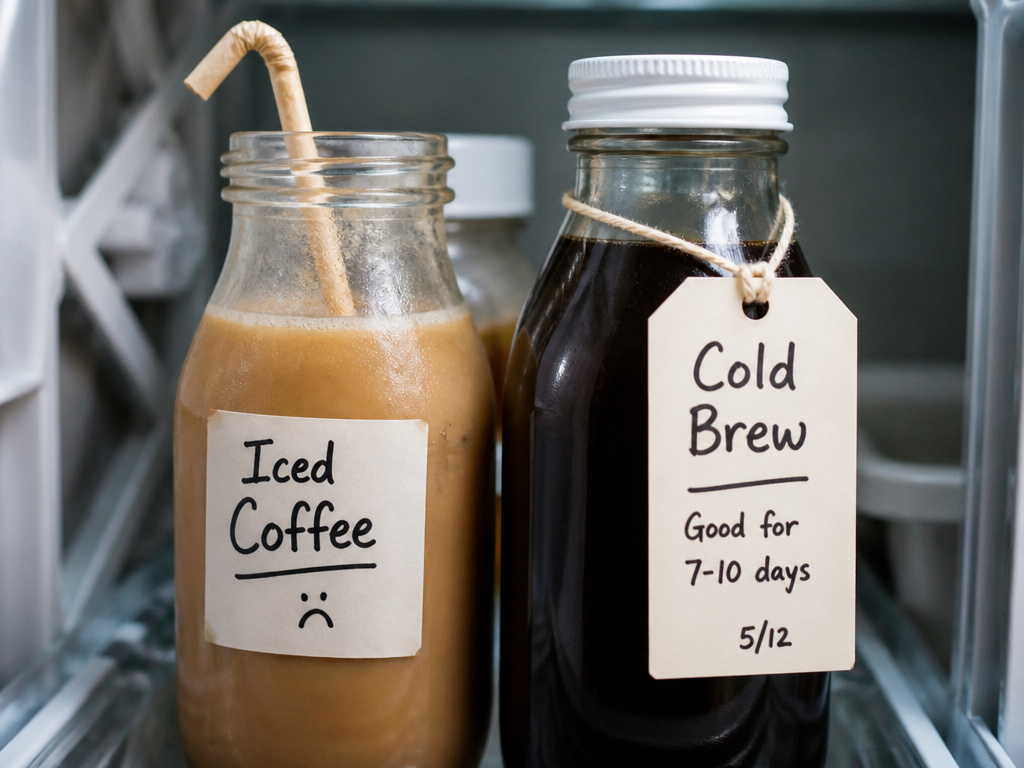
Here’s a practical difference most people discover too late. Iced coffee stales quickly. Cold brew lasts.
Iced coffee, because it was extracted hot, contains more of the organic acids and compounds that oxidize rapidly. Leave it in the fridge overnight and it often tastes flat, papery, or sour by the next afternoon. It’s best consumed within a few hours of brewing.
Cold brew, thanks to its low-temperature extraction, has fewer of those oxidation-prone compounds. Sealed in an airtight container in the fridge, a batch of cold brew concentrate maintains its flavor for 7 to 10 days. This makes it the ultimate batch-prep beverage. Brew once on Sunday, enjoy all week.
This longevity is why cafes can sell cold brew by the bottle and why it’s a staple for meal prep. You cannot do this with iced coffee.
Choosing Your Champion: A Decision Guide
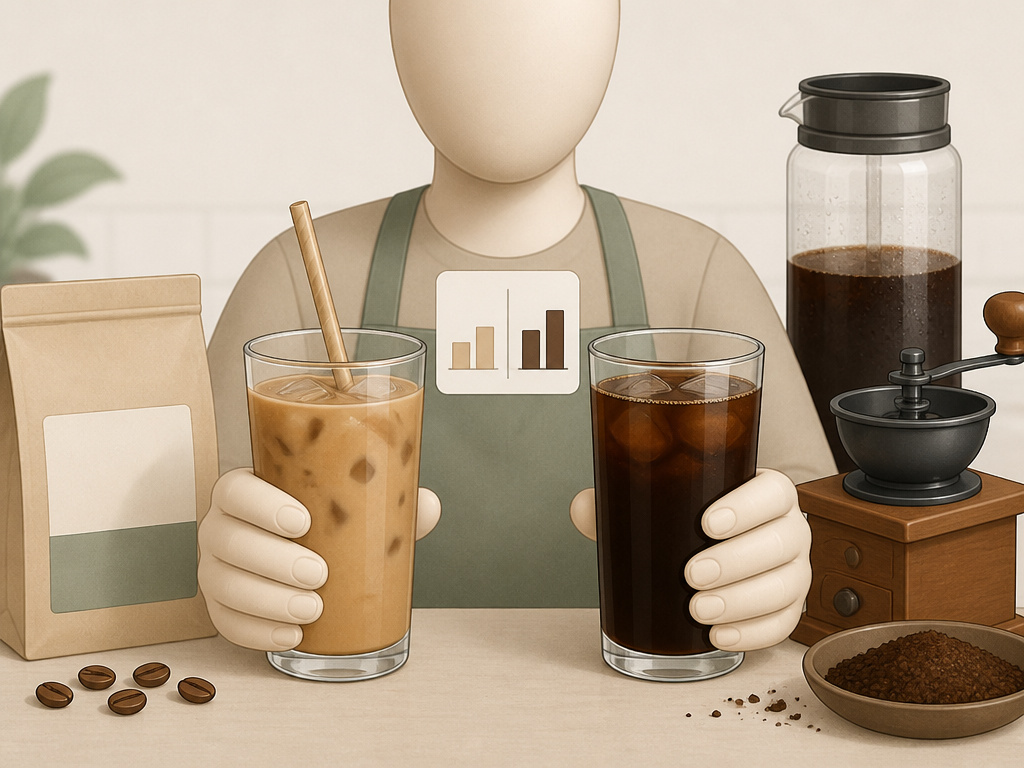
Don’t pick a team. Pick a tool for the job. Use this guide.
| Choose Iced Coffee If… | Choose Cold Brew If… |
|---|---|
| You love the bright, acidic taste of hot coffee and want it cold. | You have a sensitive stomach and need low-acid coffee. |
| You want to highlight the delicate notes of single-origin beans or light roast coffee. | You prefer a naturally sweeter, chocolatey profile or plan to add milk. |
| You need a coffee drink right now, with no planning. | You like batch preparation and having coffee ready for days. |
| You’ll drink it immediately (within a day). | You want a consistent, ready-to-drink option all week. |
Consider your beans. A vibrant Ethiopian Arabica bean sings as iced coffee. A darker blend of Arabica beans might find a better home as a rich, smooth cold brew. The coffee roast levels matter less for cold brew, which tames acidity across the board.
Your choice in coffee grinders also matters more for iced coffee, where uneven extraction is immediately apparent in the cup. For cold brew, a decent coarse grind is easier to achieve.
Frequently Asked Questions
Can you heat up cold brew?
Yes, but manage expectations. Heating cold brew makes a uniquely smooth, low-acid hot coffee. It won’t have the bright, complex highs of a traditionally hot-brewed cup. It’s a great option for those who find normal hot coffee too harsh.
Is cold brew just iced coffee that sat too long?
No. This is a common misconception. Iced coffee that sits becomes stale and over-extracted from the grounds. Cold brew is a purposeful, controlled extraction with a coarse grind and no heat, designed for a long steep. The processes and results are fundamentally different.
Which is cheaper to make at home?
Cold brew often uses more coffee grounds per final serving due to its concentrate ratios, so ingredient cost can be slightly higher. However, its batch efficiency and long shelf life can make it more cost-effective than making single servings of iced coffee daily, especially if you avoid waste.
Does cold brew really have less acid?
Yes, measurably so. The cold brew optimization research paper from the National Institutes of Health confirms that the cold extraction process results in a beverage with significantly lower titratable acidity compared to hot brew methods, which is the basis for iced coffee.
Can I use pre-ground coffee for cold brew?
You can, but it’s not ideal. Pre-ground coffee is usually a medium grind suitable for drip machines, which is too fine for cold brew. It will over-extract, leading to a bitter, muddy concentrate. For best results, grind coarse beans fresh.
Before You Go
Cold brew and iced coffee are not interchangeable. One is a time-insensitive, stomach-friendly workhorse you batch on the weekend. The other is a immediate, vibrant snapshot of your favorite beans, best enjoyed fresh.
Your priority decides. Need low acidity and convenience? Cold brew is your method. Crave complexity and immediacy? Master the flash-chill iced coffee technique. Understanding the coffee brewing parameters behind each, the grind, the ratio, the time, lets you control the outcome, turning a simple choice into a crafted daily ritual.
Try both. Measure your coffee. Taste the difference the chemistry makes. Your perfect glass of cold coffee is waiting, and now you know exactly how to build it.
