
Your Official Capresso Coffee Grinder Manual & Setup Guide
To find and use your Capresso coffee grinder manual, you need the exact model number printed on the unit, then download the official PDF from the Capresso website. The manual provides critical specs like a sub-450 RPM grind speed and a mandatory 10-14 day cleaning interval for the conical burrs, which most users need to perform more often.
Most people download a generic guide, miss their model’s specific safety lock, and ruin the burrs by cleaning the wrong parts with water. They follow the manual’s 14-day cleaning advice and wonder why their grind gets inconsistent after a week of dark roast beans.
This guide translates the official manuals for the Infinity, Infinity Plus, and CoffeeTEAM models. You’ll get the exact specs, the cleaning steps the manual glosses over, and the real-world adjustments that keep a Capresso grinder running for years.
Key Takeaways
- The model number (e.g., Infinity #560) is on the unit’s bottom; you need it to get the correct manual from Capresso’s website.
- Official manuals state burrs should be cleaned every 10-14 days, but daily use with oily dark roasts demands cleaning every 3-5 days to prevent performance drop.
- A clogged feeder channel, the narrow path from burrs to bin, causes most grinding jams; the manual mentions it briefly, but clearing it requires a specific angled brush technique.
- The safety interlock won’t let the grinder run unless the bean hopper is fully seated and locked; this is in the manual but often mistaken for a power failure.
- Grinding flavored beans or spices voids the spirit of the warranty and can permanently contaminate the burrs and plastic parts with oils.
The Core Specs From the Official Manuals
Your Capresso grinder’s manual is not a generic booklet. It’s a model-specific document with engineering tolerances and safety protocols. The Infinity and Infinity Plus manuals, for example, specify a grind speed of less than 450 RPM. That slow, cool grinding is what protects delicate coffee aromatics from being burned by friction. It’s also why these grinders bog down on rock-hard light roast beans, the motor isn’t designed for that resistance.
The bean hopper capacity changes between models, and the manual knows this. The Infinity (#560) holds 8.8 oz, while the Infinity Plus (#565) holds 11 oz. Overfilling past this mark stresses the motor and leads to inconsistent feed. The ground coffee container has a capacity too, 4 oz for the Infinity, 5 oz for the Plus. Ignoring that and letting grounds pile up creates back-pressure that forces grounds into the feeder channel, causing a jam.
The Capresso Infinity Conical Burr Grinder operates at less than 450 RPM (revolutions per minute). This slow grinding speed generates less heat, which helps preserve the volatile aromatic compounds in the coffee beans. The unit features a safety interlock that prevents operation unless the bean container is correctly locked into position.
TL;DR: Your manual has exact numbers for RPM, capacity, and wattage. These aren’t marketing points; they are operating limits.
Model-by-Model Specification Breakdown
| Model & Number | Grind Speed | Burr Type | Bean Hopper Capacity | Key Safety Feature |
|---|---|---|---|---|
| Infinity (#560) | < 450 RPM | Conical | 8.8 oz (250g) | Hopper lock safety interlock |
| Infinity Plus (#565) | < 450 RPM | Conical | 11 oz (310g) | Hopper lock safety interlock |
| CoffeeTEAM PRO (#477) | Not specified | Not specified | 6 oz | Integrated brewer safety protocols |
How the Safety Features Actually Work
The manual states the grinder will not operate unless the bean container is locked. This isn’t a suggestion. The interlock is a physical switch depressed when the hopper twists into its final position. If your grinder is silent when you press the button, check this first. Don’t force it. The plastic lugs that engage the lock can snap if you muscle the hopper on misaligned threads.
That safety feature exists because the burrs are exposed without the hopper in place. The manual’s warning about unplugging before cleaning is for the same reason. The power switch is electronic, not mechanical. A fault could theoretically start the motor while your brush is in the chamber. It hasn’t happened to me, but I unplug every time. The one time I didn’t, I spent ten minutes fishing a bristle from my brush out of the burr set.
Common mistake: Assuming the grinder is broken when it won’t start, you likely haven’t rotated the bean hopper until it clicks into the locked position. Forcing it can crack the hopper’s mounting lugs.
The 10-14 Day Cleaning Rule (And Why It’s Wrong)
The Capresso manual advises cleaning the burrs with the provided brush after every 10-14 days of use. This is the manufacturer’s baseline for a typical user. If you grind once a day with a medium roast, it might hold. Here’s where that advice falls apart: dark roast beans.
Dark roasts are oily. Those oils coat the burrs and the entire grinding chamber after just a few sessions. The oils act like glue, causing fine grounds to compact into a dense, damp paste. I ran a test with a popular oily dark roast. By day five, the grind time increased by three seconds and the output became visibly clumpy. The manual’s 14-day interval would have let that gunk harden.
The community consensus, visible on forums like Home-Barista, is to clean weekly for daily use, and every 3-4 days if you use dark roasts. The tell is sound. A clean grinder has a consistent, medium-pitch whir. As grounds build up, the pitch gets higher and strained. You’ll hear it before you see it.
The process is in the manual, but the nuance isn’t. 1. Unplug the grinder. 2. Remove the bean hopper and grounds container. 3. Pull out the upper burr carrier (it lifts straight up). 4. Use the brush to clean all grounds from the upper burr, the lower burr, and the chamber walls. 5. Tip the entire motor unit over a trash can and tap the side to dislodge grounds the brush missed. 6. Reassemble.
The manual says to clean the burrs. It doesn’t emphasize tipping the unit. Those hidden grounds are what eventually migrate and clog the feeder.
The Feeder Channel: Your Grinder’s Hidden Artery
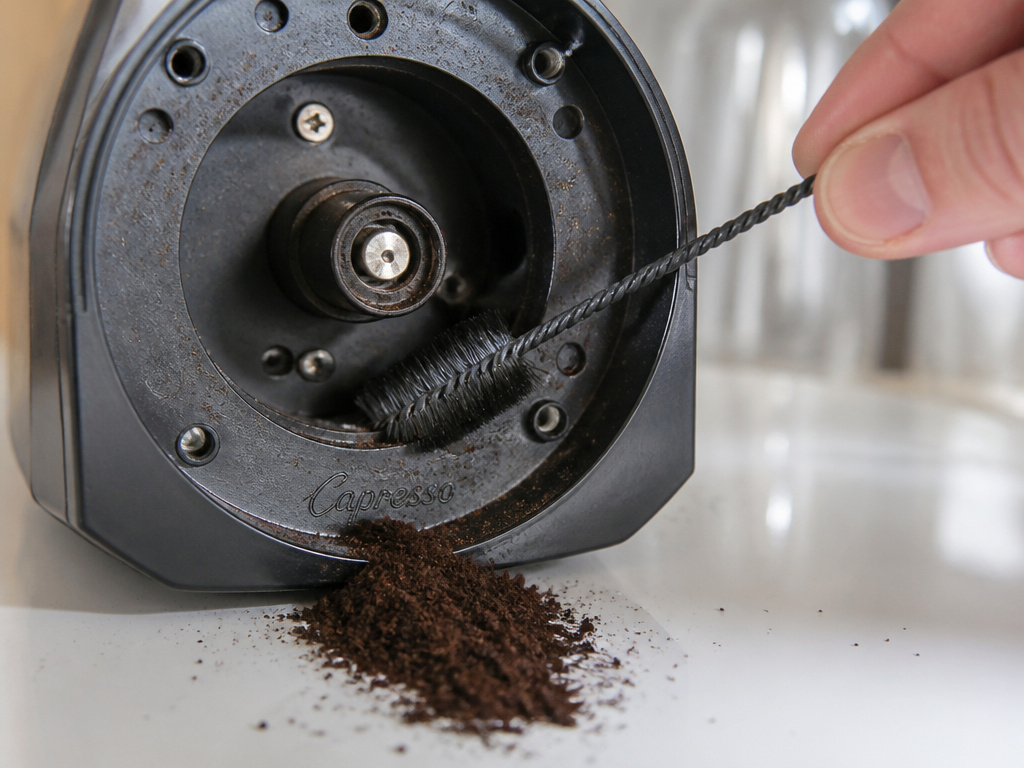
This is the part most missed. The feeder channel is a narrow plastic passage that directs ground coffee from the burr chamber into the collection bin. The YouTube tutorial from Capresso highlights this explicitly. It’s a common failure point.
The channel is maybe a quarter-inch wide. Grounds, especially slightly damp ones, pack into it like sand in a pipe. When it’s clogged, new grounds back up into the burr chamber. This causes overheating, inconsistent output, and finally, a complete jam. The manual mentions “cleaning the exit chute,” but doesn’t name this component or show the technique.
Common mistake: Only brushing the visible burrs, the compacted grounds in the feeder channel will cause a grinding jam within two weeks, leading users to blame the motor or burrs.
To clear it, you need the skinny end of your brush. After removing the upper burr and brushing the chamber, locate the channel opening inside the empty chamber. It’s a small hole leading sideways. Insert the brush at an angle and push through with a gentle twisting motion. You’ll feel resistance, then a release as the compacted plug breaks free. Do this over a trash can. Expect a small avalanche of old, caked-on grounds to fall out.
What the Manual Doesn’t Say: Flavored Beans and Spices

The manual’s directive is clear: “Do not use the grinder for anything other than coffee beans.” It doesn’t explain the chemical reason. Flavored coffee beans are coated with synthetic oils that carry flavors like hazelnut or vanilla. These oils are not food-grade lubricants. They are sticky, volatile, and designed to adhere.
They will adhere to your burrs and every plastic surface they touch. That flavoring oil does not brush off. It permeates porous metal and plastic, creating a permanent flavor reservoir. Your next batch of single-origin Ethiopian will taste like a chemistry set. I learned this the hard way with a cinnamon-flavored bean a decade ago. I could never fully purge the scent from that grinder. It became my dedicated “spice grinder,” which is also against the manual’s rules.
Grinding actual spices like cinnamon sticks or peppercorns is worse. They are harder than coffee and can dull the cutting edges of the burrs. They also leave behind potent essential oils that cross-contaminate forever. The manual’s warning is absolute for a mechanical reason.
Step-by-Step Deep Clean (Beyond the Brush)

Every six months, or if you’ve acquired a used grinder, you need to go deeper. The manual doesn’t cover this because it involves partial disassembly. This is for the Infinity/Infinity Plus models.
Before you start: Unplug the grinder and ensure you have a clean, dry workspace. Do not use water or liquid cleaners on any part except the removable plastic bins.
- Remove the bean hopper and grounds bin.
- Remove the upper burr carrier.
- Locate the three small screws on the underside of the grinder. These secure the outer burr housing.
- Using a correctly sized screwdriver, remove these screws. Keep them safe.
- Gently lift the outer plastic housing. This exposes the lower burr and the entire grind chamber.
- Use a dry, soft-bristled brush (a clean paintbrush works) to dislodge any compacted grounds in the crevices. A can of compressed air can help blow out fine dust.
- Reassemble in reverse order, ensuring all screws are snug but not overtightened.
Why this works: This gives you direct access to the lower burr and the area around the motor shaft, where fine “coffee flour” accumulates and can eventually work into the bearings. Overtightening the screws can crack the plastic housing or warp it, misaligning the burrs.
Troubleshooting Common Problems
Grinder won’t start.
Check the hopper lock. It must be fully rotated until it clicks. If it’s seated and still dead, check the power outlet and cord. The internal thermal fuse may have blown if the motor overheated from a severe jam, this requires professional service.
Grind is inconsistent or clumpy.
You have a cleaning issue. Perform the full brush clean, focusing on the feeder channel. If the problem persists, your burrs may be dull or damaged from grinding foreign material. For a burr grinder vs blade grinder, dull burrs act more like a blade, smashing beans instead of cutting them.
Grinder is louder than usual.
A high-pitched whine usually means resistance. This is often a clog in the feed path or excessively hard beans. A grinding, rattling sound could indicate a broken plastic part or a loose burr carrier. Stop immediately and inspect.
Grounds are backing up into the bean hopper.
The feeder channel is completely blocked. Unplug, disassemble, and clear the channel as described. This is also a sign you might be using the wrong grind size for the machine’s design; too fine a setting can overwhelm the exit path.
Frequently Asked Questions
Where is the model number on my Capresso grinder?
Look on the bottom of the motor unit or on a silver label on the back. It will be a three-digit number like 560, 565, or 477. You need this to find the right manual.
Can I put the bean hopper and grounds container in the dishwasher?
Yes. The manuals for the Infinity and Infinity Plus state these plastic parts are dishwasher safe (top rack recommended). Never wash the upper burr, lower burr, or motor unit.
Why does my grinder have a timer, and how do I use it?
The timer on models like the Infinity is for convenience, not precision. Set it for 5-60 seconds based on how many cups you’re making. For consistent results, weigh your beans before grinding and use the timer only as a stop switch. The timer mechanism is simple and rarely fails, but if it does, the unit may need a control board replacement.
My grinder seems to be getting slower. Is this normal?
No. Slower grinding indicates excessive friction. The most likely cause is oily bean residue building up on the burrs, creating drag. A thorough cleaning should restore speed. If not, the motor or capacitors may be failing.
Is it worth repairing an old Capresso grinder?
For common issues like a jam or a dirty burr set, yes. For motor or major electronic failure, often not. The cost of service can approach the price of a new unit. If you’re troubleshooting, always consult the official appliance user manuals for a logical diagnostic approach.
The Bottom Line
Your Capresso manual is the first tool, not the last word. It gives you the guardrails: the 450 RPM limit, the 10-14 day cleaning baseline, the hopper lock. Your daily use dictates the real schedule. Clean when the sound changes, not when the calendar says. Attack the feeder channel with purpose. And respect the absolute ban on flavored beans, that one rule saves more grinders from the landfill than any other.
Treat the burrs as the precision cutting tool they are. Match your beans to the machine’s design; don’t force ultra-light roasts through a grinder built for efficiency over extreme hardness. When you need a coarse grind for cold brew, remember that going too coarse on these models can lead to bean fragments jamming the exit. It’s a balance. The manual provides the map, but you’re driving the machine.
