
Can You Use Your Own Coffee in Nespresso? Risks & Tips
You can use your own coffee in a Nespresso OriginalLine machine with a third-party refillable capsule, but you cannot in a VertuoLine machine due to its proprietary barcode system. For OriginalLine, the specific risks are using the wrong grind size, which strains the pump, and potentially voiding the warranty if damage occurs.
Most guides stop at “yes for Original, no for Vertuo.” They skip the part where a bag of finely ground espresso, the kind you’d use in a portafilter, will jam a refillable pod on the third use. The machine’s pump isn’t built for that density. It hums, then groans, then flashes an error code you’ll need the manual to decipher.
This is the full breakdown of what works, what breaks, and the precise steps to avoid turning a cost-saving hack into a $200 service call.
Key Takeaways
- VertuoLine machines are a hard no for using your own coffee. The barcode on each Nespresso capsule tells the machine spin speed, water volume, and temperature. No barcode, no brew.
- OriginalLine machines accept refillable capsules from brands like Sealpod, but success hinges on grind size. Use a medium-fine grind, not espresso-fine.
- Nespresso’s warranty likely won’t cover damage from third-party capsules. Their official FAQ states they “cannot guarantee proper functioning” if you use other capsules.
- Poorly made capsules can get stuck. Soft plastic capsules can deform under the machine’s piercing needles, leading to leaks or a capsule you can’t eject.
- The cost savings are real but require routine. Refilling capsules adds 3-4 minutes to your coffee routine for cleaning, drying, and sealing.
The Short Answer: OriginalLine Yes, VertuoLine No
The line between the two Nespresso systems isn’t just marketing. It’s mechanical. OriginalLine machines work on simple pressure. A pump pushes hot water through a pierced capsule. VertuoLine machines add centrifugal force and digital communication.
OriginalLine machines use a 19-bar pump to force water through a pre-pierced capsule. VertuoLine machines spin the capsule at up to 7,000 RPM while reading a barcode to adjust brew parameters. This fundamental design difference is why one system can be hacked and the other cannot.
Your Vertuo machine isn’t being stubborn. It’s reading the rim of the capsule for a patterned barcode. No valid code, the machine refuses to start. Some third-party companies sell reusable Vertuo pods with sticker barcodes. User reports call them inconsistent. The machine might read it once, then reject it the next day as a “invalid capsule” error.
TL;DR: OriginalLine = mechanical, hackable. VertuoLine = digital, locked. Don’t waste money on Vertuo workarounds.
The VertuoLine Block: It’s the Barcode
Forget grind size or capsule shape. The lock is digital. Each Nespresso Vertuo capsule has a barcode printed around its rim. When you close the machine’s lever, an optical scanner reads this code.
The barcode tells the machine everything:
* How fast to spin the capsule (for froth)
* How much water to inject
* What temperature to use
* When to stop
It’s a closed system. Using your own coffee would require replicating this barcode protocol, which is not just a pattern but a verified signal. The machine’s firmware is looking for specific, Nespresso-authorized codes. This isn’t a community that has reverse-engineered it reliably.
Attempts to use foil-wrapped homemade capsules or stickers fail because the reflectivity, alignment, and code integrity are never perfect. The result is usually a blinking orange light and no coffee. You’re better off using the system as designed and exploring other methods for brewed coffee vs cafe Americano if you want to use your own beans.
The OriginalLine Workaround: Refillable Capsules
This is where the community has found a loophole. OriginalLine machines are fundamentally a pump, a heater, and a needle that pierces the top and bottom of a capsule. If a capsule is the right size and material, the machine will brew it.
Common mistake: Using espresso-fine grounds in a refillable capsule — the dense puck creates backpressure that the pump strains against. Within a dozen cycles, this can shorten the pump’s lifespan or trigger an over-pressure error that requires a reset.
The market offers two paths: third-party pre-filled capsules and empty refillables. Pre-filled ones from other brands are a gamble on freshness and grind. Refillable capsules—stainless steel like Sealpod or plastic like Capmesso—give you control.
| Capsule Type | Best For | Key Risk |
|---|---|---|
| Nespresso Branded | Guaranteed performance, warranty safety | Recurring cost, limited bean choice |
| Third-Party Pre-filled | Lower cost per capsule | Stale coffee, inconsistent grind quality |
| Refillable (Stainless) | Using fresh single-origin coffee, cost savings | User error in grind/tamp, potential for leaks |
| Refillable (Plastic) | Lowest upfront cost | Can warp/deform, more likely to stick in chamber |
The stainless steel capsules last longer and resist deforming under the piercing needles. Plastic ones are cheaper but can warp over time, especially if run through a dishwasher. A warped capsule doesn’t seat flush. Water takes the path of least resistance, leading to a weak, watery shot that leaks around the edges.
TL;DR: Stainless steel refillable capsules are the only viable way to use your own coffee. They need the correct grind and a light tamp.
Why Grind Size is Everything
The Nespresso system is designed for a specific flow resistance. Their factory grounds are a medium-fine powder, not the ultra-fine powder of true espresso.
- Too fine (espresso grind): Water can’t permeate the puck evenly. Pressure builds behind it, straining the pump. The coffee extracts unevenly, tasting bitter and sour at once. The machine may flash an error.
- Too coarse (drip grind): Water rushes through too fast. The result is a weak, under-extracted, and watery cup. No pressure, no crema.
- Just right (medium-fine): This grind resembles table salt or fine sand. It creates enough resistance for proper extraction and crema without overtaxing the machine.
If you’re serious about this, you need a decent burr coffee grinder. Blade grinders create an inconsistent mix of dust and boulders, which will clog and under-extract simultaneously. A burr grinder set to a notch or two coarser than your espresso setting is the target.
The Warranty Void No One Talks About
Nespresso’s official position is clear. Their FAQ states, “We cannot guarantee the proper functioning of the machine or the quality of the coffee if other capsules are used.”
This isn’t an idle warning. If your machine fails and needs service, a technician can often tell if non-standard capsules were used. Grounds from a different grind size or oil from darker roasts leave distinct residues in the brewing chamber and internal lines. If they determine the damage was caused by “improper use,” your warranty claim is denied.
It’s a risk you accept. The machine is yours. But know that the $50 you save on capsules could become a $150 repair bill with no coverage. It’s the same principle of checking your coffee maker manuals for approved cleaning methods to avoid voiding coverage.
A Step-by-Step Guide to Refilling OriginalLine Capsules
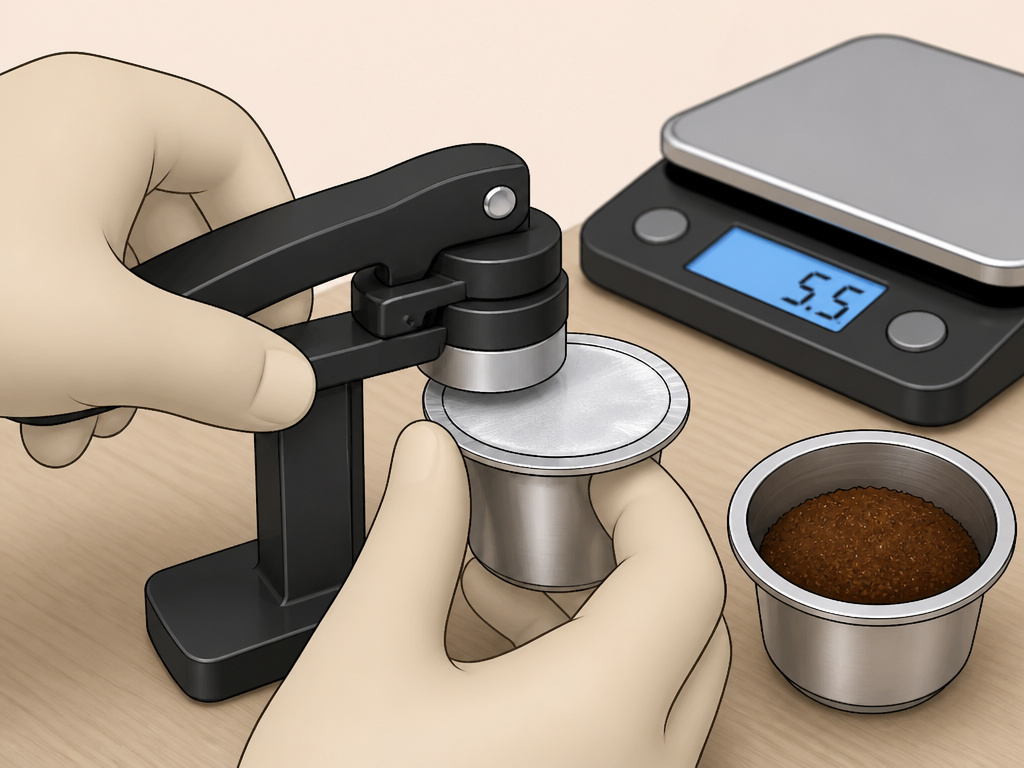
If you’ve weighed the risks and want to proceed, here is the method that minimizes machine strain. This assumes you have a stainless steel refillable capsule, like a Sealpod.
- Disassemble and clean the used capsule. Rinse it immediately after brewing. Old grounds harden and become difficult to remove. Dry every part thoroughly. Moisture inside the capsule leads to stale, musty coffee.
- Grind 5 to 6 grams of coffee. Use a medium-fine setting on your burr grinder. Weigh it. Volume measures like spoons are unreliable because grind density varies.
- Fill the capsule basket. Do not overfill. Leave about 1mm of space at the top for the foil lid to seal.
- Tamp lightly, just to level. This is not espresso. Use your finger or the flat end of a tool to gently compress the grounds into an even bed. No force. Over-tamping is the second fastest way to clog the system.
- Seal with a new foil lid. Place the lid and use the included crimping tool to fold the edges tightly. A loose seal will leak during brewing, making a mess and producing weak coffee.
- Brew immediately. Don’t let the filled capsule sit for days. The coffee will begin to stale without the nitrogen flush of commercial pods.
The process isn’t hard. It’s just a routine. The sensory cue is the sound. A proper brew has a consistent, firm gurgle. A clogged or leaking capsule makes a sputtering, uneven sound.
What About Reusing Official Nespresso Capsules?
You’ll see YouTube videos where people cut the foil off, dump the grounds, and re-seal them with new foil. It’s technically possible.
It’s also a mess. The aluminum shells are flimsy and bend easily. The piercing holes from the first use weaken the structure. When you reinsert it, the machine’s needles don’t always pierce the new foil cleanly because they’re trying to hit the same spot. This leads to leaks.
Furthermore, a Scientific Reports capsule extraction study on single-serve systems shows that the paper filter inside official capsules degrades after one use. Reusing it allows more fines (tiny coffee particles) to pass through, which can accumulate in the machine’s internal valves over time. You’re trading capsule cost for potential machine maintenance.
Frequently Asked Questions
Does using my own coffee void the Nespresso warranty?
It can. Nespresso’s warranty typically excludes damage from “improper use or maintenance.” If a technician finds evidence that third-party or refilled capsules caused a pump failure or clog, your claim will likely be denied. The official stance is that they do not guarantee machine function with other capsules.
Can I use any ground coffee in a refillable pod?
No. The grind must be medium-fine, like the consistency of fine sand. Pre-ground drip coffee is too coarse and will make weak coffee. Pre-ground espresso is too fine and risks clogging the machine. For best results, grind fresh beans using a burr coffee grinder set specifically for pod brewing.
Why won’t my VertuoLine machine accept a reusable capsule?
The Vertuo system requires a readable barcode on the capsule rim to initiate any brew cycle. Most reusable capsules lack a reliable, machine-readable barcode. Even those with sticker barcodes are often rejected after a few uses as the machine’s scanner fails to recognize them.
How many times can I reuse a stainless steel refillable capsule?
quality stainless steel capsule can last for hundreds of uses. The wear items are the silicone seal (which may need replacement after 50-100 uses) and the foil lids, which are single-use. Clean it thoroughly after each use to prevent coffee oils from going rancid.
Before You Go
The appeal is clear: better coffee, cheaper coffee, less waste. For OriginalLine owners, the path exists but is narrow. It requires the right tool (a stainless refillable capsule), the right ingredient (a medium-fine grind), and acceptance of the warranty trade-off.
For VertuoLine owners, the door is shut. The system’s design is its own ecosystem. Your money is better spent finding Nespresso-branded capsules you enjoy or using a separate machine for your favorite blonde roast coffee.
The real cost of using your own coffee isn’t just the beans. It’s your time spent fiddling and the silent risk to the machine on your counter. Get the grind right, and it can be a satisfying ritual. Get it wrong, and that morning ritual becomes a troubleshooting session.
