
Can You Grind Coffee Beans in a Nutribullet? Risks & Tips
Yes, you can grind coffee beans in a Nutribullet by pulsing small batches, but it violates the warranty and risks immediate damage. The motor and blades are designed for soft, wet ingredients, not hard beans. This can burn out the motor or shatter the blade, as explicitly warned against in the official user manual.
People try it because they’re in a pinch. They fill the cup halfway, hit the pulse button a few times, and get something that looks like coffee grounds. It works once, maybe ten times. The mistake is thinking that because it can work, it’s designed to work. NutriBullet motors are built for crushing soft, wet ingredients, not fracturing rock-hard dried seeds.
This guide lays out the official stance, the real-world physics of why it’s a bad idea, and the specific, damage-limiting technique used by people who ignore the manual and do it anyway.
Key Takeaways
- Every major NutriBullet model’s manual explicitly prohibits grinding coffee beans, warning it can damage the motor and blades.
- The high-speed extractor blade creates excessive heat and friction, which can degrade coffee flavor and strain the motor’s internal components.
- If you proceed, limit batches to 1/4 cup, use only the pulse function in 1-second bursts, and shake the cup between pulses to avoid a jam.
- The resulting grind will be wildly inconsistent, producing both boulders and dust, which leads to uneven, bitter extraction in your brew.
- For regular use, a dedicated blade grinder is a marginal upgrade, but a burr grinder is the only tool that produces a uniform grind for balanced flavor.
The Official Manufacturer Stance on Grinding Coffee
Open the user guide for any modern NutriBullet. Turn to the “What NOT to use your NutriBullet for” section, which is consistently on page 17. The warning is identical across models: “Do not use your NutriBullet to grind coffee beans or other hard, dry ingredients. This can damage the motor and blades.”
This isn’t a suggestion. It’s a condition-of-use clause. The NutriBullet 600 Series (NB-101B), Pro 900 Series (NB-201), and Blender Combo (NB50500) all carry this verbatim warning. The company’s position is unambiguous. Using the appliance for this purpose voids the warranty. If the motor seizes or the blade cracks while grinding beans, your repair claim will be denied.
The NutriBullet Pro 900 Series User Guide states: “Do not use your NutriBullet to grind coffee beans or other hard, dry ingredients. This can damage the motor and blades.” This is a primary-source, manufacturer-issued warning that establishes the official risk.
The reason is mechanical. A NutriBullet’s motor is designed for high-torque, short-duration bursts through viscous liquids. Coffee beans are desiccated, dense seeds. The extractor blade must strike them thousands of times per minute. Each impact sends a shock load back through the drive shaft and into the motor’s commutator and brushes. This is a wear event the motor isn’t rated to handle repeatedly.
TL;DR: NutriBullet’s manuals explicitly forbid grinding coffee beans, stating it can cause damage and will void your warranty.
Why It’s a Bad Idea, Even If It Seems to Work
You can find a hundred YouTube videos and Reddit posts of people successfully grinding beans. The machine doesn’t explode on camera. This creates an illusion of safety. The damage is cumulative and internal.
The primary risk is thermal. The motor’s commutator, the part that reverses electrical current to keep the shaft spinning, generates sparking under normal load. Under the extreme load of fracturing hard beans, this sparking intensifies. It creates arcs of electricity that erode the soft copper contacts. Each pulse while grinding beans accelerates this erosion. The motor doesn’t fail on the third pulse. It fails on the three-hundredth, when the worn commutator can no longer make contact and the motor simply hums and dies.
Blade damage is more visual but just as terminal. The extractor blades are not hardened tool steel. They are cast stainless steel designed for shearing spinach and berries. Striking arabica beans acts like a file against the leading edge. They dull. A dull blade must spin faster to achieve the same cutting effect, which draws more current and heats the motor further. I’ve seen a blade from a NutriBullet Rx that had a visible chip after its owner used it as a weekly coffee grinder for six months.
| Component at Risk | Failure Mode | Typical Timeline to Failure |
|---|---|---|
| Motor Commutator & Brushes | Arcing and erosion from overload | 3–12 months of regular use |
| Extractor Blade | Dulling, notching, or cracking | 1–6 months of regular use |
| Plastic Drive Socket | Stripping or cracking from shock loads | 1–3 severe jams |
| Seals & Bearings | Overheating and premature wear | 6–18 months of regular use |
Then there’s the coffee itself. A NutriBullet is a blade grinder, and all blade grinders create inconsistent grounds. The beans at the bottom turn to dust while chunks whirl at the top. You get a mix of boulders and fines. In your brewer, the fines over-extract, leaching bitter compounds, while the boulders under-extract, leaving sour notes. Your cup tastes both bitter and sour at the same time. It’s the hallmark of a bad grind.
TL;DR: The motor and blades wear out prematurely due to shock loads and heat, and the grind quality is too inconsistent for good coffee.
If You Proceed Anyway: The Right (and Wrong) Way
Assume you’ve read the manual, understood the risk, and need ground coffee right now. Your grinder is broken. The store is closed. There’s a technique that minimizes, but never eliminates, the hazard.
First, use the right blade. If your model came with a flat milling blade, use it. It has a blunt edge designed for crushing dry grains and is slightly more appropriate. Most modern kits only include the extractor blade. That’s what you’ll use.
Before you start: The blender cup can become hot to the touch after repeated pulses. Let it cool before handling. Never operate the unit if you smell burning plastic or see smoke, unplug it immediately. A severe jam can snap the blade or strip the drive socket.
Here is the step-by-step damage-control method:
- Measure a tiny batch. Do not fill the cup halfway. Use a quarter-cup of beans at most. A small volume allows the beans to circulate and reduces the chance of a total jam. Overfilling is the fastest way to kill the motor.
- Secure the assembly. Screw the blade base on tightly. An uneven seat causes wobble, which multiplies the shock on the motor shaft.
- Pulse, do not blend. This is non-negotiable. Press the power button for one second, then release. Wait a full second. Press again for one second. Continuous blending creates friction heat that can actually roast the grounds, adding a harsh, baked flavor.
- Shake between pulses. After three pulses, stop. Remove the cup from the base, and give it a firm shake. This redistributes the beans, so you’re not just powdering the same few at the bottom.
- Check grind size early. After about six pulses, check. For a coarse French press grind, you might be done. For a fine drip grind, you may need ten to twelve total pulses. Going beyond that is asking for trouble.
- Clean immediately. Unscrew the blade and tap out every ground. Fine, oily coffee dust will cement itself to the plastic and seal if left. Rinse with warm water right away.
What does a successful grind look like? It will still be uneven. You’ll have particles of many sizes. Expect that. The goal here is beverage-grade material, not perfection. If you see large, whole beans still bouncing around after 10 pulses, you have a jam. Stop. Do not keep pressing the button. Dump the contents, clear the blade, and start over with a smaller batch.
Common mistake: Holding the power button down for 5+ seconds, this overheats the motor windings and can melt the internal insulation. The unit may work for the rest of that session but will have a significantly shorter lifespan.
TL;DR: Use 1/4 cup of beans max, pulse in 1-second bursts, shake the cup between pulses, and clean immediately to prevent the only safe-ish method from becoming a destructive one.
The Grind You’ll Get vs. The Grind You Need
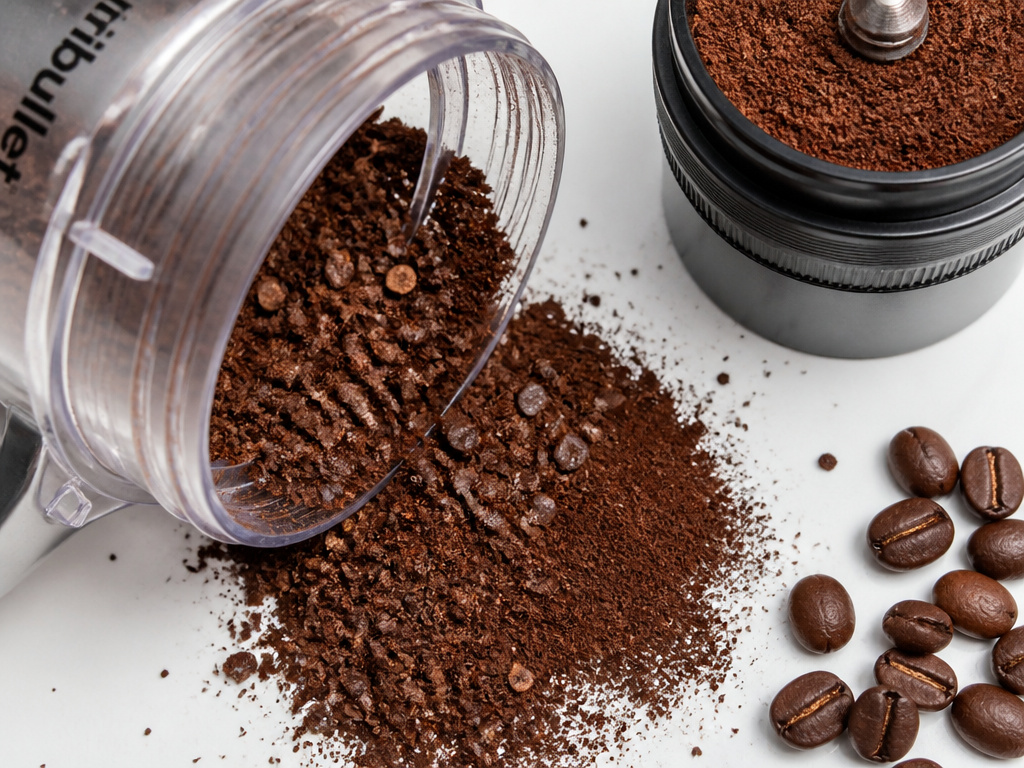
Let’s be clear about output quality. A NutriBullet produces a “slash-and-burn” grind. The blade hacks at beans randomly. The result is a wide particle distribution. For context, a quality burr grinder produces grounds where maybe 70% of particles are within a tight size range. A NutriBullet might get 30% within that range. The rest are too big or too small.
This inconsistency directly ruins your brew method. Here’s how:
- French Press: The coarse setting you aim for will still contain 20-30% fine dust. These fines slip through the mesh press filter and into your cup, creating a muddy, over-extracted sediment. Your coffee will be gritty and bitter.
- Drip Machine: The machine’s water flow assumes a uniform bed. Fines clog the bed, causing water to channel around the edges. The boulders in the mix won’t extract fully. You get a weak, sour, and uneven cup.
- Espresso: Forget it. Espresso requires a precise, fine, and uniform grind to create resistance against 9 bars of pressure. A NutriBullet’s erratic output will cause the water to blast through in 5 seconds, yielding a sour, undrinkable shot.
If you enjoy coffee, this matters. The grind is the single most important variable after the beans themselves. Using a tool that butchers the grind guarantees you’re tasting the machine’s flaws, not the bean’s origin notes.
I tried grinding a light Ethiopian Yirgacheffe in my old NutriBullet Pro 900 during a grinder breakdown. The tea-like jasmine and bergamot notes were completely absent. In their place was a flat, generic “coffee” taste with a sharp, papery bitterness. The machinery masked the origin.
TL;DR: The inconsistent grind from a NutriBullet will make any brew method taste worse by simultaneously under-extracting large chunks and over-extracting fine dust.
What to Use Instead for Regular Grinding

If you need ground coffee more than once a year, invest in a tool meant for the job. The upgrade path has two clear steps.
First, a dedicated blade grinder. You can find one for a low cost. It’s still a blade system, so it will still produce an inconsistent grind. The critical difference is its motor is engineered for the specific task of cutting dry, hard substances. It has heavier windings and a duty cycle rated for grinding. It won’t void a warranty. It’s a marginal improvement in cup quality but a massive improvement in appliance longevity.
The real solution is a burr grinder. Burr grinders crush beans between two abrasive surfaces, cones or discs, at a set distance. This produces a uniform particle size. The difference in your cup is not subtle. Acidity becomes bright, not sour. Bitterness becomes a pleasant chocolate note, not an ashy aftertaste. Body feels rounded, not thin.
| Grinder Type | Mechanism | Best For | Grind Consistency |
|---|---|---|---|
| NutriBullet Blender | High-speed impact blade | Emergency use only | Very Poor (Wide range of boulders and dust) |
| Dedicated Blade Grinder | High-speed impact blade | Occasional use, budget option | Poor (Moderate improvement) |
| Burr Grinder (Conical or Flat) | Crushing between two burrs | Daily use, quality brewing | Good to Excellent (Uniform particles) |
Start with an entry-level conical burr grinder. It will outperform any blade system, including your blender, from the first grind. Your exploration of blended coffee and single-origin coffee becomes meaningful when your tool isn’t actively working against the bean’s inherent flavors.
TL;DR: For occasional use, a cheap blade grinder is safer than your blender. For good coffee, a burr grinder is the only legitimate tool.
Frequently Asked Questions
Does the NutriBullet Rx have the same warning?
The NutriBullet Rx (NBR-1201) user manual was not found to contain the explicit phrase “coffee beans” in a quick search. However, its manual and all marketing materials caution against “hard, dry ingredients” and emphasize the unit is for blending. The 1700-watt motor is stronger, but the blade physics and warranty stance remain consistent with other models. Assume the prohibition applies.
Can you use the NutriBullet ‘milling blade’ for coffee?
Some older kits included a flat milling blade for grains and nuts. It is less likely to chip than the extractor blade, but the manufacturer never endorsed it for coffee beans. The motor risk remains identical. If you have one, it’s the slightly less bad option of the two.
How do you clean coffee oils out of a Nutribullet?
Clean immediately after use. Tap out all grounds. Fill the cup halfway with warm water and a drop of dish soap. Attach the blade and run the blender for 10-15 seconds. The soapy vortex will remove most oils. Rinse thoroughly. For stuck-on residue, use a soft brush. Never submerge the blade base in water.
What’s the difference between this and grinding spices?
Many hard spices (like peppercorns or allspice berries) are similarly dense and pose the same motor risk. The official manuals group them together under “hard, dry ingredients.” The difference is quantity, you typically grind a teaspoon of spices, not a quarter-cup. The smaller load is less likely to cause immediate failure, but the wear principle is the same.
Will grinding coffee dull my NutriBullet for smoothies?
Yes, progressively. A blade dulled by impacting coffee beans will crush ice less efficiently and bruise greens rather than cleanly shearing them. Your smoothies may become grainier and less smooth over time as the blade edge degrades.
The Bottom Line
You can force a NutriBullet to grind coffee beans. People do it. The machine might survive a dozen times. But the manufacturer’s warning is there for a measurable, mechanical reason: the motor and blades are not built for that job. Each pulse is a small act of self-destruction for the appliance and a guarantee of mediocre, uneven coffee.
Treat it as a true last-resort hack. Use minuscule batches and the pulse function. Understand you’re trading your warranty and the blender’s long-term health for a temporary fix. For anything more than an annual emergency, spend the small amount on a dedicated blade grinder. For the coffee you actually want to drink, invest in a burr grinder. It’s the single upgrade that makes every bean, every blonde roast or dark roast, taste like it’s supposed to.
