
Can You Freeze Ground Coffee? The Pro Method That Works
Yes, you can freeze ground coffee to extend its shelf life for months, but only if you follow a strict protocol that eliminates air exposure and prevents condensation. Portion fresh grounds into single-use, airtight containers, vacuum-sealed bags are best, freeze them immediately, and always thaw the sealed package overnight on the counter before opening it. Skip this if your coffee is already stale or if you only have a week’s supply.
Most guides get this wrong because they treat ground coffee like any other dry good. They miss the physics. Ground coffee is a porous, oily sponge for odors and moisture. The moment you expose frozen grounds to warm, humid air, condensation forms on every particle. That moisture doesn’t just make the coffee clump; it kickstarts oxidation and strips away volatile aromatics in minutes. The result is a flat, papery cup no matter how expensive the beans were.
This guide walks through the real method used by home-barista forums and professional tasters. We’ll cover the precise steps, the tools that matter, and the exact mistakes that ruin a batch. You’ll learn when freezing makes sense and when you should just use the coffee within two weeks.
Key Takeaways
- Freezing only works as a preservation tool for freshly ground coffee you can’t use within two weeks. It will not revive stale coffee.
- The single biggest failure point is condensation. You must thaw the sealed package completely before opening it.
- Single-dose portions in vacuum-sealed or air-squeezed bags are non-negotiable. Freezing a large, repeatedly opened container guarantees failure.
- Your home freezer at 0°F (-18°C) slows staling dramatically but doesn’t stop it. Plan to use frozen grounds within 2-3 months for best results.
- The National Coffee Association advises against freezing due to moisture risk. Enthusiasts who succeed bypass this risk with meticulous packaging.
Why Freezing Ground Coffee Is So Controversial
Official advice from groups like the National Coffee Association warns against freezing. Their stance, outlined in their public coffee storage guidelines, is that freezing can cause condensation, which degrades flavor. This is a correct assessment of the risks, not the possibility.
The conflict arises in online coffee communities. On forums like Home-Barista.com, a thread running over 16 years is filled with users who freeze successfully. They report minimal flavor loss, especially for espresso, when they treat freezing as a packaging problem. The disconnect isn’t about science, it’s about procedure. The NCA’s warning assumes average consumer behavior: tossing a half-full bag in the freezer and taking it out daily. That method always fails. The forum users treat it like a lab protocol: airtight, single-dose, no thermal shock.
Freezing at 0°F (-18°C) slows the oxidation process and the loss of volatile aromatic compounds that cause coffee to go stale. However, domestic freezers are extremely dry environments. When cold coffee is exposed to warmer air, moisture from the air condenses directly onto the coffee grounds, accelerating staling and promoting off-flavors.
This is the core mechanical truth. Freezing is a trade. You gain time but add the variable of water. Your entire method must be built to control that variable.
TL;DR: The controversy exists because the standard warning addresses the lazy method. The successful method requires precision most casual drinkers won’t use.
When Freezing Makes Sense (And When It Doesn’t)
Freezing isn’t a universal solution. It’s a specific tool for specific scenarios. Use this table to decide before you spend time portioning and sealing.
| Scenario | Freeze? | Reason |
|---|---|---|
| You bought 2 lbs of freshly ground coffee on sale. | Yes | You cannot consume it before it stales at room temperature. |
| You have a 12oz bag you’ll finish in 10 days. | No | Just store it in an airtight container in a dark cupboard. |
| Your coffee is already 3 weeks old and tastes flat. | No | Freezing preserves, it does not restore. The stale flavor is locked in. |
| You want to save a few doses of a rare, expensive single-origin. | Yes | This is the ideal use case for single-dose vacuum sealing. |
| You grind fresh daily but are going on a 3-week trip. | Yes | Portion and freeze your daily doses before you leave. |
The best candidate for freezing is coffee that is freshly ground and in surplus. The clock on flavor starts ticking the moment the beans are roasted, and grinding accelerates the process by exposing more surface area. If your timeline to consume exceeds two weeks, freezing becomes the least-bad option.
I learned this the expensive way. I once bought a two-pound bag of a fantastic Ethiopian blend coffee. I kept it in its bag with the valve closed. By the third week, the vibrant blueberry notes had faded into a generic sweetness. Freezing half of it immediately after opening would have saved those last few cups. Now, if I can’t use a large quantity quickly, it gets portioned the day it arrives.
Common mistake: Freezing coffee that’s already past its prime, you’re just preserving staleness. The bag will taste the same flat way three months later, just colder.
The Pro Freezing Method in 5 Steps
This is the method adapted from home-barista practices and YouTube guides from experts like James Hoffmann. It prioritizes eliminating air and managing moisture.
Step 1: Portion Immediately
Weigh your ground coffee into the amount you use in one brewing session. For most people, that’s 18-22 grams for a pour-over or espresso. For a French press, maybe 40-50 grams. The goal is to never re-freeze an opened package. This is why a good burr coffee grinder that produces consistent grounds is a worthwhile investment if you’re serious about quality.
Step 2: Choose Your Airtight Vessel
Your packaging is your primary line of defense. * Vacuum sealer: The gold standard. It removes almost all oxygen, which is the enemy. This is what lets users on Home-Barista.com freeze for months with success. * Heavy-duty Ziploc freezer bag: A strong second. Place the portion inside, seal almost all the way, press the bag flat to force air out the remaining opening, then finish sealing. * Small mason jar: Only if it’s truly full to the brim. A half-full jar has too much air. Ensure it’s freezer-safe to prevent cracking.
I prefer vacuum sealing for anything I plan to store longer than a month. The upfront cost of the sealer is offset by not wasting $20 bags of coffee. For a one-week portion, a meticulously squeezed Ziploc works fine.
Step 3: Label Everything
Write three things on the bag or jar with a permanent marker: the coffee name (e.g., “Colombian Huila”), the roast date, and the freeze date. In three months, you will not remember. This also helps you practice first-in-first-out rotation.
Step 4: Freeze Fast and Flat
Put the sealed portions in the coldest part of your freezer, which is usually the back or bottom. Lay bags flat to freeze quickly and save space. The goal is to bring the coffee from room temperature to 0°F (-18°C) as rapidly as possible to minimize any ongoing chemical reactions.
Step 5: Thaw Sealed Overnight
This is the rule. The night before you need that coffee, take one portion out of the freezer. Leave it sealed on your kitchen counter. Let it come fully to room temperature. This can take 8-12 hours. Only then do you open the package. Opening a cold bag invites instant condensation.
TL;DR: Portion, seal airtight, label, freeze, and thaw sealed. Break any of these and you’ll taste the difference.
Thawing: The Non-Negotiable Rule
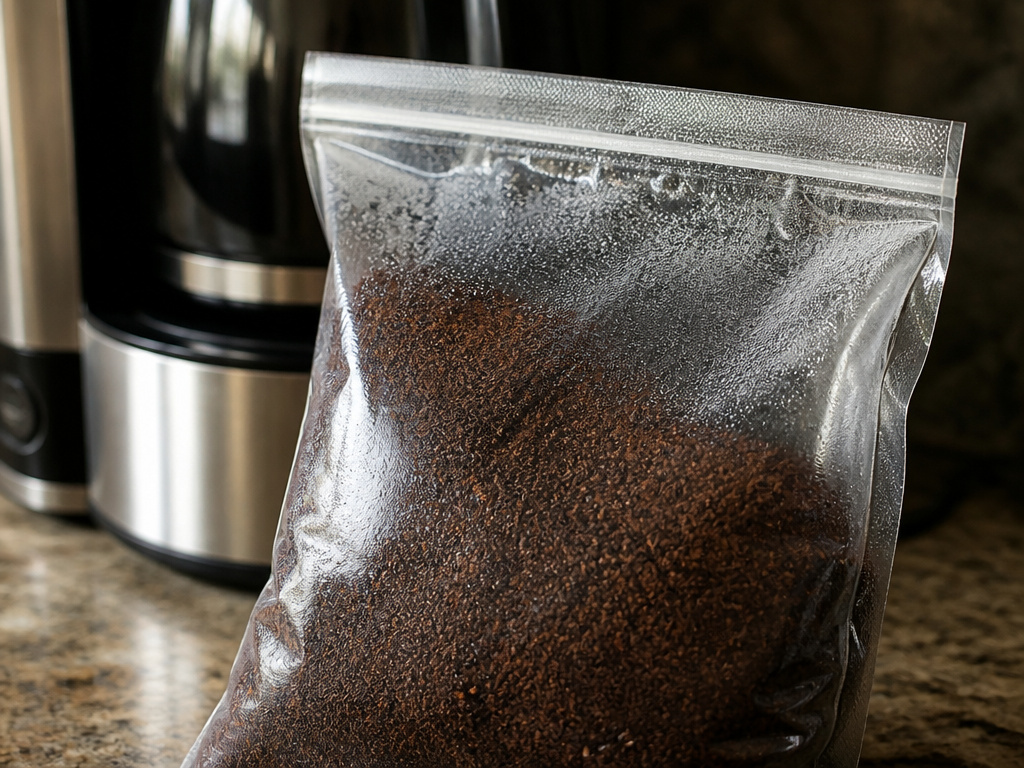
You can execute the first four steps perfectly and ruin everything at step five. Condensation is the killer.
When you take a sealed bag of 0°F coffee into a 70°F kitchen, the air inside the bag is still cold. If you open it immediately, warm, humid room air rushes in. The temperature of the coffee grounds is still far below the dew point of that incoming air. Water condenses on the grounds. They get damp. This isn’t a subtle effect, you can sometimes see the fog on the inside of the bag.
The moisture does two destructive things. First, it makes the grounds clump, which can choke a burr coffee grinder (if you were freezing whole beans) or create uneven extraction in a drip coffee basket. Second, and worse, it provides the water needed to rapidly oxidize the remaining oils and aromatics. The coffee goes stale on the counter in an hour.
The fix is simple but requires forethought. Thaw the package while it’s still sealed. The bag acts as a barrier. The coffee warms slowly, and any minimal condensation that forms will be on the outside of the bag, not on the grounds. Once the bag feels room temperature to the touch, it’s safe to open.
Common mistake: Needing coffee immediately and running a sealed bag under warm water to thaw it fast. This creates wild temperature gradients and can still cause internal condensation. Plan ahead.
Freezing vs. Other Storage Methods
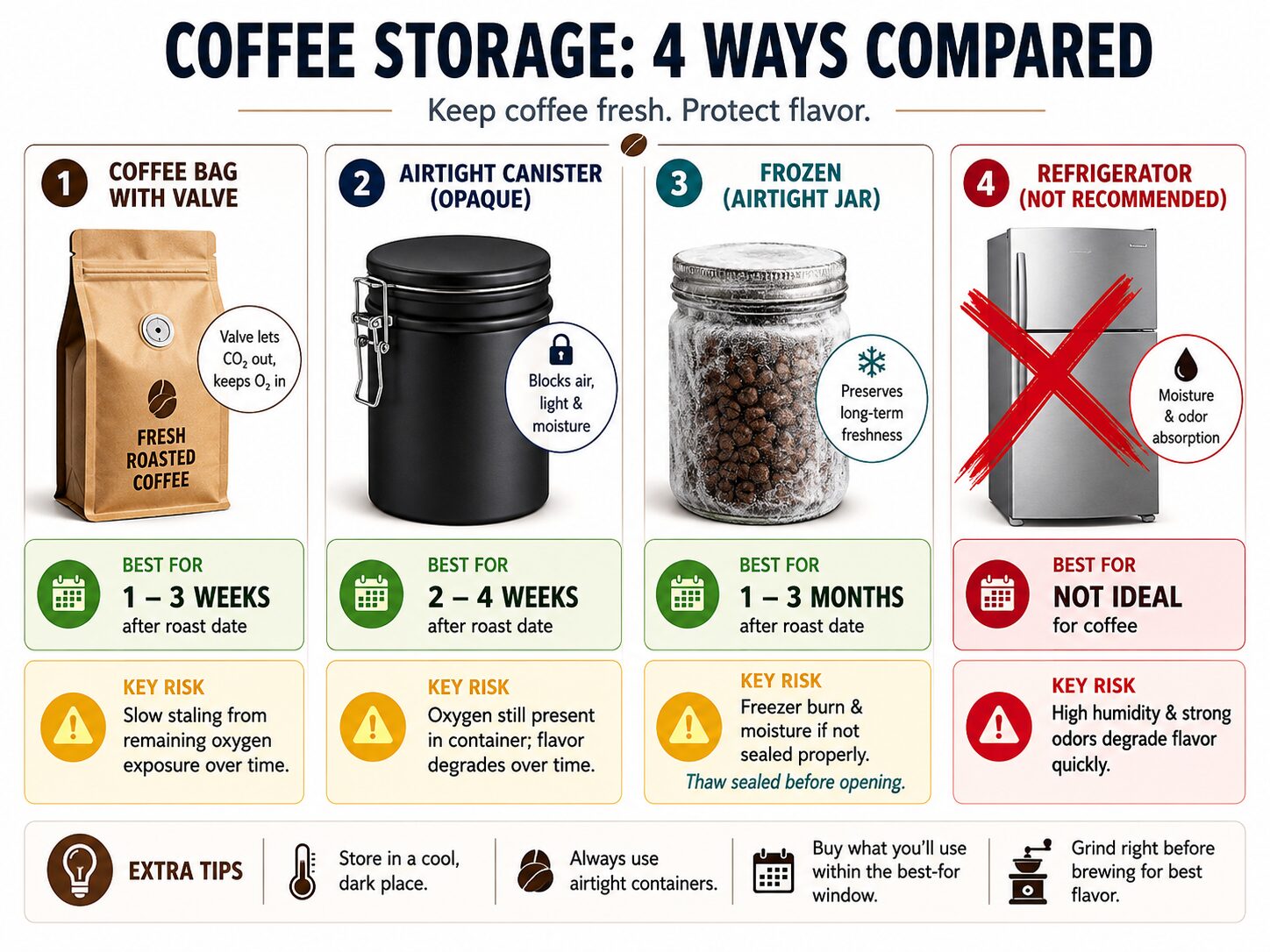
Is freezing better than just leaving coffee in the bag? It depends entirely on your timeline. Let’s compare.
| Method | Best For | Max Quality Shelf Life | Key Risk |
|---|---|---|---|
| Original bag with valve | First 3-7 days after opening | ~10 days | Valve only lets gas out; doesn’t keep air from getting in over time. |
| Airtight container in cupboard | Daily use, finishing within 2 weeks | ~14 days | Light and heat exposure if container isn’t opaque or is near the stove. |
| Freezer (single-dose, airtight) | Long-term storage of surplus fresh coffee | 2-3 months | Condensation from improper thawing; freezer burn if not sealed. |
| Fridge | Never recommended | N/A | The fridge is a humid environment full of odors. Coffee absorbs them all. |
The fridge is the worst place for coffee. It’s consistently a few degrees above freezing, not cold enough to significantly slow staling, but is packed with moisture and food smells. A study published in Scientific Reports on green and roasted coffee storage conditions reinforces that temperature and atmospheric control are the critical factors for preservation, which a home refrigerator fails to provide.
Freezing wins only when you need to pause time for a large quantity of fresh coffee. For your daily driver, an opaque, airtight canister is simpler and foolproof. This is why understanding different coffee preparation methods and their timelines matters, an espresso drinker going through beans slowly has a different storage need than a household brewing a full pot every morning.
Frequently Asked Questions
Does freezing ground coffee make it last forever?
No. Freezing at 0°F (-18°C) dramatically slows, but does not stop, the chemical processes of staling. Oils can still oxidize, and aromatics slowly dissipate. For best quality, aim to use frozen ground coffee within 2 to 3 months. After six months, expect a noticeable decline.
Can I freeze coffee in its original bag?
Only if you plan to freeze the entire, unopened bag immediately and thaw the whole thing at once later. If you open it, take some out, and re-freeze the rest, you introduce fresh, humid air each time. This guarantees condensation and flavor loss. For an opened bag, portioning is mandatory.
My frozen coffee tastes weird. What happened?
You likely tasted one of two common failures. If it tastes “off” or like freezer odors, the packaging wasn’t airtight. If it tastes flat, papery, or stale, condensation occurred, either because the package wasn’t fully sealed before freezing, or it was opened before fully thawing. Freezer burn also produces a dry, cardboard-like taste.
Is it better to freeze whole bean or ground coffee?
Whole bean coffee is always more stable than ground because it has less surface area exposed to air. If you have the choice, freeze the whole beans and grind them after thawing. However, if you’ve already purchased pre-ground coffee or use an alternative method like a Ninja blender for grinding, freezing the grounds with the method above is your best salvage option.
Do I need a vacuum sealer?
You don’t need one, but it’s the single most effective tool for the job. It removes the oxygen that causes oxidation. If you’re freezing expensive single-origin coffee or blonde roast beans known for delicate flavors, a vacuum sealer is worth the investment. For short-term storage (under a month), a Ziploc freezer bag with the air pressed out is an acceptable substitute.
The Bottom Line
Freezing ground coffee is a viable technique, but it’s not a casual hack. It’s a precise workaround for a specific problem: too much fresh coffee and not enough time. Success hinges on your willingness to treat coffee like a scientific specimen, controlling its atmosphere and temperature at every step.
Portion it fresh. Seal it absolutely airtight. Thaw it sealed. If that sounds like more effort than you want to spend, then freezing isn’t for you. You’re better off buying smaller quantities more frequently and storing them in a simple, dark container. But if you have a two-pound bag of a fantastic roast you want to savor over months, the freezer, handled correctly, is the tool that lets you do it. Just remember the first taste test after you thaw a portion. That’s when you’ll know if you got the packaging right.
