
Freezing Coffee Beans: A Complete Guide to Preserving Flavor
Yes, you can freeze coffee beans, but only if you follow a strict procedure to block air and moisture. Portion fresh roasted beans into 1-2 week amounts, seal them in airtight containers, and freeze them immediately. Thaw each portion overnight on the counter while still sealed before opening. This method can preserve peak flavor for months, even years, by dramatically slowing oxidation.
The universal mistake is treating the freezer like a pantry. People toss an open bag in, pull it out daily, and wonder why their coffee tastes flat and lifeless after a month. That routine pumps humid air into the cold beans every time, coating them in destructive ice crystals.
This guide covers the precise steps for freezing beans correctly, the science behind why it works, and the single biggest debate among home baristas: whether to grind frozen beans directly.
Key Takeaways
- Freezing works by slowing oxidation; for every one day of aging at room temperature, a frozen bean takes roughly 90 days to age the same amount.
- Always portion beans before freezing. Freezing a large, opened bag and repeatedly exposing it to air guarantees stale, frost-damaged coffee.
- The core conflict: many experts say thaw beans sealed overnight, while a vocal segment of home baristas grind directly from frozen to avoid any condensation risk.
- Never freeze green (unroasted) coffee beans. The National Coffee Association USA specifically advises against it due to moisture risks during the roasting process.
- The best containers are airtight glass jars, thick freezer bags with the air pressed out, or single-dose vials that eliminate the thaw-refreeze cycle entirely.
The Science Behind Freezing Coffee Beans
Freezing doesn’t stop time. It slows a chemical reaction called oxidation, which is the primary driver of coffee staling. Oxygen molecules break down the volatile aromatic compounds that give coffee its complex flavor. Cold temperatures dramatically reduce the speed of this reaction.
Freezer temperatures around -20°C (-4°F) slow the staling process by a factor of roughly 90 to 1 compared to room temperature storage, according to experimental observations shared by coffee professionals. This is the basis for the claim that frozen beans can remain within a “fresh” window for years.
The enemy isn’t the cold. It’s moisture and air. Your freezer is a dry environment. Any humid air that gets into your coffee container will deposit its moisture as ice crystals directly onto the bean’s porous surface. Those crystals then melt during thawing, introducing water that accelerates staling and can lead to a hollow, papery taste. This is why the research on roasted coffee storage conditions emphasizes an airtight barrier as the non-negotiable first step.
TL;DR: Freezing slows oxidation 90-fold, but only if you first create an airtight seal that locks out humid freezer air.
How to Freeze Coffee Beans: The Step-by-Step Method
This isn’t a suggestion. It’s a sequence. Skip a step, and you waste beans.
-
Portion your coffee immediately. As soon as you know you won’t finish a bag within two weeks, divide it. Base portions on your weekly use—maybe 200g if you go through a bag every 10 days. The goal is to create a single-use frozen block you won’t reopen.
Consequence of skipping: Opening a large frozen stash repeatedly introduces new humid air each time. The beans at the top get frostbitten and stale long before you reach the bottom. -
Choose and fill your vessel. You have three good options, ranked:
- Airtight glass jar (Mason jar): Ideal. Glass is impermeable and doesn’t hold odors. Fill it to the top to minimize air space.
- Heavy-duty freezer bag: Press out all the air manually before sealing. Double-bag if the plastic seems thin.
- Vacuum-sealed bag: The gold standard for removing air, but creates plastic waste. Best for very long-term storage (6+ months).
Place your portion inside. If using a bag, press it flat so it freezes in a thin, stackable brick.
-
Label clearly. Write the roast date, bean type (e.g., “Ethiopia Yirgacheffe”), and the freezing date on the container with a permanent marker. In six months, you will not remember.
-
Freeze strategically. Put the container in the back of the freezer, away from the door. This spot has the most stable temperature. Avoid the door shelf where temperature fluctuates every time you open it.
-
Thaw correctly. The night before you need that portion, move the sealed container from the freezer to your counter. Let it come to room temperature naturally while still closed. This prevents condensation from forming on the cold beans.
Consequence of skipping: Opening a container of ice-cold beans sucks warm, moist room air inside. That moisture condenses on the beans instantly, like a cold drink on a humid day. Your coffee gets soggy before you even grind it. -
Use immediately. Once thawed, open the container and treat those beans like fresh ones. Grind and brew them within a week for the best results. Do not refreeze them.
The Single-Dose Freezing Method (And the Grinding Debate)
This is where standard advice meets barista-level practice. The single-dose method solves the thawing problem by eliminating it.
You portion beans not by the week, but by the shot or cup. Use small, airtight glass vials or containers that hold exactly 18g for espresso or 20g for pour-over. Fill each vial to the brim, cap it, and freeze. When you want coffee, you take out one vial.
Now, the debate: do you thaw the vial, or grind the beans straight from frozen?
- The Thaw Camp (Official Advice): The National Coffee Association USA and many roasters say to let the sealed portion thaw overnight. Their concern is that extremely cold, hard beans could strain your grinder’s motor and cause inconsistent particle size.
- The Frozen Camp (Home-Barista Practice): A large segment of experienced home baristas on forums like Home-Barista.com grind directly from frozen. They argue that moving beans from a -20°C vial to a grinder introduces negligible condensation, and the hard, brittle state actually produces a more uniform grind with less static. The beans spend seconds exposed to air.
I’ve run both methods side-by-side with a quality burr coffee grinder. For my grinder, the frozen grind produced a marginally fluffier grounds bed with less cling. I detected no taste difference in the cup. If your grinder has a robust motor, the frozen method is valid.
| Method | Process | Best For | Risk If Done Wrong |
|---|---|---|---|
| Standard Portion Thaw | Freeze 1-2 week portions, thaw sealed overnight. | Most home brewers, those unsure about their grinder. | Opening the container cold floods beans with condensation, ruining them. |
| Single-Dose Frozen Grind | Freeze individual doses in vials, grind directly from frozen. | Enthusiasts with capable grinders, those seeking maximum convenience. | Potential for increased wear on cheap blade grinders or weak motor assemblies. |
TL;DR: Single-dose freezing in vials is the enthusiast’s choice. It lets you safely grind from frozen, bypassing the condensation risk entirely and locking in freshness dose-by-dose.
What Not to Freeze: Green Beans and Stale Coffee
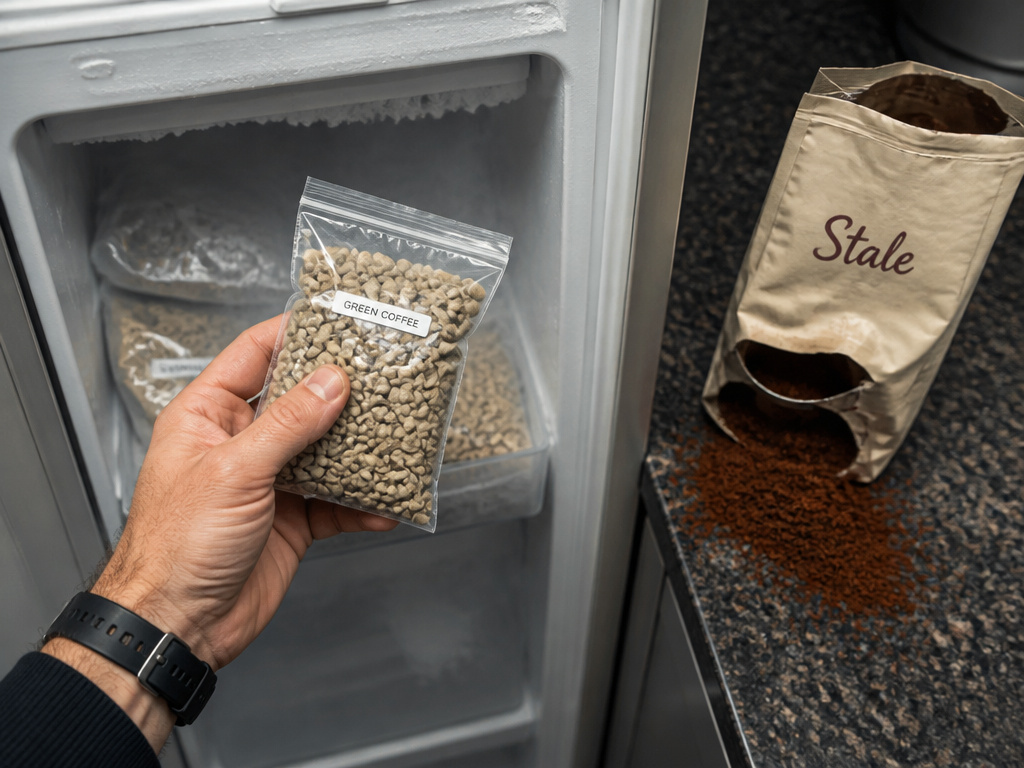
Not all coffee belongs in the cold.
Common mistake: Freezing green, unroasted coffee beans — the National Coffee Association USA specifically warns against this, as freezing can introduce moisture that disrupts the crucial roasting process and leads to baked, uneven beans.
Green beans are dense and contain moisture within their cellular structure. Introducing them to a freezer environment risks internal ice crystal formation. When those beans later go into a 400°F roaster, the rapid heating of trapped ice can cause physical damage, leading to a baked flavor profile instead of a developed roast. Store green beans in a cool, dark, dry pantry instead.
Also, do not freeze coffee as a last-ditch effort to save it. Freezing halts further decline, but it does not reverse staling. A bag that already tastes flat and papery will not magically become vibrant. It will just taste flat and papery forever. The same goes for pre-ground coffee. The increased surface area means it’s already mostly oxidized. Freezing ground coffee is pointless.
Your freezer is for preserving peak freshness, not resurrecting the dead.
Common Mistakes and How to Avoid Them
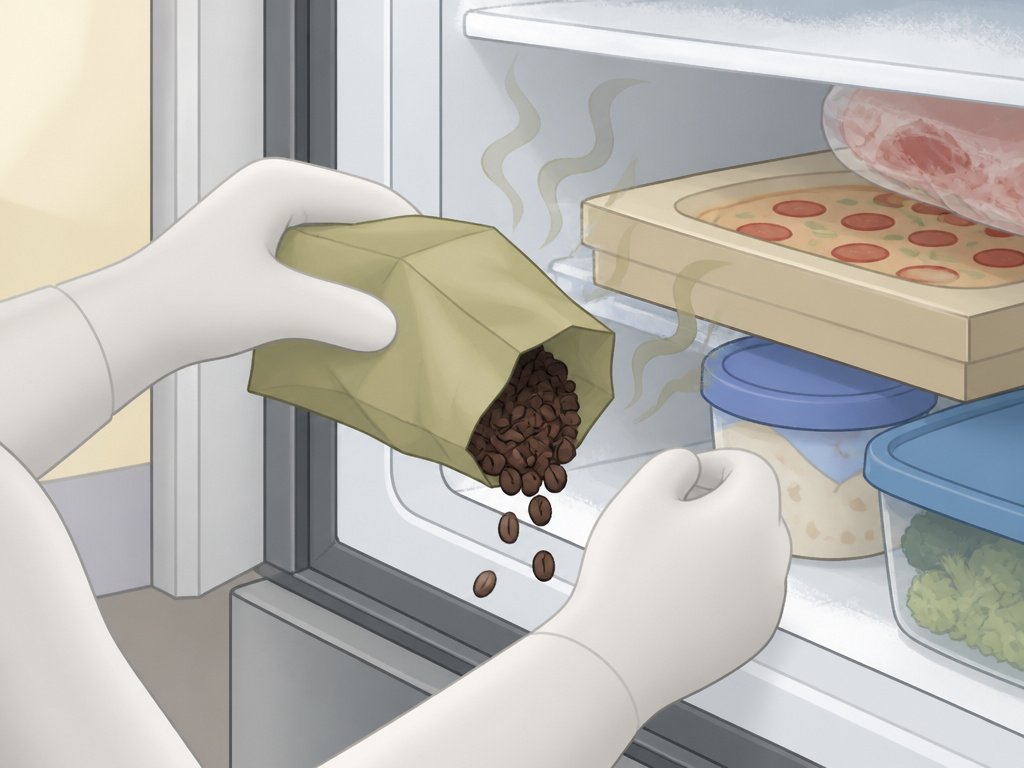
These errors turn a preservation tool into a destruction chamber.
Common mistake: Freezing the entire original bag after opening it — this guarantees daily exposure to humid air. The coffee will develop freezer burn and absorb food odors within three weeks, tasting of old pizza and disappointment.
Mistake 1: The Open-Bag Freezer Shuffle.
You use some beans, twist the bag shut, and toss it in the freezer. Tomorrow, you take it out, open it, scoop beans, and put it back. Every cycle pumps moist kitchen air into the cold bag. Ice crystals form. Odors seep in. The fix is the portioning rule above. Never refreeze an opened container.
Mistake 2: Using the Wrong Container.
A flimsy plastic bag, a coffee bag with a one-way valve, or a loosely lidded jar are all failures. The one-way valve is for off-gassing carbon dioxide, not for creating an airtight seal in a vacuum. You need a container with a positive, airtight lock. Glass jars with rubber gaskets or thick freezer bags you can manually de-air are the minimum.
Mistake 3: Thawing in the Wrong Place.
Do not speed-thaw your beans by placing the sealed container in warm water or on a heating vent. The rapid temperature change can stress the container’s seal and still promote condensation inside. Countertop thawing is slow, gentle, and safe. Plan ahead.
Frequently Asked Questions
Does freezing coffee beans change the flavor?
When done correctly, freezing preserves the existing flavor profile for a much longer period. When done incorrectly—by exposing beans to air and moisture—it can introduce off-flavors, a loss of aroma, and a thin, papery body. The goal is no change, and proper technique achieves that.
How long can you keep coffee beans in the freezer?
Properly sealed portions of freshly roasted beans can maintain excellent quality for 6-12 months. Anecdotal evidence from controlled tests suggests some single-origin coffee can remain within a “fresh” window for up to two years, though the brightest top notes may diminish after the first year.
Can you freeze coffee beans in the bag they came in?
Only if it is a true, thick, resealable freezer bag and you plan to freeze the entire unopened bag immediately. Most paper coffee bags with a foil liner are not airtight enough for long-term freezing. Once opened, the bag is useless for freezing purposes. Always transfer to an approved container.
Does freezing kill the caffeine?
No. Caffeine is a stable alkaloid molecule unaffected by freezing temperatures. Your frozen beans will have the same caffeine content as the day they were roasted. The caffeine content in coffee is determined by bean variety and roast level, not storage method.
Should you freeze ground coffee?
Avoid it. The increased surface area of ground coffee means it oxidizes extremely rapidly. By the time you grind it, the staling process is already in high gear. Freezing might slow it slightly, but you are locking in a product that is already past its prime. Always freeze whole beans.
Can you add frozen beans directly to a grinder?
This is the core debate. Many home baristas do it successfully with quality grinders, arguing it minimizes condensation. Official guidance from organizations like the NCA recommends thawing first to protect grinder mechanics. If your grinder is a high-torque burr coffee grinder, grinding frozen is a low-risk, high-reward practice. If you use a blade grinder or a weak motor, thaw first.
Before You Go
Freezing coffee beans isn’t a hack. It’s a logistical commitment. You portion, you seal, you label, you thaw patiently. The reward is drinking a light roast beans with its delicate floral notes three months after its roast date, or having a consistent espresso shot from a bag you bought in bulk. It turns the 30-day freshness window into a year-long horizon.
Remember the two rules: air is the enemy, and moisture is its weapon. Your job is to build a barrier against both. Whether you choose the single-dose vial method or the weekly jar, the principle is the same. Get the air out, keep the cold in, and let the beans thaw on their own terms. Your morning cup will taste like you just bought it.
