
Can You Bring Coffee on a Plane? | TSA & Customs Rules Guide
You can bring coffee on a plane in both carry-on and checked luggage, but the Transportation Security Administration (TSA) rules change based on its form. Solid coffee, whole beans or grounds, has no quantity limit. Liquid coffee, brew, concentrate, or cold brew, must follow the 3-1-1 liquids rule (containers 3.4 oz/100 ml or less, all fitting in one quart-sized bag). Powdered coffee (instant) over 12 ounces may trigger extra screening. For international travel, U.S. Customs generally admits roasted beans but restricts unroasted green beans.
Most people get stopped because they treat a 16-ounce bottle of cold brew like a bag of beans. The TSA officer sees a liquid, and the 3-1-1 rule applies instantly. Your favorite concentrate stays home if it’s in a big bottle, not because coffee is banned, but because you packed it wrong.
This guide walks through the TSA’s categories, the hidden powder rule, what happens at customs, and how to pack a portable brewing kit so you never drink airport swill again.
Key Takeaways
- Solid coffee (beans, grounds) flies freely in any bag. A vacuum-sealed bag in your carry-on prevents aroma from leaking into your laptop.
- Liquid coffee is subject to the strict 3-1-1 rule. Any container over 3.4 ounces stays behind, even if it’s half-full.
- The TSA powder rule targets quantities over 12 oz. A large canister of instant coffee or ultra-fine grounds may get your bag pulled for inspection.
- U.S. Customs and Border Protection (CBP) almost always allows commercially roasted beans. Unroasted green beans are an agricultural product and may be prohibited or require a permit.
- Packing a personal brewer like an Aeropress and a bag of grounds is more reliable than trusting airport coffee. It also sidesteps the liquid rule entirely.
The TSA’s Coffee Rules: Solids vs. Liquids
The TSA’s “What Can I Bring?” tool is the final word. It lists three coffee entries: ground or whole beans, liquid coffee, and coffee makers. The distinction between solid and liquid is absolute, not a judgment call.
Ground or whole bean coffee is a solid food item. You can pack it in your carry-on bag or checked bag in any quantity. There is no TSA rule limiting the weight or volume of solid coffee for domestic travel.
Your bag can hold two pounds of Kenyan AA or a single ounce of espresso blend. The officer cares about security threats, not your caffeine supply. The real risk with whole beans in a carry-on is the bag bursting. Ground coffee is worse, a fine cloud of particles coats everything if the seal fails. I learned this the hard way after a cheap ziplock gave way over Nebraska. My Kindle smelled like a roastery for a month, and the grounds gritted up the keyboard mechanism. Now I use a dedicated, thick-walled airtight coffee travel bag or a vacuum-sealed pouch.
Liquid coffee, brewed, concentrate, nitro cold brew, or even a homemade iced coffee, falls under the standard 3-1-1 liquids rule. Each passenger may carry liquids, aerosols, gels, creams, and pastes in travel-sized containers of 3.4 ounces (100 milliliters) or less. These containers must fit comfortably inside one clear, quart-sized, resealable plastic bag.
| Coffee Form | TSA Category | Carry-On Rule | Checked Bag Rule |
|---|---|---|---|
| Whole beans | Solid food | Any quantity | Any quantity |
| Ground coffee | Solid food | Any quantity | Any quantity |
| Brewed coffee | Liquid | ≤ 3.4 oz container | Any quantity |
| Cold brew concentrate | Liquid | ≤ 3.4 oz container | Any quantity |
| Instant coffee powder | Powder | ≤ 12 oz to avoid screening | Any quantity |
That means your favorite 8-ounce bottle of cold brew concentrate cannot go in your carry-on, even if it’s only a quarter full. The rule is about container size, not remaining volume. You must transfer it to a 3.4-dram bottle or check the bag. The same logic applies to liquid creamers or flavored coffee syrups.
TL;DR: Beans and grounds are fine. Any liquid coffee in your carry-on must be in a container 3.4 ounces or smaller and live in your quart-sized liquids bag.
The Hidden Hurdle: Powdered Coffee and the 12-Ounce Rule
Instant coffee, finely ground espresso powder, or even very fine light-roast grounds can fall under the TSA’s powder rule. This is the clause that catches travelers carrying large cans of instant or specialty powdered coffee.
In 2018, the TSA began requiring additional screening for powders in carry-on bags exceeding 12 ounces (approximately 350 milliliters). Officers may need to open the bag, test the powder, or ask you to move it to checked luggage. The rule exists because certain powders can obscure contents on X-ray machines or pose other security concerns.
A single-serving packet of instant coffee won’t trigger this. A full 16-ounce jar of Folgers instant or a bag of ultra-fine Turkish coffee grounds might. If you’re carrying a large quantity of powdered coffee in your carry-on, be prepared for a potential bag check. To avoid the delay entirely, pack large powder quantities in your checked baggage.
This rule also interacts with other travel powders. That large bag of protein powder or flour in your carry-on counts toward the same limit. If you have multiple powder items totaling over 12 oz, you increase the chance of secondary screening.
Common mistake: Packing a full 1-pound bag of finely ground coffee in a carry-on, the TSA officer sees a dense, uniform block on the X-ray that obscures the bag’s bottom layer, and your bag gets pulled for a physical inspection, adding 10-15 minutes to your security time.
What About International Travel and Customs?
The TSA gets you through the airport checkpoint. U.S. Customs and Border Protection (CBP) governs what you can bring back into the country. This is where the type of coffee bean matters critically.
According to the USDA APHIS agricultural products guide, roasted coffee beans are generally admissible into the United States. They are considered processed and pose a low risk for introducing plant pests or diseases. You should still declare them on your customs form.
Unroasted green coffee beans are a different story. They are a raw agricultural product. The USDA Animal and Plant Health Inspection Service (APHIS) may restrict them, especially if they originate from countries with specific plant pests. In some cases, you may need a permit or the beans may be subject to inspection, treatment, or confiscation. Always check the APHIS website for the latest requirements for your specific origin country before traveling.
If you are returning from a coffee-growing region like Colombia or Ethiopia with a souvenir bag of green beans, assume you cannot carry them on the plane. Either have them shipped by the exporter with proper phytosanitary certificates or accept that CBP may take them at the border. Roasted beans from the same farm pass through with a declaration.
This agricultural rule is why many specialty roasters ship green beans via approved commercial channels, not in tourist luggage. The FAA dangerous goods exceptions PDF also notes that certain dry agricultural products in checked baggage are exempt from hazardous materials rules, but that doesn’t override customs law.
TL;DR: Declare all coffee at customs. Roasted beans are almost always okay. Green beans are a gamble and often prohibited without prior paperwork.
Packing a Portable Coffee Kit for the Win
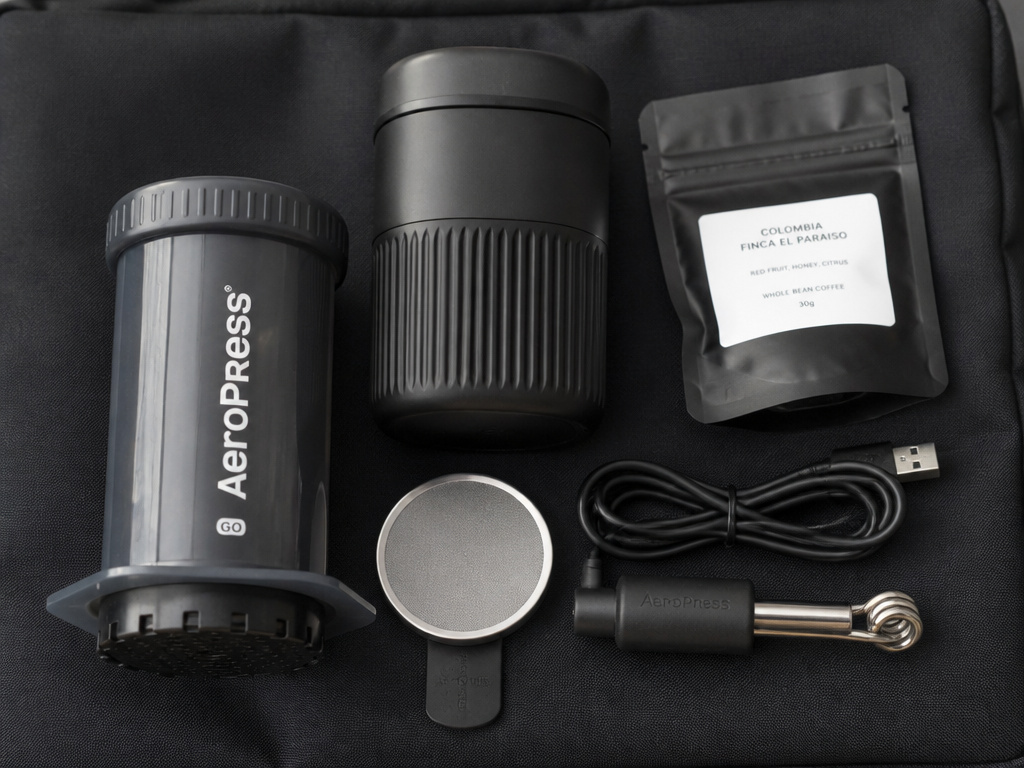
Relying on airport coffee is a recipe for disappointment. The better move is packing a personal brewing setup. This turns your bag of legal grounds into an actual cup, bypassing liquid limits and bad cafe lines.
The core of a travel kit is a brewer, grounds, and a way to heat water. Here’s the breakdown of what works and what doesn’t:
- The Brewer. Choose a compact, durable, non-electric device. The Aeropress Go is the gold standard, it packs into its own cup, uses disposable paper filters, and makes a clean, strong cup. A single-serving pour-over dripper (like a Hario V60 or Kalita Wave) with a reusable metal filter also works. Avoid glass French presses; they shatter.
- The Coffee. Pack pre-ground coffee measured for your brewer. Grinding at the airport is impractical. Dose individual servings into small bags or use a single airtight container. Remember, grounds are a solid, no limit.
- The Water Heater. This is the tricky part. You cannot carry a heating element with a fuel source or large battery. Your options are: request hot water from a flight attendant or airport cafe (the free hack from the YouTube transcript), use an airport microwave, or pack an immersion heater that plugs into a USB port (check wattage limits per the FAA PackSafe passenger guide).
- The Extras. A small digital scale is overkill. A folding travel mug is essential. Don’t forget a stirrer or spoon.
Packing this kit ensures quality and control. It also lets you explore the key coffee differences between methods right in your hotel room, comparing a travel Aeropress brew to a typical diner pot.
Coffee Makers, Pods, and Equipment

Can you bring your espresso machine? The TSA says yes for both carry-on and checked bags. Realistically, you won’t. But smaller coffee makers are common travel items.
Manual Coffee Makers: Devices like the Aeropress, manual pour-over cones, and stainless steel moka pots are solid objects. They pass through security without issue. Remove any detachable parts that might look odd on the X-ray (like the metal filter plate of an Aeropress) and pack them together.
Electric Coffee Makers: Small, dry, cordless devices like a single-cup immersion heater are fine. Devices with internal batteries or fuel cells are subject to dangerous goods regulations. Always consult the FAA PackSafe passenger guide for the latest rules on battery-powered appliances in baggage.
Coffee Pods and Capsules: Individual sealed pods (K-Cup, Nespresso, etc.) are solid items. A sleeve of ten pods is treated like a box of tea bags. You can pack them in any bag. The foil seal and plastic capsule do not change their classification. This is a convenient way to ensure consistency if your hotel has a compatible machine.
Grinders: Hand grinders are solid objects. Electric grinders with batteries fall under the same rules as other battery-powered devices. For air travel, a small hand grinder is more practical than trying to pack a Baratza Encore.
Navigating Security with Coffee: A Step-by-Step Flow

To minimize stress, follow this sequence at the security checkpoint.
- Separate your liquids. If you have a 3.4-oz bottle of coffee concentrate or creamer, place it in your quart-sized bag with your other liquids. Take this bag out of your carry-on and place it in a bin.
- Isolate large powder containers. If carrying a container of instant coffee or fine grounds larger than 12 oz, consider placing it in a separate bin. This signals to the officer that you’re aware of the rule and can speed inspection.
- Keep solid coffee packed. Your bag of whole beans or grounds can stay inside your carry-on. There’s no need to remove it.
- Declare if asked. If an officer questions your coffee, simply state, “That’s ground coffee beans” or “That’s a coffee maker.” Clarity avoids confusion.
- For checked bags, place coffee in the center of your suitcase, surrounded by soft items. This cushions against rough handling and prevents bags from being punctured.
This flow treats coffee according to its TSA category, not as a special case. The officer sees a passenger who understands the rules.
Frequently Asked Questions
Can I bring a bag of coffee beans in my purse or personal item?
Yes. A personal item is still a carry-on bag in the TSA’s view. The same rules apply: solids are unlimited, liquids must follow 3-1-1. Your purse can hold a pound of beans.
Does the TSA consider coffee a gift or food?
The TSA does not distinguish between gifts and personal use. Coffee is a food item. Its rules are based on its physical form (solid, liquid, powder), not its purpose.
What if my liquid coffee is frozen?
frozen liquid is still a liquid. The 3-1-1 rule applies. If your frozen coffee slush is in a container larger than 3.4 oz, it is not permitted in a carry-on, even if solidly frozen.
Can I bring coffee on an international flight departing the USA?
The TSA rules apply at the U.S. departure checkpoint. Your destination country’s customs rules apply upon arrival. Many countries have similar allowances for roasted coffee, but always check the import regulations of your destination.
Before You Go
Pack coffee like the expert you are: solids free, liquids tiny, powders checked if bulky. The TSA’s framework is simple once you stop thinking “coffee” and start thinking “solid, liquid, or powder.” For international returns, remember the roasted/green bean divide, declaration is your best friend. And if you want a guaranteed good cup, invest five minutes in a portable brewer. Your taste buds will thank you at 30,000 feet, far from the stale airport coffee caffeine trap. It’s a small ritual that makes any destination feel a bit more like home.
