
Can You Bring Coffee Beans on a Plane? The TSA Fine Print
You can bring coffee beans on a plane. The TSA permits both whole and ground coffee in any quantity in carry-on and checked bags for U.S. flights. However, international agricultural laws, especially for unroasted green beans, can lead to confiscation upon entry to your destination country, overriding the TSA’s simple allowance.
People get this wrong because they think TSA’s green light is the final word. It isn’t. TSA controls what leaves the airport security checkpoint. U.S. Customs and Border Protection (CBP) and the USDA’s Animal and Plant Health Inspection Service (APHIS) control what enters the country. Forgetting that second layer is how you end up with a bag of confiscated beans or a fine. This guide walks through both layers, the edge cases that cause delays, and how to pack so your beans arrive ready to brew.
Key Takeaways
- Roasted whole bean or ground coffee is TSA-approved for carry-on and checked bags with no weight limit for domestic travel.
- Liquid coffee must be in containers 3.4 ounces (100 mL) or smaller and fit inside a single quart-sized plastic bag for carry-on.
- Unroasted green coffee beans are subject to strict agricultural import restrictions and may require a phytosanitary certificate.
- For international arrivals, you must declare all plant and food products, including coffee, on the U.S. Customs form.
- Over 12 ounces (350 mL) of a powder-like substance, including finely ground coffee, may trigger additional TSA screening.
The TSA Rule Is the Easy Part
Headline rules are simple. The TSA’s official “What Can I Bring?” database lists “Coffee, ground or whole beans” as a solid you can pack in any bag. They don’t weigh it. You could theoretically check a 50-pound bag of roasted beans. The agency’s concern is security threats, not your caffeine haul.
Liquid coffee is a different category. The TSA’s 3-1-1 rule for carry-ons applies: each container must be 3.4 ounces (100 milliliters) or less, all containers must fit in one clear, quart-sized plastic bag, and you get one bag per passenger. A 12-ounce bottle of cold brew in your carry-on will be confiscated. That same bottle is fine in your checked luggage.
Technical Snippet: The TSA’s 3-1-1 rule is based on container volume, not remaining liquid. An empty 8-ounce bottle is prohibited in carry-on luggage because its capacity exceeds 3.4 ounces. A 3-ounce bottle that’s half-full is permitted. The rule exists to standardize screening for potential liquid explosives.
The universal mistake is stopping your research at the TSA page. Their rules govern what goes through the checkpoint scanner. They have zero authority over what you bring into the country from abroad or what a foreign country allows you to bring in. That’s where people get tripped up.
TL;DR: TSA says yes to solid coffee, yes to tiny liquids in a baggie. Their job ends at the X-ray machine.
What Kinds of Coffee Can You Bring?
Not all coffee travels equally. The form it takes changes the rules you must follow.
| Coffee Form | Carry-On Rules | Checked Bag Rules | Biggest Risk |
|---|---|---|---|
| Whole Beans (Roasted) | Permitted, no quantity limit. | Permitted, no quantity limit. | Agricultural inspection on international arrival if not declared. |
| Ground Coffee (Roasted) | Permitted, but over 12 oz may trigger powder screening. | Permitted, no quantity limit. | Powder rule delay; aroma mistaken for contraband during screening. |
| Liquid Coffee | 3-1-1 rule: ≤3.4 oz containers in a quart bag. | Permitted, but pack to prevent leaks. | Container size, not liquid amount, gets your bottle tossed. |
| Green/Unroasted Beans | Technically permitted by TSA. | Technically permitted by TSA. | International import bans or permits required. High confiscation risk. |
Whole roasted beans are the safest traveler. They are clearly a solid food product. Ground coffee is also solid, but its fine texture introduces a secondary TSA guideline.
Common mistake: Assuming the 3-1-1 rule only applies to liquids — finely ground coffee in a large container can fall under the TSA’s powder-like substances rule for carry-ons. Quantities over 12 ounces (about 350 milliliters) may require additional screening and should be placed in checked bags to avoid hassle.
I learned this the hard way returning from a sourcing trip with a half-kilo of vacuum-sealed, finely ground Gesha. The security officer pulled my bag for a swab test. The official line is that powders over 12 ounces “may require additional screening.” In practice, they often pull the bag for a closer look. It added ten minutes. Now any ground coffee over a standard bag goes in my checked luggage.
Liquid coffee is straightforward if you remember container size. I keep a 3-ounce bottle of cold brew concentrate in my dopp kit. The bottle itself is 3 ounces, so it’s compliant even if it’s only half full.
Green beans are the wild card. The TSA doesn’t care about them. But for international travel, they are an agricultural product, often considered a plant propagative material. Countries like Australia explicitly prohibit them without a permit. The USDA APHIS treats them as a potential vector for plant pests. If you’re bringing back green beans, you’re not dealing with a security rule. You’re dealing with an agricultural import regulation.
International Travel: The Real Hurdle Isn’t Security
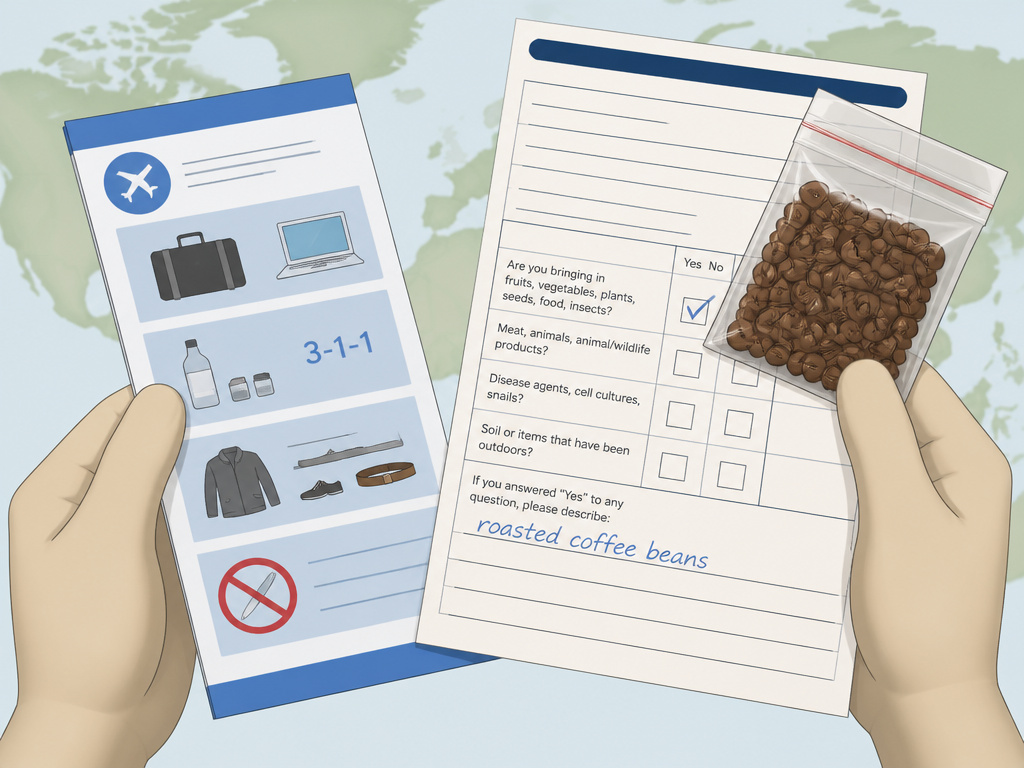
This is where the generic advice fails. The TSA governs your departure from the U.S. Your destination country’s agriculture or biosecurity agency governs your arrival. Two different governments, two different rulebooks.
For entry into the United States, you must declare all agricultural products on the Customs and Border Protection (CBP) form. This includes roasted coffee beans. The USDA APHIS agricultural import restrictions page states roasted coffee is “generally admissible.” The key word is generally. Failure to declare can result in a fine, even for admissible items. Declaring it lets the CBP officer make the final call.
I won’t risk a fine over a bag of beans. I always check “Yes” on the customs form for “Food” and write “roasted coffee beans” in the description. The officer usually waves me through. The one time I didn’t declare a particularly aromatic bag of Sumatran, I got pulled aside for a full bag search. The smell raised a flag.
For other countries, you must research. Australia’s Department of Agriculture, Fisheries and Forestry allows commercially packaged roasted beans for personal consumption. Green beans are a hard no without a permit. Other countries have similar biosecurity concerns. Assuming TSA rules apply worldwide is a guaranteed way to lose your beans at the destination airport.
Your research checklist for international travel with coffee should include:
1. The destination country’s agriculture/biosecurity import website.
2. The requirement for commercial packaging vs. bulk bags.
3. Quantity limits for personal use.
4. The specific rules for green (unroasted) coffee beans.
TL;DR: TSA lets it out, Customs decides if it comes in. Always declare food products on arrival forms.
How to Pack Coffee for a Flight (And Why It Matters)
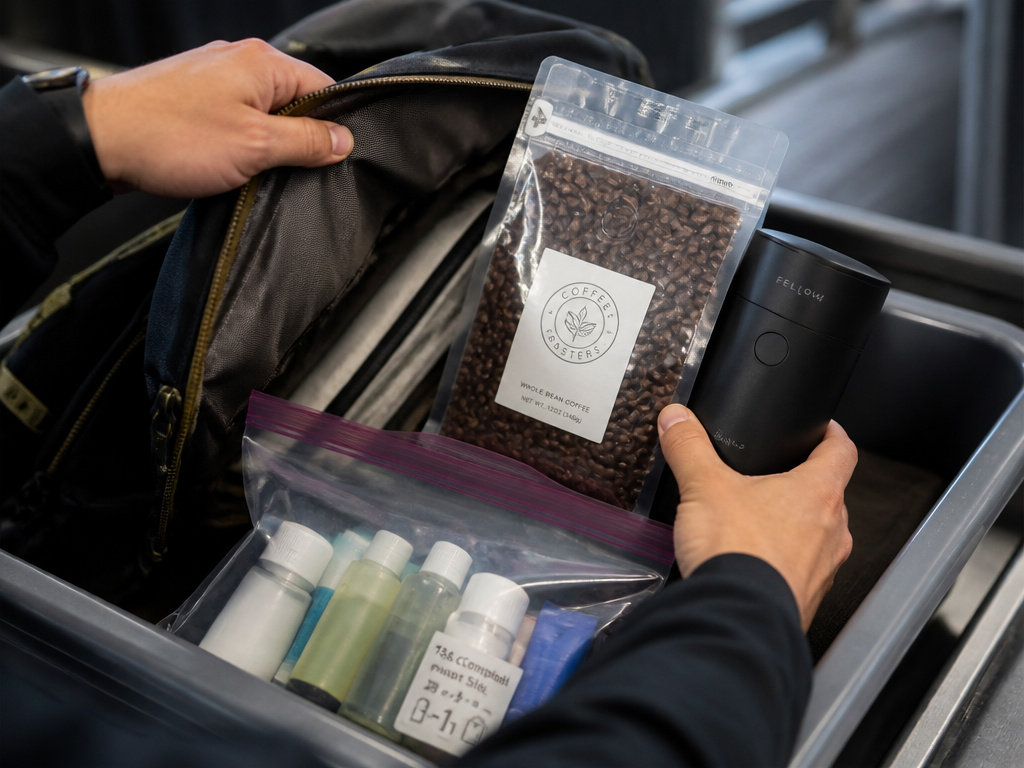
Packing is about preservation and preventing delays. Aromas escape. Bags burst. Powders spill.
Start with an airtight container. The valve on a quality coffee bag is a one-way street — it lets CO2 out but doesn’t let air (and aromas) back in. For ground coffee, I use a hard-sided, screw-top container like a Fellow Atmos or a simple Mason jar. It prevents compression from other items in your bag from rupturing the seal and keeps the grounds contained.
For carry-on, place the coffee container in an easily accessible part of your bag. If you’re pulled for a powder screening, you don’t want to unpack your entire suitcase at the checkpoint. A TSA officer once made me unload a meticulously packed carry-on because a bag of ground coffee was at the very bottom. It was a 14-ounce bag. The screening took 20 minutes.
Rule of thumb: Pack coffee in your checked bag if it’s over 12 ounces of ground or if you have more than a few bags. The risk of a time-consuming secondary screening isn’t worth the carry-on space.
If you’re transporting green coffee beans, you need more than good packaging. You need documentation. Check if your destination requires a phytosanitary certificate from the country of origin. This is a document from that country’s agriculture department stating the beans are pest-free. Without it, your beans will be confiscated and destroyed at the border. No appeals.
Liquid coffee demands a quart-sized plastic bag. Don’t just throw the bottle in your toiletry kit. Put it in the bag. I’ve seen people argue they didn’t know the rule because the bottle was “with” their liquids. The officer doesn’t care. The rule is in the bag.
The One Step Everyone Forgets (And It’s Not Packing)
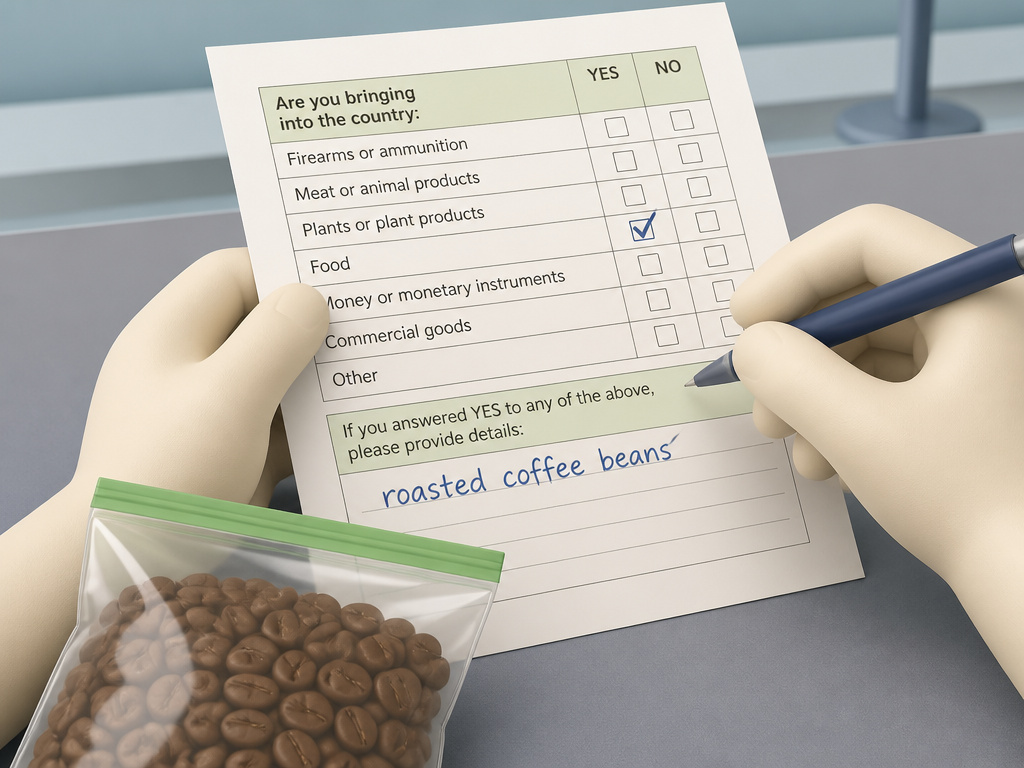
You cleared security. You landed. You grabbed your bag. You’re in the customs line. This is the most common point of failure.
You must declare the coffee on your customs form. Every time. For the U.S., mark “Yes” on the question about “Food” and write “roasted coffee beans” in the space provided. This is non-negotiable. The federal agricultural product import declaration is a legal document. Falsifying it can lead to fines up to $10,000.
Why does it matter if roasted beans are “generally admissible”? Because the customs officer needs to verify it. They are looking for soil, insects, or moisture that could carry plant diseases. Your vacuum-sealed bag from a reputable roaster will pass. A burlap sack of beans bought at a foreign market might not. Let them make that decision.
Common mistake: Not declaring coffee because you think it’s “just coffee” — CBP agriculture specialists are trained to sniff out undeclared food. The fine and the delay are guaranteed to ruin the memory of those beans.
The process is simple. Declare it. If asked, present the bag. They might inspect it visually or with a sniffer dog. Then you’re on your way. The alternative is getting pulled into secondary inspection, which adds a minimum of 30 minutes to your arrival process.
Frequently Asked Questions
Can I bring coffee beans in my carry-on bag?
Yes. The TSA explicitly permits both whole bean and ground coffee in carry-on bags. There is no weight limit. For large amounts of ground coffee (over 12 ounces), be prepared for possible additional screening under the powder rule.
Does the TSA consider ground coffee a powder?
It can. The TSA’s guidance on powders states that substances “like spices, powdered milk, sugar, coffee, etc.” may be subject to additional screening if in quantities greater than 12 ounces/350 mL in carry-on bags. To avoid delays, pack large amounts of finely ground coffee in your checked luggage.
Can I bring green coffee beans into the United States?
It depends. The USDA APHIS may allow green beans for personal consumption, but they must be declared and are subject to inspection. They may be prohibited if they originate from a country with certain plant diseases. Always declare them and be prepared for the possibility they will be confiscated.
What about liquid coffee or cold brew?
Liquid coffee must follow the 3-1-1 liquids rule for carry-ons: containers of 3.4 ounces (100 mL) or less, all fitting inside one quart-sized, clear plastic bag. You can pack larger bottles in your checked baggage.
Do I need to declare coffee at customs?
Yes. When entering the United States, you must declare all plant and food products, including roasted coffee beans, on the CBP declaration form. Failure to declare can result in fines, even for items that are ultimately allowed.
Before You Go
The short answer is always yes, you can bring coffee beans on a plane. The long answer requires you to match the coffee’s form to the correct set of rules. Roasted beans are a solid food for the TSA but a declared agricultural product for Customs. Ground coffee can trigger a powder screening. Liquid coffee lives by the 3.4-ounce rule. Green beans operate under an entirely different, stricter legal framework.
Print the TSA page for coffee. Bookmark the USDA APHIS traveler page. Use an airtight container. Declare everything at customs. That sequence turns a potential security-line debate into a non-event. Your only concern should be whether your hotel has a decent burr coffee grinder or if you packed your Aeropress.
