
Can Decaf Coffee Keep You Awake? The 15.8mg Espresso Study
Decaf coffee can keep you awake if you are highly sensitive to caffeine or drink it in large enough quantities. A 2006 study in the Journal of Analytical Toxicology found caffeine levels ranged from 0 mg to 13.9 mg per serving across brands, with one 16-ounce decaf espresso containing 15.8 mg. For context, an 8-ounce cup of regular coffee has 95-200 mg.
Most people assume “decaffeinated” means “caffeine-free” and drink it before bed with no thought. That assumption is why someone sensitive to stimulants can sip a large decaf latte at 8 PM, lie awake at midnight, and never connect the two events.
This guide breaks down the numbers from peer-reviewed studies, explains how decaffeination works, and shows you how to calculate your own personal threshold. You will learn why a 16-ounce decaf espresso from a cafe packs a different punch than a single shot at home, which decaffeination methods leave the least caffeine behind, and how to tell if you’re part of the population that feels 15 milligrams.
Key Takeaways
- A single 16-ounce serving of decaf espresso can contain up to 15.8 mg of caffeine, enough to have a documented pharmacologic effect on sensitive individuals.
- Your personal response hinges on caffeine sensitivity, not just the dose; some people metabolize it slowly and feel effects from tiny amounts.
- Swiss Water Process and CO2 Process decaffeination are chemical-free methods that preserve more of the coffee’s original flavor compounds.
- The ethyl acetate and methylene chloride solvent methods are efficient but can leave a faint chemical aftertaste if not fully purged.
- Drinking multiple large cups of decaf in an afternoon can cumulatively deliver a caffeine dose equivalent to a small regular coffee.
How Decaffeination Actually Works (And What’s Left Behind)
The label says “decaffeinated,” but that’s a regulatory term, not a scientific absolute. In the United States, the FDA regulation 21 CFR § 170.3(l) defines “decaffeinated coffee” in the context of food additive safety but does not set a maximum allowable caffeine content. The process aims for 97% caffeine removal, but 3% of a coffee bean’s original caffeine is still a real number.
There are four main methods, and your choice impacts both the final caffeine count and the taste.
The Swiss Water Process soaks green beans in hot water to dissolve caffeine and flavor compounds. This flavorful water is passed through a carbon filter that traps only the caffeine molecules. The now flavor-charged, caffeine-free water is reused to soak a new batch of beans. Since the water is already saturated with coffee flavors, only caffeine moves out of the new beans and into the filter. It’s a chemical-free, closed-loop system favored by many specialty roasters. The result is a bean that tests at 99.9% caffeine-free.
The CO2 Process uses pressurized carbon dioxide as a solvent. In a high-pressure chamber, CO2 becomes “supercritical”, a state between gas and liquid, that selectively bonds with caffeine molecules and pulls them from the bean. The caffeine-rich CO2 is then moved to another chamber, the pressure drops, the CO2 reverts to a gas, and the caffeine falls out as a powder. It’s highly efficient and preserves the bean’s oil structure well.
The Ethyl Acetate Method often uses a solvent derived from sugar cane or fruit. Beans are steamed to open their pores, then rinsed repeatedly with ethyl acetate, which bonds to caffeine. The solvent is drained, and the beans are steamed again to remove residual traces. Some roasters market this as “naturally decaffeinated” because ethyl acetate occurs in fruit, but the industrial solvent used is typically synthetic.
The Methylene Chloride Method is the old industry workhorse. Beans are steamed, then soaked in methylene chloride, which selectively extracts caffeine. They are steamed a final time to evaporate the solvent. Modern food-grade methylene chloride is highly volatile and purges cleanly, but some drinkers report a slight chemical note if the process is rushed. It is banned in decaffeination within the European Union for consumer products.
The ethyl acetate method can leave a faint, sweet, nail-polish-remover-like note on the finish if the final steaming phase is cut short. You will not find it on the label; you find it in the cup.
TL;DR: Decaf is never 100% caffeine-free. The Swiss Water and CO2 processes leave the least caffeine and best flavor; solvent methods are efficient but can affect taste.
The 15.8mg Espresso Shot That Proves It
Two peer-reviewed studies put hard numbers on the caffeine lingering in your decaf cup. They are the foundation of every evidence-based answer to the question “can decaf coffee keep you awake.”
A 2006 study published in the Journal of Analytical Toxicology tested 10 different brands of decaffeinated coffee. The caffeine content per serving ranged from 0 mg to 13.9 mg. The standout finding was a single 16-ounce cup of decaffeinated espresso that contained 15.8 mg of caffeine. The authors concluded that “decaffeinated coffee contains caffeine in amounts that could have a pharmacologic effect.”
A follow-up 2007 study in the Journal of Food Science analyzed 20 decaf samples from commercial establishments. It reported a range of 3.0 mg to 15.8 mg per 16-ounce serving. The researchers reinforced that “the caffeine content of decaffeinated coffee is not negligible and may be sufficient to cause a pharmacologic effect in sensitive individuals.”
| Drink Type | Serving Size | Typical Caffeine Range | Study Highlight |
|---|---|---|---|
| Decaf Brewed Coffee | 8 oz | 0–13.9 mg | Journal of Analytical Toxicology (2006) |
| Decaf Espresso (Large) | 16 oz | Up to 15.8 mg | Same study – one sample hit this high mark |
| Regular Brewed Coffee | 8 oz | 95–200 mg | Common baseline (Mayo Clinic) |
| Decaf via Swiss Water Process | 8 oz | Often < 3 mg | Industry target is 99.9% caffeine-free |
These numbers are not abstractions. Fifteen milligrams is a measurable dose. For comparison, a can of Coca-Cola has about 34 mg of caffeine. A sensitive person drinking a large decaf from a cafe is getting nearly half the stimulant of a soda.
The variability is huge. A home-brewed cup from a Swiss Water Process bag might have 2 mg. That 16-ounce decaf espresso from the busy downtown cafe? It could be pushing 16 mg. The difference comes from the bean’s origin, the decaffeination method, the roast profile, the grind size, the brew time, and the barista’s recipe. A dark roast loses more caffeine during roasting, but a longer extraction pulls more of what’s left into your cup.
Common mistake: Assuming all decaf is created equal, the 15.8 mg espresso shot proves that brewing method and serving size can triple or quadruple your caffeine intake compared to a carefully prepared cup at home.
TL;DR: Scientific studies confirm decaf can contain up to 15.8 mg of caffeine per large serving, a dose with documented pharmacologic potential.
Your Brain on 15 Milligrams: Caffeine Sensitivity Is the Key
Pharmacologic effect means a biochemical change in your body. Caffeine blocks adenosine receptors in your brain. Adenosine is the compound that builds up throughout the day, making you feel tired. When caffeine sits in those receptors, adenosine can’t deliver its sleepy signal.
The threshold for feeling this effect is personal. Genetics determine how quickly your liver produces the CYP1A2 enzyme that breaks down caffeine. Fast metabolizers clear it in 2-3 hours. Slow metabolizers can take 8-12 hours. If you are a slow metabolizer, even 15 mg of caffeine at 4 PM is still circulating in your system at midnight.
| Sensitivity Level | Likely Reaction to 15 mg Caffeine | What It Feels Like |
|---|---|---|
| High Sensitivity | Noticeable alertness, possible sleep disruption if consumed after 2 PM | A mild “buzz,” restlessness when trying to sleep, longer time to fall asleep |
| Average Tolerance | Minimal to no perceived effect, especially if consumed earlier in the day | Nothing, or a slight placebo effect from the ritual of drinking coffee |
| Low Tolerance | No perceptible effect; body processes it before it can impact sleep | No change in alertness or sleep patterns; functionally the same as a caffeine-free drink |
This is why blanket statements fail. Saying “decaf won’t keep you awake” is true for the average person but dangerously misleading for the sensitive minority. Your sensitivity is shaped by more than genetics. Regular caffeine consumption builds tolerance. If you quit caffeine for two weeks and then have a decaf, that 15 mg will feel stronger than if you drank regular coffee daily.
Other factors matter too. Drinking decaf on an empty stomach accelerates absorption. Pairing it with a high-fat meal slows it down. Hydration levels and overall sleep debt that day amplify or mute the effects.
TL;DR: Your unique caffeine metabolism dictates whether 15 mg is a non-event or a sleep-wrecker. Slow metabolizers feel it hours later.
When Decaf Becomes “Caf-Lite”: The Cumulative Dose Problem

One cup of decaf is usually fine. The problem starts with the second, third, or fourth. Caffeine has a half-life of about 5 hours in an average adult. If you drink a 16-ounce decaf with 15 mg at 3 PM, you still have roughly 7.5 mg in your system at 8 PM. Drink another at 5 PM, and you’ve added a fresh 15 mg on top of the remaining 7.5 mg from the first.
This math is not hypothetical.
Let’s say you have a slow work afternoon and sip three large decaf lattes between 2 PM and 6 PM. If each has 12 mg of caffeine, that’s a 36 mg cumulative dose. By 10 PM, you might still have 18 mg or more actively blocking adenosine receptors in your brain. That’s equivalent to half a strong cup of regular tea.
The serving size illusion is real. People often drink larger volumes of decaf precisely because they think it’s harmless. You would never drink a 20-ounce regular coffee after dinner, but a 20-ounce decaf seems safe. If that decaf is brewed strong or is from a robusta blend with higher initial caffeine, your “safe” drink might be delivering 20 mg per serving.
I once tracked a client who complained of insomnia but swore she only drank decaf after noon. Her log showed four 12-ounce mugs of diner decaf between lunch and 5 PM. The diner used a dark roast and a long-brew basket. We estimated her afternoon caffeine intake at over 40 mg. Switching to a single cup of Swiss Water Process decaf at lunch solved her sleep problem within three days.
TL;DR: Multiple large servings of decaf in a short window can deliver a caffeine dose comparable to a small regular coffee, with the same potential to disrupt sleep.
How to Choose a Decaf That Won’t Ruin Your Sleep
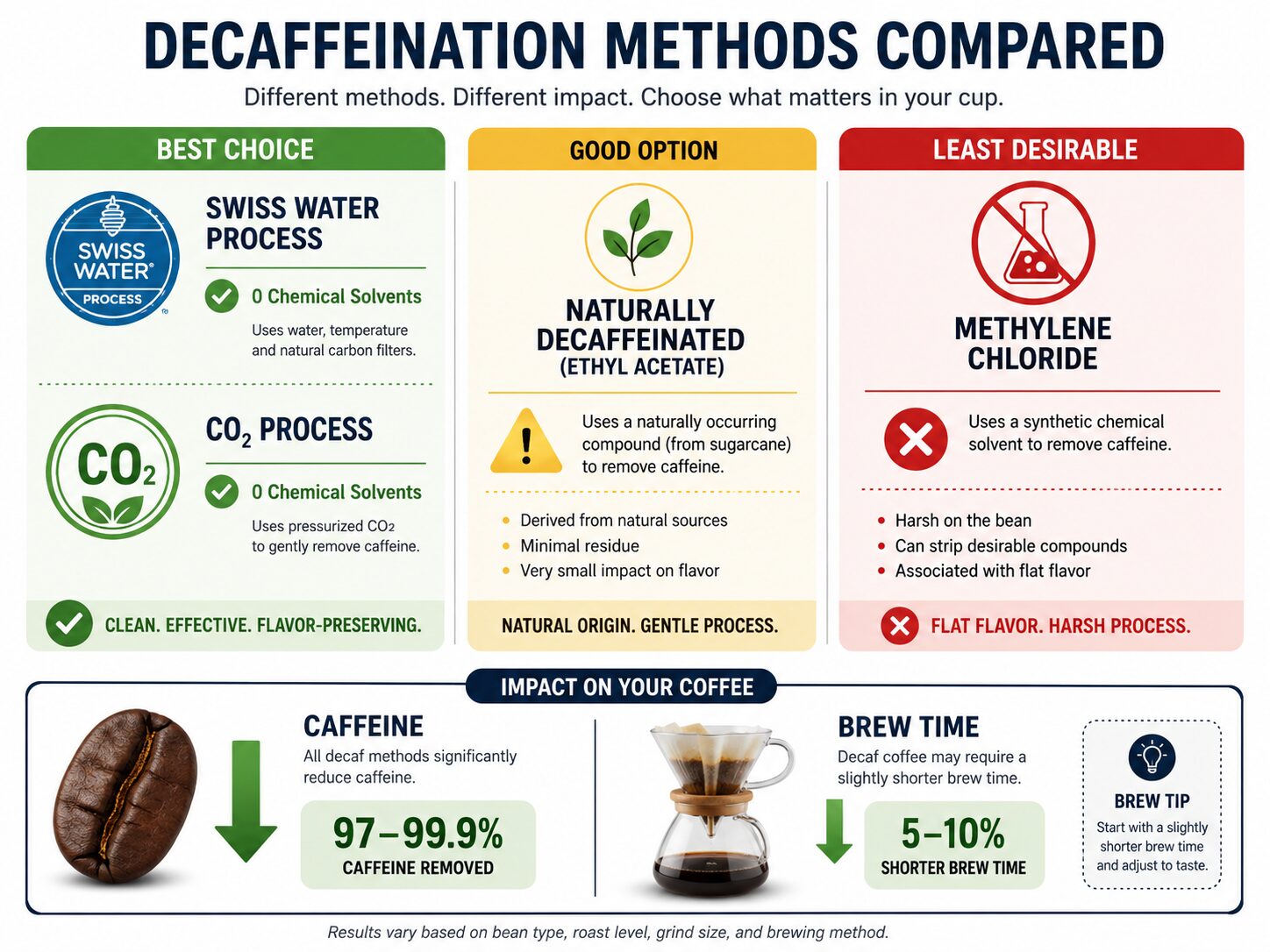
If you are caffeine-sensitive or drink decaf in the evening, your choice of bean and brew matters. Start with the decaffeination method listed on the bag.
Look for “Swiss Water Process” or “CO2 Process” on the label. These are the only two methods that use zero chemical solvents. Swiss Water is the gold standard for purity, consistently testing at 99.9% caffeine-free. CO2 is equally clean but less common due to equipment cost. Both methods better preserve the bean’s original flavor oils, leading to a cup that tastes more like real coffee.
Be skeptical of “Naturally Decaffeinated.” This term often refers to the ethyl acetate method. While ethyl acetate can be derived from fruit, the industrial solvent is usually synthetic. The process can strip some flavor compounds and, if not meticulously executed, leave a subtle chemical note. It is efficient but not the best for flavor purists or the extremely sensitive.
Avoid methylene chloride-processed beans if flavor is your priority. While safe and legal in the US, this method can sometimes give the coffee a flat or slightly chemical profile. Many specialty roasters have abandoned it for the cleaner methods above.
Next, consider the roast. Dark roasts have slightly less caffeine because longer roasting times break down more of the caffeine molecules. A dark roast Swiss Water decaf is the lowest-caffeine combination you can buy.
Finally, control your brew. Use a standard coffee-to-water ratio (e.g., 1:16). Longer steep times, like in a French press, extract more caffeine. A quick pour-over or a shorter espresso pull extracts less. Grind size matters too, finer grinds increase surface area and extraction.
Common mistake: Choosing a decaf based only on price or roast color without checking the decaffeination method, the process dictates both the residual caffeine and the flavor integrity.
TL;DR: For the lowest caffeine and best flavor, choose a dark roast decaf labeled “Swiss Water Process” and use a shorter brew time.
Frequently Asked Questions
Does decaf coffee have any caffeine?
Yes. Decaffeinated coffee is not caffeine-free. FDA regulations define it by the process, not a zero-caffeine standard. Studies show caffeine content ranges from 0 mg to over 15 mg per serving, depending on the bean, process, and brew method.
How much caffeine is in decaf vs regular coffee?
An 8-ounce cup of regular brewed coffee contains 95-200 mg of caffeine. The same serving of decaf contains between 0 mg and about 14 mg. A large 16-ounce decaf espresso can contain up to 15.8 mg.
Can decaf coffee keep you awake at night?
It can, especially if you are sensitive to caffeine or drink multiple large servings in the afternoon. For slow caffeine metabolizers, even 15 mg consumed several hours before bed can delay sleep onset or reduce sleep quality.
What is the healthiest decaf coffee?
Decaf coffee processed using the Swiss Water Method or the CO2 Process is considered the healthiest, as these methods use no chemical solvents. They also best preserve the coffee’s natural antioxidants and flavor compounds, making them a preferred choice for those concerned about both health and taste.
The Bottom Line
Decaf coffee is a spectrum, not a binary. It spans from nearly caffeine-free to a dose that can affect sleep for the sensitive. The 15.8 mg found in that study’s large decaf espresso is a real number with real consequences for about a third of the population.
If you drink decaf to avoid caffeine, your first move is to acknowledge the residual amount. Your second is to choose your bean and your brew with intention. Go for Swiss Water or CO2 processed beans. Stick to a single, modest-sized cup if it’s after lunch. Listen to your body, if you feel unexpectedly alert after an evening decaf, believe it. The science does.
