
How to Grind Coffee Beans in a Vitamix: Container Matters
You can grind coffee beans in a Vitamix blender, but you must use the optional Dry Grains Container or the specific S-Series 32-ounce container. The standard wet container will grind beans, but its blade design pulls ingredients down, creating heat and friction that can scorch coffee oils and, over many uses, visibly dull the stainless steel blades.
The universal mistake is assuming any blender container works the same. People grab their standard pitcher, dump in beans, and blast them. That works once. Do it twice a week for a year and you’ll notice the scratches. The blade geometry is wrong, and the motor is too powerful for a delicate, dry ingredient.
This guide walks through the two containers Vitamix actually designs for dry grinding, the exact pulsing technique that prevents a dust cloud, and the honest truth about why your French press will still taste muddy compared to using a real burr grinder.
Key Takeaways
- The Vitamix Dry Grains Container (Part 000679) uses a reverse-vortex blade to lift dry ingredients, making it the only container Vitamix officially recommends for grinding coffee.
- Grinding in the standard wet container causes cosmetic blade scratching over time and generates enough heat to compromise coffee flavor in a single session.
- For a passable coarse grind, use a rapid pulse technique: 1-2 second bursts on the lowest variable speed, listening for the sound change.
- A Vitamix cannot produce a consistent medium or fine grind suitable for drip or espresso; the particle size will be a mix of dust and chunks.
- For batches smaller than 1/2 cup of beans, the blades may not engage properly, leaving whole beans at the bottom of the container.
The Container Is Everything
Head design changes the entire process. A Vitamix is not a single tool but a motor base that accepts different containers, each with a specific blade engineered for a task. Using the wrong one for coffee is like using a butter knife to chop carrots, it’ll work, but poorly and with damage.
The Vitamix Dry Grains Container, sold separately under part number 000679, is the only accessory the company explicitly markets for dry ingredients like whole grains and spices. Its blades are engineered to create a reverse vortex, pushing dry ingredients away from the blades and up the sides of the container. This circulation is critical. It prevents the beans from getting jammed under the blades and reduces the heat generated by constant friction.
The Dry Grains Container uses a blade geometry that creates a reverse vortex for dry ingredients, contrasting with the wet container’s downward-pulling design. This is stated in the official product specifications from Vitamix.
The S-Series 32-ounce container (part number 001589) is a newer hybrid option. Vitamix describes its “laser-cut, stainless-steel hammermill and cutting blades” as suitable for both wet and dry ingredients. It’s a more versatile pick if you own one, but it’s still a blade-based system.
Your standard 64-ounce or 48-ounce wet container is the problem. Those blades are angled to pull liquid and soft ingredients down into the cutting path, creating the famous vortex for smoothies. With hard, dry beans, this design creates intense point contact. The beans hammer against the blade edges instead of circulating.
TL;DR: Only the Dry Grains Container or the S-Series 32oz container are designed for coffee beans. The standard pitcher will work in a pinch but damages the blade finish over time.
Why Your Standard Pitcher is a Bad Idea
It grinds. I’ve done it. The motor has more than enough power to smash a cup of beans into something resembling grounds. The issue isn’t immediate failure, it’s progressive, cumulative wear you won’t notice until your next smoothie has unblended flecks of kale.
The blade steel is hardened, but coffee beans are a mild abrasive. Each grinding session acts like a light sanding pass. Forum users who grind in their wet containers three or four times a week report fine, hairlike scratches radiating from the blade edges after six months. It’s cosmetic at first. The real impact is on the blade’s cutting edge, which can dull slightly, reducing its efficiency for emulsifying dressings or pureeing soup.
Heat is the other, more immediate enemy. The wet-container blade design generates friction heat quickly. You can smell it, a faint, toasted aroma that isn’t from the roast. That’s the volatile coffee oils burning. It imparts a flat, slightly bitter note to your cup, especially noticeable in lighter roasts.
Common mistake: Using the standard wet container for frequent coffee grinding, the abrasive action creates micro-scratches on the blade surface, and within 6-12 months of weekly use, you’ll see a visible loss of the mirror finish and a drop in blending performance for wet ingredients.
The company’s position is clear. The owner’s manuals for the Ascent and Explorian series state the Dry Grains Container is for grinding whole grains and the wet container is not recommended for that task. This isn’t a vague suggestion. It’s a design specification.
| Container Type | Blade Action | OK for Coffee? | Primary Risk |
|---|---|---|---|
| Standard Wet Container | Pulls ingredients down | Not recommended | Blade scratching, heat generation, flavor damage |
| Dry Grains Container | Reverse vortex, pushes up | Yes, designed for it | None when used correctly |
| S-Series 32oz Container | Hammermill & cutting combo | Yes | Higher cost, smaller capacity |
The Pulse Technique That Actually Works
You have the right container. Now you need the right touch. Turning the dial to high and letting it rip for ten seconds makes coffee dust, not grounds. It also launches a fine powder plume that coats the inside of the lid and your kitchen counter.
Start with at least half a cup of beans. Smaller amounts, like a single serving for a pour-over, don’t create enough mass for the blades to catch and circulate effectively. You’ll get a few ground beans and several whole ones rattling around the bottom.
Secure the lid. Set the variable speed dial to 1, the lowest setting. The goal is control, not power. Press the pulse button in rapid, deliberate bursts, one second on, one second off. Listen closely. The first two pulses will sound like a loud, chaotic rattle. By the fourth or fifth pulse, the sound shifts to a smoother, lower hum. That’s your cue.
Stop after five to seven pulses. Remove the lid and check. For a coarse French press grind, you might be done. For a medium grind, you’ll need more pulses, but shorten them to half-second bursts. This incremental approach prevents the motor from building momentum and generating heat.
- Measure your beans. Use a scale if you have one. Half a cup is about 60 grams.
- Set the speed to 1. This is non-negotiable. High speed turns beans to dust in three seconds.
- Pulse in 1-second bursts. Count them out loud. Five pulses, stop, check.
- Adjust with shorter pulses. Need it finer? Pulse for half a second, six more times.
- Let the dust settle. Wait fifteen seconds before removing the lid to avoid inhaling fines.
Skipping the pulse step and using a continuous blend creates a vortex that traps chunks at the top while pulverizing the beans at the bottom. Your grind will be wildly inconsistent.
What a Vitamix Can’t Do for Coffee
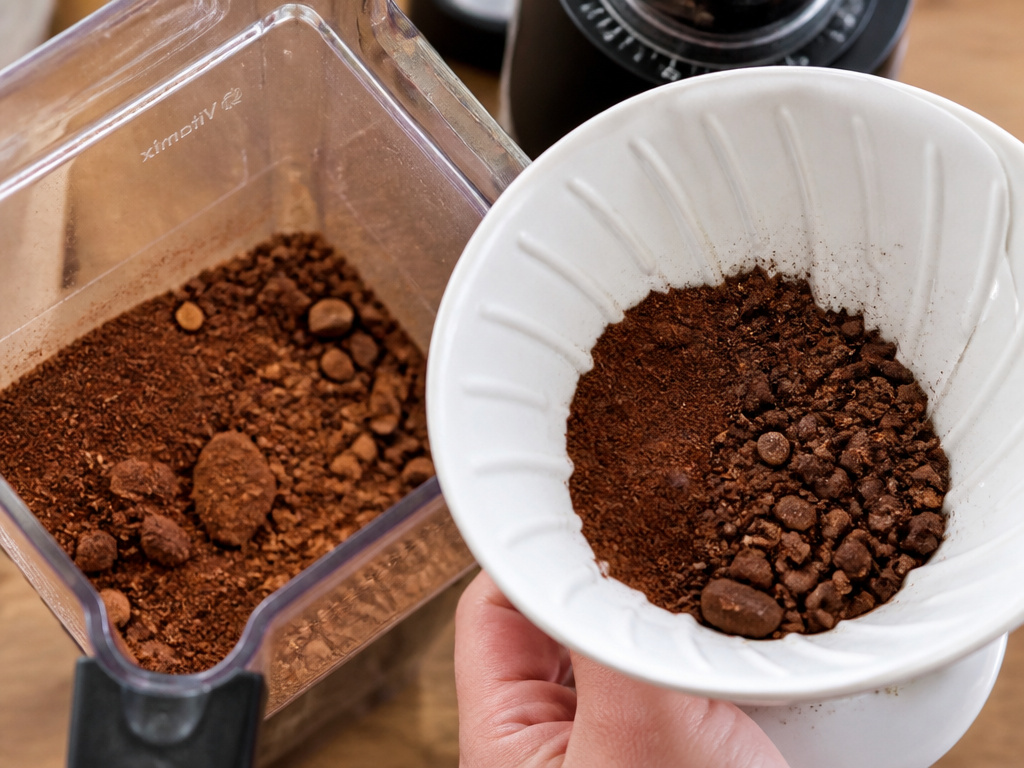
It will never be a burr grinder. Understanding that mechanical limitation saves you from disappointment. A burr grinder crushes beans between two abrasive surfaces, producing particles of nearly uniform size. A blade grinder, which is what a Vitamix becomes for this task, chops beans randomly with spinning blades. The result is a mix of large boulders and microscopic fines.
For a French press, fines slip through the mesh filter and make the cup muddy and over-extracted. For drip or pour-over, the boulders under-extract, yielding a weak, sour cup. For espresso, it’s a complete non-starter. The inconsistent particle size creates massive channeling, and the machine can’t build proper pressure.
I tried dialing in a light roast for a pour-over using only my Vitamix dry container. After twenty minutes of pulsing and sifting, I still had 15% of the batch as unusable chunks. The resulting cup was simultaneously bitter and weak, a sign of both over and under-extraction in the same brewer.
This isn’t about motor power. It’s about precision. The burr grinders versus blade grinders debate centers on particle uniformity. A high-end burr grinder achieves over 90% particle consistency. The best blade technique in a Vitamix might hit 60%. That gap is tasted, not just measured.
If your goal is a occasional coarse grind for cold brew or a cowboy-pot camping trip, the Vitamix with the dry container is adequate. If you care about unlocking the nuanced flavor notes of your single-origin coffees or blonde roast beans, you need a dedicated burr grinder.
Maintenance and Long-Term Care
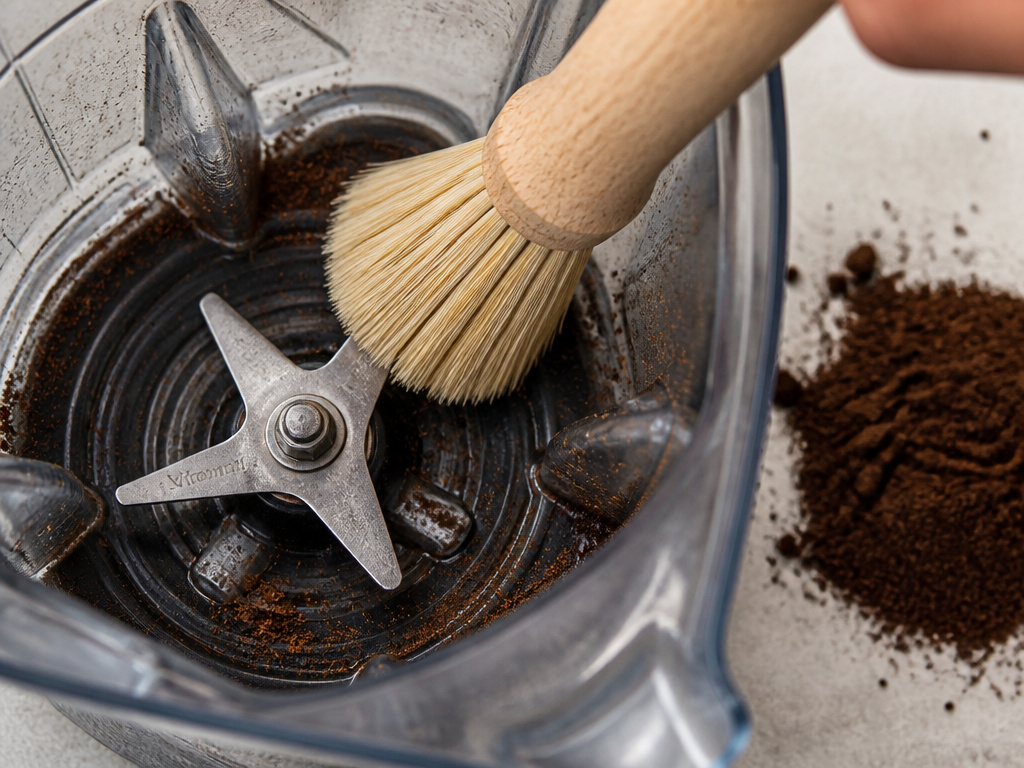
Grinding coffee is a dry, abrasive task. It leaves behind oils and fine dust. This residue is different from the wet pulp of a smoothie and requires a different clean-up.
After grinding, never just add water and soap and blend. The coffee dust will form a paste that sticks in the container’s crevices. Instead, remove the container from the base and take off the lid. Dump the grounds into your filter or storage jar. Then, use a dry brush or a dedicated dry-container brush to sweep out the remaining fines from the bottom and the blade area. A few sharp taps against your palm dislodges most of it.
Only after the dry residue is gone should you rinse the container with warm water. For a deeper clean, add a drop of dish soap and a cup of warm water, then blend on low for 30 seconds. Rinse thoroughly. Always dry the container completely before storage to prevent any moisture from interacting with the next batch of dry ingredients.
This maintenance habit protects your investment. It also prevents cross-contamination of flavors. The last thing you want is a hint of Ethiopian Yirgacheffe in your pancake batter because you used the same dry container for both tasks without cleaning it properly.
Consider the coffee machine maintenance principles you apply to your brewer. The same logic of residue management applies to your grinding tool, even if it’s a blender accessory.
Frequently Asked Questions
Can I grind coffee beans in my Vitamix without the dry container?
Technically, yes. The standard wet container will chop the beans. However, Vitamix does not recommend this, as the blade design is for wet ingredients. It creates more heat, risks scratching the blades over time, and can negatively impact coffee flavor. It’s a last-resort option.
How fine can a Vitamix grind coffee beans?
It can produce a powdery fine grind, but it will be extremely inconsistent. You’ll have a majority of fine powder mixed with a significant number of medium-sized chunks. This is unsuitable for espresso or any brewing method requiring a uniform particle size. It’s fundamentally a limitation of the blade-based chopping mechanism.
Will grinding coffee dull my Vitamix blades?
Grinding coffee in the dedicated Dry Grains Container will not dull the blades under normal use, the container and blades are designed for abrasive dry goods. Grinding in the standard wet container will cause cosmetic scratching and can eventually dull the cutting edges, reducing performance for its primary tasks like blending and pureeing.
Is a Vitamix better than a cheap blade coffee grinder?
For coffee, no. A $20 dedicated blade coffee grinder is often better because it’s designed for a small batch of one specific dry ingredient. It’s easier to control and clean. A Vitamix is overkill, its powerful motor and large container make it harder to manage small batches effectively, leading to more inconsistency. The one advantage a Vitamix has is if you already own the Dry Grains Container for other tasks, like making flour.
Before You Go
You can grind coffee in a Vitamix. The correct path is clear: use the Dry Grains Container, measure at least half a cup of beans, and master the low-speed pulse. It will get you a serviceable coarse grind for methods that are forgiving, like French press or cold brew.
But recognize the ceiling. This is a blender doing an impression of a grinder. The inconsistent particle size it produces will muddle the clarity of your coffee, masking the distinct notes of your Arabica coffee beans. If coffee is your occasional drink, it’s a clever hack. If it’s your passion, the investment in a proper burr grinder is non-negotiable. The difference isn’t subtle, it’s the difference between hearing a song and understanding the lyrics.
