
Burr vs Blade Coffee Grinder: The Key to Flavor & Control
Burr coffee grinders crush beans between two shaped surfaces, producing a uniform particle size. Blade grinders chop beans with spinning blades, producing a random mix of powder and chunks. The particle gap between them is about 40 microns, the difference between a balanced cup and a muddy, bitter mess.
Most people think a blade grinder is fine for drip coffee. It isn’t. The inconsistency isn’t just a little variation. It’s a 40-micron spread that guarantees every cup has both under-extracted sour notes and over-extracted bitter sludge at the same time. That gap kills clarity.
This guide maps the physics, the real owner gripes, and the one scenario where a blade grinder actually wins. We’ll cover burr types, motor specs, failure modes you won’t read in a manual, and how to pick a grinder that doesn’t waste your beans.
Key Takeaways
- Blade grinders produce a particle size spread of about 40 microns, mixing powder and boulders in every batch. Sieving removes 30-40% of the output as waste.
- A burr grinder’s motor torque matters more than wattage. The Baratza Encore ESP uses a high-torque DC motor at 550 RPM to avoid bogging down on light roast beans.
- Ceramic burrs chip if a pebble gets in the beans. Steel burrs dull faster but start sharper, which is why the Comandante C40 MK4 uses High-Nitrogen Stainless Steel for espresso.
- Blade grinders excel at spice grinding. The chopping action pulverizes peppercorns and cumin seeds faster than a burr can, per a 2018 Journal of Food Science study.
- Static buildup in grinders like the Mahlkönig EK43S requires the Ross Droplet Technique, a single drop of water on the beans before grinding, to keep grounds from sticking.
What is the Actual Particle Gap Between a Blade and a Burr Grinder?
The gap isn’t abstract. It’s measurable. Blade grinders like the KRUPS F203 or Proctor Silex E160BY chop. Burr grinders like the Baratza Encore ESP crush. Chopping yields randomness. Crushing yields control.
Blade grinders operate at 200 Watts, spinning at an unregulated speed that depends on bean load. They produce a particle size distribution spanning roughly 40 microns, from dust to chunks. Burr grinders like the Baratza Encore ESP regulate the gap between two 40mm M2 Steel conical burrs to a target range between 250 and 1200 microns, holding the spread to under 10 microns for a given setting.
That 40-micron spread is the problem. In a blade batch, the fines extract too fast, turning bitter. The boulders extract too slow, staying sour. You get both flavors in one cup. It’s muddy.
A burr grind holds the spread tight. Each particle reaches its extraction sweet spot around the same time. The cup tastes clean, one note, not two conflicting ones.
TL;DR: Blade grinders mix powder and boulders with a 40-micron spread, guaranteeing a muddy cup. Burr grinders crush to a tight 10-micron range, yielding a single, clear flavor note.
Why Does Grind Consistency Matter More Than You Think?
It decides extraction, not just speed. Extraction is the transfer of flavor from bean to water. Uniform particles extract uniformly. Random particles extract randomly.
Think of frying potato slices. Uniform slices cook evenly. A mix of chips and wedges gives you some burnt, some raw. Coffee extraction works the same way. Water hits all grounds at once. If the grounds are different sizes, they react differently.
For espresso, the pressure amplifies the problem. An espresso machine pushes water through the grounds at 9 bars. Fine particles choke the flow, over-extracting into bitterness. Coarse particles let water rush through, under-extracting into sourness. A blade grinder cannot produce the uniform fine grind espresso demands. The Baratza Encore ESP was designed specifically to bridge that gap, with a stepped adjustment mechanism that lets you dial in for pressurized baskets.
For pour-over, fines clog the filter. They create a muddy bed that stalls the draw-down, over-extracting the bottom layer. A manual burr grinder like the Comandante C40 MK4 Nitro Blade produces a uniform medium grind that keeps the water flowing evenly, which is why it’s a staple for single-origin pour-over brewers.
Common mistake: Using a blade grinder for light roast beans, the dense beans bog down the 200 Watt motor, the blades stall, and you get an uneven chop that tastes both sour and bitter no matter how long you grind.
The motor strain is real. Light roast beans are harder. A blade grinder’s motor isn’t torque-controlled. It spins freely until the load hits. Dense beans act as a load. The motor bogs, the blades chop inconsistently, and the grind becomes a mix of powder and whole bean fragments. You’ll smell the motor heating up after about 30 seconds of grinding a light roast.
The One Thing Blade Grinders Do Better
They pulverize spices. A 2018 study in the Journal of Food Science and Technology found impact grinding, the blade method, was effective for achieving fine particle sizes in black pepper and cumin. The goal with spices is maximum surface area, not uniformity. Chopping works.
A burr grinder would crush spices, but it would also leave larger, irregular pieces because spices aren’t uniform in size or density. The blade’s random action actually hits more of the material over time. For a kitchen that needs a coffee and spice grinder, the KRUPS F203 is a legitimate choice. Just don’t expect it to work for your morning espresso.
The trade-off is waste. You’ll lose about 10-20% of your coffee grounds as unusable fines if you try to sieve a blade output for a brew method. For spices, that’s fine, you use the powder. For coffee, that’s beans you paid for ending up in the trash.
TL;DR: Blade grinders win at spice grinding because the random chop maximizes surface area. For coffee, that same randomness wastes 10-20% of your beans as dust.
Conical vs. Flat Burrs: Which Crush Pattern Suits Your Method?
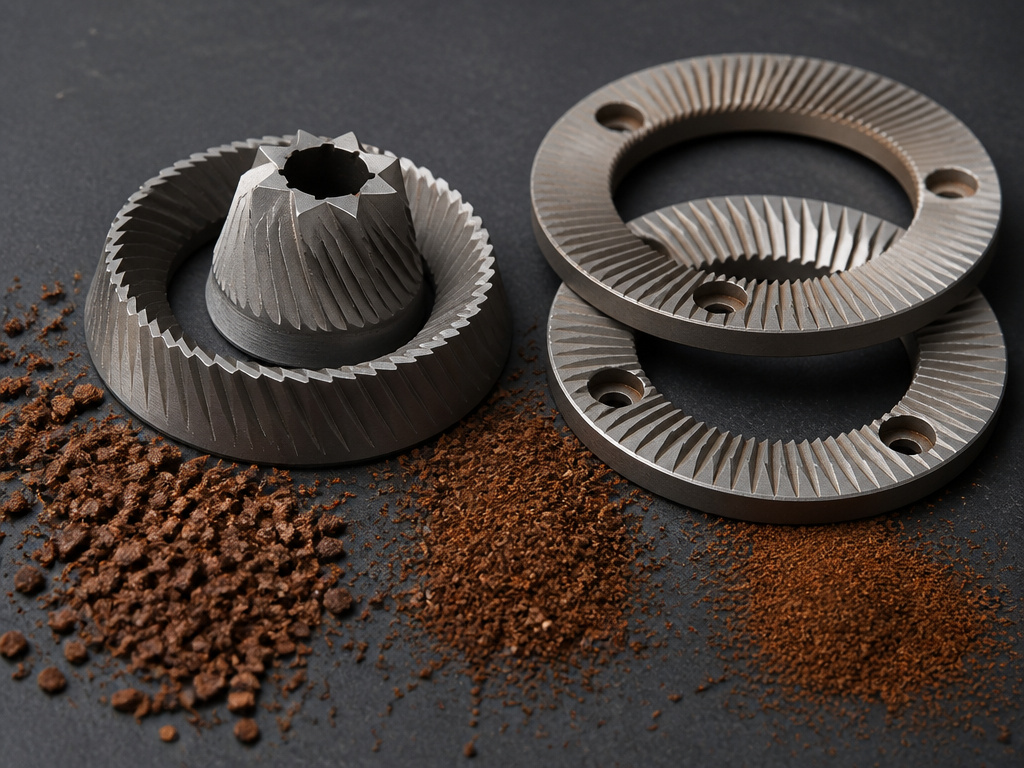
Conical burrs are two cone-shaped pieces that meet. Flat burrs are two parallel rings. The crush pattern changes the particle distribution and the grinder’s behavior.
| Burr Type | Best For | Trade-Off |
|---|---|---|
| Conical Burrs (Baratza Encore ESP, Comandante C40) | Espresso, quieter operation, less heat generation | Can become inconsistent at coarse settings if the crankshaft lacks support |
| Flat Burrs (Mahlkönig EK43S) | Pour-over, filter coffee, maximum uniformity | More expensive, louder, generate more friction heat |
Conical burrs guide beans through a narrowing channel. They crush with less friction, which means less heat transfer to the beans. Heat during grinding robs aroma. The Comandante C40 MK4 Nitro Blade uses conical burrs made from High-Nitrogen Stainless Steel, a material that starts sharp and holds its edge for espresso, but will dull faster than ceramic. That’s the trade-off: sharp now, replace later.
Flat burrs shear beans between two parallel surfaces. The shear force produces a more uniform particle distribution, especially in the medium-coarse range ideal for pour-over. The Mahlkönig EK43S uses 98mm cast steel flat burrs and a 1300 Watt motor to achieve that uniformity at 19-21 grams per second. The trade-off is noise and heat. Flat burr grinders are loud. They also generate more friction, which can warm the grounds if you grind large batches.
I ran a Hario Skerton ceramic burr hand grinder for a year. The crankshaft wobble at coarse settings meant my French press grind always had a few boulders. I switched to a steel burr manual grinder and the wobble vanished, the support structure matters more than the burr material for coarse grinding.
The wobble problem is a design flaw, not a material flaw. A conical burr set needs a stable axle. If the axle wobbles, common in cheaper manual grinders, the gap between the burrs varies during rotation. That variation throws boulders into your coarse grind. It’s why many manual grinders advertise “espresso capability” but fail at French press.
Electric vs. Manual Burr Grinders: The Torque and Noise Trade-Off

Electric grinders use motors. Manual grinders use your arm. The choice isn’t just about effort, it’s about torque control and noise.
Electric burr grinders have a motor that provides consistent torque. The Baratza Encore ESP uses a high-torque DC motor spinning at 550 RPM with no load. That torque prevents bogging down when you feed light roast beans. The trade-off is noise. Electric grinders sound like a small jet engine. If you grind before 6 AM, everyone in the house hears it.
Manual burr grinders are silent. The Comandante C40 MK4 requires about 45 seconds of cranking for 20 grams of beans at an espresso grind. Your arm provides the torque, which means you can feel the bean density. Light roasts take more effort. Dark roasts grind easier. That tactile feedback is useful for diagnosing bean hardness, but it’s also a workout.
Here’s the breakdown:
- For espresso: Electric is better. The torque consistency matters for pulling multiple shots. A manual grinder will fatigue your arm.
- For pour-over: Manual can work. The grind is coarser, requiring less effort.
- For noise-sensitive environments: Manual wins. No motor means no sound.
- For speed: Electric wins. The Baratza Encore ESP grinds 20 grams for espresso in about 15 seconds.
The manual path has a hidden benefit. You learn the beans. Feeling the resistance tells you about roast level, moisture, and even bean age. An electric grinder just spins.
The $25 Blade Grinder That Ruined a $30 Bag of Beans

I bought a KRUPS F203 because the box said “Coffee & Spice Grinder.” I had a bag of single-origin Ethiopian Yirgacheffe light roast that cost $30. I wanted to try it in a French press.
The motor bogged on the first grind. The beans were dense. The sound changed from a high-speed whir to a labored chop. After 25 seconds, I stopped. The result was a mix of powder, medium grounds, and a few whole bean halves. I sieved it with a paper towel. The fines, the dust, accounted for about 35% of the output. I threw that away.
The brew was terrible. Sour from the boulders, bitter from the fines. Muddy. I saved the remaining beans and ground them in a borrowed Baratza Encore. The difference wasn’t subtle. The cup was clean, floral, bright. The blade grinder wasn’t a coffee grinder. It was a bean destroyer.
That’s the reality. A blade grinder’s 200 Watt motor isn’t meant for dense coffee. It’s meant for spices, or for dark roasts that are brittle and crack easily. If you use it for light roast or single-origin beans, you’re wasting money. The grinder costs $25. The beans cost $30. You lose $10 in wasted fines every time.
How to Choose Your Grinder: A Step-by-Step Decision Matrix
Don’t just pick the prettiest one. Match the grinder to your brew method, your beans, and your tolerance for noise and waste.
- Identify your primary brew method. Espresso and pour-over demand a burr grinder. Drip coffee and French press can tolerate a blade grinder if you accept waste and inconsistent taste.
- Test your beans. If you buy light roast or single-origin beans, you need a burr grinder. The blade will bog down and produce a bad grind. Dark roast blends might work in a blade grinder, but you’ll still get inconsistency.
- Measure your noise tolerance. Electric burr grinders are loud. If you grind early in the morning, a manual grinder like the Comandante C40 is silent.
- Consider spice grinding. If you need a kitchen tool for peppercorns, cumin, and dried herbs, a blade grinder does that job well. The KRUPS F203 is a legitimate spice grinder.
- Budget for replacement. Steel burrs dull. Ceramic burrs chip. Manual grinders need arm effort. Electric grinders need motor maintenance. Plan for the long-term cost.
| Scenario | Recommended Grinder Type | Why |
|---|---|---|
| Espresso at home | Electric conical burr grinder (Baratza Encore ESP) | Torque-controlled motor, fine adjustment range, handles light roasts |
| Pour-over / filter coffee | Manual conical burr grinder (Comandante C40 MK4) | Silent, uniform medium grind, no heat transfer |
| Drip coffee only, budget-limited | Blade grinder (KRUPS F203) | Acceptable for dark roasts, excellent for spices |
| Professional café / multi-brew | Flat burr grinder (Mahlkönig EK43S) | Maximum uniformity, high speed, low retention |
The matrix ignores brand loyalty. It matches mechanism to use case. Your brew method decides the mechanism.
Frequently Asked Questions
Can I use a blade grinder for espresso?
No. Espresso requires a uniform fine grind. A blade grinder produces a mix of powder and chunks. The powder will over-extract and choke the machine; the chunks will under-extract and sour the shot. Even with a pressurized basket, the inconsistency will muddy the flavor.
Why are manual burr grinders so expensive?
The burr material and axle stability cost money. The Comandante C40 MK4 uses High-Nitrogen Stainless Steel burrs and a precision-machined axle that doesn’t wobble at coarse settings. Cheaper manual grinders use ceramic burrs and a less stable axle, which leads to inconsistency. You pay for the precision.
Do I need to sieve my grounds if I use a blade grinder?
Sieving removes the fines, which can improve taste for coarse methods like French press. But you’ll lose 30-40% of your grounds as waste. Sieving adds time and waste. It’s a workaround, not a solution.
What’s the Ross Droplet Technique?
It’s a single drop of water added to the beans before grinding in high-static grinders like the Mahlkönig EK43S. The water reduces static electricity, which keeps grounds from sticking to the chamber and creating retention. One drop is enough. More than that risks clogging.
Can a blade grinder damage my beans?
It doesn’t damage them; it grinds them inconsistently. The real damage is to your wallet, you waste a portion of every grind as unusable fines. For expensive single-origin beans, that waste adds up quickly.
Before You Go
Blade grinders chop. Burr grinders crush. Chopping is random, crushing is controlled. That control costs money, noise, or effort.
If you brew espresso or pour-over, a burr grinder is non-negotiable. The Baratza Encore ESP for electric, the Comandante C40 MK4 for manual. If you only brew dark roast drip coffee and also grind spices, a blade grinder like the KRUPS F203 is a legitimate kitchen tool, but know you’ll waste beans and get a muddy cup.
The particle gap is 40 microns. That gap is the difference between a clean, single-flavor note and a sour-bitty muddle. Your beans deserve the right crush.
