
How Often to Change Your Breville Coffee Machine Filter
Replace your Breville coffee machine filter by removing the tank, soaking a new ClaroSwiss filter for five minutes, setting the date dial, and reassembling it. The official interval is every 3 months or 40 liters, whichever comes first.
Most owners follow that three-month rule. They miss the real problem.
The 3-month schedule works if your water is soft. In hard water areas, that filter is exhausted in half the time. You’ll get scale anyway, and the machine’s reminder light will be the least of your worries.
This guide walks through the physical swap, explains why the official interval is a starting point, and shows you how to match your filter changes to your actual water.
Key Takeaways
- The factory filter is a Breville ClaroSwiss cartridge. Soak it for five minutes before use.
- Official replacement is every 3 months or 40 liters, but hard water requires monthly changes.
- A spent filter turns dark brown and feels slimy. Scale flakes in the tank are a late-stage warning.
- Using reverse osmosis or heavily softened water without adding minerals can damage the machine’s boiler.
- Set the filter holder’s date dial. It’s the only reminder you’ll get before the machine’s descale alarm triggers.
Why Your Breville Has a Filter in the First Place
It’s not just for taste. The ClaroSwiss filter in your Breville’s tank does two specific jobs that protect the machine.
First, it reduces scale-forming minerals like calcium and magnesium. This is the primary defense against limescale clogging the thermoblock or boiler, the heating element, and the steam wand. Second, it uses activated carbon to adsorb chlorine and other organic compounds that can give coffee a flat or chemical aftertaste.
The Breville ClaroSwiss water filter is an in-tank cartridge that reduces water hardness and chlorine. Per Breville manuals for the BES990, BES870, and BES878, its rated capacity is 40 liters or 3 months of use, whichever limit is reached first.
The 40-liter figure assumes average tap water. If your water is very hard, the mineral-removal resin inside the filter saturates faster. The carbon bed also has a finite capacity. Once saturated, the filter stops working. You’re just running unfiltered water through a plastic housing.
TL;DR: The filter is a consumable shield against limescale and bad tastes. Its lifespan depends entirely on your water’s mineral content.
The Two Ways a Filter Fails
You can’t see the resin inside. You judge by two external signs.
The first is time or volume. Hit three months or brew roughly 40 liters of coffee, and the filter is done. The second is visual. A brand-new filter is white and the plastic holder is clear. A spent one turns the water in the holder a murky brown. The cartridge itself darkens. If you touch it during removal, it feels slick.
Common mistake: Waiting for the machine’s “Replace Filter” light — the alert triggers on a simple timer, not on actual filter capacity. In hard water, the filter is spent weeks before the light comes on.
If you see fine, white flakes swirling in the tank after you fill it, that’s limescale already forming. The filter is gone. Those flakes will eventually deposit on heating surfaces.
Another failure mode is using water that’s too pure. This happens with reverse osmosis systems or certain water softeners. The ClaroSwiss filter isn’t designed for that. More critically, water with zero mineral content becomes corrosive. It can leach metals from the boiler and internal pipes. Your shots might taste metallic. The machine isn’t built for distilled water.
What’s the Real Replacement Schedule for Hard Water?
Breville’s manual doesn’t have a chart for water hardness. The 3-month/40L baseline is a compromise for typical municipal water.
In practice, you match the filter to your water’s grain-per-gallon (GPG) number. If you don’t know yours, check your local water utility’s annual report.
| Water Hardness Level (GPG) | Recommended Filter Change | What Happens If You Don’t |
|---|---|---|
| Soft (0–3 GPG) | Every 3 months | Minimal scale, taste may dull after month 3 |
| Moderate (3–7 GPG) | Every 2 months | Scale starts on thermoblock after 60 days |
| Hard (7–11 GPG) | Every 5–6 weeks | Visible flakes in tank by week 7, descale alarm within 4 months |
| Very Hard (11+ GPG) | Every 4 weeks | Filter saturation in under 30 days; severe scaling risk |
Reddit’s r/espresso community is blunt about this. Users in Arizona and Texas report changing filters monthly. They treat the official interval as a marketing-safe minimum, not an optimal guide.
If your machine sees daily use by a household, the 40-liter volume limit will hit before three months. A single double shot uses about 60ml of water. Two shots a day hits 40 liters in roughly 11 months. That math is wrong for most homes. Volume is the secondary limit.
The date dial on the filter holder is your best friend. Set it the day you install the filter. When you glance at the tank, you’ll know.
How to Install a New Breville Filter (Step-by-Step)

You need a new ClaroSwiss filter and five minutes. The process is identical for the Oracle Touch, Barista Express, and Barista Pro.
Step 1: Remove the Tank and Old Filter
Lift the water tank straight up and out of the machine. Dump any remaining water. Find the circular filter holder in the base of the tank. Twist it counterclockwise and pull up to release it. Pinch the tabs on the plastic holder and pull the old filter cartridge out. Throw it away.
Step 2: Soak and Assemble the New Filter
Take the new ClaroSwiss filter from its packaging. Submerge it completely in a cup or bowl of clean water for five minutes. Not two, not three. Five. This pre-hydrates the internal resin. If you skip the soak, the first few tanks of water won’t be filtered properly.
Rinse the filter under the tap. Snap it firmly into the clean plastic holder until it clicks.
Step 3: Set the Date and Reinstall
Rotate the dial on the filter holder so the current month aligns with the arrow or indicator mark. Slide the assembled holder back into the tank’s socket. Twist clockwise until it locks.
Fill the tank with fresh water to the MAX line. Slide the tank back into the machine.
That’s the part people skip. They forget to set the date dial. Two months later they have no idea when they changed it. The machine’s electronic reminder is a fallback, not a primary tool.
Can You Use Other Water Filters with a Breville?

Yes, but with caveats.
Many owners pre-filter their water with a Brita pitcher or an under-sink system. This extends the life of the in-tank ClaroSwiss filter because it’s dealing with fewer impurities. It’s a good strategy. Just remember the in-tank filter still needs changing. Its resin still degrades over time, even with pristine input water.
I ran my Barista Express on Brita-filtered water for a year, still changing the ClaroSwiss every three months. The used filters came out barely tinted. I stretched it to four months once. The next descale cycle was twice as long, fighting a thin scale film on the thermoblock.
Do not use the machine with straight reverse osmosis or distilled water. It needs some mineral content for taste and to prevent corrosion. Products like Third Wave Water or similar remineralization packets are designed for this. Add them to your tank after filtration.
The machine’s internal sensor measures water conductivity. Pure water won’t trigger the pump correctly. You might get error codes.
What Happens If You Ignore the Filter Light?
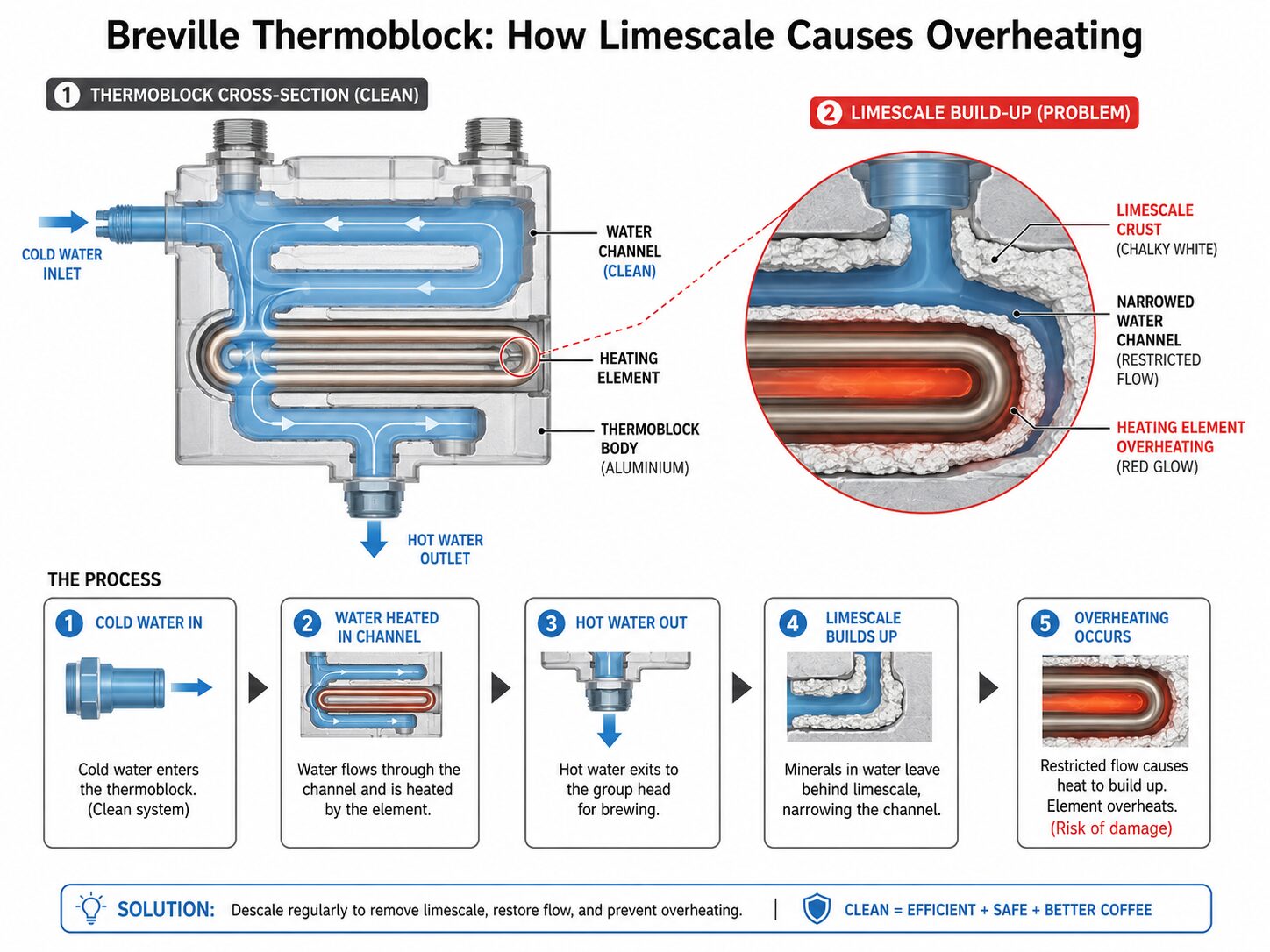
The “Replace Filter” message is a timer. It doesn’t test the water.
When you dismiss it, the machine continues operating. The spent filter just passes water through. Scale begins depositing on the hottest parts it can find: the thermoblock heating element, the steam wand thermostat, the three-way solenoid valve.
The first symptom is noise. The pump strains against narrowed waterways. Next, the steam wand loses pressure. Finally, the group head delivers lukewarm water because scale insulates the heater. The descale alert will trigger, but the descaling solution now has to eat through a thick crust, not a thin film.
A full descale cycle might not fix it. The heating element can overheat and fail. Replacing a thermoblock costs nearly half the price of a new machine.
Common mistake: Thinking the filter is only for taste — scale buildup is a mechanical failure. It destroys the machine from the inside, and the warranty doesn’t cover it.
The economics are simple. A ClaroSwiss filter costs less than a decent bag of coffee. A new thermoblock assembly costs more than ten bags. Change the filter.
Frequently Asked Questions
Can I use my Breville without the water filter?
Yes, but you must use the blank plastic bypass plug that came with the machine. It fits in the filter holder socket. Do not run the tank with the socket empty; water will leak into the machine’s base. If you lost the plug, you can order a replacement from Breville.
My filter holder is stuck. How do I remove it?
Push down firmly on the holder while twisting counterclockwise. Mineral deposits can cement it in place. If it won’t budge, fill the tank with a 50/50 mix of white vinegar and warm water. Let it sit for an hour to dissolve the scale, then try again. Rinse thoroughly afterward.
Is the Breville filter the same for all models?
The ClaroSwiss filter is standard for most recent Breville espresso machines, including the Oracle Touch (BES990), Barista Express (BES870), and Barista Pro (BES878). Older models like the BES860 or dual-boiler BES920 might use a different filter type. Always check your manual or the filter packaging for compatibility. Some coffee machine manuals are explicit about part numbers.
Why does my coffee taste bitter after changing the filter?
new filter can strip more minerals than your palate is used to, altering the extraction. Your grind might now be too fine for the changed water chemistry. Try adjusting your grind setting slightly coarser for the first few shots after a filter change. This is especially noticeable with single origin coffees that are sensitive to water composition.
How do I dispose of the used Breville filter?
The plastic holder is recyclable where #5 plastic is accepted. The spent filter cartridge itself is not biodegradable and should go in the trash. For a more sustainable approach, consider eco-friendly filters for your drip brewer, but the Breville system is proprietary.
Before You Go
Change your filter by the calendar, not just the machine’s light. Hard water cuts the lifespan in half. Look at the filter when you remove it—its color tells the true story.
Soak the new one for a full five minutes. Set the date dial. These two steps guarantee it works from the first tank.
Pair it with a pitcher filter if you want, but don’t run pure RO water. The machine needs some minerals. Your coffee’s flavor depends on it, and your machine’s life absolutely requires it. A clogged thermoblock is a permanent problem. A spent filter is a five-minute fix. Choose the easier fight.
