
The Physics of Filter Coffee: Why Brew Time Is So Critical
The physics of filter coffee dictates that brew time is critical because it controls extraction. Target 4–6 minutes. Shorter times (under 3 min) yield sour, underextracted coffee; longer times (over 6 min) yield bitter, overextracted coffee. This occurs because sweet compounds extract first, followed by bitter ones.
The physics of filter coffee is the study of how water temperature, flow rate, and grind particle size interact to extract soluble compounds from coffee grounds. It explains why a 6-minute brew can taste bitter and why a 3-minute one tastes sour. The goal is to hit an extraction yield between 18% and 22% of the coffee’s mass, which requires water between 92°C and 96°C and a total brew time of 4 to 6 minutes.
Most people think a longer brew equals stronger coffee. That’s backwards. Longer contact time pulls out more bitter, astringent compounds long after the sweet, fruity ones are gone. You’re not making it stronger; you’re making it worse.
This guide breaks down the core principles, temperature, time, and turbulence, into actionable steps. We’ll look at the science behind grind size, why water quality matters more than you think, and how to diagnose your brew by taste. You’ll learn to use physics, not guesswork, to make your next pot.
Key Takeaways
- Target a brew temperature of 92–96°C (197–205°F) and a total time of 4–6 minutes for optimal extraction.
- Grind size is your primary control for flavor; sour means grind finer, bitter means grind coarser.
- One gram of ground coffee absorbs two milliliters of water, account for this in your pour.
- Minimize fines (particles smaller than 100 µm) for filter coffee; they over-extract and cause bitterness.
- Use fresh, oxygenated water; water left in a reservoir overnight loses dissolved oxygen and brews a flat cup.
What are the core principles of filter coffee physics?
Filter coffee brewing is a percolation process. Hot water flows through a bed of ground coffee, dissolving soluble compounds as it goes. Three variables dominate: water temperature, contact time, and the surface area of the coffee particles.
The European Coffee Brewing Center (ECBC) certification standards give us the numbers. Water in the brew basket must reach 92°C and stay between 92–96°C for the entire brew cycle. Solubles yield, the percentage of coffee mass dissolved into the water, should land between 18.0% and 22.0%. Beverage strength, which is the concentration of those solubles in your cup, should be between 1.30% and 1.55%.
Water temperature in the brew basket must reach 92ºC and stay between 92-96ºC throughout the brew, never exceeding 96ºC. Solubles yield (extraction) should range between 18.0% to 22.0%. Beverage strength (solubles concentration) should be between 1.30% to 1.55%.
If any one variable drifts, the others must compensate. Use water that’s too cool, and you’ll need a finer grind or longer contact time to hit the same extraction. That’s a shaky balance. Get the temperature right first.
TL;DR: Hit 92–96°C water temp, then adjust grind size to get a 4–6 minute total brew time for a balanced extraction.
How does grind size change extraction?
Grind size determines surface area. Finer grinds have exponentially more surface area exposed to water. This lets extraction happen faster. A grind that’s too fine will over-extract before your target brew time is up, pulling bitter and astringent compounds into the cup. A grind that’s too coarse will under-extract, leaving sour, acidic notes dominant.
The relationship isn’t linear. Going from a coarse to a medium grind might double your extraction rate. Going from medium to fine might triple it. Your grinder matters more than your brewer here. A blade grinder produces a wild mix of particle sizes, from powder to chunks. A good burr grinder benefits from consistent particle size, which leads to even extraction.
| Grind Size | Visual Cue | Target Brew Time | Risk If Wrong |
|---|---|---|---|
| Extra Coarse | Like sea salt | 8+ minutes (cold brew) | Sour, weak coffee |
| Coarse | Like rough sand | 6-8 minutes (French press) | Under-extracted, acidic |
| Medium-Coarse | Like table salt | 5-6 minutes (Chemex) | Can be either sour or bitter |
| Medium | Like beach sand | 4-5 minutes (drip machine) | Balanced extraction target |
| Medium-Fine | Like fine sand | 3-4 minutes (pour-over) | Bitter, over-extracted if too long |
| Fine | Like table sugar | 25-45 seconds (espresso) | Clogged filter, bitter cup |
The target for most drip coffee method brewers is a medium grind. If your coffee tastes sour, grind finer. If it tastes bitter or dry, grind coarser. Change only one variable at a time.
The Fines Problem
Fines are coffee particles smaller than 100 micrometers. In espresso, they are necessary for creating resistance and surface area in a short extraction window. In filter coffee, they are mostly a problem.
Fines over-extract rapidly. They release bitter, astringent compounds long before the larger particles are fully extracted. This muddies the clarity of your cup. A 2020 study in Scientific Reports on single-serve coffee extraction publication found that the proportion of fines, not the median particle size, was the primary factor controlling extraction time in capsules. More fines meant longer, more uneven extraction.
Fines are generally undesirable in filter coffee as they are prone to over-extraction, contributing bitterness and astringency. Minimizing fines in filter brewing can lead to a cleaner, sweeter cup with smoother mouthfeel.
Your grinder creates fines. Some are inevitable. The goal is to minimize them. High-quality burr grinders produce fewer fines than blade grinders. Even with a great grinder, if you hear a high-pitched whine during grinding, you’re creating extra fines from friction heat. Pulse your grinder instead of running it continuously.
TL;DR: Fines over-extract and cause bitterness. A good burr grinder minimizes them, leading to a cleaner cup.
Why does water temperature matter so much?
Temperature controls solubility. Different coffee compounds dissolve at different rates depending on heat. Sugary, fruity compounds extract well at lower temperatures. Bitter, woody compounds need more heat to leave the bean.
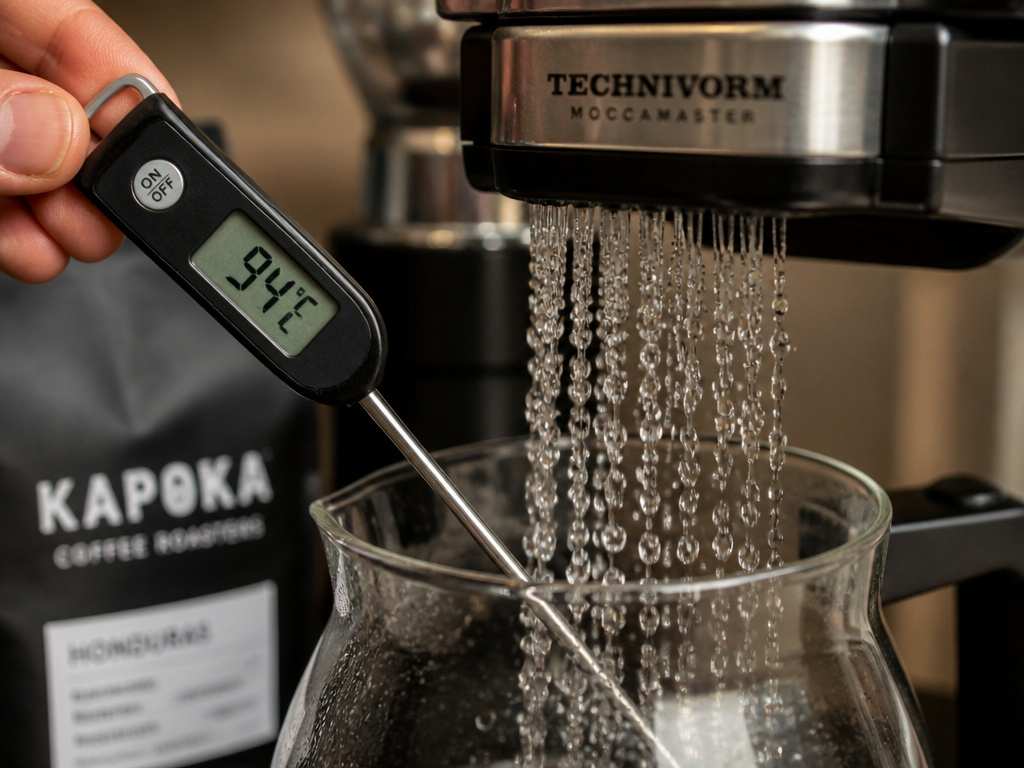
The ECBC standard’s 92–96°C range is not arbitrary. Below 92°C, you struggle to hit an 18% extraction yield without drastically extending brew time or grinding impractically fine. Above 96°C, you risk extracting harsh, bitter compounds too quickly, even with a coarser grind. Your brewer might not hold this range. A Technivorm Moccamaster is certified to do it. Many cheap drip machines barely hit 85°C at the shower head.
Here’s a test. Run water through your empty brewer into a cup. Measure the temperature immediately with a thermometer. If it’s below 90°C, your machine is the limiting factor. Pre-heating the machine with a full reservoir of boiling water can help, but it’s a patch, not a fix.
Common mistake: Brewing with water straight from a kettle that’s cooled to 80°C, the sour, thin cup that results needs a grind so fine it will clog the filter, creating a muddy brew.
Water quality is the other half. The Technivorm Moccamaster manual explicitly advises using cool, fresh, filtered or bottled water. Water left in a reservoir overnight loses dissolved oxygen. Oxygen is a carrier for aroma compounds. Stale water makes a flat-tasting brew regardless of your perfect grind and temperature.
How do you calculate and control brew time?
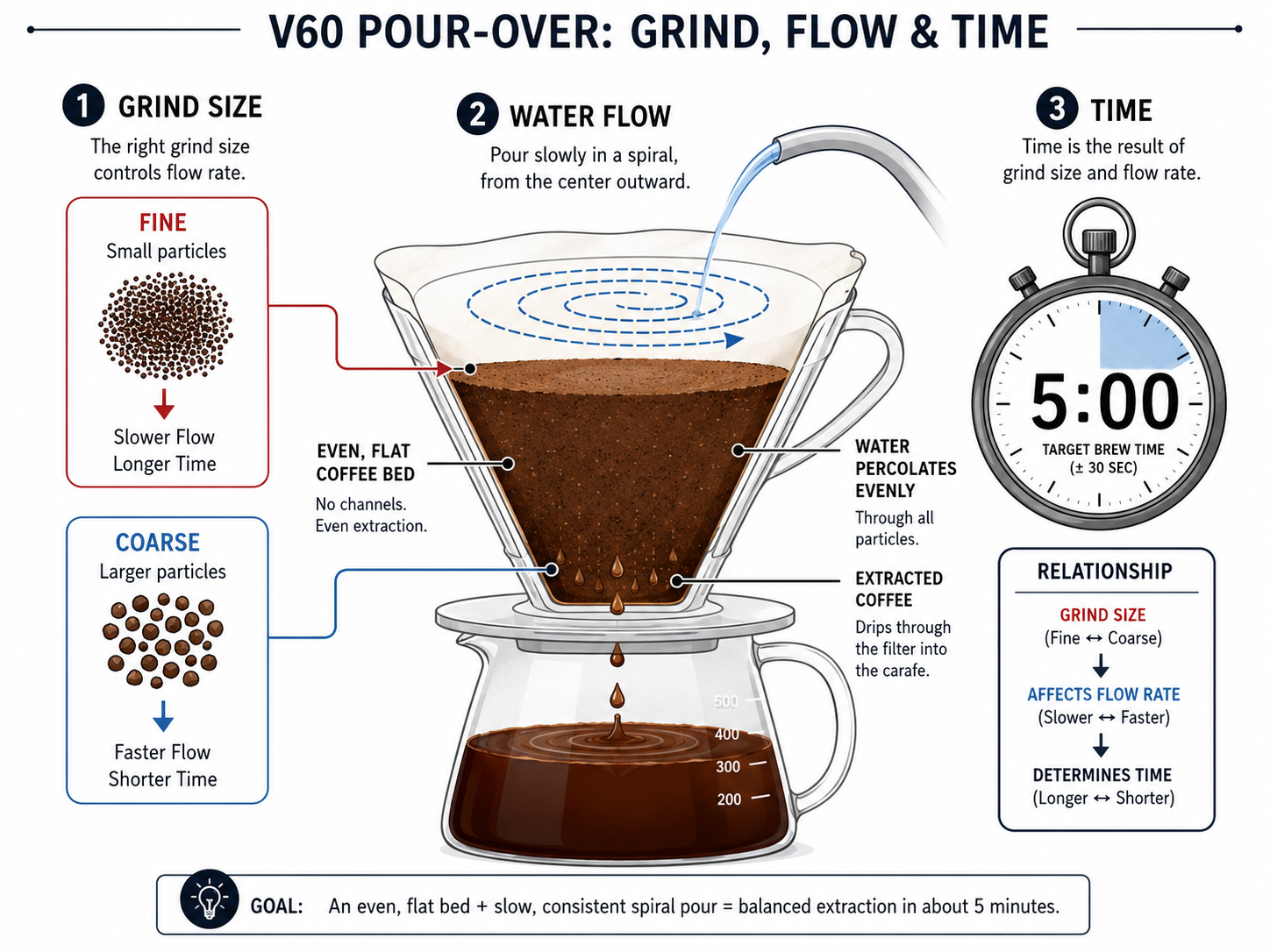
Brew time is the result of your grind size, water temperature, and pour technique. It is not a variable you set directly. You influence it. The ECBC standard states a typical brewing time for filter coffee brewers is 4 to 6 minutes.
Start with a medium grind and your water at 94°C. From the moment water first hits the grounds, your total brew time, including any pouring or blooming phases, should land in that 4–6 minute window. If it drains in 3 minutes, your coffee will be under-extracted and sour. Grind finer. If it takes 7 minutes, it will be over-extracted and bitter. Grind coarser.
For manual pour-overs, your pour pattern is part of the time. A slow, controlled pour from a gooseneck kettle increases contact time. Aggressive pouring can dig channels in the coffee bed, letting water rush through without extracting evenly. The goal is an even, flat bed of grounds after the drawdown.
The Two Main Brewing Methods
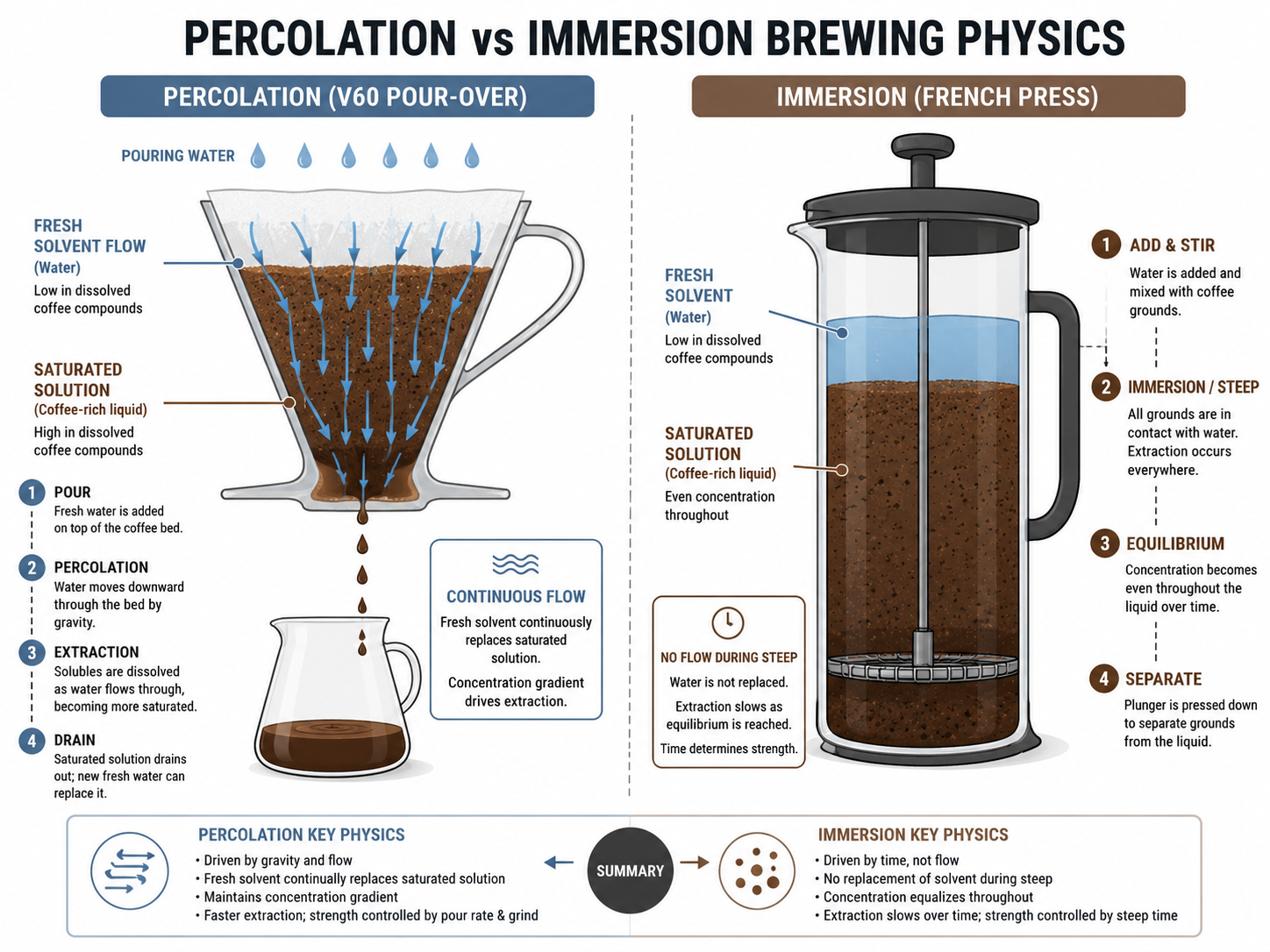
All filter coffee falls into one of two categories: percolation or immersion. The physics are different for each.
Percolation is what most people think of: water flows through a stationary bed of coffee grounds. This includes drip machines, pour-overs, and batch brewers. Efficiency is high because fresh, unsaturated water is always contacting the grounds, carrying away solubles. Control is also high, as you manage the flow rate.
Immersion involves steeping grounds in water, then separating them. The French press is the classic example. Extraction is slower because the water surrounding the grounds becomes saturated with coffee solids, slowing further dissolution. This is why coffee professional Scott Rao contends that 99% of professionals do not grind fine enough for French press, they need the increased surface area to compensate for the method’s lower extraction efficiency.
| Method | Category | Key Physics Principle | Best For |
|---|---|---|---|
| Drip Machine | Percolation | Continuous fresh solvent (water) flow | Consistency, larger batches |
| Pour-Over (V60, Kalita) | Percolation | Controlled flow rate via pour technique | Clarity, nuanced single-origins |
| French Press | Immersion | Steeping in a saturated solution | Body, texture |
| AeroPress | Hybrid (immersion then percolation) | Pressure-assisted filtration | Versatility, strength control |
Your choice of coffee bean origins plays into this. Dense, hard light roast beans from high altitudes often need a slightly finer grind and higher temperature to extract fully, especially in immersion brews where efficiency is lower.
What about coffee-to-water ratio and bed depth?
The ECBC recommends a coffee-to-water ratio of 50–60 grams per liter for comparative testing. That’s a 1:16.7 to 1:20 ratio. Most home recipes settle around 1:16.5 (60g/L). This ratio determines strength, not extraction. Extraction is about what percentage of the coffee dissolves. Strength is about how concentrated that solution is.
You can have a strong, under-extracted coffee (sour and intense) or a weak, over-extracted coffee (bitter and thin). Ratio fine-tunes strength after you’ve dialed in extraction with grind and time.
Bed depth is the often-overlooked variable. The ECBC standard says cylindrical filter baskets should provide bed depths between 2.5 cm and 5 cm. Why? Water flowing through a deep, narrow bed behaves differently than through a wide, shallow one. A deeper bed offers more resistance, increasing contact time. It also requires a coarser grind to allow water to pass through in the target time. If your brewer has a small basket, you might need to use less coffee or grind coarser to hit the 4–6 minute window.
One gram of ground coffee absorbs two milliliters of water. This matters for your pour. If your recipe calls for 500ml of water and 30g of coffee, the grounds will absorb 60ml. You’ll only get about 440ml of brewed coffee in your carafe. Plan your final yield accordingly.
Troubleshooting Your Brew by Taste
Your palate is the best instrument. Here’s how to diagnose the physics from the flavor in your cup.
Sour, sharp, salty taste: This is under-extraction. The water hasn’t pulled enough sugars and balanced compounds from the coffee. The fix is usually to grind finer, which increases surface area. You can also increase water temperature slightly or extend contact time by pouring more slowly.
Bitter, dry, astringent taste: This is over-extraction. The water has pulled too many bitter, woody compounds. Grind coarser to reduce surface area and shorten the contact time. Check that your water isn’t too hot.
Flat, dull, lacking sweetness: This often points to water quality or stale coffee. Try brewing with fresh, filtered water. If that doesn’t help, your coffee might be stale or your brewed coffee strength might be off, adjust your ratio slightly.
Common mistake: Chasing a sour cup by extending brew time with the same fine grind, you’ll eventually hit bitterness, but you’ll miss the sweet spot in the middle. The correct move is to grind finer first, which increases extraction efficiency without over-extracting the outer layers of the grounds.
Make one change at a time. Write down what you did. The optimal grind for filtration is a moving target that changes with coffee age, roast level, and even humidity.
Frequently Asked Questions
What is the ideal water temperature for filter coffee?
The ideal range is 92–96°C (197–205°F). This temperature range maximizes the extraction of desirable sugars and acids while minimizing the extraction of harsh, bitter compounds. Many home drip machines don’t reach this temperature, which is why pre-heating with boiling water or using a dedicated kettle can make a significant difference.
How does grind size affect brew time?
Grind size is the primary controller of brew time in a percolation brew. Finer grinds create more surface area and more resistance to water flow, slowing the brew down. Coarser grinds allow water to pass through more quickly. If your brew finishes too fast (<4 min), grind finer. If it takes too long (>6 min), grind coarser.
What are “fines” and why are they bad for filter coffee?
Fines are coffee particles smaller than 100 micrometers. They have an enormous surface area relative to their volume, so they over-extract very quickly, contributing bitter and astringent flavors to the cup. Minimizing fines through a quality burr grinder and proper technique is key to a clean-tasting filter coffee.
Is a more expensive coffee maker worth it for the physics?
Often, yes. Certified brewers like the Technivorm Moccamaster are engineered to deliver water in the correct temperature range (92–96°C) for the correct time (4–6 minutes) consistently. Cheaper machines often miss one or both parameters, making it impossible to brew to the SCA/ECBC standards no matter how perfect your beans and grind are.
Can I use the same grind setting for pour-over and my drip machine?
Probably not. Drip machines typically have a faster flow rate and less thermal mass than a manual pour-over setup. You will usually need a slightly coarser grind for a drip machine to hit the same 4–6 minute target brew time. Start with your pour-over setting and go one click coarser on your grinder for the machine.
Before You Go
The physics isn’t just theory. It’s the explanation for why your last cup was bitter and how to fix the next one. Start with water at the right temperature. Let grind size be your main control for flavor, targeting a 4 to 6 minute total brew time. Remember that one gram of coffee holds onto two milliliters of water, your final yield will be less than your pour.
A good burr grinder that minimizes fines will do more for your coffee than a $200 gooseneck kettle. If your tap water tastes bad, your coffee will too. The standards from the SCA and ECBC exist because they work. Hit those numbers, 92–96°C, 4–6 minutes, 18–22% extraction, and you’ll move from making drinkable coffee to making exceptional coffee every single time.
{
“@context”: “https://schema.org”,
“@type”: “HowTo”,
“name”: “Applying the Physics of Filter Coffee for a Balanced Brew”,
“totalTime”: “PT6M”,
“tool”: [
{
“@type”: “HowToTool”,
“name”: “Burr grinder”
},
{
“@type”: “HowToTool”,
“name”: “Scale accurate to 0.1g”
},
{
“@type”: “HowToTool”,
“name”: “Gooseneck kettle or batch brewer with temperature control”
},
{
“@type”: “HowToTool”,
“name”: “Timer”
}
],
“step”: [
{
“@type”: “HowToStep”,
“name”: “Measure your coffee and water”,
“text”: “Use a 1:16.5 coffee-to-water ratio (60g coffee per liter). Weigh both ingredients on a scale.”
},
{
“@type”: “HowToStep”,
“name”: “Grind your beans”,
“text”: “Set your burr grinder to a medium-fine setting. Aim for a particle size that looks like coarse sand, not powder.”
},
{
“@type”: “HowToStep”,
“name”: “Pre-heat your brewer and vessel”,
“text”: “Pour hot water through your empty filter and into your serving carafe to warm everything up. Discard this water.”
},
{
“@type”: “HowToStep”,
“name”: “Start your brew timer”,
“text”: “Begin pouring water just off the boil (92-96°C) over the grounds in a slow, circular motion to saturate all the coffee evenly.”
},
{
“@type”: “HowToStep”,
“name”: “Manage the drawdown”,
“text”: “Allow the water to drain completely. The total brew time, including pouring, should be between 4 and 6 minutes for most batch brewers.”
},
{
“@type”: “HowToStep”,
“name”: “Taste and adjust”,
“text”: “If the coffee tastes sour or weak, grind finer next time. If it tastes bitter or astringent, grind coarser.”
}
]
}
{
“@context”: “https://schema.org”,
“@type”: “FAQPage”,
“mainEntity”: [
{
“@type”: “Question”,
“name”: “What is the ideal water temperature for filter coffee?”,
“acceptedAnswer”: {
“@type”: “Answer”,
“text”: “The ideal range is 92–96°C (197–205°F). This temperature range maximizes the extraction of desirable sugars and acids while minimizing the extraction of harsh, bitter compounds. Many home drip machines don’t reach this temperature, which is why pre-heating with boiling water or using a dedicated kettle can make a significant difference.”
}
},
{
“@type”: “Question”,
“name”: “How does grind size affect brew time?”,
“acceptedAnswer”: {
“@type”: “Answer”,
“text”: “Grind size is the primary controller of brew time in a percolation brew. Finer grinds create more surface area and more resistance to water flow, slowing the brew down. Coarser grinds allow water to pass through more quickly. If your brew finishes too fast (6 min), grind coarser.”
}
},
{
“@type”: “Question”,
“name”: “What are \”fines\” and why are they bad for filter coffee?”,
“acceptedAnswer”: {
“@type”: “Answer”,
“text”: “Fines are coffee particles smaller than 100 micrometers. They have an enormous surface area relative to their volume, so they over-extract very quickly, contributing bitter and astringent flavors to the cup. Minimizing fines through a quality burr grinder and proper technique is key to a clean-tasting filter coffee.”
}
},
{
“@type”: “Question”,
“name”: “Is a more expensive coffee maker worth it for the physics?”,
“acceptedAnswer”: {
“@type”: “Answer”,
“text”: “Often, yes. Certified brewers like the Technivorm Moccamaster are engineered to deliver water in the correct temperature range (92–96°C) for the correct time (4–6 minutes) consistently. Cheaper machines often miss one or both parameters, making it impossible to brew to the SCA/ECBC standards no matter how perfect your beans and grind are.”
}
},
{
“@type”: “Question”,
“name”: “Can I use the same grind setting for pour-over and my drip machine?”,
“acceptedAnswer”: {
“@type”: “Answer”,
“text”: “Probably not. Drip machines typically have a faster flow rate and less thermal mass than a manual pour-over setup. You will usually need a slightly coarser grind for a drip machine to hit the same 4–6 minute target brew time. Start with your pour-over setting and go one click coarser on your grinder for the machine.”
}
}
]
}
