
Is Espresso Powder Same as Instant Coffee? We Compare Them
This post contains affiliate links. As an Amazon Associate, we earn from qualifying purchases.
No, espresso powder is not the same as instant coffee. The core difference is concentration and purpose: espresso powder is a highly concentrated, fine powder made from brewed and dehydrated espresso, designed primarily for baking to impart a deep coffee flavor without adding liquid. Instant coffee is a granulated, soluble product made from brewed coffee, intended for quick reconstitution into a drink. They differ in caffeine, processing, flavor, and best uses.
The confusion starts on the grocery store shelf. Both come in jars. Both dissolve. The mistake is thinking they’re interchangeable. Swap one for the other in a recipe and the entire balance shifts, the cake tastes weak or the drink turns bitter.
This guide breaks down the manufacturing, the numbers, and the real-world results. You’ll learn exactly when to use each, why their caffeine levels are inverted, and how a mistake from 1901 still shapes what’s in your cupboard today.
Key Takeaways
- Espresso powder is for baking, instant coffee is for drinking. Substituting one for the other dulls flavor or creates unwanted bitterness.
- Instant coffee packs nearly double the caffeine. An 8-oz cup of instant has 80–120mg; a shot of espresso powder has about 58mg.
- The beans and process are different. Espresso powder often uses dark roast Arabica beans, while instant coffee frequently relies on Robusta beans processed at high heat.
- Homemade “espresso powder” is just strong coffee grounds. True commercial powder is a concentrated instant product, not merely ground beans.
- Price signals quality for instant coffee. A YouTube taste test found a $30 jar tasted of fruity cherries, while a $1 option smelled like chicken broth.
The Caffeine & Flavor Breakdown
Open both jars. The visual difference is the first clue. Espresso powder is a very fine, almost dusty powder. Instant coffee consists of larger, crunchy granules or crystals. This physical form hints at their divergent internal chemistry and intended destinations, one into batter, the other into hot water.
Espresso powder is a flavoring agent. Instant coffee is a beverage base. This fundamental divide dictates their formulation: powder maximizes soluble coffee solids for impact without volume; granules optimize quick, complete dissolution in liquid.
The most surprising difference is the caffeine. Common logic says espresso is stronger. With these powders, the opposite is true. Data from industry sources shows an 8-ounce cup of reconstituted instant coffee delivers between 80 and 120 milligrams of caffeine. A single serving of espresso powder, equivalent to one shot, contains approximately 58 milligrams. You get nearly twice the stimulant kick from the instant drink.
Flavor profiles split just as sharply. A proper espresso powder, like those from Medaglia d’Oro or King Arthur Baking, offers a pure, intense coffee punch. It’s designed to cut through fat and sugar in chocolate cakes and buttercreams without contributing acidity or bitterness. Instant coffee, especially cheaper brands using Robusta beans, carries a distinct, often harsh, roasted note. This can taste flat or ashy in baked goods. In a mug, that same profile reads as “bold” to many drinkers.
TL;DR: Instant coffee has more caffeine and a harsher flavor. Espresso powder is less caffeinated but offers a cleaner, more concentrated coffee taste for recipes.
How They’re Made: From Bean to Jar
You cannot understand the end product without knowing the journey. The manufacturing processes for these two items are cousins, not twins. Both start with brewing coffee, but their paths diverge dramatically in temperature, pressure, and purpose.
Instant coffee production is an industrial-scale effort to create a shelf-stable, instantly soluble drink. After brewing a very strong coffee concentrate, manufacturers use one of two methods: spray-drying or freeze-drying. Spray-drying blasts the liquid through hot air, creating fine powders. Freeze-drying freezes the concentrate and then uses a vacuum to sublimate the ice, leaving behind those recognizable porous granules. The technical guide from the Brazilian Instant Coffee Association notes that during percolation brewing for instant, the solid concentration can vary between 6% and 32%, and hydrolysis temperatures reach 160°C to 175°C under pressure. This high-heat process is part of what develops instant coffee’s characteristic, sometimes aggressive, flavor.
Espresso powder takes a more focused route. Manufacturers brew an actual espresso, finely ground dark roast Arabica beans under high pressure, to create an intensely flavored liquid. This concentrate is then dehydrated, often using a lower-temperature method to preserve volatile aromatics, and ground into an ultra-fine powder. The goal isn’t solubility in a cup of water; it’s the ability to disperse evenly in a dry flour mixture or fat-based frosting and deliver a potent flavor payload.
| Aspect | Espresso Powder | Instant Coffee |
|---|---|---|
| Primary Bean | Often high-quality Arabica, dark roast | Frequently Robusta or Arabica/Robusta blends |
| Key Process | Brew espresso, dehydrate, mill to fine powder | Brew concentrate, spray-dry or freeze-dry into granules |
| Processing Heat | Lower temperatures to preserve flavor | High heat (160–175°C) for hydrolysis and drying |
| End Product Form | Fine, dusty powder | Granules or small crystals |
| Designed For | Incorporating into dry or fat-based mixes (baking) | Instant dissolution in hot or cold water (drinking) |
When to Use Each (And When to Run)
This is the decision matrix that matters. Using the wrong one doesn’t just make a subpar result; it can ruin a dish or a drink. Your goal dictates your choice.
Reach for espresso powder when:
- Baking chocolate desserts: It deepens chocolate flavor without adding moisture. A teaspoon in brownie batter is magic.
- Making rubs or spice mixes: It adds a complex, roasted note to meat rubs.
- Creating coffee-flavored frostings or buttercreams: It dissolves seamlessly into fat for a smooth, potent flavor.
- You need pure coffee flavor without liquid: This is its superpower.
Reach for instant coffee when:
- You want a fast, cheap cup of coffee: That’s its original and best purpose.
- Making a coffee-flavored liquid: Think tiramisu soak or coffee liqueur.
- Some recipes specifically call for it: Certain old-school recipes, like some Russian black cake recipes, rely on its specific flavor.
- You need a caffeine boost in a smoothie or protein shake: It blends in easily.
Common mistake: Using instant coffee in a chocolate cake to save money. The harsh, ashy notes amplify in the oven, and the cake will taste faintly burnt, not richly of coffee. The sugar and fat can’t hide it.
What about the edge case? Can you use instant coffee in a pinch for baking? The consensus from baker forums is maybe, but with a warning. If a recipe needs a subtle coffee note and you have a high-quality instant (think the $30 “coffee diamond” type from the YouTube review), it might work. The cheap stuff that “smells like chicken broth” will let you down. For a reliable, bold coffee flavor, the specialized tool, espresso powder, wins.
The reverse mistake is trying to make a drink with espresso powder. Because it’s so fine and concentrated, it can create a sludgy, overpowering cup. A YouTube experimenter filled an espresso machine portafilter with instant coffee and pulled a shot; it tasted “so sour.” The machinery and the material were mismatched.
A Brief History of Convenience Coffee
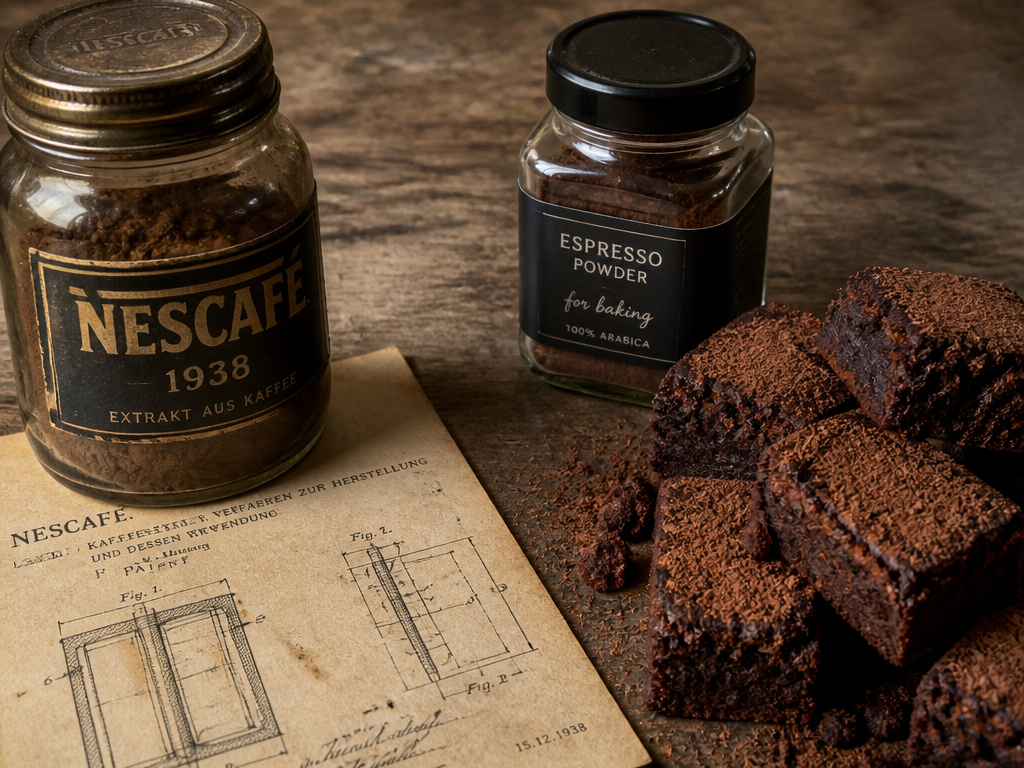
The stories behind these jars are a century apart. Instant coffee’s origin is a tale of patents and world’s fairs. The first stable version was invented by Satori Kato in 1901 and sold at the Pan-American Exposition in New York. The breakthrough for mass production came from Max Morgenthaler in 1937, who was solving the problem of wasting coffee surpluses for Nestlé. His work led to the launch of Nescafé in 1938, cementing instant coffee’s place in pantries worldwide. This history is documented in industry guides.
Espresso powder has no such singular inventor. It evolved as a byproduct of the specialty baking world’s need for a consistent, potent flavoring. While early cooks might have simply used very finely ground coffee, the commercial product we know emerged to meet the demand for reliability, the same flavor intensity, batch after batch. This difference in origin explains their cultural place: one is a global beverage commodity; the other is a niche culinary ingredient.
Homemade “Espresso Powder” vs. The Real Thing
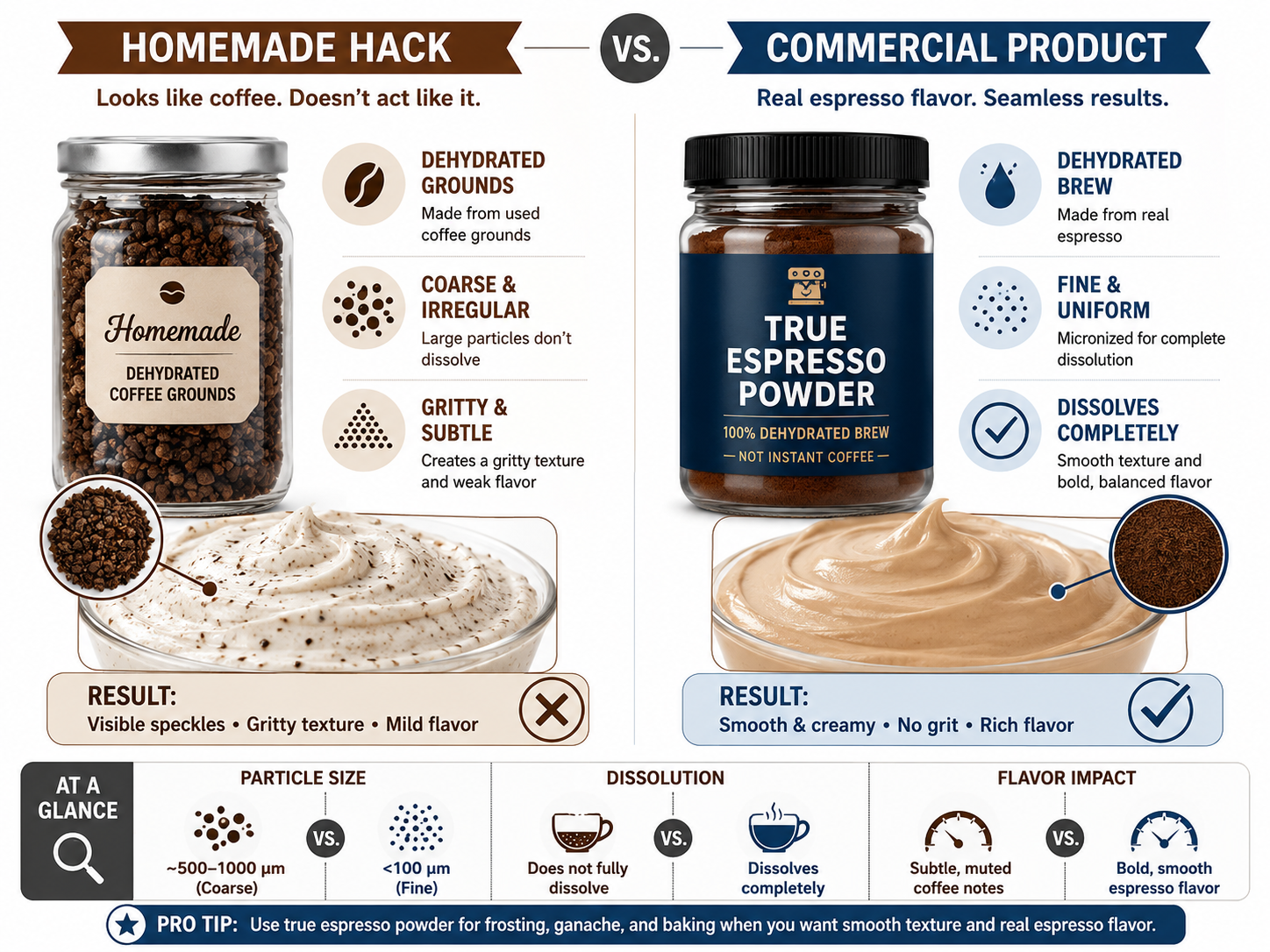
A popular internet hack suggests making your own espresso powder by baking leftover brewed coffee grounds until dry, then grinding them. Let’s be clear about what this creates. This method produces dehydrated coffee grounds, not true espresso powder. The flavor will be subtle, stale, and gritty. A brand blog on the subject confirms homemade versions result in a more subtle flavor.
True commercial espresso powder is a concentrated instant product. It starts as brewed espresso, not spent grounds, and undergoes a controlled dehydration process that preserves soluble flavor compounds. The result is a powder that dissolves completely, leaving no sediment. The homemade version won’t dissolve in frosting. You’ll get tiny speckles and an off flavor.
If you want to try the homemade route for small-batch recipes, here’s the least-worst method:
1. Brew a very strong batch of espresso or coffee using a dark roast.
2. Spread the liquid very thinly on a silicone baking mat.
3. Dehydrate in an oven at its lowest setting (under 200°F) for several hours until completely bone-dry and flaky.
4. Grind the brittle sheets in a clean spice grinder to a fine powder.
5. Sift through a fine mesh strainer.
Store it airtight. It will work in a pinch for a rub or a bold recipe, but manage your expectations. It lacks the shelf stability and concentrated punch of a product like Ferrara or Medaglia d’Oro.
Frequently Asked Questions
Can I use espresso powder to make a cup of coffee?
Technically yes, but you shouldn’t. It will create an extremely strong, almost syrupy cup that’s difficult to balance. It’s wasteful of a premium baking ingredient. Use instant coffee or ground coffee for drinking.
What’s the best espresso powder for baking?
Medaglia d’Oro Instant Espresso Coffee is the long-standing gold standard for its pure, non-bitter flavor. King Arthur Baking Company’s Espresso Powder is also highly regarded and consistently fine-textured.
Does espresso powder go bad?
Like all dried coffee products, it loses potency over time. Stored in an airtight container in a cool, dark place, it’s best used within a year for peak flavor. It won’t spoil, but it will taste flat.
Is there a decaf version of espresso powder?
Yes, several brands offer decaffeinated instant espresso powder. It’s excellent for adding coffee flavor to desserts for those sensitive to caffeine without the stimulant effect.
Why is some instant coffee so cheap?
Lower-cost instant coffee often uses Robusta beans, which are hardier and cheaper to grow than Arabica, and may employ less expensive spray-drying methods. The flavor reflects this, as noted in online taste comparisons where budget options had unfavorable, broth-like aromas.
The Bottom Line
They share a shelf, but they are not substitutes. Espresso powder is your secret weapon for deep, resonant coffee flavor in baking, a specialized tool for a specific job. Instant coffee is a convenient, caffeine-forward solution for a quick drink. Remember the caffeine flip: the drinking powder is stronger. Remember the history: one changed global coffee habits, the other perfected the chocolate cake.
Keep both in your pantry. Use the fine powder when flour and butter are involved. Use the granules when you need a fast mug. Understanding this distinction is what separates a good recipe from a great one.
{
“@context”: “https://schema.org”,
“@type”: “HowTo”,
“name”: “How to Choose Between Espresso Powder and Instant Coffee”,
“totalTime”: “PT5M”,
“tool”: [
{
“@type”: “HowToTool”,
“name”: “Measuring spoons”
},
{
“@type”: “HowToTool”,
“name”: “Small bowl for mixing”
}
],
“step”: [
{
“@type”: “HowToStep”,
“name”: “Identify your use case”,
“text”: “Determine if you need the ingredient for baking (choose espresso powder) or for making a quick drink (choose instant coffee).”
},
{
“@type”: “HowToStep”,
“name”: “Check caffeine needs”,
“text”: “Note that instant coffee has nearly double the caffeine per serving compared to a shot of espresso powder.”
},
{
“@type”: “HowToStep”,
“name”: “Assess flavor intensity”,
“text”: “For a bold, non-bitter coffee punch in recipes, use espresso powder. For a milder, sometimes harsher flavor in liquid, use instant.”
},
{
“@type”: “HowToStep”,
“name”: “Consider making your own”,
“text”: “For a subtle homemade option, brew very strong espresso, spread it thin, and dehydrate it completely before grinding.”
}
]
}
{
“@context”: “https://schema.org”,
“@type”: “FAQPage”,
“mainEntity”: [
{
“@type”: “Question”,
“name”: “Can I use espresso powder to make a cup of coffee?”,
“acceptedAnswer”: {
“@type”: “Answer”,
“text”: “Technically yes, but you shouldn’t. It will create an extremely strong, almost syrupy cup that’s difficult to balance. It’s wasteful of a premium baking ingredient. Use instant coffee or ground coffee for drinking.”
}
},
{
“@type”: “Question”,
“name”: “What’s the best espresso powder for baking?”,
“acceptedAnswer”: {
“@type”: “Answer”,
“text”: “Medaglia d’Oro Instant Espresso Coffee is the long-standing gold standard for its pure, non-bitter flavor. King Arthur Baking Company’s Espresso Powder is also highly regarded and consistently fine-textured.”
}
},
{
“@type”: “Question”,
“name”: “Does espresso powder go bad?”,
“acceptedAnswer”: {
“@type”: “Answer”,
“text”: “Like all dried coffee products, it loses potency over time. Stored in an airtight container in a cool, dark place, it’s best used within a year for peak flavor. It won’t spoil, but it will taste flat.”
}
},
{
“@type”: “Question”,
“name”: “Is there a decaf version of espresso powder?”,
“acceptedAnswer”: {
“@type”: “Answer”,
“text”: “Yes, several brands offer decaffeinated instant espresso powder. It’s excellent for adding coffee flavor to desserts for those sensitive to caffeine without the stimulant effect.”
}
},
{
“@type”: “Question”,
“name”: “Why is some instant coffee so cheap?”,
“acceptedAnswer”: {
“@type”: “Answer”,
“text”: “Lower-cost instant coffee often uses Robusta beans, which are hardier and cheaper to grow than Arabica, and may employ less expensive spray-drying methods. The flavor reflects this, as noted in online taste comparisons where budget options had unfavorable, broth-like aromas.”
}
}
]
}
