
Safety Guide: Is Day Old Coffee Safe to Drink or Not?
Plain black coffee, refrigerated in a sealed container within two hours of brewing, is generally safe to drink for 3 to 4 days. The primary risk with day-old coffee isn’t acute food poisoning from pathogens, but rather a rapid decline in flavor quality and the potential for mold growth if stored improperly. The safety equation changes completely if you added milk, creamer, or sugar, which can reduce the safe window to just a few hours at room temperature.
Most people get this wrong because they treat all “old coffee” the same. They’ll leave a mug with a splash of creamer on their desk all afternoon and reheat it the next morning, or they’ll refrigerate black coffee for a week and wonder why it tastes like cardboard. The safety and drinkability of day-old coffee depend entirely on two specific variables that most quick-guide articles gloss over.
This guide breaks down the science behind coffee degradation, the real-world safety thresholds from storage studies, and the exact steps to assess your leftover brew. We’ll look at what peer-reviewed research says about green bean storage, why the “24-hour freshness” rule is misleading, and when you should absolutely pour it out.
Key Takeaways
- Milk is the accelerant. Adding dairy or sugar turns coffee into a bacterial breeding ground. Coffee with milk left at room temperature for more than 2 hours is a high-risk beverage.
- Temperature is everything. Refrigeration slows staling and microbial growth. Black coffee left on the counter for 12+ hours is likely safe but will taste terrible; the same brew refrigerated can remain palatable for days.
- “Safe” and “good” are different. Safety concerns (pathogens) are low for black coffee. Quality degradation (oxidation, flavor loss) happens within hours. A 2025 sensory study found coffee’s optimal flavor profile can develop over 8 days post-roast, challenging the “drink it immediately” dogma.
- Your nose knows. The most reliable test for day-old coffee is smell. Sour, rancid, or musty odors signal spoilage, even if no visible mold is present.
- Know your own risk profile. Individuals with compromised immune systems, pregnant women, or those with sensitive stomachs should adopt a stricter “when in doubt, throw it out” policy.
The Two Variables That Change the Risk
Head design changes the entire process. Look at the business end of your trimmer.
Common mistake: Treating black coffee and coffee with creamer as having the same shelf life, dairy reduces the safe consumption window from days to hours at room temperature, creating a real risk of foodborne illness.
The question “is day old coffee safe to drink” has two answers because coffee is not one product after brewing. It splits into two distinct chemical environments based on what you’ve added. Black coffee is acidic, with a pH usually between 4.5 and 5.5. This low pH inhibits the growth of many common foodborne pathogens like E. coli and Salmonella. The main villains in black coffee are oxidative staling and, eventually, mold spores that can float in from the air.
Add milk or creamer, and you’ve neutralized that defense. The protein and sugar in dairy provide a rich food source for bacteria. The warmth of the coffee creates an ideal incubation temperature. A study on beverage safety consistently shows that dairy-containing liquids left in the “danger zone” (40°F to 140°F) for over two hours should be discarded. That timeline shrinks if your kitchen is particularly warm.
Sugar alone also presents a risk, though less immediate than dairy. It feeds any microbial life present, speeding up spoilage. Your personal coffee consumption risks from caffeine are one thing; the risk from bacterial toxins in spoiled, sweetened coffee is another.
TL;DR: Black coffee’s acidity protects it; adding dairy or sugar removes that protection and demands a much shorter safety timeline.
How Long Does Coffee Stay Safe? (And When Does It Stop Tasting Good)

Wind direction decides whether the head feeds or jams.
Safety and quality run on different clocks. You can often drink something that is perfectly safe but tastes like bitter, stale water. The Specialty Coffee Association (SCA) sets a water activity upper limit of 0.70 for green coffee beans to be considered “specialty grade,” as noted in a Nature Scientific Reports study on coffee storage. That research also found green beans stored at 20°C aged the fastest, while beans held at -10°C and 10°C maintained quality over 12 months. This temperature dependence applies to your brewed coffee, just on a compressed scale.
| Coffee Type | Safe at Room Temp | Safe Refrigerated | Peak Flavor Window |
|---|---|---|---|
| Black Coffee | Up to 12 hours | 3–4 days | 30 minutes to 4 hours |
| Coffee with Milk/Creamer | 1–2 hours max | 24 hours | Immediately |
| Cold Brew Concentrate | 4–6 hours | 7–10 days | 12–24 hours after brewing |
| Black Coffee (Hot Brew, in Thermal Carafe) | 4–6 hours | Not needed if kept >140°F | 1–2 hours |
The “peak flavor window” is where things get interesting and where common wisdom falters. A 2025 peer-reviewed study in the European Food Research and Technology journal used a Franke S700 professional coffee machine and ISO 4120:2021 sensory analysis protocols. It compared coffee at 1 day post-roast to coffee at 145 days post-roast. The kicker? Over 73% of samples showed optimal sensory characteristics after a minimum eight-day maturation period, not the SCA’s recommended 24-hour rest. Your brewed coffee stales quickly, but the beans themselves might still be developing.
TL;DR: Black coffee stays safe for days but tastes best within hours. Coffee with dairy is a ticking clock, refrigerate it within two hours or dump it.
The Science of Staling: What Actually Happens Overnight
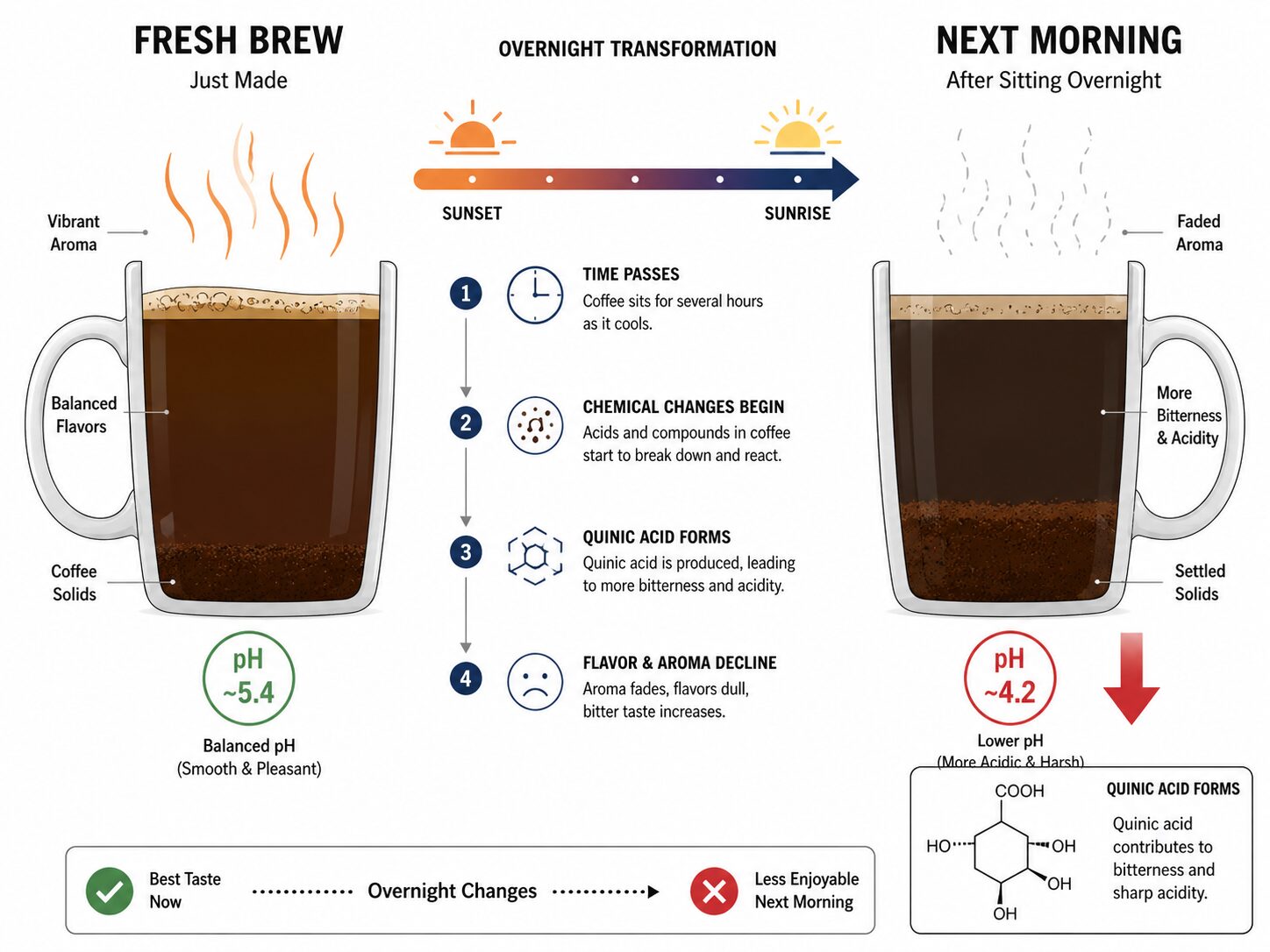
You have two proven paths: shim the burr carrier with 0.05mm brass washers, or replace the chassis if it’s a Eureka model with the known wobble.
Oxygen and time are the enemies of fresh coffee. Within hours of brewing, volatile aromatic compounds, the ones that give coffee its fruity, floral, or chocolatey notes, begin to evaporate or break down. This process, called oxidation, is accelerated by heat and exposure to air.
Simultaneously, the acids in coffee continue to react. Chlorogenic acids break down into quinic and caffeic acids. Quinic acid is a major contributor to the harsh, sour bitterness you taste in stale coffee. This isn’t a safety issue, but it’s the reason reheated coffee often tastes more bitter and flat. The perceived acidity in your cup changes, becoming sharper and less pleasant.
If you’ve added milk, a parallel and more concerning process occurs. Bacteria like Bacillus cereus, which can survive the brewing temperature, begin to multiply. These bacteria can produce heat-stable toxins that cause vomiting and diarrhea. Reheating the coffee kills the bacteria but does not destroy these toxins. This is why your stomach might rebel even after nuking yesterday’s latte.
The physical cues are important. For black coffee, look for an oily sheen or slick on the surface, this is often released coffee oils, not necessarily mold, but it indicates advanced aging. For coffee with dairy, any visible cloudiness, separation, or clumping is a hard stop. Your sense of smell is your best tool. A sour, cheesy, or downright rancid smell means the chemical breakdown is advanced. Don’t drink it.
TL;DR: Oxidation strips flavor and increases bitterness; bacterial growth in dairy-laced coffee can produce toxins that survive reheating.
Step-by-Step: How to Store and Test Leftover Coffee
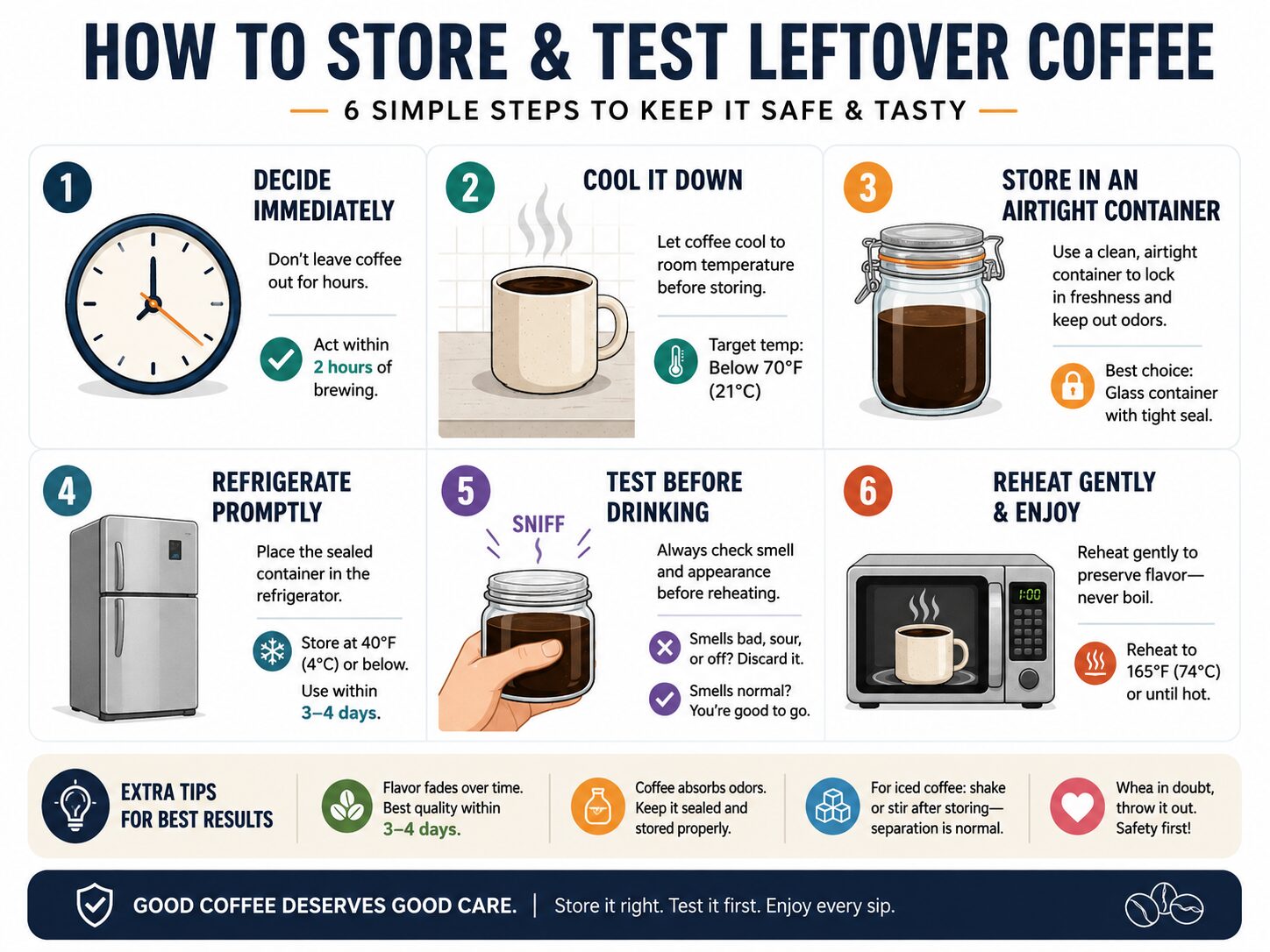
Follow the right sequence and the swap takes five minutes.
Before you start: The biggest hazard is assuming safety. If coffee with dairy has been lukewarm for an unknown period, discard it. The second hazard is scalding from reheating in a microwave without a stir; superheated liquid can erupt violently.
Here is the method to maximize safety and salvage some quality.
- Decide immediately. As soon as you know you won’t finish the pot, decide its fate. If it’s black, plan to refrigerate. If it has dairy, decide to drink it within the hour or commit to refrigerating it right now.
- Cool it down. Don’t put piping hot coffee directly into a sealed container in the fridge. It raises the fridge’s internal temperature and creates condensation inside the container. Let it sit on the counter for 15-20 minutes to approach room temperature. This is a critical window for dairy coffee, don’t let this cooling period extend beyond two hours total from brew time.
- Use the right vessel. Pour the coffee into a clean, airtight container. Glass or ceramic is better than plastic, which can absorb odors and flavors. Minimize the air gap, use a small container that the coffee nearly fills.
- Refrigerate promptly. Get the sealed container into the fridge. This slows both staling reactions and any microbial growth to a crawl.
- The next-day inspection. Before drinking, open the container and smell. It should smell like coffee, perhaps muted. Any sour, off, or fermented odor means it’s spoiled. Look at it. Black coffee should be clear; any floating particles or film are bad signs.
- Reheat properly. If it passes inspection, reheat it in a microwave-safe mug. Heat it in 30-second intervals, stirring in between, until steaming hot. This ensures even heating and prevents superheating. Do not re-boil it on the stove, as this will drive off all remaining volatile aromatics and make it taste even worse.
Skipping the airtight container lets oxygen in, speeding up staling. Skipping the smell test risks drinking something spoiled because “it looks okay.” The nose is rarely wrong.
When You Should Absolutely Throw It Out
Restringing rewards patience. Force the line, force the cover, force the wind direction, all three break things.
Certain conditions are non-negotiable stop signs. Ignoring them turns a question of quality into a gamble with your coffee and digestion.
- It has milk or creamer and sat out overnight. This is the cardinal sin. The risk of bacterial toxin production is too high. The sour taste isn’t just “old milk”; it’s likely lactic acid from bacterial fermentation.
- You see any mold. This appears as fuzzy spots on the surface or floating in the coffee. Mold can produce mycotoxins. Do not attempt to scoop it off and drink the rest; the threads (hyphae) and toxins permeate the liquid.
- It smells sour, rancid, or cheesy. Your olfactory system is detecting the byproducts of spoilage, trust it.
- The container wasn’t clean. If you poured leftover coffee back into a dirty mug or a container that held something else, you introduced new microbes.
- You have a compromised immune system, are pregnant, or have a sensitive stomach. Your margin for error is smaller. When in doubt, pour it out. The potential digestive effects of coffee are amplified with spoiled product.
- It’s been refrigerated for over 5 days (black) or 24 hours (with dairy). These are conservative ceilings. The quality will be gone, and the risk, while still low for black coffee, begins to outweigh the benefit.
I once tried to salvage a half-cup of coffee from a travel mug that had rolled under my car seat for three days in summer heat. The smell when I opened it was aggressively sour and cheesy. I poured it out immediately. The lesson wasn’t just about temperature; it was about the unseen microbial world that takes over when conditions are right.
Frequently Asked Questions
Can you get food poisoning from day old black coffee?
It is extremely rare. The low pH of black coffee inhibits most common pathogens. The primary risk would come from extreme contamination (e.g., using dirty equipment, storing in a filthy container) or the growth of mold, which can take days. The usual result of drinking “off” black coffee is a bad taste or stomach upset from increased acidity, not a classic foodborne illness.
Does reheating coffee kill bacteria?
Reheating coffee to a steaming temperature (above 165°F) will kill most active bacteria and mold present. However, it does not destroy the heat-stable toxins some bacteria, like Bacillus cereus, may have already produced while the coffee sat at room temperature. This is why reheating doesn’t make spoiled dairy coffee safe.
How can you make coffee taste better the next day?
For refrigerated black coffee, try making iced coffee or a coffee-based smoothie. The chilling masks staleness. You can also use it in baking, replace water in brownie or chocolate cake mixes with strong, day-old coffee to enhance chocolate flavor. Do not try to improve the taste of old coffee with dairy; discard it.
Is cold brew safer to drink after a day?
Yes, cold brew concentrate, due to its even lower pH from prolonged steeping, has a slightly longer safe refrigerated shelf life, up to 7-10 days if kept in a clean, airtight container. Its flavor also holds up better over time compared to hot-brewed coffee. Always keep it refrigerated.
What about the health benefits of old coffee?
The health benefits of coffee, like antioxidants, degrade over time. Day-old coffee will have significantly lower levels of beneficial volatile compounds and antioxidants compared to fresh coffee. You’re primarily getting the caffeine and whatever flavor remains.
Before You Go
The safety of day-old coffee isn’t a mystery. It’s a simple function of ingredients and storage temperature. Black coffee, treated right, is a low-risk leftover. Coffee with dairy is a high-maintenance guest that needs to be chilled quickly or shown the door.
Remember the rule of two: two hours for dairy coffee at room temp, and two key variables (additives and temperature) to assess any cup. Your nose is the final judge, if it smells wrong, it is wrong. While a scientific analysis of coffee storage conditions shows beans can be stable for months under ideal conditions, your brewed cup operates on a much shorter, more demanding timeline. When you understand the mechanisms at play, you can stop guessing and start making informed, safe choices with every leftover sip.
{
“@context”: “https://schema.org”,
“@type”: “HowTo”,
“name”: “How to Safely Store and Assess Day Old Coffee”,
“totalTime”: “PT5M”,
“tool”: [
{
“@type”: “HowToTool”,
“name”: “Airtight container (glass or ceramic preferred)”
},
{
“@type”: “HowToTool”,
“name”: “Refrigerator”
},
{
“@type”: “HowToTool”,
“name”: “Clean spoon for tasting”
}
],
“step”: [
{
“@type”: “HowToStep”,
“name”: “Identify additives”,
“text”: “Determine if your leftover coffee contains milk, creamer, or sugar. Dairy changes the safety timeline dramatically.”
},
{
“@type”: “HowToStep”,
“name”: “Cool and seal”,
“text”: “Let the coffee cool to room temperature, then pour it into a clean, airtight container to limit oxidation and contamination.”
},
{
“@type”: “HowToStep”,
“name”: “Refrigerate promptly”,
“text”: “Place the sealed container in the refrigerator within two hours of brewing. Do not leave it on the counter overnight.”
},
{
“@type”: “HowToStep”,
“name”: “Conduct a visual and smell test”,
“text”: “Before drinking, inspect for any surface film or cloudiness. Smell for sour, rancid, or off odors that were not present originally.”
},
{
“@type”: “HowToStep”,
“name”: “Taste a small amount”,
“text”: “If it passes the visual and smell check, take a small sip. Discard immediately if it tastes unpleasantly sour, bitter, or flat beyond normal staleness.”
}
]
}
{
“@context”: “https://schema.org”,
“@type”: “FAQPage”,
“mainEntity”: [
{
“@type”: “Question”,
“name”: “Can you get food poisoning from day old black coffee?”,
“acceptedAnswer”: {
“@type”: “Answer”,
“text”: “It is extremely rare. The low pH of black coffee inhibits most common pathogens. The primary risk would come from extreme contamination (e.g., using dirty equipment, storing in a filthy container) or the growth of mold, which can take days. The usual result of drinking \”off\” black coffee is a bad taste or stomach upset from increased acidity, not a classic foodborne illness.”
}
},
{
“@type”: “Question”,
“name”: “Does reheating coffee kill bacteria?”,
“acceptedAnswer”: {
“@type”: “Answer”,
“text”: “Reheating coffee to a steaming temperature (above 165°F) will kill most active bacteria and mold present. However, it does not destroy the heat-stable toxins some bacteria, like Bacillus cereus, may have already produced while the coffee sat at room temperature. This is why reheating doesn’t make spoiled dairy coffee safe.”
}
},
{
“@type”: “Question”,
“name”: “How can you make coffee taste better the next day?”,
“acceptedAnswer”: {
“@type”: “Answer”,
“text”: “For refrigerated black coffee, try making iced coffee or a coffee-based smoothie. The chilling masks staleness. You can also use it in baking, replace water in brownie or chocolate cake mixes with strong, day-old coffee to enhance chocolate flavor. Do not try to improve the taste of old coffee with dairy; discard it.”
}
},
{
“@type”: “Question”,
“name”: “Is cold brew safer to drink after a day?”,
“acceptedAnswer”: {
“@type”: “Answer”,
“text”: “Yes, cold brew concentrate, due to its even lower pH from prolonged steeping, has a slightly longer safe refrigerated shelf life, up to 7-10 days if kept in a clean, airtight container. Its flavor also holds up better over time compared to hot-brewed coffee. Always keep it refrigerated.”
}
},
{
“@type”: “Question”,
“name”: “What about the health benefits of old coffee?”,
“acceptedAnswer”: {
“@type”: “Answer”,
“text”: “The health benefits of coffee, like antioxidants, degrade over time. Day-old coffee will have significantly lower levels of beneficial volatile compounds and antioxidants compared to fresh coffee. You’re primarily getting the caffeine and whatever flavor remains.”
}
}
]
}
