
How to Store Coffee Beans Properly | Stop Flavor Loss Now
Store coffee beans in a truly airtight container kept in a cool, dark place. For roasted beans, this means a vacuum canister like the Fellow Atmos or a press-seal canister like the Airscape on a pantry shelf. For storage beyond two weeks, freeze individual doses in sealed jars and grind from frozen. Never use the refrigerator.
Most guides stop at “airtight container, cool dark place.” They skip the part where you open the freezer, shrug, and toss the whole bag in. Two weeks later, that bag is a sponge. The beans smell like last night’s leftovers and the brew tastes flat. That’s the universal mistake.
This guide walks through the real mechanics of coffee staling. We’ll cover why the standard advice works, when to break it, and the exact method for freezing that actually preserves flavor instead of destroying it.
Key Takeaways
- Oxygen is the primary enemy. A bag’s one-way valve lets CO2 out but doesn’t keep air from seeping back in. You need an active barrier.
- The refrigerator is a guaranteed failure. The constant temperature cycling and high humidity force moisture into the bean’s porous structure, carrying odors with it.
- Freezing works only with perfect protocol: portion into single doses, seal airtight, and grind directly from frozen. Thawing a whole bag introduces condensation.
- Green (unroasted) coffee beans are a different material. They can be stored in a cool, dark place for months or frozen for over a year without significant quality loss.
- In high-humidity climates, even good containers struggle. Adding a food-safe desiccant packet to the cupboard can be a necessary extra step.
The 4 Enemies of Fresh Coffee
Coffee staling isn’t magic. It’s a series of predictable chemical reactions driven by four environmental factors. Understand these, and your storage choices become obvious.
The first and fastest attacker is oxygen. Roasting creates hundreds of volatile aromatic compounds. Oxygen molecules break these down, a process called oxidation. The result is a loss of the bright, fruity, and floral notes, leaving behind flat, cardboard-like flavors. This begins the moment beans are roasted.
Common mistake: Relying on the coffee bag’s valve for storage — that valve is for off-gassing carbon dioxide after roasting, not for keeping oxygen out. Once the bag is open, air flows freely in and out, accelerating oxidation daily.
Light, especially direct sunlight, provides the energy to speed up oxidation. It’s a catalyst. Storing beans in a clear container on a countertop is a fast track to stale coffee. Heat has a similar effect, increasing the kinetic energy of molecules and making every degrading reaction happen faster.
Moisture is a subtler destroyer. Coffee beans are hygroscopic; they pull water vapor from the air. This moisture doesn’t just make grounds clump. It facilitates the hydrolysis of oils and sugars, leading to rancid, sour off-flavors. This is the core reason the refrigerator fails so spectacularly.
TL;DR: Fight oxygen with an airtight seal, defeat light and heat with a dark cupboard, and avoid moisture by steering clear of the fridge.
Choosing Your Storage Container (It’s Not the Bag)
The bag your beans came in is packaging, not a storage solution. The one-way valve has one job: to let carbon dioxide escape after roasting so the bag doesn’t burst. It does nothing to prevent oxygen from entering, especially once you’ve broken the seal.
You need a container designed to exclude air. The market offers two effective philosophies, each with a different mechanism.
The first is the active vacuum canister, like the Fellow Atmos. It uses a manual pump on the lid to suck air out, creating a negative pressure seal. The claim is it can extend coffee life by up to 50%. The mechanism is sound—less oxygen means slower oxidation.
The second is the passive press-seal canister, like the Airscape. This uses a two-lid system. You press a inner lid down onto the beans, forcing air out through a one-way valve in the center, then screw the outer lid on to lock that air out. It doesn’t create a vacuum, but it minimizes the air volume in contact with the beans.
| Container Type | Best For | Mechanism | Risk If Compromised |
|---|---|---|---|
| Vacuum Canister (e.g., Fellow Atmos) | Long-term storage of a single coffee batch. | Manual pump removes air, creating a negative-pressure seal. | If the seal fails, air rushes in all at once. The pump gasket must be clean. |
| Press-Seal Canister (e.g., Airscape) | Daily use, frequent opening. | Inner lid presses down to displace air, outer lid locks it out. | Not a true vacuum; some air remains. Must be pressed down after each use. |
| Simple Airtight Jar | Short-term use (under 1 week). | Basic rubber or silicone gasket. | Constant air headspace; oxidation proceeds faster than in active containers. |
Glass or stainless steel are the preferred materials. They are inert and don’t hold odors. Avoid clear glass unless you keep it in a dark cupboard. Ceramic is fine but often has a less reliable seal. The container should be sized to fit your coffee batch with minimal extra space.
TL;DR: Ditch the bag. For best results, use an Airscape for daily beans or a Fellow Atmos for coffee you won’t touch for a week. A simple airtight jar is a bare minimum.
The Freezing Debate: How to Do It Right
The standard commodity advice is a blanket “don’t freeze coffee.” This is wrong, but the reasoning behind the warning is correct. Most people freeze coffee wrong, ruining it. The problem isn’t the cold; it’s the moisture and air exposure during the freeze-thaw cycle.
When you toss a half-full bag into the freezer, every time you open the freezer door, warm, moist air hits the cold bag. This causes condensation to form on the outside and, eventually, inside on the beans. That moisture is absorbed, carrying frozen-food odors with it. Thawing the entire bag to room temperature repeats this condensation event internally.
I used to freeze whole bags of expensive single-origin coffee. The first post-thaw brew was okay. By the third day, the remaining beans had a faint, icy bitterness I couldn’t dial out with any burr grinder setting. I wasted half a bag each time.
The professional workaround is single-dose freezing. The goal is to freeze the coffee in an airtight, moisture-proof state and only ever expose one dose to ambient air.
- Portion: Weigh your coffee into individual brew doses (e.g., 18g for espresso, 25g for a pour-over). Use small glass jars with airtight lids or dedicated vacuum-seal bags.
- Seal: Pack them tightly, expel as much air as possible, and seal. Label with the coffee name and date.
- Freeze: Place the portions in the freezer, towards the back where temperature is most stable.
- Use: Remove one portion at a time. For whole bean storage, let the sealed jar sit for a minute, then open and grind immediately. The beans are still cold, preventing condensation from forming on them. For pre-ground freezing (not ideal, but an option), use the grounds straight from the jar.
This method works because you eliminate the repeated warming and cooling of a large mass. A Scientific Reports coffee storage study supports the principle, noting that stability in cold conditions is achievable with proper moisture and oxygen barriers.
TL;DR: You can freeze coffee. The rule is to freeze once, thaw once, in a single-serving, airtight package. Never re-freeze thawed beans.
Why the Refrigerator Always Loses
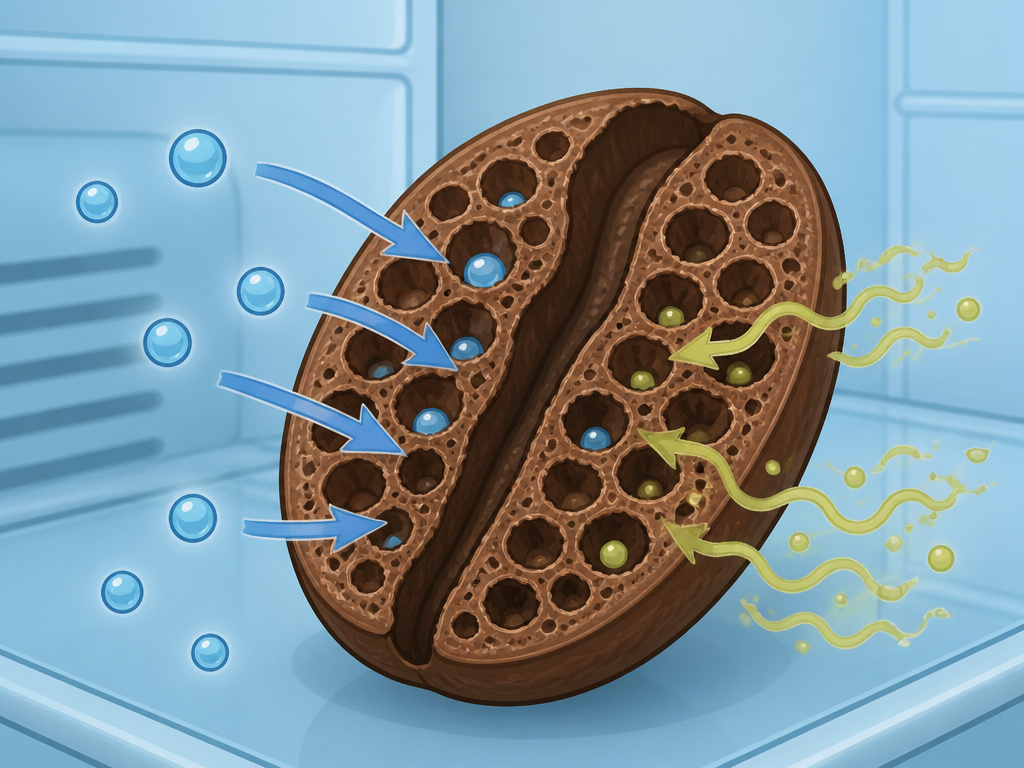
The refrigerator seems like a cool, dark place. It is not. It is a humid, odor-filled box that cycles through temperature fluctuations every time its compressor kicks on and off. This is the worst possible environment for roasted coffee.
The mechanism is straightforward. Coffee beans are porous. When cold beans sit in a humid environment, water vapor condenses onto their surface and is drawn into the pores. When you take the beans out, they warm up, but that trapped moisture doesn’t just leave. It remains inside the bean, accelerating staling reactions. The constant cycling from cold (when the door is shut) to less cold (when the door is open) repeats this moisture-grabbing process.
Furthermore, refrigerators are full of volatile organic compounds from other foods—onions, cheese, leftovers. Coffee beans will absorb these odors through the same porous structure, leading to bizarre and unpleasant flavor contamination in your cup. The data from an NIH library coffee quality research paper shows that fluctuating humidity has a more detrimental impact on roasted bean quality than steady, cool temperatures.
The door shelf is the absolute worst location. It experiences the greatest temperature swings every time the door opens. If you must use the fridge for something, let it be butter, not your Colombian Arabica.
TL;DR: The fridge’s humidity and odor absorption guarantee stale, funky coffee. There is no use case where it is the correct choice for roasted beans.
Special Cases and Edge-Case Protocols
Not all coffee storage is about a bag of freshly roasted blonde roast beans. Two common edge cases break the standard rules and need their own playbook.
Green (Unroasted) Coffee Beans
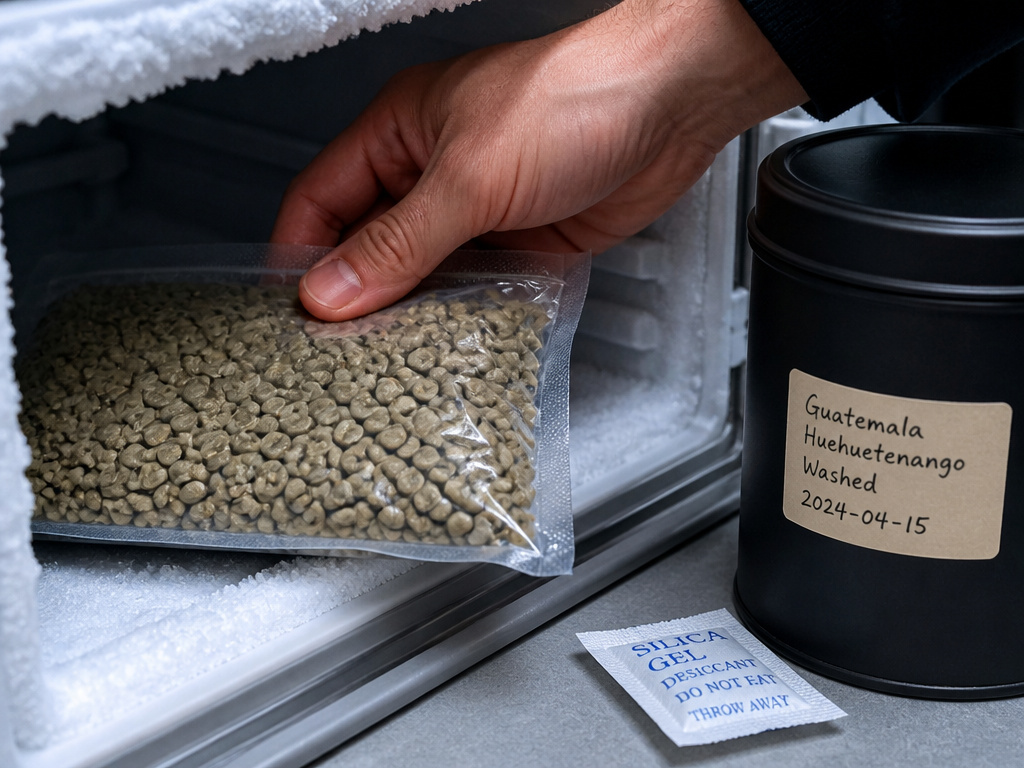
Green beans are a stable, dry seed. They haven’t undergone the roasting process that creates volatile oils and a porous structure. This makes them far more resilient. You can store green beans in a breathable bag (like burlap) in a cool, dark, dry pantry for 6-12 months with minimal quality loss. For storage over a year, freezing is an excellent option. Portion them into vacuum-sealed bags, remove the air, and freeze. They’ll remain viable for home roasting for 2 years or more. The low moisture content prevents ice crystal damage.
High-Humidity Environments
In tropical or very humid climates, the ambient moisture in the air is a constant threat. Even a good container seal can be challenged over time. In these cases, controlling the storage environment is key.
* Use your most airtight container (vacuum preferred).
* Store it in the coolest, most interior cupboard possible, away from exterior walls.
* Consider placing a food-safe silica gel desiccant packet in the cupboard (not in the container with the beans) to help reduce ambient humidity around the container. Check and reactivate or replace the packet every few months.
Very Long-Term Storage (Months)
For coffee you want to save for a special occasion several months away, combine the two strongest methods: single-dose freezing with vacuum sealing. Weigh doses, seal them in high-barrier vacuum bags, freeze, and do not open the freezer until the day you need that specific coffee. This is the gold standard for preservation, effectively pausing the staling clock.
Frequently Asked Questions
Can I store coffee beans in the original bag with the clip it came with?
No. The clip only closes the bag; it does not create an airtight seal. The bag material itself is permeable to air over time. You are merely slowing down the staling process slightly, not stopping it. Transfer to an airtight container.
How long do whole bean coffee beans last?
For peak flavor, consume within 2-4 weeks of the roast date. After opening, with proper airtight storage in a cool, dark place, they will remain drinkable for another 2-3 weeks but will gradually lose nuance. With single-dose freezing, peak flavor can be extended for 2-3 months.
Does grinding all my beans at once help with storage?
It harms it. Grinding increases surface area exponentially, exposing more of the coffee’s oils and aromatics to oxygen. Pre-ground coffee stales in minutes, not days. Always grind immediately before brewing. If you must pre-grind, use an airtight container and consume within 24 hours.
Do those fancy coffee canisters with CO2 valves work?
They are better than a bag, but often not as good as a dedicated vacuum or press-seal canister. The valve is typically designed for off-gassing from very freshly roasted beans, not for creating a long-term seal. Their primary advantage is often aesthetic.
What’s the best container for coffee beans on the counter?
The best container for the counter is one you then place in a cupboard. If you insist on keeping it out, use an opaque, ceramic or stainless steel canister with a solid silicone gasket. Never use a clear glass container on a countertop exposed to sunlight.
The Bottom Line
Coffee storage is a fight against chemistry. You win by minimizing the bean’s exposure to oxygen, light, heat, and moisture. Start by moving your beans into a proper airtight canister the moment you open the bag. Keep that canister in a pantry.
Ignore the old scare stories about freezing. If you buy in bulk or want to save a special roast, use the single-dose freezing method. It’s a reliable technique that preserves flavor when done with precision. Just remember to keep your beans far away from the refrigerator’s humid, odor-filled environment.
Your daily ritual deserves the best possible cup. Good storage is the simplest, most effective upgrade you can make after buying a quality burr grinder. It costs less than a bag of good beans and pays off in every single brew.
{
“@context”: “https://schema.org”,
“@type”: “HowTo”,
“name”: “How to Store Coffee Beans for Maximum Freshness”,
“totalTime”: “PT5M”,
“tool”: [
{
“@type”: “HowToTool”,
“name”: “Airtight storage container (e.g., Fellow Atmos or Airscape)”
},
{
“@type”: “HowToTool”,
“name”: “Small glass jars or vacuum bags for freezing”
},
{
“@type”: “HowToTool”,
“name”: “Permanent marker for labeling”
}
],
“step”: [
{
“@type”: “HowToStep”,
“name”: “Transfer beans immediately”,
“text”: “Move your roasted coffee beans from their original bag into an airtight container as soon as you open them. The bag’s one-way valve is for off-gassing, not long-term storage.”
},
{
“@type”: “HowToStep”,
“name”: “Choose the right container”,
“text”: “Select a container that seals out air. Vacuum canisters like the Fellow Atmos actively remove oxygen, while press-seal canisters like the Airscape use a plunging lid to force air out.”
},
{
“@type”: “HowToStep”,
“name”: “Store in a cool, dark cupboard”,
“text”: “Place the sealed container in a kitchen cupboard away from the stove, oven, or any direct sunlight. Heat and light accelerate staling.”
},
{
“@type”: “HowToStep”,
“name”: “Freeze in single-dose portions if needed”,
“text”: “For storage beyond two weeks, divide beans into individual serving sizes (e.g., 18g for espresso) in small airtight jars or vacuum bags. Freeze them and grind directly from frozen when needed.”
}
]
}
{
“@context”: “https://schema.org”,
“@type”: “FAQPage”,
“mainEntity”: [
{
“@type”: “Question”,
“name”: “Can I store coffee beans in the original bag with the clip it came with?”,
“acceptedAnswer”: {
“@type”: “Answer”,
“text”: “No. The clip only closes the bag; it does not create an airtight seal. The bag material itself is permeable to air over time. You are merely slowing down the staling process slightly, not stopping it. Transfer to an airtight container.”
}
},
{
“@type”: “Question”,
“name”: “How long do whole bean coffee beans last?”,
“acceptedAnswer”: {
“@type”: “Answer”,
“text”: “For peak flavor, consume within 2-4 weeks of the roast date. After opening, with proper airtight storage in a cool, dark place, they will remain drinkable for another 2-3 weeks but will gradually lose nuance. With single-dose freezing, peak flavor can be extended for 2-3 months.”
}
},
{
“@type”: “Question”,
“name”: “Does grinding all my beans at once help with storage?”,
“acceptedAnswer”: {
“@type”: “Answer”,
“text”: “It harms it. Grinding increases surface area exponentially, exposing more of the coffee’s oils and aromatics to oxygen. Pre-ground coffee stales in minutes, not days. Always grind immediately before brewing. If you must pre-grind, use an airtight container and consume within 24 hours.”
}
},
{
“@type”: “Question”,
“name”: “Do those fancy coffee canisters with CO2 valves work?”,
“acceptedAnswer”: {
“@type”: “Answer”,
“text”: “They are better than a bag, but often not as good as a dedicated vacuum or press-seal canister. The valve is typically designed for off-gassing from very freshly roasted beans, not for creating a long-term seal. Their primary advantage is often aesthetic.”
}
},
{
“@type”: “Question”,
“name”: “What’s the best container for coffee beans on the counter?”,
“acceptedAnswer”: {
“@type”: “Answer”,
“text”: “The best container for the counter is one you then place in a cupboard. If you insist on keeping it out, use an opaque, ceramic or stainless steel canister with a solid silicone gasket. Never use a clear glass container on a countertop exposed to sunlight.”
}
}
]
}
