
Master How to Make French Press Coffee With This Simple Method
To make French press coffee, use a 1:15 coffee-to-water ratio, a coarse grind like sea salt, and water at 200°F (93°C). The key is an extended 8-minute steep with a mid-brew stir, which settles the fine sediment and produces a clean, full-bodied cup without the common sludge or bitterness.
Most people get two things backwards: they brew for only four minutes and plunge too fast. That combination guarantees a cup with gritty sediment and harsh, over-extracted notes from the fines at the bottom of the carafe.
This guide walks through the equipment, the precise measurements, and the adjusted timing that professional baristas use to bypass those problems. We’ll also cover how to adapt the method for cold brew and what to do when your press itself is the issue.
Key Takeaways
- Use a coarse grind, finer than breadcrumbs but coarser than table salt. A fine grind will over-extract and slip through the mesh filter.
- Weigh your coffee and water. A 1:15 ratio (e.g., 55g coffee to 825g water for a 1L press) is the target. Volume measures like tablespoons are inconsistent.
- Extend the steep to 8 minutes total. Stir at the 4-minute mark to break the crust and help grounds settle, resulting in dramatically less sediment in your cup.
- Plunge with deliberate slowness. A 30-second press minimizes agitation. Stop just as the filter screen touches the coffee bed; forcing it down compresses fines into the brew.
- Pour everything out immediately after plunging. Leaving coffee in contact with the grounds continues extraction, turning your balanced cup bitter within minutes.
The Non-Negotiable Gear Shortlist
You need four things. A scale matters more than an expensive kettle.
A digital kitchen scale that reads to 0.1 grams is the single most important tool. Measuring coffee by weight eliminates the wild variability of scoops. One “tablespoon” of a light roast bean is a different weight than a tablespoon of a dense dark roast. That variance throws your ratio off before water even touches grounds.
Your grinder is next. A consistent coarse grind is non-negotiable. Burr grinders produce uniform particles, which extract evenly. Blade choppers create a mix of dust, chunks, and medium bits. The dust over-extracts into bitterness; the chunks under-extract, leaving flavor behind. If you only have a blade grinder, pulse in short bursts and shake the grinder between pulses to encourage a more even result. It’s a workaround, not a solution.
For the water, any kettle that can heat to just off a boil works. A gooseneck offers more control for the initial pour, but it’s not required. The French press itself should be clean, with no old oils coating the glass or mesh. Disassemble the plunger assembly after each use and wash the filter screen thoroughly. Coffee oils solidify and rancidify, giving every subsequent brew an off flavor.
Before you start: The plunger assembly, especially on older or recalled models, can fail under pressure. The 2016 Bodum recall of the “Columbia” thermal press was due to the plunger knob detaching, posing a burn hazard. Before each use, check that the knob, filter screen, and center rod are securely fastened. Never force a stuck plunger.
Grind Size and Consistency
Aim for the texture of coarse sea salt or very coarse breadcrumbs.
This is coarser than what you’d use for a drip machine. The ISO 6668:2008 standard for coffee sample preparation specifies grinding parameters that ensure even extraction, and the principle translates directly: uniformity is critical. When particles are the same size, they release their flavors at the same rate. In a French press, the large particle size also physically prevents most fines from passing through the mesh filter later.
If your grind is too fine, two things happen. First, the increased surface area causes over-extraction, pulling out bitter compounds quickly. Second, the microscopic fines slip through the filter and into your cup, creating the signature muddy sludge. If your grind is too coarse, the water can’t penetrate the dense particles fully, resulting in a weak, sour, under-extracted brew. You’ll see large, dry grounds floating even after a long steep.
| Grind Visual Cue | Feels Like | Result in French Press |
|---|---|---|
| Powder / Espresso Fine | Flour | Bitter, extremely muddy, likely to clog the plunge |
| Table Salt / Drip Medium | Granulated sugar | Some bitterness, noticeable sediment, standard 4-min brew |
| Coarse Sea Salt (Target) | Breadcrumbs / Rock Salt | Clean, full-bodied, minimal sediment with 8-min method |
| Very Coarse / Cold Brew | Rough peppercorns | Weak, sour, potentially watery if steep time isn’t extended |
The best grinder for French press is a burr model set to its coarsest setting. Test it. Grind a small batch and inspect. If you see a lot of powder at the bottom of your grounds catcher, your grinder may be producing too many fines even at the coarse setting, common with entry-level burr grinders. A quick fix is to gently shake or tap the grounds in a sieve to let some of the finest dust fall out before brewing.
TL;DR: Grind coarser than you think. Uniform particles the size of coarse sea salt prevent sludge and over-extraction. Blade grinders can’t hit this target consistently.
Water Quality and Temperature
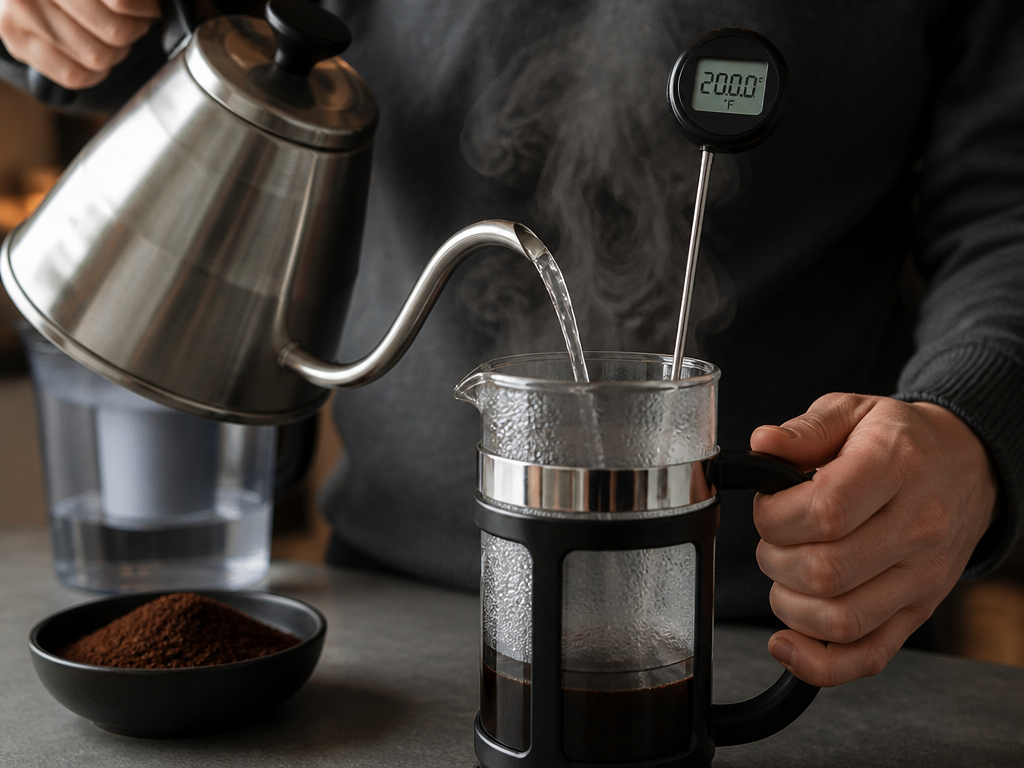
Use filtered water heated to 200°F (93°C).
The water is the solvent. If your tap water tastes like chlorine or minerals, that flavor will extract into your coffee. A simple carbon filter pitcher makes a noticeable difference. The ideal brewing temperature is just below boiling, around 200°F (93°C). Boiling water (212°F) can scald the coffee, extracting harsh, bitter compounds prematurely.
How do you get 200°F without a thermometer? Bring your water to a full boil, then take it off the heat and let it sit for 30 seconds. That’s usually enough. Preheating your French press is a small step people skip. Pour some of this hot water into the empty carafe, swirl it, and dump it out before adding your coffee grounds. A cold glass carafe steals heat from the brew water, dropping the temperature at the crucial start of extraction.
The ISO 6669:2007 standard for brewing test samples emphasizes controlled water temperature as a primary variable for reproducible flavor. A 5-degree swing changes extraction yield.
The Core 8-Minute French Press Method
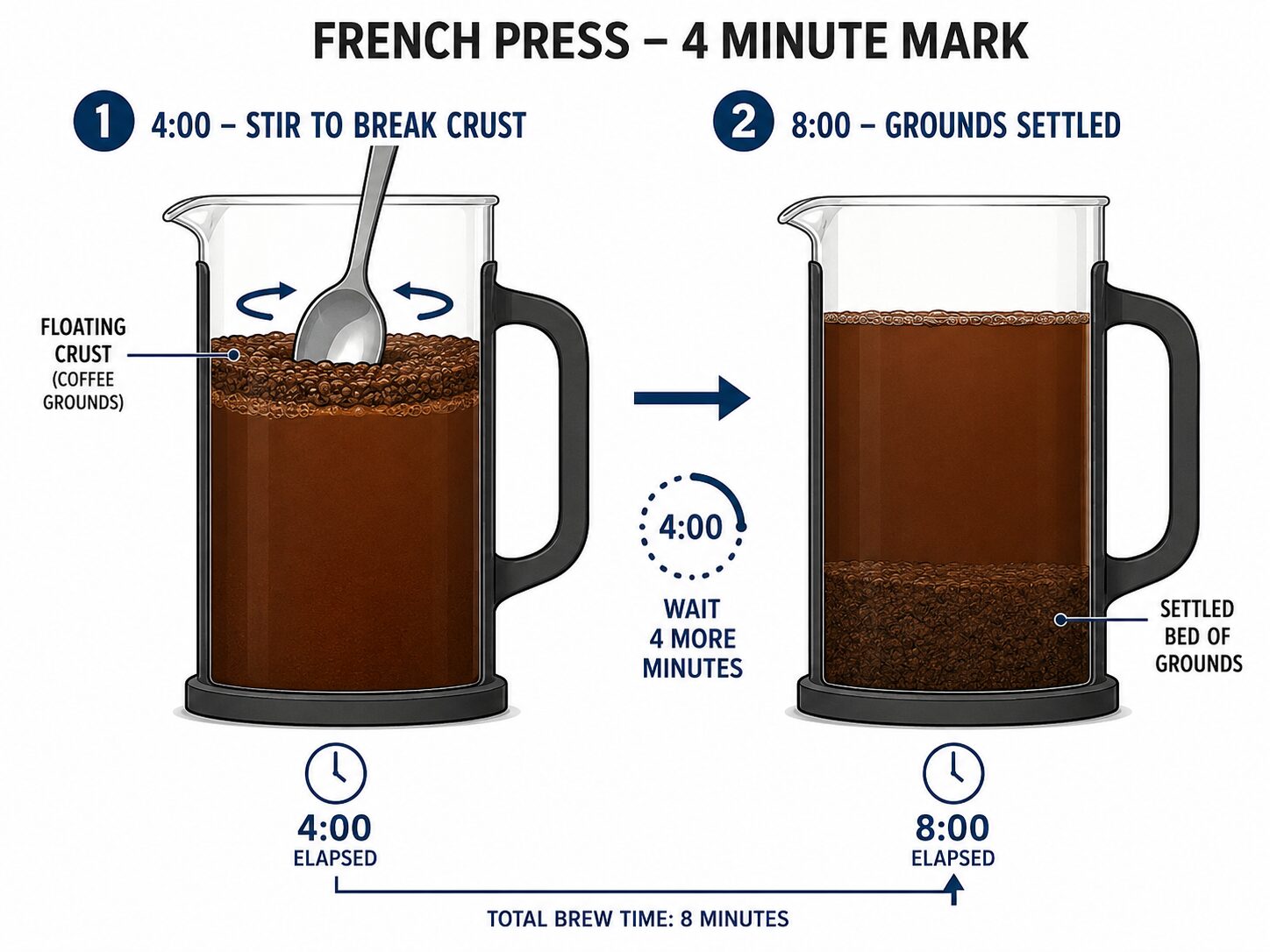
This is the sequence that replaces the standard four-minute brew. The extra time isn’t for stronger coffee; it’s for separation.
Start with your preheated press. Add your coarse-ground coffee. For a standard 1-liter press like the Bodum Chambord, that’s 55 grams of coffee. Start your timer and pour just enough 200°F water to saturate all the grounds, about 115 grams, or twice the weight of the coffee. You’ll see it bubble and foam as gases escape. This is the bloom. Give the carafe a gentle swirl to ensure no dry pockets remain. Wait 30 seconds.
Now, pour the remainder of your water. Your total water weight should be 825 grams for a 1:15 ratio (55g coffee x 15 = 825g). Fill to about an inch below the rim to avoid overflow when you place the lid. Place the lid on top with the plunger fully raised. Do not plunge.
At the 4-minute mark on your timer, remove the lid. You’ll see a crust of coffee grounds floating on top. Take a spoon and give the top a gentle, thorough stir. This breaks the crust and causes almost all of the grounds to sink to the bottom. Now, place the lid back on and wait another 4 minutes. You are not pressing yet.
After 8 total minutes, the coffee bed will be compact at the bottom, with clear brew above it. Now, press the plunger. Do it slowly. Take a full 20 to 30 seconds to lower it all the way. You should feel very little resistance. Stop the moment the filter screen touches the top of the grounds. Do not compress them.
Immediately pour all the coffee out of the French press and into a separate serving carafe or your mug. Leaving it sitting on the grounds will continue extraction, and the settled fines will start to diffuse back into the liquid.
Common mistake: Plunging fast and hard at 4 minutes, this churns the settled fines back into suspension, guaranteeing a gritty cup, and over-extracts the bottom layer of grounds within another minute.
TL;DR: Stir at 4 minutes, wait until 8 minutes, then plunge slowly and pour everything out immediately. The extended steep settles fines for a clean cup.
Why the Extended Steep and Stir Works
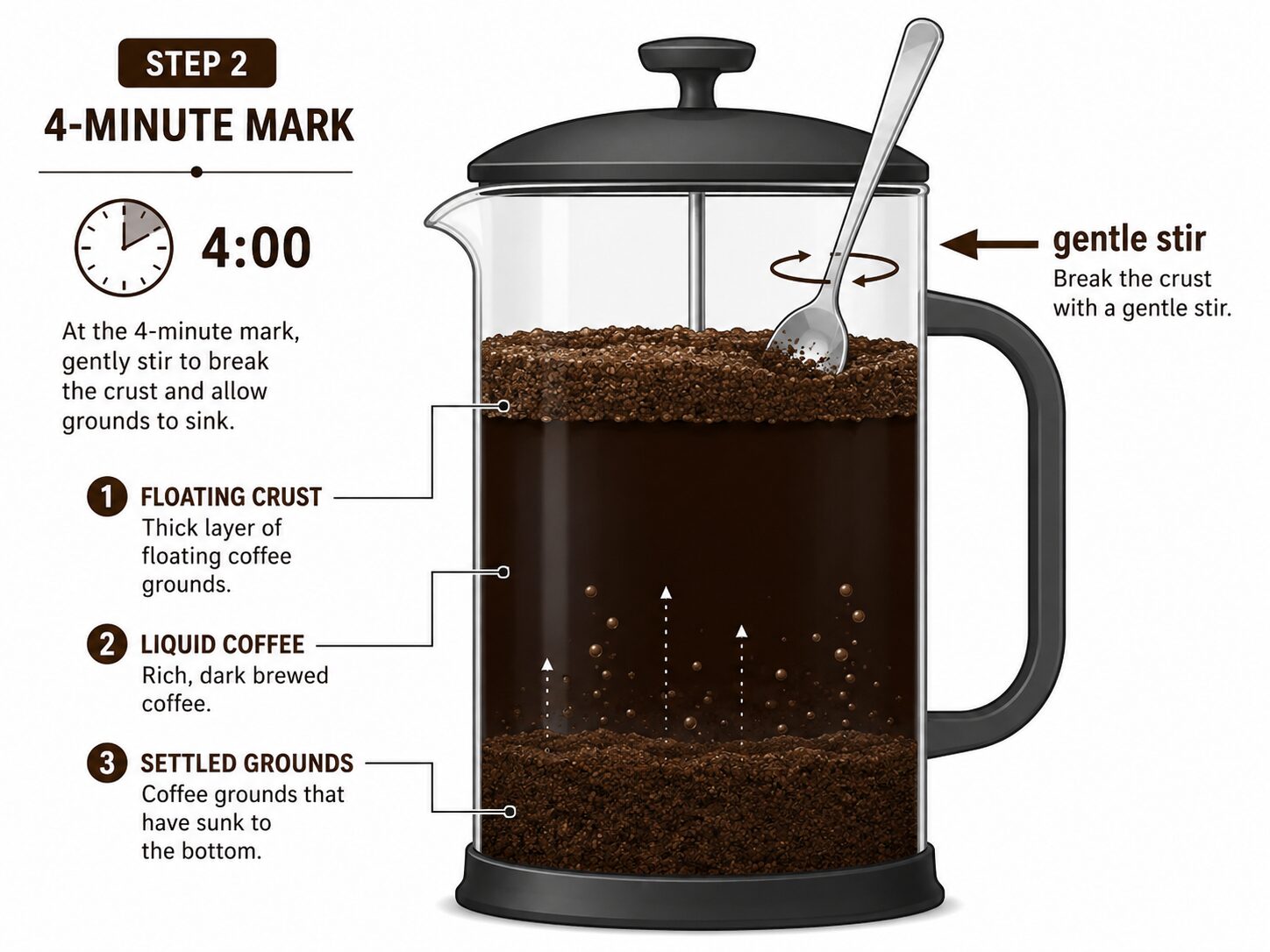
Physics, not magic. The stir introduces a controlled agitation that speeds settlement.
When you add water, the gases trapped inside the coffee grounds cause them to float, forming a crust. Without intervention, some grounds stay suspended for a long time. The gentle stir at the halfway point releases trapped gases from the remaining grounds, causing them to become waterlogged and sink. The larger, heavier particles fall quickly. The slower-settling fines follow over the next few minutes.
By the 8-minute mark, the coffee bed is stratified and compact. When you finally plunge, the filter screen moves through clear liquid and only has to trap the stray particles that didn’t settle. The slow press avoids creating currents that would disturb this settled bed. The result is a cup with the body and oils of a French press, but the clarity of a pour-over. It’s the best of both methods.
This approach is a direct divergence from manufacturer instructions like Bodum’s, which recommend a 4-minute steep and a simple plunge. That simpler method works, but it leaves more variables to chance, the consistency of your grind, the evenness of your pour, the density of your coffee bed. The 8-minute method is forgiving. It corrects for imperfect gear.
Troubleshooting Your French Press
Your coffee tastes bitter, sour, or muddy. Here’s the fix.
Bitter & Muddy: This is over-extraction plus fines. Your grind is too fine, your water is too hot, or you left the coffee sitting on the grounds after plunging. Go coarser on the grind, ensure your water is at 200°F, and decant immediately after pressing.
Sour & Weak: This is under-extraction. Your grind is too coarse, your water isn’t hot enough, or your brew time was too short. Grind a touch finer, make sure your water is just off the boil, and stick to the full 8-minute steep.
Plunger is hard to press: You have a grind that’s far too fine, or you’ve overfilled the press. It could also be a failed filter screen. Never force it. Unscrew the plunger assembly, scoop out the grounds, and inspect the mesh for clogs or damage. Forcing it can break the carafe or the knob, a known hazard in older models.
| Symptom | Likely Cause | Immediate Fix |
|---|---|---|
| Bitter, harsh taste | Grind too fine; water too hot | Coarsen grind; let boiled water cool 45 seconds |
| Sour, lacking flavor | Grind too coarse; water too cool | Grind finer; use water within 30 sec of boiling |
| Gritty, muddy cup | Fines from blade grinder; fast plunge | Use burr grinder; adopt 8-min steep with stir |
| Plunger jams | Extreme fine grind; overfill | Stop, disassemble, clean, restart with coarser grind |
Adapting the Method for Cold Brew
A French press is an excellent vessel for cold brew concentrate.
The process is the same in principle, immersion brewing, but the variables shift dramatically. Use an even coarser grind, similar to rough peppercorns. The extended contact time (12-24 hours) means a fine grind will extract far too much, resulting in a bitter, astringent concentrate. A common ratio is 1:8 (coffee to water by weight) to make a strong concentrate you’ll dilute later.
Add cold or room-temperature filtered water to your grounds in the press. Stir gently to ensure all grounds are wet. Place the lid on top with the plunger up, and let it steep in the refrigerator for 12 to 24 hours. The longer time extracts sweetness and body without the high-temperature acidity.
When it’s ready, press the plunger down slowly. Pour the concentrate into a separate sealed container. Dilute with water or milk to your taste, usually a 1:1 ratio. The cold brew method bypasses almost all bitterness and produces a smooth, sweet cup. It’s a completely different product from hot French press coffee, but it uses the same tool.
Frequently Asked Questions
Why is my French press coffee always bitter?
Bitterness is a classic sign of over-extraction. The most common culprits are a grind that’s too fine, water that’s too hot (boiling), or leaving the brewed coffee sitting on the grounds after plunging. Ensure your grind looks like coarse sea salt, let your boiling water rest for 30 seconds, and pour the coffee into a separate carafe immediately after pressing.
Can I use pre-ground coffee for French press?
You can, but you sacrifice control. Most pre-ground coffee is ground for drip machines, which is finer than the ideal French press coarse grind. This will lead to more sediment and a higher risk of bitterness. If you must use it, shorten your total steep time slightly to around 6 minutes and be prepared for a sludgier cup.
How do I clean my French press properly?
Disassemble it completely after every use. Rinse the glass carafe, then separate the plunger assembly: unscrew the knob, remove the filter screens and spring. Wash all parts with warm, soapy water. Coffee oils build up on the mesh and turn rancid, tainting future brews. A monthly deep clean with a cafiza tablet or a vinegar solution will dissolve stubborn residues.
What’s the best coffee bean for French press?
The French press’s full-immersion method and metal filter allow oils and fine particles through, which amplifies body and complexity. Single-origin coffees from regions like Ethiopia or Colombia shine, as their distinct floral, fruity, or nutty notes come through clearly. Medium to dark roasts also perform well, as the method tames some bitterness. Experiment with light roast beans too, the 8-minute method can extract their delicate acidity without harshness.
How long does French press coffee stay fresh?
It’s best consumed immediately. If you must keep it, pour it into a thermal carafe within 5 minutes of finishing the brew. Do not leave it in the French press on the warmer plate or counter. The continued contact with grounds will make it bitter within 15-20 minutes. It does not hold well for reheating later.
Before You Go
Making great French press coffee hinges on three adjustments: a coarse, consistent grind, an 8-minute steep with a mid-brew stir, and decanting immediately after the plunge. This method isn’t more work, it’s just different timing that solves the sludge problem permanently.
Weighing your coffee and water removes guesswork. Checking your plunger assembly for integrity is a basic safety step. And remember that the French press is versatile; the same carafe makes stellar cold brew with a coarser grind and a long, cold steep.
The goal is a clean, rich cup that highlights the coffee, not the method’s flaws. Start with the 8-minute sequence. The difference is in the first sip, no grit, just flavor.
{
“@context”: “https://schema.org”,
“@type”: “HowTo”,
“name”: “How to Make French Press Coffee Using the 8-Minute Method”,
“totalTime”: “PT10M”,
“tool”: [
{
“@type”: “HowToTool”,
“name”: “French press (e.g., Bodum Chambord 1.0L)”
},
{
“@type”: “HowToTool”,
“name”: “Burr coffee grinder”
},
{
“@type”: “HowToTool”,
“name”: “Gooseneck or standard kettle”
},
{
“@type”: “HowToTool”,
“name”: “Digital kitchen scale”
},
{
“@type”: “HowToTool”,
“name”: “Timer”
}
],
“step”: [
{
“@type”: “HowToStep”,
“name”: “Weigh and grind coffee”,
“text”: “Weigh 55 grams of whole bean coffee. Grind to a coarse consistency, similar to coarse sea salt or breadcrumbs.”
},
{
“@type”: “HowToStep”,
“name”: “Preheat and add grounds”,
“text”: “Pour hot water into the empty press to warm it, then discard. Add the ground coffee to the dry, preheated carafe.”
},
{
“@type”: “HowToStep”,
“name”: “Bloom and fill”,
“text”: “Start your timer. Pour just enough 200°F (93°C) water to saturate all grounds (about 115g). Swirl gently. After 30 seconds, pour the remaining water to reach 880g total.”
},
{
“@type”: “HowToStep”,
“name”: “Steep and stir”,
“text”: “Place the lid on top with the plunger up. At the 4-minute mark, give the crust of grounds a gentle stir with a spoon.”
},
{
“@type”: “HowToStep”,
“name”: “Rest and separate”,
“text”: “Let the coffee rest for another 4 minutes, for 8 minutes total brew time. This allows grounds to settle fully.”
},
{
“@type”: “HowToStep”,
“name”: “Plunge and pour”,
“text”: “Very slowly press the plunger down until it just touches the coffee bed. Pour all coffee into a separate serving carafe immediately to stop extraction.”
}
]
}
{
“@context”: “https://schema.org”,
“@type”: “FAQPage”,
“mainEntity”: [
{
“@type”: “Question”,
“name”: “Why is my French press coffee always bitter?”,
“acceptedAnswer”: {
“@type”: “Answer”,
“text”: “Bitterness is a classic sign of over-extraction. The most common culprits are a grind that’s too fine, water that’s too hot (boiling), or leaving the brewed coffee sitting on the grounds after plunging. Ensure your grind looks like coarse sea salt, let your boiling water rest for 30 seconds, and pour the coffee into a separate carafe immediately after pressing.”
}
},
{
“@type”: “Question”,
“name”: “Can I use pre-ground coffee for French press?”,
“acceptedAnswer”: {
“@type”: “Answer”,
“text”: “You can, but you sacrifice control. Most pre-ground coffee is ground for drip machines, which is finer than the ideal French press coarse grind. This will lead to more sediment and a higher risk of bitterness. If you must use it, shorten your total steep time slightly to around 6 minutes and be prepared for a sludgier cup.”
}
},
{
“@type”: “Question”,
“name”: “How do I clean my French press properly?”,
“acceptedAnswer”: {
“@type”: “Answer”,
“text”: “Disassemble it completely after every use. Rinse the glass carafe, then separate the plunger assembly: unscrew the knob, remove the filter screens and spring. Wash all parts with warm, soapy water. Coffee oils build up on the mesh and turn rancid, tainting future brews. A monthly deep clean with a cafiza tablet or a vinegar solution will dissolve stubborn residues.”
}
},
{
“@type”: “Question”,
“name”: “What’s the best coffee bean for French press?”,
“acceptedAnswer”: {
“@type”: “Answer”,
“text”: “The French press’s full-immersion method and metal filter allow oils and fine particles through, which amplifies body and complexity. Single-origin coffees from regions like Ethiopia or Colombia shine, as their distinct floral, fruity, or nutty notes come through clearly. Medium to dark roasts also perform well, as the method tames some bitterness. Experiment with light roast beans too, the 8-minute method can extract their delicate acidity without harshness.”
}
},
{
“@type”: “Question”,
“name”: “How long does French press coffee stay fresh?”,
“acceptedAnswer”: {
“@type”: “Answer”,
“text”: “It’s best consumed immediately. If you must keep it, pour it into a thermal carafe within 5 minutes of finishing the brew. Do not leave it in the French press on the warmer plate or counter. The continued contact with grounds will make it bitter within 15-20 minutes. It does not hold well for reheating later.”
}
}
]
}
