
How to Clean a Hamilton Beach Coffee Pot | The Missed Step
This post contains affiliate links. As an Amazon Associate, we earn from qualifying purchases.
To clean a Hamilton Beach coffee pot, you must descale the internal system with a vinegar solution to remove mineral scale. This scale insulates the heating element, makes the machine work harder, and flakes into your coffee, causing a sour or metallic taste. Soap only cleans the removable carafe and filter basket.
To clean a Hamilton Beach coffee pot, you need to address three separate zones with three different cleaners: the removable parts with soapy water, the internal system with a 1:1 vinegar-water solution, and stubborn carafe stains with a dishwasher tablet. The machine’s plastic and glass parts can handle dish soap, but the internal tubing and heating element cannot.
Most people think a quick soapy rinse of the carafe is enough. They miss the mineral scale that builds up inside the machine itself. That scale is calcium carbonate, the same stuff in your kettle, and it doesn’t wash off with Dawn. It insulates the heating element, makes the machine work harder, and eventually flakes off into your coffee. You’ll know it’s there when your morning cup tastes sour or metallic no matter what beans you use.
This guide covers the monthly deep-clean cycle Hamilton Beach recommends, plus the one-step hack for a cloudy carafe that actually works.
Key Takeaways
- Use a 1:1 ratio of white vinegar to cold water for descaling, half vinegar, half water. Stronger solutions can damage internal seals.
- Run two to three rinse cycles with fresh water after descaling. Any leftover vinegar taste will ruin your next pot.
- Never put dish soap in the main unit’s water reservoir. Soap residue is nearly impossible to flush out and will foam in every subsequent brew.
- A dishwasher tablet and boiling water will lift stubborn brown stains from a glass carafe in 30 minutes without scrubbing.
- Descale every 30 days if you have hard water. Waiting three months lets scale harden into a crust that requires a full teardown to remove.
The 3-Cleaner Showdown
Your coffee pot isn’t one thing to clean. It’s three. Treating it like one guarantees you’ll miss a zone, and that zone will be the one that ruins the flavor.
The carafe and brew basket get coffee oils and grounds. You can use hot soapy water or a dishwasher. The internal water tank, tubes, and heating element get mineral deposits from your water. For that, you need an acid, vinegar or citric acid. Stubborn, baked-on stains on the carafe glass need an alkaline boost and heat, which is where the dishwasher tablet trick comes in.
Using the wrong cleaner in the wrong place causes more problems. Dish soap in the reservoir is a nightmare. It foams through the entire system and takes a dozen rinse cycles to clear. Vinegar on a fresh coffee oil stain in the carafe does nothing; the oil needs a surfactant. Match the problem to the solvent.
Before you start: Unplug the machine and let it cool completely. Never pour cleaning solutions into a hot reservoir, the thermal shock can crack plastic components. Wear gloves if you have sensitive skin; vinegar and dishwasher detergent are mild acids and alkalis.
Soap and Water for Removable Parts
Take the carafe, the brew basket, and the lid off the machine. These are almost always dishwasher safe, but only on the top rack. The intense bottom-rack heat can warp the plastic basket over time.
If washing by hand, use the hottest water you can stand and a generous squirt of dish soap. A soft-bristled brush gets into the basket corners where oils hide. Rinse with clear water until the squeak is gone. Any soap film left behind will taste like detergent in your next cup.
Common mistake: Putting the carafe’s plastic lid in the dishwasher’s silverware basket, the high-pressure spray can force water into the hinge mechanism, leading to mold growth inside the lid within a week.
Vinegar for the Machine’s Internals
This is the descaling step. Mineral scale is calcium carbonate, and vinegar is acetic acid. The reaction dissolves the scale. Hamilton Beach’s official support page specifies a solution of half white vinegar and half cold water.
Fill the reservoir with this mix. Place the empty carafe on the warming plate. Run a full brew cycle. When it’s done, let the hot vinegar solution sit in the carafe and inside the machine for 30 minutes. This dwell time is what actually breaks down the scale; a quick pass-through does very little.
After the soak, discard the vinegar water. Now you rinse. Fill the reservoir with fresh cold water and run a full brew cycle. Dump that water. Do it again. Most manuals, including the Hamilton Beach 12 Cup Programmable model guide, recommend two to three rinse cycles to be sure.
If you skip the rinse cycles, the next pot of coffee will taste sharply of vinegar. It overpowers even dark roast beans.
The Dishwasher Tablet for Stubborn Carafe Stains
Brown, baked-on rings in a glass carafe are tannins and minerals fused together. Soap won’t touch them. Vinegar might soften them after multiple soaks. A dishwasher tablet and boiling water will dissolve them in one shot.
Drop one standard dishwasher tablet into the stained carafe. Pour boiling water over it until the carafe is half full. The tablet will fizz and dissolve. Let it sit for 30 minutes. The alkaline detergent and heat work together to lift the stain. You might not even need to scrub. Dump the solution, rinse thoroughly, and you’re done.
TL;DR: Carafe and basket get soap; internal tubing gets a 1:1 vinegar-water solution; stubborn carafe stains get a dishwasher tablet and boiling water.
The Monthly Descaling Cycle
Hamilton Beach recommends descaling “every 30 days or more often depending on water hardness.” That’s not a suggestion. It’s the timeline before scale becomes a mechanical problem.
In areas with hard water, limescale accumulates fast. After 90 days, it transitions from a soft, dissolvable film to a hard, crusty deposit. At that point, a standard vinegar cycle might not reach it. You’ll need a commercial descaler or, in extreme cases seen in repair videos, a physical disassembly to chip it out.
| Water Hardness Level | Descaling Frequency | What Happens If You Skip It |
|---|---|---|
| Soft (0–60 ppm) | Every 2–3 months | Minor flavor degradation |
| Moderately Hard (61–120 ppm) | Every month | Heating element efficiency drops 10–15% |
| Hard (121–180 ppm) | Every 3–4 weeks | Scale flakes into coffee, tastes metallic |
| Very Hard (181+ ppm) | Every 2–3 weeks | Clogged spray head, longer brew times, risk of overheating |
The process is straightforward, but the timing matters.
- Unplug and cool. Never work on a warm machine.
- Mix the solution. Use the 1:1 vinegar-water ratio. Don’t guess. Measuring ensures you don’t use a concentration that could degrade rubber seals.
- Run and soak. Start a full brew cycle with the solution. When it finishes, set a timer for 30 minutes. Walk away.
- Rinse, twice. Dump the vinegar water. Run a full cycle with fresh water. Dump it. Run a second cycle. Sniff the empty carafe. If you catch a whiff of vinegar, run a third cycle.
- Dry it out. Leave the reservoir lid open and the carafe off the plate for an hour. Stagnant moisture is how mold starts.
I ran my first Hamilton Beach on straight vinegar once, thinking “stronger is better.” The brew cycle sputtered and steamed. A week later, the reservoir lid’s rubber seal turned brittle and cracked. Stick to the 50/50 mix.
What Not to Do (And Why It Breaks Things)
Cleaning a coffee maker seems simple until you see the repair bill. These are the errors that turn a $50 maintenance job into a $150 replacement.
Never use dish soap in the water reservoir. It seems logical, soap cleans things. But soap suds are engineered to cling. They cling to the interior plastic tubing and the heating element. You’ll spend an hour running clear water through, watching suds bubble into the carafe each time. Eventually you give up and make coffee, which then tastes like you brewed it with Palmolive.
Don’t use abrasive scrubbers on the warming plate. That glossy surface is coated. A green Scotch-Brite pad scratches it. Once scratched, coffee stains bake into the scratches permanently. Use a soft cloth dampened with vinegar or a plastic scraper for stubborn spills.
Avoid bleach or ammonia-based cleaners anywhere. These chemicals can react with mineral deposits or plastic components, releasing fumes. They’re also nearly impossible to rinse out fully. Lingering bleach residue plus acidic coffee equals chlorine gas in tiny, unpleasant amounts.
Don’t forget the external wipe-down. Coffee drips down the outside, onto the counter, and under the machine. That sticky residue attracts ants and cockroaches. A monthly pass with a damp cloth prevents a pest problem you didn’t see coming.
TL;DR: Soap belongs only on removable parts. Abrasives ruin the warming plate. Bleach creates toxic fumes. Skipping the exterior wipe-down invites pests.
How to Clean a Cloudy or Stained Carafe
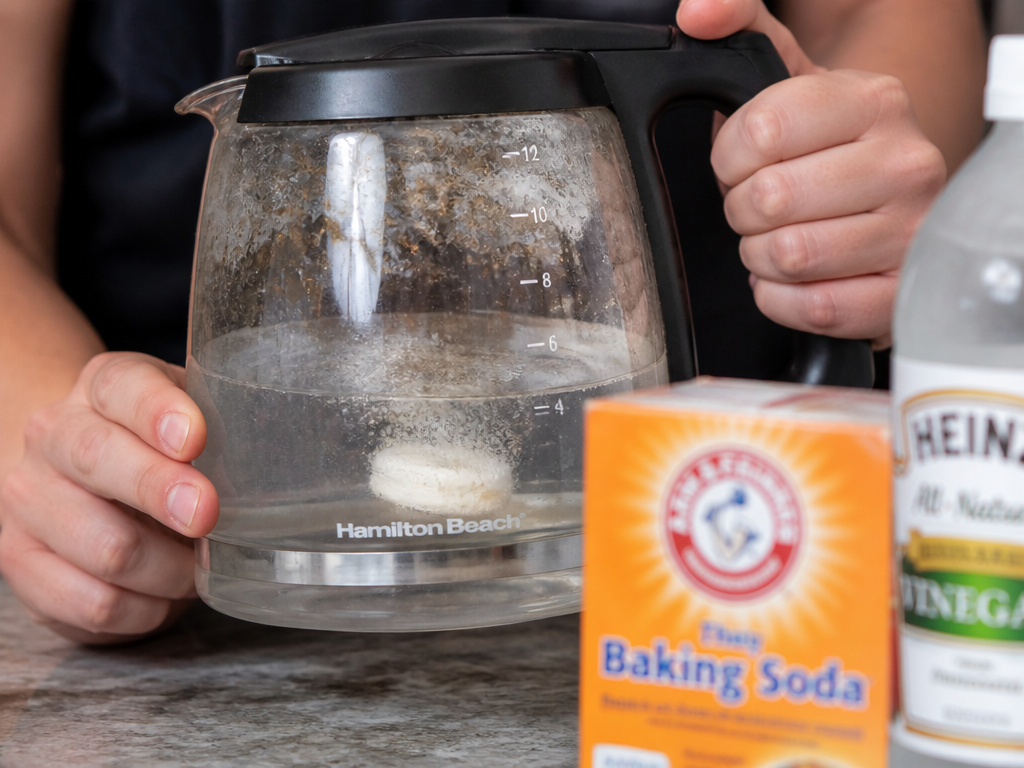
Cloudiness is usually a hard water film. Stains are tannins from coffee. They look similar but need different treatments.
For cloudiness, the dishwasher tablet method works best. The alkaline detergent dissolves the mineral film. For brown tannin stains, you can try a paste of baking soda and water. Make a thick slurry, coat the inside of the carafe, and let it sit overnight. Rinse it out in the morning. If that fails, move to the dishwasher tablet.
Some people swear by denture cleaning tablets. They work on the same principle as the dishwasher tablet, alkaline detergent plus effervescence, but they’re more expensive per use.
| Cleaning Method | Best For | Process | Risk If Skipped |
|---|---|---|---|
| Dishwasher Tablet + Boiling Water | Severe mineral clouding, baked-on rings | 1 tablet, half carafe boiling water, 30 min soak | Residue requires intense rinsing; can leave a soapy film |
| Baking Soda Paste | Light tannin stains, odor removal | Paste, overnight soak, scrub | Grit can scratch glass if not fully dissolved |
| White Vinegar Soak | Fresh cloudiness, light scale | Equal parts vinegar & hot water, 1 hour soak | Will not touch baked-on stains; may etch glass over time |
| Denture Tablet | All of the above | 1-2 tablets, warm water, 1 hour soak | Most expensive option; may not be stronger than dishwasher tablet |
After any chemical soak, rinse the carafe until you can no longer smell the cleaner. Then run your hand around the inside. It should feel slick, not slippery. A slippery feel means soap or detergent residue remains.
Frequently Asked Questions
Can I use lemon juice instead of vinegar to descale?
Yes, but it’s less effective. The citric acid in lemon juice is weaker than acetic acid in vinegar. You’d need a higher concentration and longer soak time. For the same result, you might need two cycles with lemon juice versus one with vinegar.
Why does my coffee still taste bad after cleaning?
Old coffee oils have likely polymerized, turned into a plastic-like coating, inside the brew basket or on the showerhead. Vinegar doesn’t dissolve polymerized oils. You need a specific coffee machine cleaner like Urnex or a strong baking soda soak to break them down. This is common on machines older than a year.
Is the Hamilton Beach coffee pot dishwasher safe?
The glass carafe and plastic brew basket are dishwasher safe, top rack only. The main unit with the heating element and electronics is not. Never submerge it or put it in the dishwasher.
How often should I clean my coffee pot?
Wash the carafe and basket after every use with soap and water. Descale the internal system every 30 days if you have hard water, or every 60 days with soft water. This follows the Hamilton Beach official cleaning guidelines.
Can I use CLR or other chemical descalers?
Check your manual first. Many Hamilton Beach models warn against using harsh chemical descalers as they can damage internal plastic and rubber components. When in doubt, stick with the manufacturer-approved vinegar solution or a commercial coffee machine cleaner labeled as safe for plastic.
The Bottom Line
Cleaning a Hamilton Beach coffee pot is a fifteen-minute job you do once a month. The sequence is fixed: unplug, wash the removable parts, run a 1:1 vinegar solution through the machine, let it soak, rinse it twice, and dry everything. The dishwasher tablet trick rescues a stained carafe when nothing else works.
The cost of skipping it is higher than you think. Scale buildup makes the machine work harder, shortens its life, and puts white flakes in your cup. Old coffee oils make every pot taste bitter and stale. Doing it right means your morning coffee tastes like the beans you bought, not the machine you forgot to clean.
