
The Right Way to Clean Your Coffee Maker & Improve Taste
To clean a coffee maker, you must descale the internal tubing and heating element to remove mineral deposits, then scrub every removable part with soap and water to eliminate rancid coffee oils. The Keurig K-Duo manual specifies a 10-ounce dose of Keurig Descaling Solution followed by three 12-ounce rinse brews, while the Cuisinart DCC-1200 booklet calls for a 1:3 vinegar-to-water solution run through two full cycles.
Most guides tell you to run vinegar through the machine. They skip the part where you scrub the carafe spout and filter basket corners with a soft-bristled brush. That’s where the stale, bitter taste lives after the minerals are gone.
This guide walks through the monthly clean for a drip machine, the quarterly descale for hard water, and the completely different process for espresso machines. You’ll get the manufacturer specs, the community arguments over vinegar, and what happens when you leave oil in the carafe for six weeks.
Key Takeaways
- Vinegar works, but a commercial descaler like Keurig Descaling Solution dissolves heavy limescale faster and leaves less odor.
- Always remove integrated water filters before descaling. The acid damages the filter media and can push charcoal granules into your brew path.
- Espresso machines need a dedicated backflushing detergent like Cafiza for the group head. Drip machine descaler can ruin boiler seals.
- The carafe spout and filter basket corners harbor old oils that vinegar won’t touch. Scrub them with a soft brush and dish soap every clean.
- If your coffee starts tasting sour or weak, descale immediately. Scale buildup insulates the heating element, dropping brew temperature by 5–10°F.
The 5-Step Monthly Clean (and the One Step Nobody Does)
A monthly clean prevents oil buildup. It takes twenty minutes.
First, unplug the machine. Remove the carafe, filter basket, and any removable water reservoir lid or cover. Wash these in the sink with hot water, dish soap, and a soft-bristled brush. Focus on the carafe spout, coffee oils collect there and turn rancid. Rinse thoroughly.
Common mistake: Only rinsing the carafe with water, the oils are not water-soluble and will coat the glass, giving every future pot a stale, bitter background note within three weeks.
Wipe the machine’s exterior with a damp microfiber cloth. Clean the warming plate, which gets sticky from coffee drips. Dry everything with a clean towel before reassembling.
Now for the internal flush. Fill the reservoir with fresh cold water and run a full brew cycle without coffee. Discard the hot water. This clears loose debris.
TL;DR: Monthly cleaning is about removing oils, not scale. Scrub the carafe spout and filter basket with soap; a water-only rinse leaves the bittering agents behind.
Why Vinegar Works, and When It Doesn’t
White vinegar’s acetic acid dissolves calcium and magnesium carbonate, the white, chalky limescale in your water lines. It’s cheap and available.
But acetic acid is weak. For water harder than 7 grains per gallon, or for machines that haven’t been cleaned in a year, vinegar might need multiple cycles. It also leaves a smell. Some people swear they can taste it for a pot or two after rinsing.
Commercial descalers like Keurig Descaling Solution use stronger acids, citric or sulfamic. They work faster on heavy deposits. They also rinse out more completely. The trade-off is cost.
| Descaling Agent | Best For | Risk If Skipped |
|---|---|---|
| White vinegar (1:1 with water) | Monthly maintenance, soft water (< 4 gpg hardness) | May not remove heavy scale; can leave odor if not rinsed thoroughly |
| Keurig Descaling Solution | Keurig machines, hard water (> 7 gpg), neglected machines | More expensive; not always needed for light maintenance |
| Citric acid powder | Eco-conscious users, those sensitive to vinegar smell | Must be measured precisely; too concentrated can damage seals |
Manufacturers pick sides. The Cuisinart DCC-1200 manual explicitly says to use a 1:3 vinegar-to-water solution. Keurig’s K-Duo guide mandates their branded solution. If you use vinegar in a Keurig and something goes wrong, your warranty claim might get denied.
The Consumer Reports coffee maker cleaning guide notes that either method works, but following your specific machine’s manual is the safest path.
Descaling Your Drip Coffee Maker: A Rinse Cycle Isn’t Enough
Descaling removes mineral deposits from the internal heating element and water tubes. It’s a quarterly task for most, monthly if you have hard water.
Here’s the full, effective process, not the abbreviated version.
- Remove the water filter. If your machine has an integrated charcoal filter, take it out before adding any descaling solution. The acid can break down the filter media. The Keurig K-Duo manual states this clearly on page 14.
- Mix your solution. For vinegar, use equal parts white vinegar and water. For a commercial descaler like Keurig Descaling Solution, use 10 ounces as the manual directs.
- Start the brew cycle. Pour the solution into the reservoir and start a normal brew cycle into the empty carafe.
- Pause and soak. Halfway through the cycle, turn the machine off. Let the hot acidic solution sit in the internal lines for one hour. This is the step most people skip. The dwell time is what dissolves thick scale.
- Finish the cycle. Turn the machine back on and let it finish brewing. Dump the hot descaling solution.
- Rinse, twice. Fill the reservoir with fresh cold water. Run a full brew cycle and discard the water. Do this a second time. For Keurig machines, the manual calls for three rinse brews with 12 ounces of water each.
- Run a final water cycle. Brew one more full pot of fresh water and discard it. This guarantees no vinegar or descaler taste carries over.
I ran straight vinegar through a Mr. Coffee for three years, always rushing the rinse. The machine started leaking from the base in year four. When I opened it, the aluminum heating chamber was pitted where scale had glued itself to the metal and the acid eventually ate through. Now I use a diluted solution and never skip the soak.
Skipping the soak step means the acid doesn’t have time to work on the heating element. The scale stays, acting as an insulator. Your brew temperature drops, and the coffee tastes weak and under-extracted.
TL;DR: Descale quarterly. Always remove the water filter first. Let the solution sit in the machine for an hour mid-cycle. Rinse with two full pots of fresh water afterward.
Espresso Machines Are a Different Animal
Drip machine cleaning and espresso machine cleaning share almost nothing. An espresso machine has a boiler, a steam wand, a group head, and a portafilter. Each part needs a specific cleaner.
You cannot use vinegar or drip machine descaler in an espresso machine’s boiler. The acid concentration is wrong and can degrade rubber seals. You need a boiler descaler formulated for espresso machines, often citric acid-based.
The group head and portafilter require a backflushing detergent like Cafiza. This powder breaks down coffee oils that vinegar cannot touch.
| Espresso Machine Part | Cleaning Agent | Frequency | Consequence of Skipping |
|---|---|---|---|
| Portafilter basket & shower screen | Cafiza (backflush detergent) | Daily | Oils bake onto metal, causing channeling and bitter shots within a week |
| Steam wand | Damp cloth immediately after use | After every use | Milk sugars caramelize, clogging the tip; becomes unusable in days |
| Boiler | Espresso machine descaler (citric acid) | Every 3–6 months | Scale insulates heating element, causing overheating and eventual failure |
| Drip tray & water reservoir | Dish soap & water | Weekly | Mold growth; foul taste contaminates brew water |
Backflushing is the key ritual. You put a teaspoon of Cafiza in the portafilter, lock it into the group head, and run the machine for ten seconds without a coffee puck. The detergent surges through the shower screen and dissolves the oils. Repeat until the water runs clear.
Neglecting the steam wand is the most common error. Wipe it with a wet cloth right after frothing milk. Let milk dry on it once, and you’ll need a needle to poke out the clog.
What Breaks When You Don’t Clean It
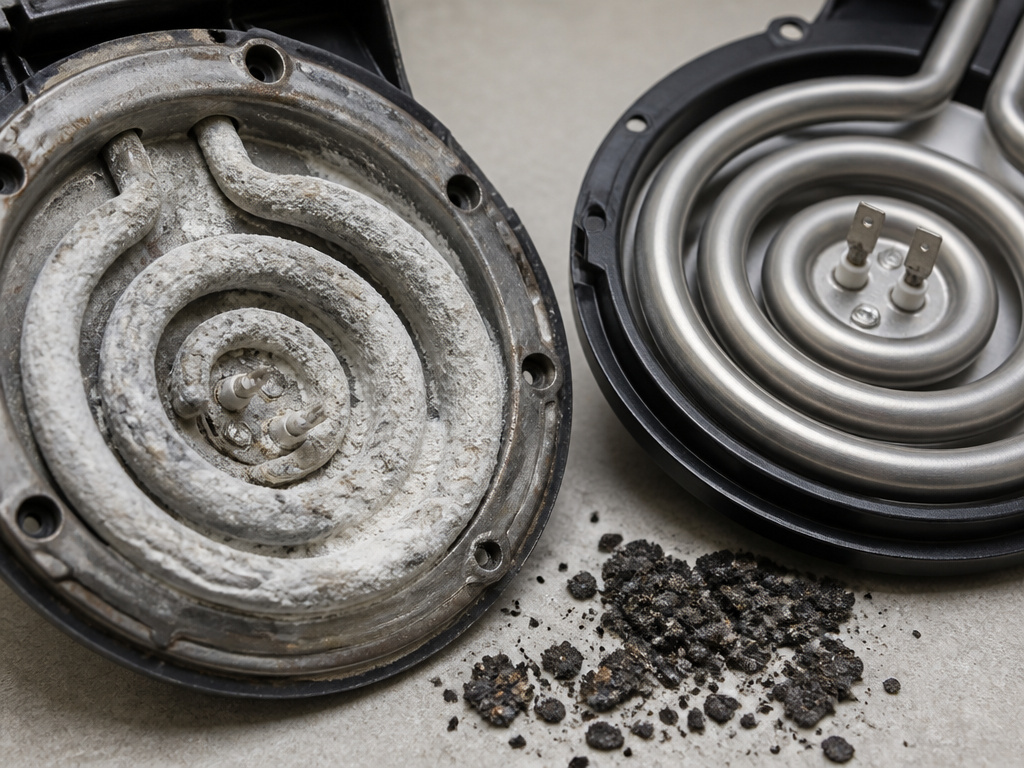
Coffee makers are simple machines. They fail in predictable ways when neglected.
The heating element is the first victim. Limescale acts as insulation. The thermostat keeps powering the element to reach temperature, but the scale barrier holds the heat in. The element overheats and burns out. This is the “it just stopped heating” failure.
The water tubes clog next. Minerals narrow the passage until water flow slows to a trickle. Your brew cycle takes twice as long, or the machine stops dispensing water altogether.
Common mistake: Using vinegar in a machine with an integrated water filter, the acid degrades the filter media, and you end up with black charcoal granules in your carafe and a ruined filter housing.
Old coffee oils turn rancid. They give your coffee a bitter, stale taste no amount of fresh beans can mask. These oils coat the carafe, basket, and internal shower head if you have a drip machine with one.
The 2014 recall of 7.2 million Keurig MINI Plus brewers, cited by the Consumer Product Safety Commission, was due to hot liquid spraying from the brewer, a failure linked to clogging and pressure issues often exacerbated by poor maintenance. Scale and debris obstruct the needle that pierces the K-Cup.
Regular cleaning prevents these failures. It’s cheaper than a new machine.
Tools and Supplies You Actually Need
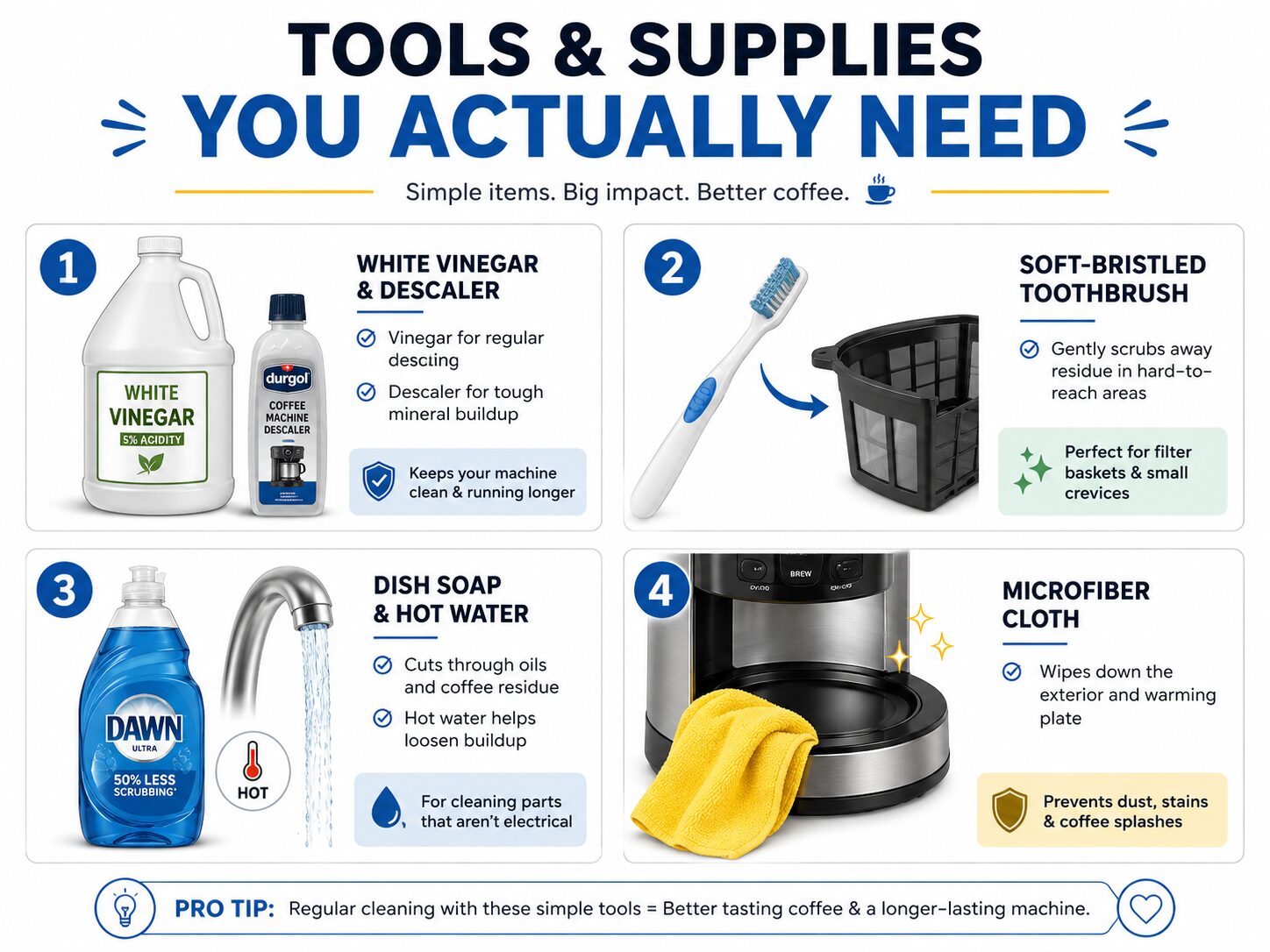
You don’t need a specialty kit. These four items handle 95% of coffee maker cleaning.
- White vinegar or a commercial descaler. Keep a gallon of white distilled vinegar under the sink. For Keurig or Nespresso machines, buy the brand’s solution. It’s formulated for their internal parts.
- A soft-bristled brush. An old toothbrush works. Use it on the carafe spout, the filter basket corners, and around the water reservoir opening. Hard bristles scratch plastic and glass.
- Dish soap and hot water. Dawn or any degreasing soap cuts the coffee oils.
- A clean microfiber cloth. For wiping the exterior and warming plate without scratching.
For espresso machines, add Cafiza for backflushing and a dedicated boiler descaler. Don’t substitute.
If your machine has a removable water reservoir, check its shape. Some have narrow necks. A bottle brush helps reach inside.
Owners of Bunn commercial-style machines like the VP17 series should also have the deliming tool mentioned in the manual. It’s a small pick for clearing the spray head holes.
Frequently Asked Questions
Can I use lemon juice instead of vinegar to descale my coffee maker?
You can, but citric acid is less effective than acetic acid on calcium carbonate scale. It also requires a higher concentration and longer soak time. For a heavily scaled machine, a commercial descaler or vinegar is the better choice.
How often should I clean my coffee maker?
Scrub the carafe, basket, and exterior with soap weekly. Descale the internal system every three months, or monthly if you have hard water. This schedule aligns with the NSF/ANSI 4 commercial equipment standard for sanitation frequency.
Why does my coffee still taste bad after descaling?
The descaling removed the minerals, but rancid coffee oils are still coating the carafe and filter basket. These oils are not water-soluble and aren’t removed by vinegar. You need to scrub those parts with dish soap and a brush.
Is it safe to run vinegar through a Keurig?
Keurig strongly advises against it. Their manual for the K-Duo series specifies using Keurig Descaling Solution. Using vinegar may void the warranty and can damage internal components not designed for acetic acid.
Can I clean my coffee maker with baking soda?
No. Baking soda is a base, not an acid. It does not dissolve limescale. It can create a paste that clogs water lines. Use vinegar or a commercial descaler for descaling, and dish soap for cleaning oils.
Before You Go
Cleaning a coffee maker isn’t about making it look new. It’s about temperature and taste. Scale on the heating element drops your brew temperature. Oils in the carafe make every pot taste stale.
Descale quarterly with a proper solution, vinegar for light duty, a commercial descaler for hard water or Keurig machines. Always remove the water filter first. Let the solution soak for an hour inside the machine.
Then scrub. The carafe spout and filter basket corners trap oils that vinegar ignores. A soft brush and dish soap is the fix.
Espresso machines live by different rules. Use Cafiza for the group head, not vinegar. Wipe the steam wand immediately.
Your next pot will taste like the beans, not the machine.
