
Master Your Brew: How Much Coffee Per Cup of Water to Use
The starting point for most hot brewing methods is 55 to 60 grams of coffee per liter of water, which translates to a coffee-to-water ratio between 1:16 and 1:18. For a standard 12-ounce (355ml) cup, that’s roughly 21 to 22 grams of coffee.
The universal mistake is skipping the scale. A tablespoon of one coffee isn’t the same weight as a tablespoon of another, a dark oily roast packs tighter than a dry light roast. A scoop of pre-ground supermarket coffee weighs almost double what a scoop of whole-bean specialty coffee does after grinding. You get watery, sour coffee or thick, bitter sludge and blame the beans.
This guide maps the whole territory. We’ll cover the official industry target, why grams matter more than scoops, and where to deliberately break the rules for cold brew, espresso, or just because you like your mug a certain way.
Key Takeaways
- The Specialty Coffee Association (SCA) Golden Cup standard is 55g coffee per liter of water, a 1:18 ratio. It’s your benchmark, not your bible.
- Measure by weight, not volume. A gram scale is the single tool that makes everything else work. A tablespoon of coffee can weigh anywhere from 5 to 12 grams.
- Grind consistency dictates ratio success. An inconsistent blade-ground coffee needs a slightly stronger ratio (like 1:15) to compensate for uneven extraction.
- Cold brew and espresso ratios are in a different universe. Cold brew uses a 1:4 to 1:8 ratio for concentrate; espresso targets 1:1 to 1:3.
- Your perfect cup lives within a 3-gram window. Find it by changing only one variable at a time: ratio, grind, then water temperature.
What is the Golden Cup Standard Coffee-to-Water Ratio?
The Specialty Coffee Association defines a target. Their Golden Cup standard, detailed in official SCA documentation, specifies 55 grams of coffee per liter of water, with a tolerance of ±10%. This lands you squarely in a 1:16 to 1:18 coffee-to-water ratio.
The SCA Golden Cup standard is a sensory-analysis benchmark designed to produce a brew that extracts between 18% and 22% of the coffee’s soluble material. This range, achieved with a 1:18 ratio at 200°F (93°C) water temperature over a 4–5 minute contact time, balances sweetness, acidity, and bitterness for a majority of palates.
TL;DR: The industry’s quality target is 1:18. It’s the center of the dartboard, but the bullseye is wherever your taste lands.
Why the SCA Picked Those Numbers
The ratio isn’t arbitrary. At 1:18, with proper grind and temperature, water saturates the coffee grounds fully and pulls out the sugars and flavorful acids before it starts grabbing the bitter, astringent compounds. Go weaker, say, 1:20, and the water over-extracts the same grounds. It runs out of delicious stuff to dissolve and starts chewing on the woody, hollow-tasting structural fibers. That’s why weak coffee often tastes both thin and harsh.
If your coffee tastes sharp and sour, the water hasn’t pulled enough solubles out. A stronger ratio or finer grind fixes that. If it tastes ashy and bitter, the water has pulled too much. A weaker ratio or coarser grind dials it back.
The Tools & Measurements You Actually Need
A proper digital scale with 0.1-gram precision costs less than a bag of good beans. It’s non-negotiable. A burr grinder is a close second. The blade grinder in your cabinet pulverizes beans unevenly. You get a mix of powder, fine grit, and boulders. The powder over-extracts and turns bitter instantly; the boulders under-extract and leave sour notes. A consistent grind from a burr machine lets the water flow evenly, so the ratio you choose is the ratio you get.
Your kettle matters less than its thermometer. Water between 195°F and 205°F (90°C–96°C) is the sweet spot. Boiling water (212°F/100°C) scorches the grounds and guarantees a burnt, flat taste, especially on lighter roasts. Gooseneck kettles offer control for pour-over, but any kettle with temperature control works.
Coffee Ratio Table: A Quick-Reference Guide
This table shows the starting ratio for common methods. Adjust from here based on taste.
| Brewing Method | Typical Ratio (Coffee:Water) | Best For | Risk If Skipped |
|---|---|---|---|
| Pour-Over (V60, Chemex) | 1:15 to 1:17 | Highlighting clarity, acidity, and nuanced flavors in single-origin beans. | Using 1:18 on a dense, lightly-roasted Ethiopian can under-extract, leaving a tart, tea-like cup. |
| Automatic Drip | 1:16 to 1:18 | Consistency and hands-off volume brewing, especially with a SCA-certified machine like a Bonavita. | Straying to 1:20 makes the coffee taste hollow and over-extracted; the machine can’t compensate. |
| French Press | 1:14 to 1:16 | Full-bodied, textured cups with more oils and sediment. | A 1:18 ratio brewed for 4 minutes tastes thin and weak; the immersion method needs more coffee. |
| AeroPress | 1:10 to 1:16 | Versatility—can mimic espresso strength or clean pour-over. | Beginners using the 1:16 “standard” recipe often produce a cup that’s too weak and sour. |
| Cold Brew (Concentrate) | 1:4 to 1:8 | A smooth, low-acidity base meant for dilution with water or milk. | A 1:12 ratio tastes like weak, stale iced coffee after 18 hours of steeping. |
Common mistake: Measuring coffee by volume (tablespoons) instead of weight, the density difference between a light and dark roast can vary your actual dose by over 100%. Your chosen ratio becomes meaningless, and you’ll chase flavor problems with grind settings forever.
How to Calculate Your Coffee Dose in Seconds
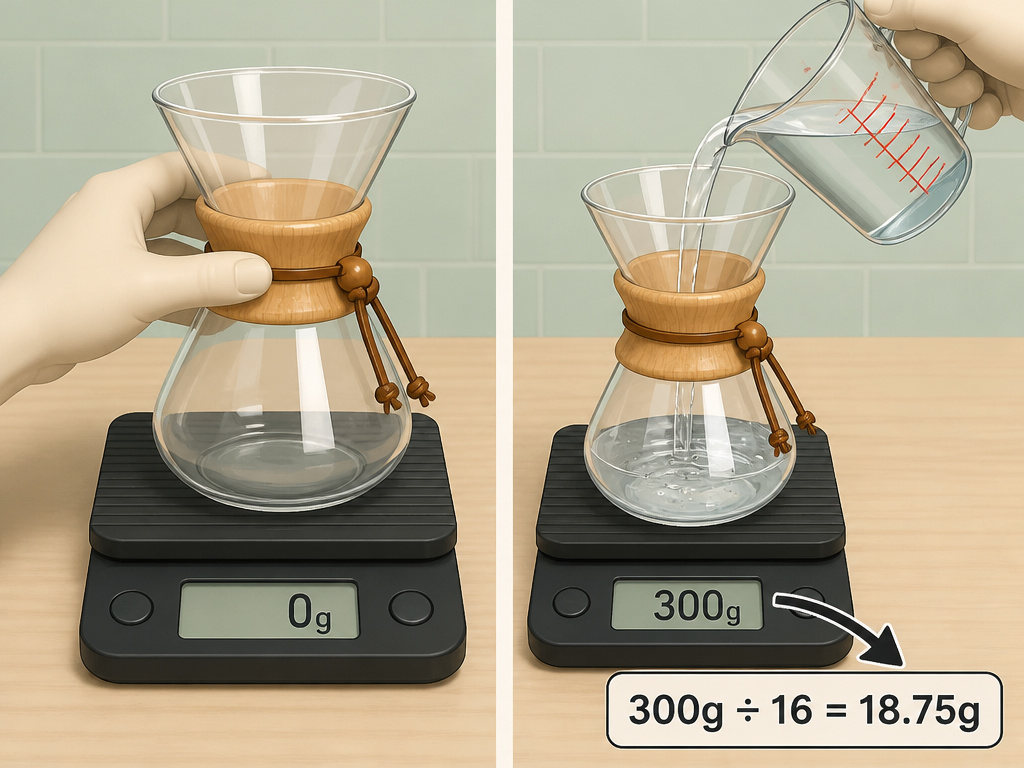
The math is simple division. Decide your ratio and your water weight.
- Choose your ratio. Start at 1:16 if you like it strong, 1:18 if you like it standard. Write it down.
- Weigh your water. Place your empty brewer on the scale, tare it, add water. For one mug, 300g is a good start (about 10 ounces).
- Divide. Water weight ÷ second number of your ratio = coffee weight. Example: 300g water ÷ 16 = 18.75g coffee.
- Grind and brew. Weigh out 19g of beans, grind, and brew.
If you’re making a full pot, a liter (1000g) of water at 1:17 needs about 59g of coffee. Most home bags are 340g (12oz). That bag makes roughly five to six full liters at a proper ratio, not the ten pots your machine’s carafe suggests.
I ignored the scale for months. I’d scoop two tablespoons of a light Ethiopian roast into my AeroPress and wonder why it tasted like lemon juice. Weighed it: 11 grams. For a 200g brew, that’s a 1:18 ratio, should be fine, right? But the AeroPress needs a stronger push, more like 1:12. I was drinking under-extracted sour water. The scale showed me I was dosing for the wrong brewer.
TL;DR: Water weight divided by your ratio number equals coffee weight. A calculator is unnecessary.
When Should You Stray From the Golden Cup Ratio?
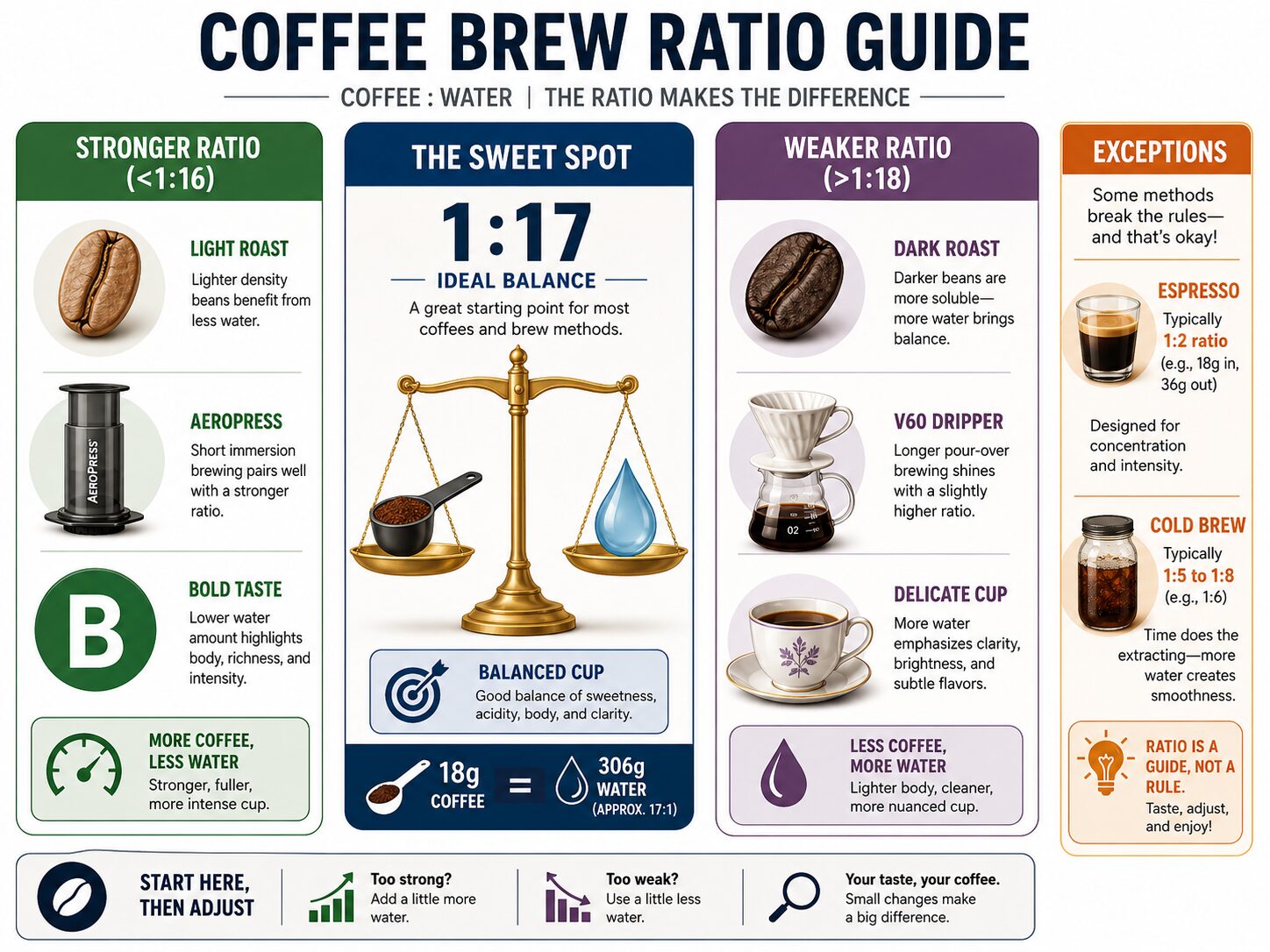
The SCA standard is for a specific, balanced profile. Your taste isn’t standard. Here’s when to deliberately break the rule.
Your beans demand it. Very light roasts are denser and harder to extract. A 1:15 or even 1:14 ratio gives the water more coffee material to work with, preventing a weak, sour cup. Very dark roasts are more soluble and can taste ashy at 1:15. A 1:18 or 1:19 ratio often works better.
Your grinder isn’t perfect. If you’re using a blade grinder or an old burr grinder with worn burrs, your grind is inconsistent. The fine particles will over-extract. Using a slightly stronger ratio (like 1:15) ensures the larger particles still contribute flavor before the fines turn everything bitter. It’s a band-aid, but it works.
You have a specific brewer. The official Chemex brewing guide suggests a starting point of 1:15 to 1:17, stronger than the SCA standard, because its thick filters and long brew time benefit from a higher coffee charge. The AeroPress community regularly uses ratios as strong as 1:10 for espresso-like shots.
The Cold Brew and Espresso Exception
These methods aren’t playing the same game. Cold brew uses cold or room-temperature water, which is terrible at extraction. To get any meaningful flavor in 12–24 hours, you need a massive amount of coffee. A 1:4 to 1:8 ratio produces a concentrate you then dilute 1:1 with water or milk. It’s a different drink entirely.
Espresso forces hot water through finely-packed coffee at high pressure. The contact time is 25–30 seconds. The output is a small, intense shot measured in grams. A typical espresso brew ratio is 1:1 (18g in, 18g out) for a ristretto, or 1:2 (18g in, 36g out) for a standard shot. Comparing this to a 1:18 drip ratio is like comparing a reduction sauce to a broth.
| Factor | Reason to Use a Stronger Ratio (<1:16) | Reason to Use a Weaker Ratio (>1:18) |
|---|---|---|
| Bean Roast Level | Very light roasts, dense beans (e.g., Ethiopian) | Very dark roasts, oily beans (e.g., French roast) |
| Brew Method | Immersion (French Press, AeroPress), long contact | Fast pour-over (some V60 techniques), short contact |
| Water Quality | Very soft water (low mineral content) | Hard water (high mineral content) |
| Desired Taste Profile | Bold, heavy body, intense flavor | Tea-like, delicate, nuanced clarity |
How Does Grind Size Interact With Coffee-to-Water Ratio?
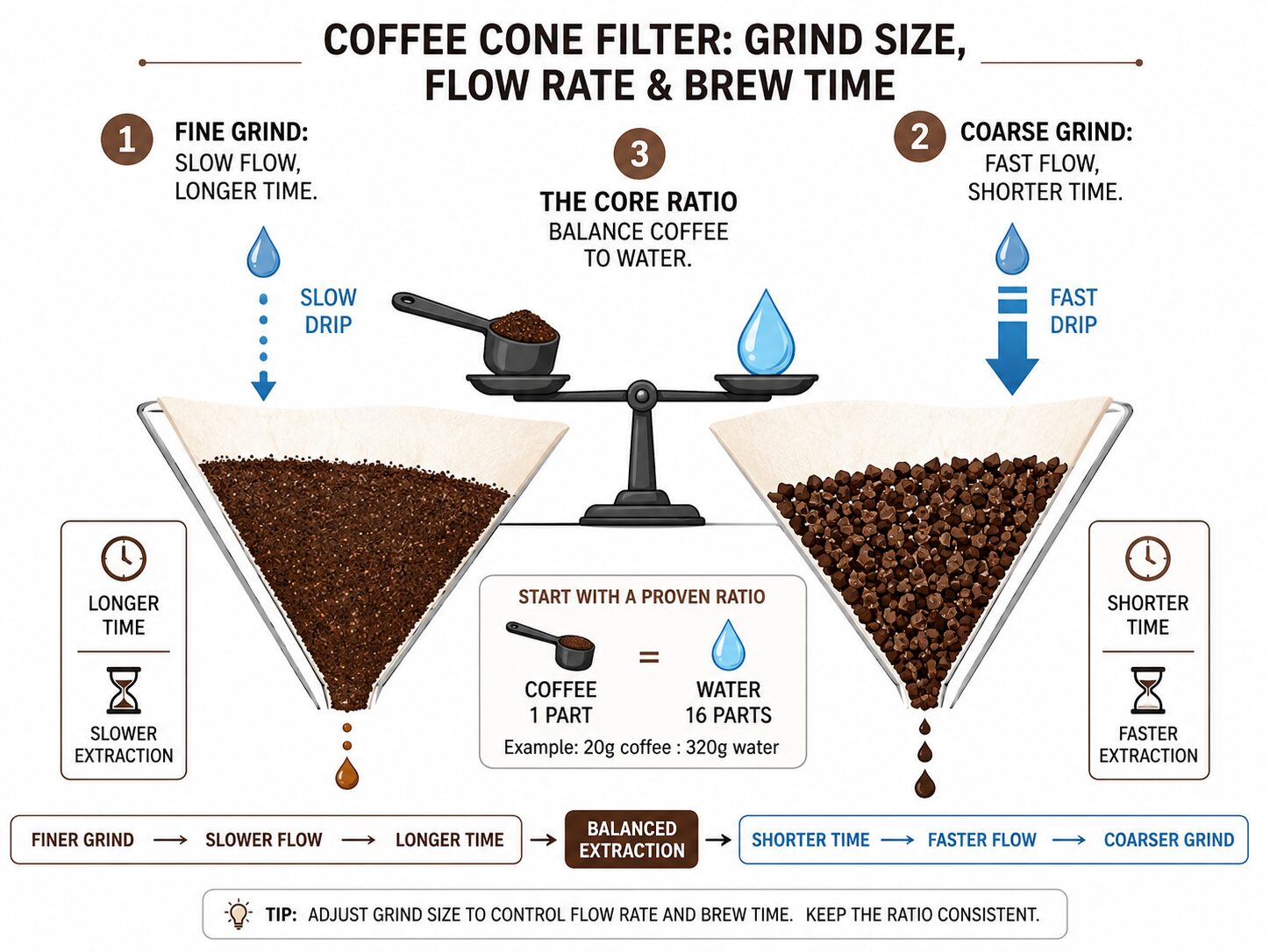
Grind size controls flow rate. Finer grinds slow the water; coarser grinds speed it up. Your ratio and your grind work as a team. If you change your ratio to make stronger coffee, you may also need to grind coarser to keep the brew time balanced. Otherwise, you push into bitterness.
Think of it like this: a 1:15 ratio with a medium-coarse grind might brew in 3:30 and taste perfect. The same 1:15 ratio with a fine grind might brew in 4:30 and taste bitter, the extra time pulled out too much. Sometimes, a better fix for weak coffee isn’t more coffee, but a finer grind.
This interdependence is why a good burr grinder is an investment. Inconsistent grind from a cheap machine adds a wild card that makes dialing in your ratio frustrating. You think you’ve found your perfect 1:17, but the next bag has a different density and your grinder produces a different particle spread. The ratio feels broken. It’s the grinder.
Common mistake: Changing both the ratio and the grind size at the same time after a bad cup. You won’t know which variable fixed the problem (or made it worse). Adjust one, taste, then adjust the other.
TL;DR: Finer grind strengthens extraction; coarser grind weakens it. Adjust grind to fix sour/bitter balance after you’ve settled on a ratio you like.
Troubleshooting Your Ratio: Weak, Sour, or Bitter Coffee
Your taste buds are the best diagnostic tool. Here’s what they’re telling you, and how to respond with your ratio and grind.
- Weak & Tea-Like: The coffee lacks body and sweetness, maybe with a sharp acidity. The water didn’t extract enough. Fix: Increase your coffee dose (strengthen the ratio) or grind finer. Try a 1:15 ratio first.
- Bitter & Astringent: The coffee has a harsh, drying aftertaste. The water over-extracted, grabbing bitter compounds. Fix: Decrease your coffee dose (weaken the ratio) or grind coarser. Try a 1:19 ratio.
- Sour & Sharp: This is distinct from weak. It’s a bright, often unpleasant acidity. Common in immersion brews that are underextracted. Fix: Grind finer to increase extraction. Your ratio might already be strong enough.
- Muddy & Flat: The coffee lacks clarity and tastes muddled. Could be stale beans, water that’s too hot, or, importantly, a ratio that’s too strong combined with a grind that’s too fine. Fix: Weaken the ratio slightly (to 1:17) and ensure your grind is no finer than medium.
Remember, water temperature is the third variable. If your coffee is both weak and bitter, your water might be too cool, stalling extraction early and then over-extracting as it sits. Use hotter water (200°F–205°F) before tweaking your ratio.
Frequently Asked Questions
What is the best coffee-to-water ratio for drip coffee makers?
For a standard drip coffee maker, start with a 1:17 ratio. This aligns with the SCA Golden Cup standard that many SCA-certified machines, like Bunn coffee makers and Bonavita brewers, are designed to optimize. Measure 55 grams of coffee per liter of water (or about 11 grams per 6-ounce cup). If your machine has a stronger brew setting, you might prefer a 1:16 ratio for more intensity.
How many tablespoons of coffee per cup of water should I use?
This is where things break down. One level tablespoon of most medium-ground coffee weighs about 5-7 grams. For a 1:17 ratio in a 6-ounce (177ml) cup, you’d need about 10.5 grams of coffee, or roughly two tablespoons. However, a tablespoon of a dense light roast might be 6g, while a fluffy dark roast might be 4g. Volume is unreliable. Use a scale.
Is the coffee-to-water ratio different for cold brew?
Yes, drastically. Cold brew uses a 1:4 to 1:8 coffee-to-water ratio to create a concentrate. For example, 100 grams of coffee to 500 grams of water (1:5) is common. This concentrate is then diluted 1:1 with water or milk before drinking. The final drinkable strength is roughly equivalent to a 1:10 or 1:12 ratio.
How does using a French press change the ratio?
The French Press is an immersion brewer. Because the water is in constant contact with the grounds and the metal filter lets through more oils and fine particles, a slightly stronger ratio is typical. Start at 1:15 (67g coffee per liter). This provides the body and richness the method is known for without tipping into bitterness during the 4-minute steep.
Before You Go
Forget the perfect ratio. Find your ratio. Start at 1:17 with a medium grind and 200°F water. Taste it. If you want more oomph, inch to 1:16 next time. If it’s too intense, try 1:18. Write down what you like for each type of bean. A light Ethiopian might sing at 1:15 in your V60, while a chocolatey Colombian blend tastes best at 1:18 in your automatic drip.
The grams are your guide, not your governor. The scale is the tool that unlocks consistency, so you can repeat your wins and diagnose your losses. Once you know your weight, you can play with the other variables, grind, temperature, pour technique, with confidence. The right amount of coffee per cup of water is the amount that makes you want another cup.
{
“@context”: “https://schema.org”,
“@type”: “HowTo”,
“name”: “How to Measure Coffee Per Cup of Water for a Balanced Brew”,
“totalTime”: “PT10M”,
“tool”: [
{
“@type”: “HowToTool”,
“name”: “Digital kitchen scale with 0.1g precision”
},
{
“@type”: “HowToTool”,
“name”: “Burr coffee grinder”
},
{
“@type”: “HowToTool”,
“name”: “Gooseneck kettle or standard kettle”
}
],
“step”: [
{
“@type”: “HowToStep”,
“name”: “Weigh your water”,
“text”: “Place your brewing vessel on the scale, tare it, and add your desired amount of water. For a single cup, start with 300 grams (about 10 ounces).”
},
{
“@type”: “HowToStep”,
“name”: “Calculate your coffee dose”,
“text”: “Using a 1:16 ratio, divide your water weight by 16. For 300g of water, you need 18.75g of coffee. Round to 19g for simplicity.”
},
{
“@type”: “HowToStep”,
“name”: “Grind your coffee”,
“text”: “Grind the weighed coffee beans to a medium-fine consistency suitable for your brewer. A burr grinder is essential for even particle size.”
},
{
“@type”: “HowToStep”,
“name”: “Brew and adjust”,
“text”: “Brew using your chosen method. Taste the result. If it’s weak or sour, use a finer grind or a stronger ratio (1:15) next time. If it’s bitter or harsh, use a coarser grind or a weaker ratio (1:17).”
}
]
}
{
“@context”: “https://schema.org”,
“@type”: “FAQPage”,
“mainEntity”: [
{
“@type”: “Question”,
“name”: “What is the best coffee-to-water ratio for drip coffee makers?”,
“acceptedAnswer”: {
“@type”: “Answer”,
“text”: “For a standard drip coffee maker, start with a 1:17 ratio. This aligns with the SCA Golden Cup standard that many SCA-certified machines, like Bunn coffee makers and Bonavita brewers, are designed to optimize. Measure 55 grams of coffee per liter of water (or about 11 grams per 6-ounce cup). If your machine has a stronger brew setting, you might prefer a 1:16 ratio for more intensity.”
}
},
{
“@type”: “Question”,
“name”: “How many tablespoons of coffee per cup of water should I use?”,
“acceptedAnswer”: {
“@type”: “Answer”,
“text”: “This is where things break down. One level tablespoon of most medium-ground coffee weighs about 5-7 grams. For a 1:17 ratio in a 6-ounce (177ml) cup, you’d need about 10.5 grams of coffee, or roughly two tablespoons. However, a tablespoon of a dense light roast might be 6g, while a fluffy dark roast might be 4g. Volume is unreliable. Use a scale.”
}
},
{
“@type”: “Question”,
“name”: “Is the coffee-to-water ratio different for cold brew?”,
“acceptedAnswer”: {
“@type”: “Answer”,
“text”: “Yes, drastically. Cold brew uses a 1:4 to 1:8 coffee-to-water ratio to create a concentrate. For example, 100 grams of coffee to 500 grams of water (1:5) is common. This concentrate is then diluted 1:1 with water or milk before drinking. The final drinkable strength is roughly equivalent to a 1:10 or 1:12 ratio.”
}
},
{
“@type”: “Question”,
“name”: “How does using a French press change the ratio?”,
“acceptedAnswer”: {
“@type”: “Answer”,
“text”: “The French Press is an immersion brewer. Because the water is in constant contact with the grounds and the metal filter lets through more oils and fine particles, a slightly stronger ratio is typical. Start at 1:15 (67g coffee per liter). This provides the body and richness the method is known for without tipping into bitterness during the 4-minute steep.”
}
}
]
}
