
Answer: How Long Is Ground Coffee Good For Before It Stales
Ground coffee is good for about one month in the pantry after opening, and one to two years in the freezer, according to the USDA FoodKeeper app. Unopened packages last three to five months at room temperature. The clock on freshness starts the moment you grind, with a significant 60 percent of its volatile aromas disappearing within the first 15 minutes of exposure to air.
Most people think an opened bag of pre-ground coffee lasts forever. They stash it in the cupboard, use a scoop every morning, and wonder why their cup tastes flat and papery by the third week. The flavor didn’t just fade. It oxidized.
This guide breaks down the exact shelf-life numbers from the USDA, explains the science of staling, and shows you how to stretch your coffee’s peak flavor using methods that actually work. We’ll cover pantry storage, freezer myths, and why your refrigerator is the worst place for your beans.
Key Takeaways
- The USDA states opened ground coffee lasts one month in the pantry and one to two years in the freezer. Unopened, it’s three to five months.
- Grinding accelerates staling exponentially. One YouTube analysis cites a 60 percent loss of aroma compounds in just 15 minutes post-grind.
- Never store coffee in the refrigerator. The constant humidity and odor exchange degrade flavor faster than a dry pantry.
- The enemies are air, light, heat, and moisture. An opaque, airtight container in a cool, dark place is the minimum defense.
- Freezing works, but only if you do it in a single, airtight portion. Thawing and refreezing introduces moisture that ruins the grounds.
The 60% Aroma Loss Statistic That Changes Everything
You buy whole beans for a reason. Grinding is the single most destructive act in the coffee lifecycle. It’s not just about creating smaller particles. It’s about exposing an immense new surface area to oxygen.
Once ground, coffee can lose up to 60% of its volatile aroma compounds within 15 minutes. The increased surface area from grinding dramatically accelerates the oxidation process, turning bright, complex flavors flat and stale before your kettle even boils.
I learned this the hard way with a bag of a fantastic Ethiopian Yirgacheffe. I ground a week’s worth on a Sunday, proud of my efficiency. By Wednesday, the vibrant blueberry and jasmine notes were gone. The Thursday cup tasted like generic brown water. I blamed my technique, my water, my machine. The culprit was the canister on my counter. The timeline was undeniable.
This is why the first rule of coffee storage is also the simplest: grind immediately before brewing. If you use pre-ground, you’ve already lost that battle. Your storage strategy is now a damage-control operation from the moment you open the bag.
TL;DR: Grind right before you brew. Pre-ground coffee is already past its peak aroma by the time you seal the bag.
The USDA’s Official Shelf-Life Guidelines
Forget the vague “few weeks” advice. The USDA FoodKeeper app, a primary source from the Food Safety and Inspection Service, gives exact numbers. These are the baselines for food safety and quality, not just enthusiast opinion.
| Coffee State | Pantry (Room Temp) | Freezer | Notes |
|---|---|---|---|
| Unopened, Ground | 3–5 months | 1–2 years | Original packaging with a one-way valve intact. |
| Opened, Ground | 1 month | 1–2 years | Must be transferred to an airtight container. |
| Whole Bean | 6–9 months | 1–2 years | Lasts longer due to less surface area. |
The one-month pantry clock for opened ground coffee is your hard deadline for good flavor. It won’t spoil or make you sick after that. It just won’t taste like anything worth drinking. The oils oxidize, the aromatics evaporate, and what’s left is the hollow skeleton of the roast.
Notice the freezer time is the same for opened and unopened. That’s because temperature is the great pause button. At freezer temperatures, chemical reactions like oxidation slow to a crawl. But you have to guard against moisture and freezer burn, which is why proper packaging is non-negotiable. A flimsy bag folded over won’t cut it.
TL;DR: Opened ground coffee has a one-month pantry life per the USDA. The freezer extends that to two years, but only if you seal it perfectly.
Your Coffee’s Three Enemies (and One False Friend)
Staling isn’t one thing. It’s a coordinated attack from three elements, with a fourth often mistaken for an ally.
- Oxygen. This is the main actor. Oxidation breaks down the flavorful compounds and fragrant oils in coffee. Every minute spent exposed to air is a minute of decay. A burr grinder creates a more consistent particle size than a blade, but it also creates millions of tiny surfaces for oxygen to attack immediately.
- Light. Especially sunlight. UV radiation accelerates the breakdown of those same compounds. This is why quality coffee bags are often matte and opaque, not clear. Storing your coffee in a glass jar on a sunny windowsill is a recipe for rapid flavor death.
- Heat. Warm environments speed up all chemical reactions, including staling. Keep your coffee away from the stove, oven, or top of the refrigerator.
- Moisture (The False Friend). Humidity is a silent killer. It makes grounds clump, promotes mold, and washes away soluble flavors before water even touches them. This is the core reason the refrigerator is banned. The constant cycling from cold to room temperature every time you open the door draws ambient moisture straight into your coffee. The result is a damp, musty bag that smells of last night’s leftovers.
The best storage vessel fights all three enemies. It’s opaque (blocks light), airtight (blocks oxygen and moisture), and kept in a cool, dark place (counters heat). A resealable bag with a one-way valve is good. A dedicated vacuum canister is better for long-term holds.
Common mistake: Storing coffee in the refrigerator to “keep it fresh” — the humidity and odor absorption will stale your coffee faster than a dry, dark pantry. You’ll taste the difference in under a week.
Why Your Freezer is Your Best Friend (If You Follow These Rules)
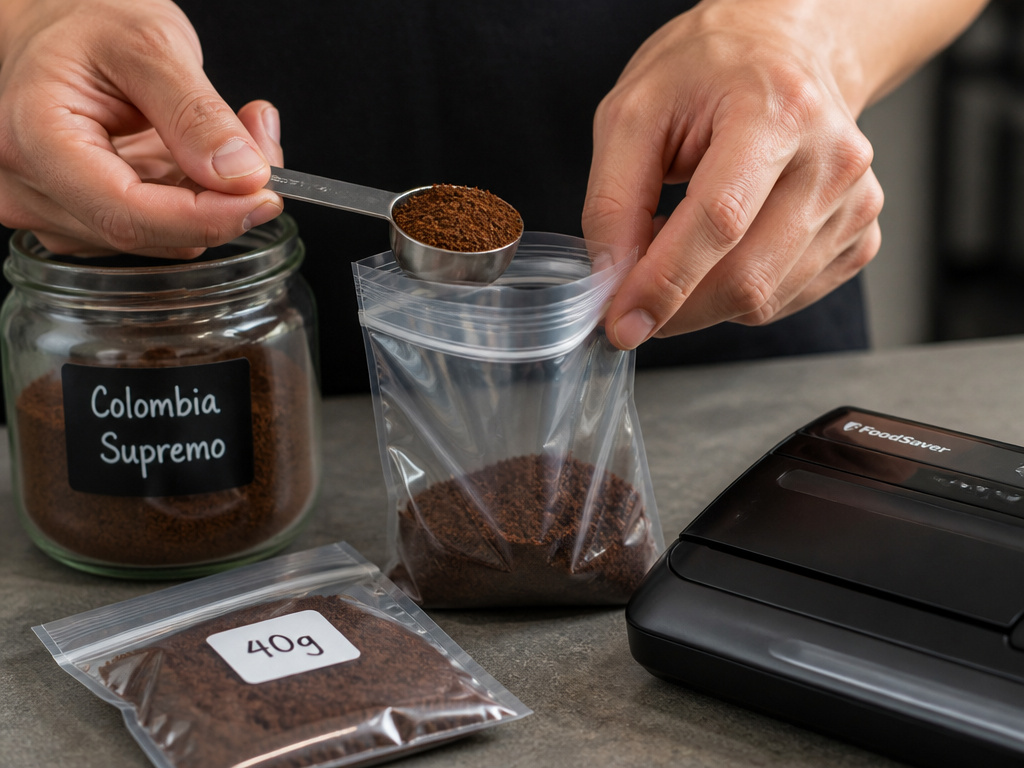
Freezing ground coffee works. The science is clear. Low temperatures dramatically slow molecular movement and chemical reactions. But most people freeze coffee wrong, which leads to the myth that freezing ruins flavor.
The wrong way: toss the entire, half-used bag into the freezer, take it out every morning to scoop, then put it back.
The right way requires a single, upfront commitment.
- Portion Control. Divide your ground coffee into amounts you’ll use in one sitting. For me, that’s about 40 grams, enough for a full Chemex.
- Airtight, Moisture-Proof Packaging. Use a small, thick freezer bag. Squeeze out all the air before sealing. A vacuum sealer is the gold standard here.
- The One-Thaw Rule. Take out only the portion you need. Let it come to room temperature while still sealed. This prevents condensation from forming on the cold grounds. Once opened, use it immediately. Never refreeze.
When you do this, frozen coffee can taste remarkably close to fresh for months. I’ve kept a portioned single-origin coffee in the freezer for four months and pulled a delicious, nuanced cup. The key is the airtight seal and the no-return policy.
For everyday coffee you use within the month, the pantry is simpler. But for preserving a special light roast beans or a large bag you found on sale, the freezer is your most powerful tool.
Step-by-Step: How to Store Ground Coffee for Maximum Freshness
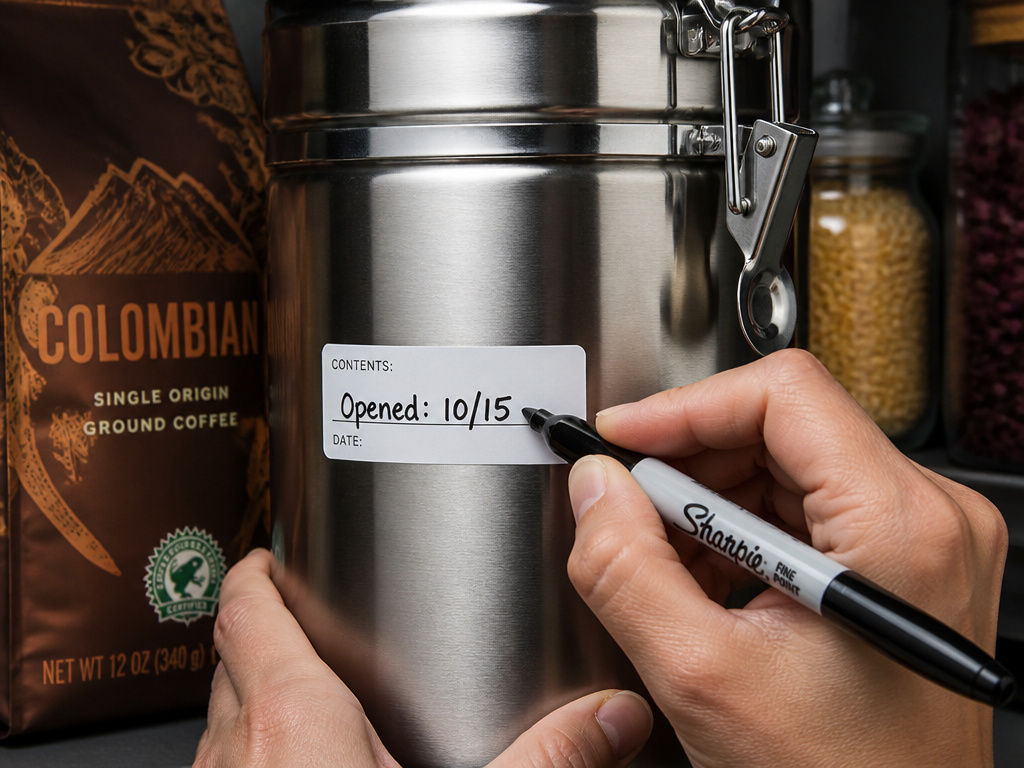
Follow this sequence from the moment you get your coffee home. It turns the USDA’s one-month guideline into a full month of great cups, not a slow decline.
- Decide Your Timeline. Are you drinking this within a month? If yes, pantry storage is fine. Planning to keep it longer than four weeks? Portion it for the freezer immediately.
- Choose Your Container. If the original bag has a sturdy resealable zipper and a one-way valve (the little round patch), it can stay. If not, transfer to an opaque, airtight container. Ceramic or stainless steel with a rubber gasket seal are ideal.
- Label with the “Opened On” Date. Write it directly on the container with a marker. This is non-negotiable. Memory is fuzzy; ink is truth. Your countdown starts now.
- Find the Right Spot. A cupboard away from the stove, oven, sink, or dishwasher. A cool, dark, dry pantry shelf is perfect.
- Freeze with Strategy (If Applicable). Portion, seal, label with contents and date, and place in the back of the freezer where temperature is most stable.
Skipping the labeling step means you’ll inevitably keep a container past its prime. You’ll brew a bland cup, blame the coffee, and miss the real lesson. The date tells you when to be extra critical of the flavor.
Pantry vs. Freezer: A Direct Comparison
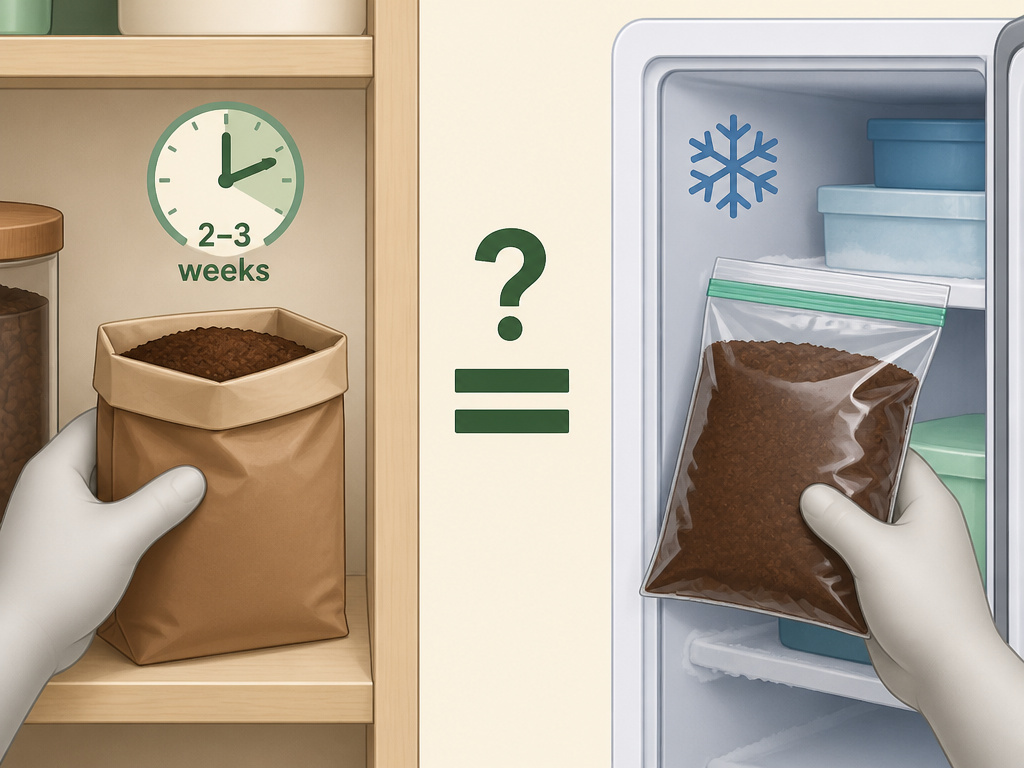
Is freezing always better? Not exactly. It’s a trade-off between convenience and preservation. This table lays out the winner for common scenarios.
| Scenario | Pantry Winner | Freezer Winner | Why |
|---|---|---|---|
| Daily driver, used within 2–3 weeks | Yes | No | Convenience outweighs minor freshness loss. No thawing needed. |
| Special occasion coffee | No | Yes | Preserves delicate aromatics for the day you want a perfect cup. |
| Buying in bulk to save money | No | Yes | Locks in freshness for the entire supply, preventing waste. |
| Forgetting to plan ahead | Yes | No | You can’t brew frozen coffee instantly. Pantry coffee is always ready. |
| High-humidity climate | No | Yes | The freezer’s dry cold defeats ambient moisture better than any pantry. |
For your everyday blended coffee, the pantry is fine. For that expensive bag of Colombian coffee you’re saving for guests, the freezer is insurance.
How to Tell If Your Ground Coffee Has Gone Bad
Coffee doesn’t “spoil” like milk. It stales. Use your senses in this order.
- Smell. Fresh ground coffee has a potent, pleasant aroma specific to its roast and origin. Stale coffee smells faint, dusty, or like cardboard. If you open the container and get no fragrance, it’s past its prime.
- Look. Fresh grounds are dry and flow freely. Stale or moist grounds clump together. Any signs of visible mold (fuzzy spots) mean immediate disposal.
- Taste. This is the final test. Brew it. Stale coffee tastes flat, bitter without complexity, or papery. It lacks sweetness, acidity, or any defining character. If it tastes like “hot brown water,” it’s stale.
If it’s just stale, it’s safe to drink—just disappointing. Toss it in the compost and start fresh. This is also a good time to check your coffee maker instructions for a cleaning cycle. Old oils in your machine can mimic stale flavors.
Common mistake: Using twice as much stale coffee to try and boost flavor — this only doubles the bitterness and intensity of the stale notes. You cannot brew your way out of oxidation.
Frequently Asked Questions
Does vacuum sealing make a difference?
Yes, significantly. Vacuum sealing removes almost all oxygen from the package, putting oxidation on hold. It’s the best method for long-term freezer storage. For pantry storage, a container with a tight seal is sufficient for the one-month window.
Can I store ground coffee in its original bag?
You can, but only if the bag is resealable and has a one-way valve (the small round patch that lets CO2 out without letting air in). If it’s just a bag you tear open and fold over, transfer the grounds to an airtight container immediately. That folded-over bag lets in air constantly.
Why does coffee have a “best by” date instead of an “expiration” date?
Coffee is a shelf-stable product. The “best by” date is the manufacturer’s estimate of peak quality, not safety. It’s based on the roast date. You can safely drink coffee past this date, but the flavor will have degraded. The USDA’s timelines are a more practical guide for post-opening life.
Does the roast level affect how long ground coffee lasts?
Dark roasts have more of their internal structure broken down by the longer roasting process and their oils are more readily on the surface. This makes them stale slightly faster than light or medium roasts. A dark roast’s bold flavor can mask staleness longer, but the countdown is ticking faster. Be extra vigilant with storing dark roasts.
Is it worth buying pre-ground coffee?
Only for absolute convenience, and with the understanding you’re sacrificing peak flavor. If you buy pre-ground, choose a local roaster who grinds it fresh for you, buy in smaller quantities you’ll use within two weeks, and store it impeccably. For the best cup, a home burr grinder and whole beans is the undeniable upgrade.
The Bottom Line
Ground coffee’s lifespan isn’t a mystery. The USDA says one month in the pantry, two years in the freezer. The real-world flavor cliff arrives much sooner if you let air, light, and moisture have their way.
Your move is straightforward. Get an opaque, airtight container. Write the date you opened it. Keep it in a cool, dark cupboard. If you won’t finish it in a month, portion and freeze it right away. And never, ever put it in the refrigerator.
The goal isn’t to make coffee last forever. It’s to make every cup you brew taste as good as it did on day one. That starts the second you open the bag.
{
“@context”: “https://schema.org”,
“@type”: “HowTo”,
“name”: “How to Store Ground Coffee to Maximize Freshness”,
“totalTime”: “PT5M”,
“tool”: [
{
“@type”: “HowToTool”,
“name”: “Airtight opaque storage container”
},
{
“@type”: “HowToTool”,
“name”: “Freezer-safe bag or container”
},
{
“@type”: “HowToTool”,
“name”: “Permanent marker for labeling”
}
],
“step”: [
{
“@type”: “HowToStep”,
“name”: “Transfer to an airtight container”,
“text”: “If your coffee bag lacks a resealable zip or a one-way valve, immediately pour the ground coffee into an opaque, airtight container.”
},
{
“@type”: “HowToStep”,
“name”: “Label with the grind date”,
“text”: “Write the date you opened the package or ground the beans directly on the container. This is your freshness countdown clock.”
},
{
“@type”: “HowToStep”,
“name”: “Choose your storage location”,
“text”: “For daily use within a month, store in a cool, dark pantry. For long-term storage beyond a month, portion and freeze.”
},
{
“@type”: “HowToStep”,
“name”: “Freeze correctly”,
“text”: “Divide coffee into single-use portions in airtight bags, squeeze out excess air, and place in the freezer. Thaw portions without opening to prevent condensation.”
}
]
}
{
“@context”: “https://schema.org”,
“@type”: “FAQPage”,
“mainEntity”: [
{
“@type”: “Question”,
“name”: “Does vacuum sealing make a difference?”,
“acceptedAnswer”: {
“@type”: “Answer”,
“text”: “Yes, significantly. Vacuum sealing removes almost all oxygen from the package, putting oxidation on hold. It’s the best method for long-term freezer storage. For pantry storage, a container with a tight seal is sufficient for the one-month window.”
}
},
{
“@type”: “Question”,
“name”: “Can I store ground coffee in its original bag?”,
“acceptedAnswer”: {
“@type”: “Answer”,
“text”: “You can, but only if the bag is resealable and has a one-way valve (the small round patch that lets CO2 out without letting air in). If it’s just a bag you tear open and fold over, transfer the grounds to an airtight container immediately. That folded-over bag lets in air constantly.”
}
},
{
“@type”: “Question”,
“name”: “Why does coffee have a \”best by\” date instead of an \”expiration\” date?”,
“acceptedAnswer”: {
“@type”: “Answer”,
“text”: “Coffee is a shelf-stable product. The \”best by\” date is the manufacturer’s estimate of peak quality, not safety. It’s based on the roast date. You can safely drink coffee past this date, but the flavor will have degraded. The USDA’s timelines are a more practical guide for post-opening life.”
}
},
{
“@type”: “Question”,
“name”: “Does the roast level affect how long ground coffee lasts?”,
“acceptedAnswer”: {
“@type”: “Answer”,
“text”: “Dark roasts have more of their internal structure broken down by the longer roasting process and their oils are more readily on the surface. This makes them stale slightly faster than light or medium roasts. A dark roast’s bold flavor can mask staleness longer, but the countdown is ticking faster. Be extra vigilant with storing dark roasts.”
}
},
{
“@type”: “Question”,
“name”: “Is it worth buying pre-ground coffee?”,
“acceptedAnswer”: {
“@type”: “Answer”,
“text”: “Only for absolute convenience, and with the understanding you’re sacrificing peak flavor. If you buy pre-ground, choose a local roaster who grinds it fresh for you, buy in smaller quantities you’ll use within two weeks, and store it impeccably. For the best cup, a home burr grinder and whole beans is the undeniable upgrade.”
}
}
]
}
